“Something Indecent?”

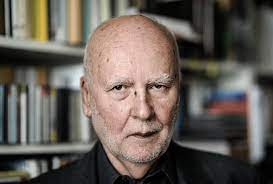
Polish Poet Czeslaw Milosz (1911-2004)

Czeslaw Milosz was born in Eastern Europe the same year as my father was born. Only, Elek Paris was no poet; and Czeslaw Milosz was one of the greatest poetic voices of his century. For many years, he lived in the United States and taught at Berkeley. He won the Nobel Prize for Literature in 1980 and died in his native Poland in 2004.

Note that the title of the following poem ends with a question mark:

Ars Poetica?

I have always aspired to a more spacious form   
that would be free from the claims of poetry or prose   
and would let us understand each other without exposing   
the author or reader to sublime agonies.   

In the very essence of poetry there is something indecent:   
a thing is brought forth which we didn’t know we had in us,   
so we blink our eyes, as if a tiger had sprung out   
and stood in the light, lashing his tail.   

That’s why poetry is rightly said to be dictated by a daimonion,   
though it’s an exaggeration to maintain that he must be an angel.   
It’s hard to guess where that pride of poets comes from,   
when so often they’re put to shame by the disclosure of their frailty.   

What reasonable man would like to be a city of demons,   
who behave as if they were at home, speak in many tongues,   
and who, not satisfied with stealing his lips or hand,   
work at changing his destiny for their convenience?   

It’s true that what is morbid is highly valued today,   
and so you may think that I am only joking  
or that I’ve devised just one more means   
of praising Art with the help of irony.   

There was a time when only wise books were read,   
helping us to bear our pain and misery.   
This, after all, is not quite the same   
as leafing through a thousand works fresh from psychiatric clinics.   

And yet the world is different from what it seems to be   
And we are other than how we see ourselves in our ravings.
People therefore preserve silent integrity,   
thus earning the respect of their relatives and neighbors.   

The purpose of poetry is to remind us   
how difficult it is to remain just one person,   
for our house is open, there are no keys in the doors,   
and invisible guests come in and out at will.

What I’m saying here is not, I agree, poetry,   
as poems should be written rarely and reluctantly,   
under unbearable duress and only with the hope   
that good spirits, not evil ones, choose us for their instrument.

“A Song on the End of the World”

Czeslaw Milosz (1911-2004)

Born in Lithuania, but known primarily as a Polish poet, Czeslaw Milosz is perhaps my favorite Eastern European poet of the 20th century. In 1980, he won the Nobel Prize for Literature. Here is one of my favorites among his works, written in Warsaw in 1944:

A Song on the End of the World

On the day the world ends
A bee circles a clover,
A fisherman mends a glimmering net.
Happy porpoises jump in the sea,
By the rainspout young sparrows are playing
And the snake is gold-skinned as it should always be.

On the day the world ends
Women walk through the fields under their umbrellas,
A drunkard grows sleepy at the edge of a lawn,
Vegetable peddlers shout in the street
And a yellow-sailed boat comes nearer the island,
The voice of a violin lasts in the air
And leads into a starry night.

And those who expected lightning and thunder
Are disappointed.
And those who expected signs and archangels’ trumps
Do not believe it is happening now.
As long as the sun and the moon are above,
As long as the bumblebee visits a rose,
As long as rosy infants are born
No one believes it is happening now.

Only a white-haired old man, who would be a prophet
Yet is not a prophet, for he’s much too busy,
Repeats while he binds his tomatoes:
There will be no other end of the world,
There will be no other end of the world.

With the Cutlers

They suddenly appear on Page 207 of Olga Tokarczuk’s House of Day, House of Night (1988), a strange sect known for sharp knives:

They spent their days singing psalms and making knives. They made blades better than anyone in the whole of Silesia and fitted them with carefully polished handles made of ash wood, which every human hand fell in love with instantly. They sold them once a year in early autumn when the apples were ripening on the trees. They held a sort of fair, which attracted people from all over the district; they each bought several knives, sometimes as many as a dozen, in order to sell them on at a profit. During these fairs people forgot that the Cutlers were of a different faith and believed in a different God, and that it would have been easy to produce evidence and drive them away. For who would make such good knives then?

Whenever they bore a child they mourned instead of rejoicing. Whenever someone died, they undressed him, laid his naked corpse in a hole in the ground and danced around the open grave.

About forty pages later appears this poem, called “The Cutlers’ Psalm”:

Futility on all the earth
blessed be barren wombs
holy be all sterility
sacred is decay, desirous is decline
wondrous the fruitlessness of winter
the empty shells of nuts
logs burnt to ashes that still keep the shape of the tree
seeds that fall on to stony ground
knives gone blunt
streams run dry
the beat that devours another’s offspring
the bird that feeds on another’s eggs
war that is always the start of peace
hunger that is the beginning of repletion
Sacred old age, daybreak of death,
time trapped in the body,
death sudden, unexpected.
death downtrodden like a path in the grass
To do, but have no results
to act, but stir nothing
to age, but change nothing
to set off, but never arrive
to speak, but not give voice

Whew!

When to Photograph a Poet

Polish Poet Adam Zagajewski (1945-2021)

The following poem by Adam Zagajewski hits the nail right on the head when describes the very uncinematic and unphotographic life of a poet.

Poets Photographed

Poets photographed,
but never when
they truly see,
poets photographed
against a backdrop of books,
but never in darkness,
never in silence,
at night, in uncertainty,
when they hesitate,
when joy, like phosphorus,
clings to matches.
Poets smiling,
well informed, serene,
Poets photographed
when they’re not poets.
If only we knew
what music is.
If only we understood.

The Other Football

Argentine Footballers Celebrating After Scoring Against Poland

Yesterday, I watched the World Cup match between Argentina and Poland. Unlike most viewers, there are a whole lot of teams I like. I realize that the United States is still new at this game and can be upset by the likes of Liechtenstein or Moldova. A generation from now, I suspect that what we call soccer will be more prevalent, if for no other reason that parents won‘t want their sons growing up brain-damaged like Herschel Walker.

In yesterday’s game, I liked both Argentina (as I’ve visited their country three times) and Poland (because I’m Eastern European myself). Argentina won the game 2-0, but both Argentina and Poland advanced to the quarter finals. I think it was because the sum of the team members’ jersey sizes was a prime number.

The announcers kept talking about how surreal the end of the game was because so many teams were still in play, irrespective of their win/loss standings. Also considered in the standings were scores for remembering to say “please” and “thank you”; the number of syllables in the first stanza of their respective national anthems; the teams’ overall dental hygiene; and how well the teams could pronounce the name of the country they were in. (I think the latter is something like “Catarrh”, no?)

Argentina dominated the game, but the poles had one real hero in their goalie, Wojciech Szczesny. (Gesundheit!) For the entire first half, he batted away everything the Argentinians could throw at him, including soccer balls, off-color epithets, and one extremely rusted steam locomotive. Only in the second period did two goals get by him.

The Star of the Polish Team: Goalkeeper Wojciech Szczesny

Although soccer football does have its problems, such as the higher mathematics involved in calculating who gets to move on to the quarter finals and the treatment of draws. In American sports, there are a lot of stops and starts to allow for advertisers to plug their products and services. Soccer football games stop only for injuries, and then they add a mysterious number of make-up minutes after the regulation ninety minutes. I guess Americans will just have to get used to all that intensity and uncertainty. The rest of the world seems to have.

Chain of Chance

The following is adapted from a post I made on the late unlamented Blog.Com on August 14, 2009.

I had not read one of Stanislaw Lem’s (1921-2006) novels for a number of years, remembering only that I always enjoyed them for their quirkiness and imagination. A few days ago, I picked up one of his books at random: It was Chain of Chance (1975).

Picture to yourself a series of murders or suicides of a seemingly random group of people. What they have in common is all are males in their fifties who were athletic in build, and all were visiting a spa in Naples, Italy. The victims consisted of both Americans and Europeans. Sent to investigate what happened in a washed-out American astronaut who calls himself Adams after one of the victims. He attempts to set himself up as a guinea pig doing what the average victim did and trying to see what happens. There were some strange occurrences, such as the collapse of a woman in a large shop where there are no visible employees on the Naples-Rome highway.

At the Rome airport, “Adams” survives a terrorist bomb blast and saves a young French girl’s life. Suspected as being in with the terrorists, he calls in his embassy; and matters get straightened out allowing him to proceed to Paris.

There he meets with Dr. Philippe Barth, a French computer scientist who served as a consultant for the Sûreté, the national security service. The story then suddenly sags as “Adams” describes in exhaustive detail what the victims had in common, what they did, and so on. I thought to myself at this point that perhaps I had picked up the first loser by Lem, but it took only a few pages for the author to recover and pose an ingenious demonstration.

At the Paris Orly airport, “Adams” begins feeling strangely demented and suicidal. In the nick of time, he handcuffs himself to some solid furniture and begins to take notes of what appears to be a series of attacks, culminating in unconsciousness.

I will not divulge Lem’s brilliant ending, except to drop one hint: There is a close tie-in with the subject of The Futurological Congress (1971), which remains my favorite of his books. One more clue. Here is the thinking of one of the people attending the security meeting with Barth, a mathematician named Saussure whom I think is a stand-in for the author:

Man wanted everything to be simple, even if mysterious: one God—in the singular, of course; one form of natural law; one principle of reason in the universe, and so on. Astronomy, for example, held that the totality of existence was made up of stars—past, present, and future—and their debris in the form of planets. But gradually astronomy had to concede that a number of cosmic phenomena couldn’t be contained within its scheme of things. Man’s hunger for simplicity paved the way for Ockham’s razor, the principle stating that no entity, no category can be multiplied unnecessarily. But the complexity that we refused to acknowledge finally overcame our prejudices. Modern physics has turned Ockham’s maxim upside down by positing that everything is possible. Everything in physics, that is; the complexity of civilizations is far greater than that of physics.

In the world of speculative fiction—and I regard him as more properly a writer of this rather than science fiction—few could approach the Pole in his inventive mind, humor, and psychological acuteness. Among his works that I have enjoyed are the following, all of which are still available in good English translations:

  • The Investigation (1959)
  • Return from the Stars (1961)
  • Solaris (1961), which was made into a great Russian film by Andrei Tarkovsky
  • Memoirs Found in a Bathtub (1961)
  • The Futurological Congress (1971)—my favorite among his works
  • Tales of Pirx the Pilot (1973) and More Tales of Pirx the Pilot (1973), published in Poland as a single work
  • One Human Minute (1986)

I see that I have read quite a few of Lem’s work—and at the same time, not nearly enough.

“View with a Grain of Sand”

View from a Window

Here is a marvellous poem by the Nobel Prize winning Polish poet Wisława Szymborska. It is called “View with a Grain of Sand.” Never before have I seen a poem about things written from the decidedly non-human stance of the things themselves. See what you think:

View with a Grain of Sand

We call it a grain of sand,
but it calls itself neither grain nor sand.
It does just fine without a name,
whether general, particular,
permanent, passing,
incorrect, or apt.

Our glance, our touch mean nothing to it.
It doesn’t feel itself seen and touched.
And that it fell on the windowsill
is only our experience, not its.
For it, it is no different from falling on anything else
with no assurance that it is finished falling
or that it is falling still.

The window has a wonderful view of a lake,
but the view doesn’t view itself.
It exists in this world
colorless, shapeless,
soundless, odorless, and painless.

The lake’s floor exists floorlessly,
and its shore exists shorelessly.
Its water feels itself neither wet nor dry
and its waves to themselves are neither singular nor plural.
They splash deaf to their own noise
On pebbles neither large nor small.

And all this beneath a sky by nature skyless
in which the sun sets without setting at all
and hides without hiding behind an unminding cloud.
The wind ruffles it, its only reason being
that it blows.

A second passes.
A second second.
A third.
But they’re three seconds only for us.

Time has passed like a courier with urgent news.
But that’s just our simile.
The character is invented, his haste is make-believe,
his news inhuman.

Leonardo Da Vinci’s Last Days

Château de Amboise, Where Leonardo Is Buried

King François I of France invited Leonardo Da Vinci to move to Amboise, where he lived in a splendid house within walking distance of the Chåteau de Amboise. Polish Poet Adam Zagajewski wrote a poem musing on Leonardo’s last act on the Loire in France.

Leonardo

He lives in France now,
calmer and much weaker.
He is the jewel in the crown. Favored
with the monarch’s friendship.
The Loire rolls its waters slowly.
He considers the projects
he left unfinished.
His right hand, half-paralyzed,
has already departed.
His left would also like to take its leave.
And his heart, and his whole body.
Islands of light still
stand sentry.

“Try to Praise the Mutilated World”

Polish Poet Adam Zagajewsky (1945-2021)

We lost another great poet last year when Adam Zagajewsky died in Kraców, Poland. He is one of a handful of Central and Eastern European poets whose work I have come to love, poets like Joseph Brodsky, Czeslaw Milosz, Wisława Anna Szymborska, and Boris Pasternak. This is one of my favorites among his works:

Try to Praise the Mutilated World

Try to praise the mutilated world.
Remember June's long days,
and wild strawberries, drops of rosé wine.
The nettles that methodically overgrow
the abandoned homesteads of exiles.
You must praise the mutilated world.
You watched the stylish yachts and ships;
one of them had a long trip ahead of it,
while salty oblivion awaited others.
You've seen the refugees going nowhere,
you've heard the executioners sing joyfully.
You should praise the mutilated world.
Remember the moments when we were together
in a white room and the curtain fluttered.
Return in thought to the concert where music flared.
You gathered acorns in the park in autumn
and leaves eddied over the earth's scars.
Praise the mutilated world
and the gray feather a thrush lost,
and the gentle light that strays and vanishes
and returns.

The translation is by Clare Cavanagh.

“Lot’s Wife”

Polish Poet Wisława Szymborska

Polish Poet Wisława Szymborska

Every once in a while, the Nobel Prize Committee makes a correct choice, and Polish poet Wisława Szymborska is certainly one—one of the few in recent years who is deserving of the honor. Here is a poem entitled “Lot’s Wife,” about a woman who, while fleeing with her husband Lot from the destruction soon to overcome Sodom, was turned into a pillar of salt for looking back:

They say I looked back from curiosity.
But I could have had reasons other than curiosity.
I looked back from regret for a silver bowl.
From distraction while fastening the latchet of my sandal.
To avoid looking longer at the righteous neck
of Lot my husband.
From sudden certainty that had I died
he would not even have slowed his step.
From the disobedience of the meek.
Alert to the pursuit.
Suddenly serene, hopeful that God had changed His mind.
Our two daughters were almost over the hilltop.
I felt old age within me. Remoteness.
The futility of our wandering. Sleepiness.
I looked back while laying my bundle on the ground.
I looked back from fear of where next to set my foot.
On my path appeared serpents,
spiders, field mice, and fledgling vultures.
By now it was neither the righteous nor the wicked—simply all living creatures
crept and leapt in common panic.
I looked back from loneliness.
From shame that I was stealing away.
From a desire to shout, to return.
Or just when a sudden gust of wind
undid my hair and lifted up my garment.
I had the impression they watched it all from the walls of Sodom
and burst out in loud laughter time and time again.
I looked back from anger.
To relish their great ruin.
I looked back for all the reasons I have mentioned.
I looked back despite myself.
It was only a rock that turned back, growling under foot.
A sudden crevice that cut my path.
On the edge a hamster scampered up on his two hind feet.
It was then that we both glanced back.
No. No. I ran on.
I crept and clambered up,
until the darkness crashed down from heaven,
and with it, burning gravel and dead birds.
For lack of breath I spun about repeatedly.
If anyone had seen me, he might have thought me dancing.
It was not ruled out that my eyes were open.
It could be that I fell, my face turned toward the city.

Salt Pillar Thought To Be Lot’s Wife

Salt Pillar Thought To Be Lot’s Wife

Perhaps Szymborska’s beloved and much beleaguered Poland was that Sodom, unjustly punished by history for being positioned between two ogres that alternately and in combination devoured it for no good reason.