Is Rain a Frenemy?

L.A. Caught in the Throes of an “Atmospheric River”

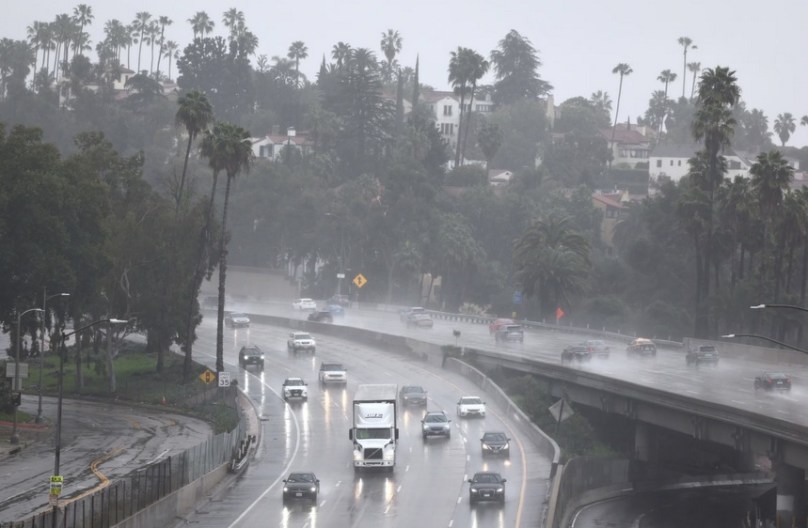
It seems that Southern California is in a perpetual drought, except when we are being drenched by monster rainstorms. I love rain because it makes the surrounding hillsides green, that is, when it doesn’t send those same hillsides sliding into the ocean.

The Los Angeles River is something of a joke for most of the year. (You might remember the car chase scenes in Terminator 2 along its concrete banks.) Right now, it is a raging torrent which I would not dare to approach.

At the supermarket today, I forgot an item on my grocery list for our supper. After watching Fritz Lang’s M (1931) on TCM (Turner Classic Movies), I noticed that the rain was still coming down, so I decided to make do with miscellaneous food items I had lying around the kitchen. Why didn’t I go back to the market? For one thing, it was already dark; and L.A. drivers go crazy when there is anything heavier than a drizzle.

Fortunately, I am a bookworm and a cinephile, so I have no problem entertaining myself. Martine, however, likes to take long walks; and the weather lately has not been conducive.

Playing Havoc With the Weather

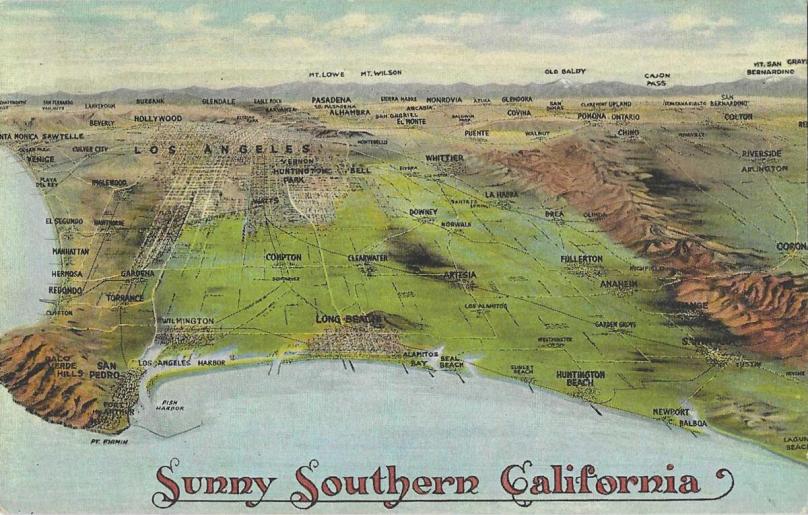
An Old Relief Map of Southern California

I remember from my early days in Cleveland, whatever happened to one side of the city also happened to the other sides. That’s because Cleveland was, if not as flat as a pancake, pretty darn flat. In fact the highest elevation in the whole State of Ohio is 1,549 feet (472 meters).

Compare that with Los Angeles County where I live. When I look out my front door, I can see the Santa Monica Mountains just a few miles north of me, where the highest elevation is 3,111 feet (948 meters) at the curiously named Sandstone Peak. Curiously named because it actually isn’t sandstone. And there is one peak in the San Gabriel Mountains—Mount San Antonio, aka Mount Baldy—which rises to 10,064 feet (3,069 meters).

When the news gives the regional weather report, it has to differentiate between several different weather zones:

  • Coastal (where I live)
  • Los Angeles basin
  • Valleys (San Fernando and San Gabriel)
  • Mountains
  • “Inland Empire” (San Bernardino and Riverside)
  • Lower desert
  • Upper desert

If the forecasters warn of an upcoming rainstorm, we in the coastal region might see only a few stray drops, while the San Gabriel Mountains might have a foot of snow dumped on their peaks.

So any “all-purpose” one-line weather forecast for Los Angeles is pretty meaningless. Los Angeles County is pretty big—4,084 square miles or 12,310 square kilometers, exceeded in area by only eight States. So if you’re flying into LAX from the East, you might want to check out Weather.Com or the National Oceanic and Atmospheric Administration (NOAA) website—provided that the Musk-Rat doesn’t gut it.

Send Us Rain, But Not Too Much!

Finally Some Rain to Put Down the Wildfires

Just within the last half hour it has started to rain. It has provoked some strange news stories in which the hope is expressed that there won’t be too much. Yes, if there is “too much” rain, there will be mudslides. But then it is all part of the cycle of wind, wildfires, mudslides, and earthquakes that has formed (and will continue to form) the Southern California landscape.

I’m just happy that the air will be more breathable and that the increased humidity will relieve us from painful peeling hangnails. If there are mudslides, that will just be part of the cost we will have to bear for living in this strange and beautiful place.

The rains are expected to last for the next couple of days.

Too Much and Not Enough

Heavy Rain in Southern California

Is it time to turn on the news yet? And when it is, what do you expect to hear? I don’t know about you, but I have come to the conclusion that the purpose of the news is to sell advertising by making the viewers fearful, such that they will want to be “informed” on the latest developments and continue to come back for more.

I have been asked by several friends outside of California whether I have “survived” the rainstorms that have hit the state this month. Evidently, I have, as I am writing this blog.

Southern California weather news can be illustrated by the following Venn diagram:

The blue circle indicates that “there has been too much rain”; the yellow circle, that “there has not been enough rain.” And what about the pale green zone where the two circles intersect? That’s when some weather reports are saying “there has been too much rain” and some others are saying that “there has not been enough rain”—at the same time!

At the same time we have been bombarded by reports of too much rain, there have been numerous stories that now a La Nina weather pattern is being established and that soon we will not be getting enough rain.

Apparently, there is no such thing as “just the right amount of rain.” It’s always a case of too much or not enough.

My suggestion for all of you: Try not to turn on the news just before going to bed. It will play havoc with your sleep.

Heat » Evaporation » Clouds » Rain » Flooding

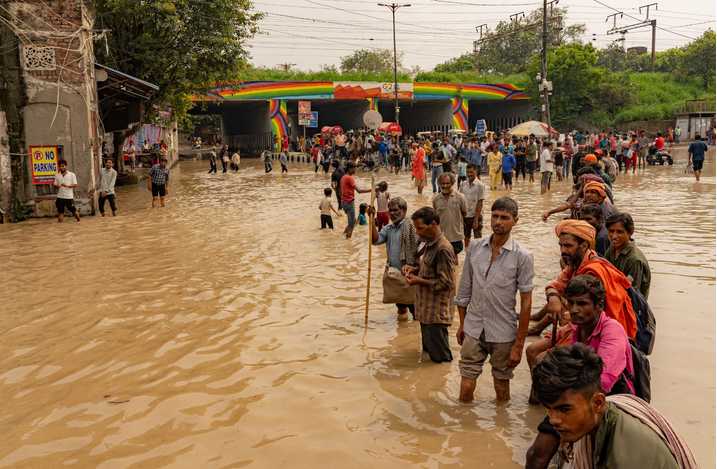
Scene of Flooding in Delhi, India

This isn’t altogether scientific, but I think I might possibly see how global warming translates into disastrous weather such as tornadoes, hurricanes, typhoons, and other types of storms associated with heavy rains and flooding.

It all begins with hot weather. According to National Geographic Magazine, the hotter it gets, the more evaporation takes place;

The National Weather Service in the United States measures the rate of evaporation at different locations every year. Scientists there found that the rate of evaporation can be below 76 centimeters (30 inches) per year at the low end, to 305 centimeters (120 inches) per year on the high end.

The variability is based on temperature. The evaporated vapors form clouds until the air in a place just can’t take any more. The article continues:

Once water evaporates, it also helps form clouds. The clouds then release the moisture as rain or snow. The liquid water falls to Earth, waiting to be evaporated. The cycle starts all over again.

Many factors affect how evaporation happens. If the air is already clogged, or saturated, with other substances, there wont be enough room in the air for liquid to evaporate quickly. When the humidity is 100 percent, the air is saturated with water. No more water can evaporate.

Then—you guessed it!—it comes down as rain. Sometimes, lots of rain. Such as Los Angeles received when a hurricane hit Southern California a couple weeks ago with record rainfall. Those record rainfalls have been happening all over the globe: Burning Man at Black Rock City in Nevada; Derma in Libya, at the edge of the Sahara Desert; and Delhi, India.

So I think that the whole cycle of drought and flood will become ever more extreme, sometimes in the most unlikely places.

Earth’s Answer

Hurricane Seen from Above

If global warming was some sort of challenge to us, then I would say we lost. There are still multitudes that will think nothing of denying it until their own asses catch fire. Re-reading J. R. R. Tolkien’s The Lord of the Rings, I am conscious of a kind of Celtic sadness as the Barbarians stagger up to the gates and unthinkingly push back against anything that will help our world as we knew it survive into the future.

There are just too many Barbarians, and they delight in making grimaces at us Libtards. We are to be pwned at all events. It as as Sly says in Shakespeare’s The Taming of the Shrew: “Therefore, paucas pallabris, let the world slide. Sessa!”

Well we some some indications of what the world’s “slide” will entail. There are hurricanes, tornadoes, overheated oceans that cook the fish, floods, droughts, record heat. And that°s just the start.

Face it, we humans are toxic to the earth. So we can expect that the earth will just up the ante and make it impossible for us to live as we have done into the future. I can think of no better symbol for our future than the floods at Burning Man near Nevada’s Black Rock City:

Perhaps to come are cacti growing in the Amazon Basin, Hurricanes in Southern California (hey, we had one last week!), trees growing the northern Alaskan bush, accelerated extinction of plant and animal species, ever fiercer and more widespread wild fires, food shortages, water shortages, the disappearance of green lawns—and that’s just the beginning.

So continue to say there is no such thing as global warming, and get ready to run for your life.

Hiking to Inspiration Point

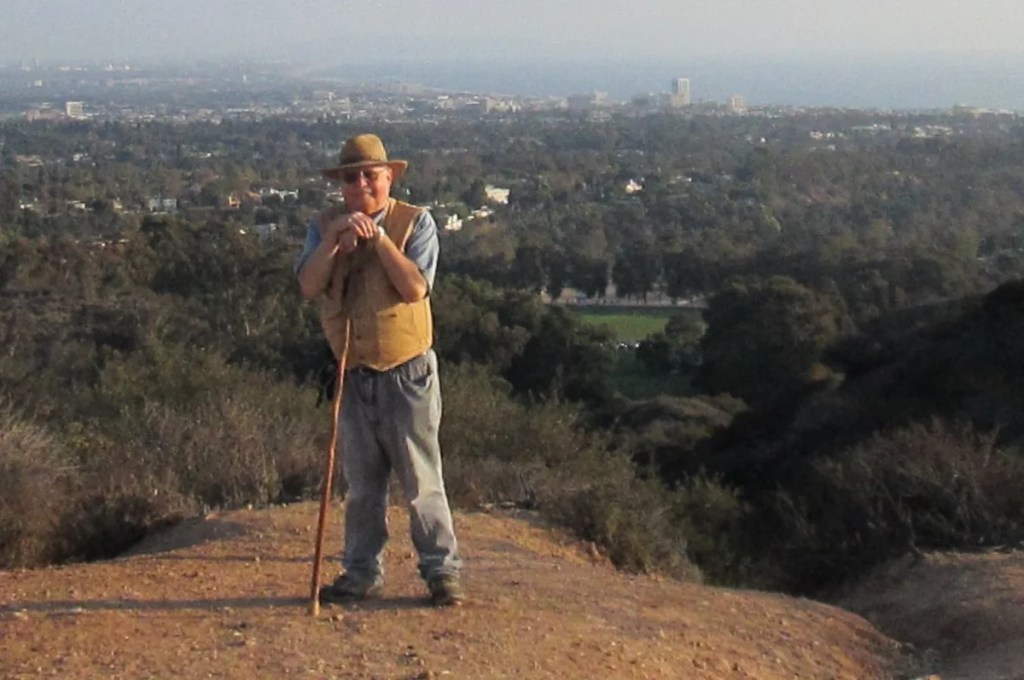
Atop Inspiration Point Ten Years Ago

Today I took a hike … sort of. Now that we are not being flooded out very week, I needed some exercise—only to find that I was way out of shape. I drove to the Will Rogers State Historical Park in Pacific Palisades. Now this is a trail I had hiked many times before, but today I couldn’t quite make it to the top. And that despite the fact that the trip there and back was only 9/10 of a mile (1.5 km) with a total gain of 119 feet (36 meters)!

I am resolved to try again soon. It is amazing how a long spell of bad weather can expose how out of shape one is.

No matter. I still enjoyed the experience. The hills were covered with purple and gold wildflowers, and at several points there were still rivulets seeping from the hills right through the center of the trail. At three points along the trail, there are benches . I took advantage of them once on the way up and once on the way down. It was a lovely day, with coastal fog starting to come in at the lower elevations.

In another ten or twelve weeks, it’ll be too hot to hike this trail, so I had better do it again soon perhaps two or three times. When it gets really hot in L.A., it’s better to stick to level ground—and that early in the morning. Once 11 am rolls along, it becomes a sweaty ordeal.

When I finished the walk, I sat down on one of the three rocking chairs on the porch of Will Rogers’s old house and watched parents play with their children on the wide lawn in front.

Atmospheric Rivers

The Engine That Created California’s Storms This Year

Climate change is giving us a whole new language to describe the giant rain/snowstorms that have pummeled California since November 2022. Originally, there were the Pineapple Expresses which dumped large amounts of precipitation. There were maybe one or two in a rainy season, and just as likely none. Now the term Atmospheric River is used by the National Oceanic and Atmospheric Administration (NOAA). And then there are the Bomb Cyclones, fast-developing storms that occur when atmospheric pressure drops at least 24 millibars over a 24-hour period. Sometimes, all three terms are used to describe the same storm.

This year, California has experienced thirteen Atmospheric River storms this rainy season, dumping a record amount of precipitation in the form of rain and snow. I was watching a news report from Mammoth Lakes today which claimed that over 700 inches of snow have fallen in the area so far.That’s over 58 feet in all. Fortunately, it didn’t all fall at one time.

I suspect that we are probably at or near the end of these storms for this rainy season. These events have convinced me that there is risk entailed by siting a house in a low river valley or by a non-rocky hillside. Or by living in a trailer park.

The good news is that California agriculture will probably recover stronger than ever, except for those crops that don’t like too much water.

The Snowcapped Mountains of L.A.

The San Gabriel Mountains Seen from Altadena

This has been the coldest winter I can remember since I first moved to Southern California in 1966. It has been wet, too—but not quite the wettest. That honor belongs to several winters in the 1970s and early 1980s, and most particularly the winter of 2004-2005.

As I drove to the Original Farmers Market at 3rd and Fairfax, I saw the peaks of the San Gabriel Mountains covered with a heavy mantle of snow. The mercury stood in the low 50s Fahrenheit (or low teens Celsius).

Southern California winters usually consist of periods of cold interspersed with several warm spells, where the temperature can go as high as the 80s and 90s Fahrenheit (or 30s Celsius). For the last few months, however, I have been wearing long-sleeves shirts, a wool vest or sweater, and a windbreaker. In December, my gas bill topped $365.00—a new record!

I feel sorry for tourists who come to L.A. to bask in the sunshine and spend some time tanning at the beach. They will likely encounter icy winds and blowing sand.

Fiercely Unhuggable

It’s Hard to Be a Tree Hugger in the Desert

This Friday, I will be driving to Palm Desert in the Coachella Valley to visit my brother and sister-in-law. Consequently, I will probably not post here again until Monday January 30—and then only if I feel up to it.

This is supposed to be a nice weekend, except for the possibility of rain on Sunday and Monday. Fortunately, I noticed this week that my right front windshield wiper was starting to fall to pieces, so I had it replaced. The driver’s side windshield wiper (which on a Subaru Forester is two inches longer than the passenger side wiper) is on order.

Usually, most Southern Californians bet that whatever rain is predicted will spend itself in the mountains and leave us high and dry. Not this year, however.

It’s always fun to spend time with Dan and Lori, and I am looking forward to it.

So hasta la vista!