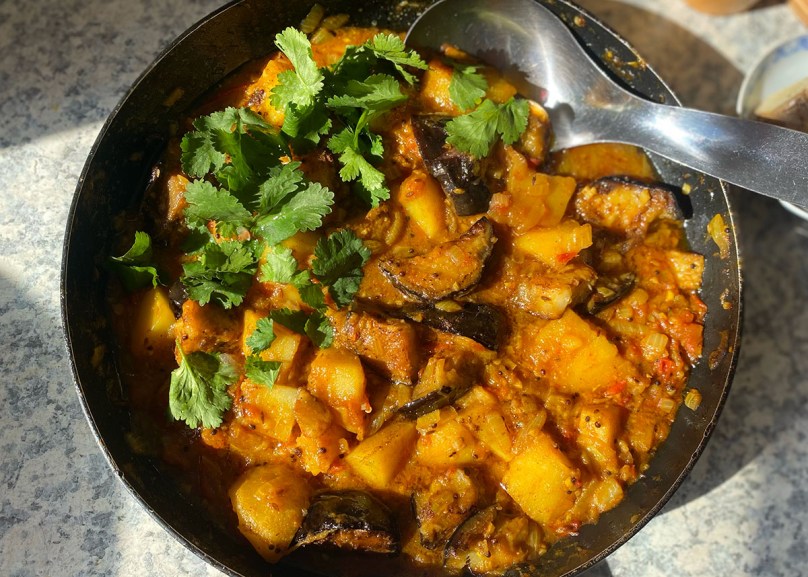
Potato Eggplant Curry

This recipe came to me through the “How to Cook Great” site on YouTube. Click here for an instructive video that produces almost exactly what I will describe in this post. The following recipe will make 4-5 servings of a delicious vegan curry.

For some of the ingredients, you will need to shop at an Indian grocery—especially if you want the dish to taste authentic. These ingredients are marked in the text by IND in square brackets: [IND].

I typically use a largish nonstick pot that has a cover for the final stage of cooking.

On to the recipe:

  1. Put several tablespoons of sunflower seed oil in the pot and turn to heat to moderate high.
  2. When the oil is hot, add a several tablespoons of black mustard seeds [IND] and cumin seed (also known as jeera) [IND] and watch the seeds pop. Stir for up to a minute.
  3. Take two largish russet potatoes, peel them, and cut into pieces slightly smaller than 1 cubic inch. Stir for several minutes.
  4. Add a large dollop of garlic ginger paste [IND] and stir in.
  5. Add salt to taste,
  6. Slice one medium size red onion and stir into the mix. Stir for a couple of minutes.
  7. Add the following three spices, approximately one heaping tablespoon of each: (a) haldi turmeric [IND], (b) cumin, and (c) (if desired) a hot chile powder. For the chile powder, you can substitute Hungarian paprika if you can’t handle the heat. Stir.
  8. Dice into pieces a medium to large eggplant and add to the mix. Continue stirring.
  9. If you like spicy food, mice one jalapeño or two serrano chile peppers.
  10. Cut up four or five small tomatoes and add to the pot. Stir.
  11. Turn down the heat to medium low, cover the pot, and cook for ten to twenty minutes.
  12. Chop a handful of cilantro and add before serving.
Going Vegetarian With Style

You Start by Fire-Roasting Hatch or Ancho Chiles…

I think that if you are seriously interested in going vegetarian, you should avoid bland vegetarian dishes altogether. That’s why I think that most American vegetarian recipes are yuck.

Of late, I have been working on a Spanish rice recipe that is inspired by three sources:

  • Rice-a-Roni Spanish Rice, combining rice with vermicelli
  • Mexican dishes based on fire-roasted chiles
  • My Mom’s unbearably hot home Hungarian lecso, or tomato and pepper stew (unbearable because I was only a kid at the time)

Here are the steps to making my Spanish Rice recipe:

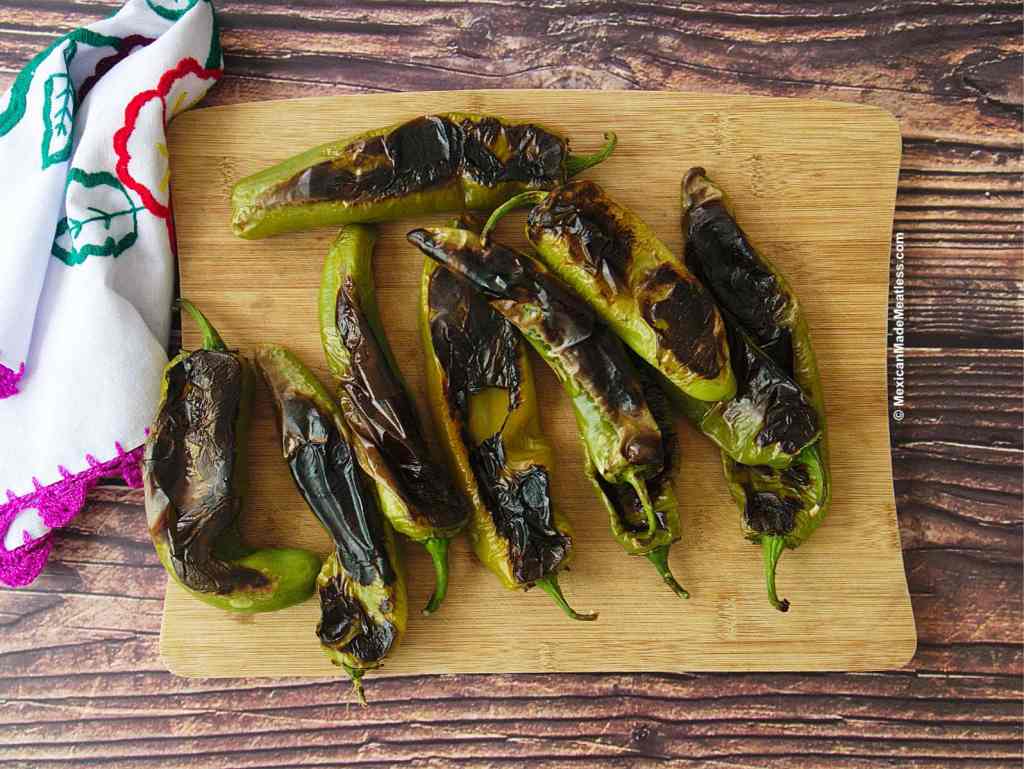
  1. Get two or more Hatch or Ancho or California or Pueblo chiles. They are about six inches long. Fire roast them until the skin is black and blistered, as in the above photo. Lay them aside to cool.
  2. Toss a half handful of vermicelli or fideo noodles in a pan with olive oil and heat until they turn dark brown. Lay them aside. Pieces should be 1/2 to 3/4 inches in length.
  3. In a large pot with cover, add about a quarter cup of olive oil and begin to heat (medium).
  4. Peel and chop one Spanish onion and add.
  5. Using a small sharp knife, trim the blistered skin from the chiles you have fire roasted. Chop them and add to the onions.
  6. Crush six (yes, six!) cloves of garlic and add to the onions and chile.
  7. Add one cup of long grain rice (I use Trader Joe’s Jasmine Rice) to the mixture and stir for a couple of minutes.
  8. Chop up a pound of ripe, fresh tomatoes and add to the rice. I like Campari Tomatoes for this.
  9. Add the browned vermicelli noodles at this point.
  10. Add salt and pepper to taste.
  11. Add one can of chicken (or vegetable) stock and about 3/4 cup of water.
  12. Lower heat and cover.
  13. When most of the liquid has been absorbed, chop one can of pitted black olives roughly and add to the rice mix. Stir to prevent burning from the bottom.

And that’s pretty much it. The fire-roasted chiles give this dish a nice background burn. If you’re a real chile-head, you can also add a Jalapeño or Serrano chile for an added foreground burn. Yow!

I’m still playing with this recipe, so you may hear more from me about this.

Frito Pies

This Is the Way It Looked When I First Ate One

The first time I ate a Frito Pie, it looked like the above photo, and it was purchased from where it was invented, a lunch counter in Santa Fe, New Mexico.

The second time was today. I cooked it myself from this recipe. As I made it to please Martine, the finickiest of all eaters, there was no way I could add raw onions as a garnish. And I used a mild La Victoria Red Enchilada sauce, even though my preferences is for spicy hot dishes. I second the recommendation of using Ranch House canned beans, as they go very well with this recipe. Oh, and I recommend extra sharp cheddar cheese. By the way, don’t use any other chips other than original recipe Fritos: That’s why it’s called Frito Pie.

Tomorrow, I will serve the leftovers with cut up fresh avocado. It’s not in the recipe, but I think it would go well with it.

Stuffed Cabbage

Not all my cooking creations are successful. The first time I tried cooking Hungarian stuffed cabbage rolls—a dish I was brought up on by my mother and great-grandmother—the rolls all fell apart. I didn’t know the trick of trimming the thick “veins” in the cabbage leaves, and I don’t remember parboiling and coring the cabbage.

This week, I got it right. First of all, I consulted with my brother, who is by far the best cook in the family. Then he sent me the recipe he uses. Here it is.

It took me five hours to cook the cabbage rolls from start to finish, though much of that time was waiting for the rolls to boil for 1½ to 2 hours. I used four different kind of meats in my recipe: smoked Hungarian gyulai kolbasz, Hickory smoked bacon, ground pork, and ground beef. Fortunately, there’s a great butcher shop at Alpine Village in Torrance which has several different types of kolbasz.

Once you make stuffed cabbage rolls, it’s easy to cook enough to feed a family for several days. Our lasted five days, with some left over that we had to discard because i have a rule that no cooked dish I make can be eaten for more than five days.

If you should try the recipe, be sure to get some fresh dill and some marjoram and—most important of all—real Hungarian paprika from Szeged, Hungary. The Spanish stuff has the color, but not the flavor.

Cooking With Manjula

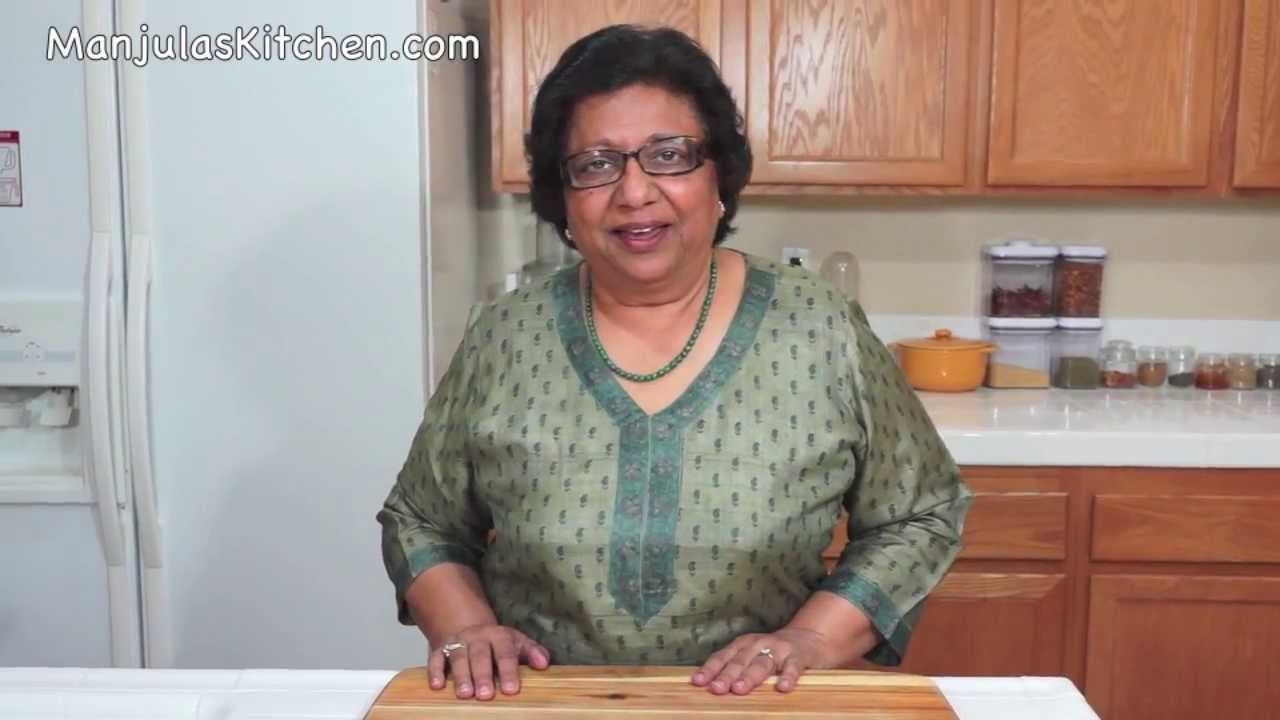
Manjula Jain, Master Chef and YouTube Luminary

During this hyperextended coronavirus quarantine period, I have picked up a few good habits. Perhaps the best of them is taking authenticity more seriously in my cooking. I have been making Indian vegetarian dishes for over thirty years, but now, thanks to YouTube, I am more serious about trying to cook them approximately the way a resident of India would.

For one thing, that involves a more serious attention to the spices used in Indian cooking. Fortunately, there are a number of Indian groceries in Culver City along Venice Boulevard, my favorite being India Sweets & Spices. Just to give you an example, here is a list of spices for Chickpea Pulav, which I will be preparing later this week:

  • Cumin seeds (jeera)
  • Asafetida (hing)
  • Bay leaves (tajpat)
  • Ginger (I use a bottled ginger/garlic paste from Laxmi)
  • Turmeric (haldi)
  • Mango powder (amchoor)
  • Garam Masala (which is mostly cardamom)

In addition, I will also be adding a few additional spices not called for in the recipe, including powdered red chile, cumin powder, cilantro, and coriander powder.

If you are interested in Indian vegetarian cooking, I highly recommend Manjula Jain’s Cooking with Manjula, 2nd Edition, which can be obtained for $5.00 in a downloadable format. (In my case, it turned out to be Microsoft Edge PDF, which took me a little while to learn how to print so that it doesn’t stretch off the page.) There are approximately 150 pages of recipes, which make it a good deal for the cost involved.

I highly recommend you try the Chickpea Pulav first, which Manjula calls a “Spicy Rice with Chickpeas.” I am going to be busy trying her other recipes, which you can also find on the web and YouTube. Here’s the YouTube recipe for the Chickpea Pulav: Click here.


No Expert at Facebook

I Have Shown Myself to Be Ignorant of Facebook Security


If you have tried to follow the links to my brother’s recipes, you will have found out you can’t see any of them because you are not a friend of Jennifer’s. I have not given up hope: I will investigate how to get around Mister Zuckerface’s security. Stay tuned to this spot in the coming days.

The Singing Chef and Others

Singing Chef Harpal Singh

Although I still have a shelf of cookbooks, it is unlikely that I will add to it. For my own ventures into cooking, I am increasingly turning to YouTube where I can see the dish being made and what it looks like when it is completed.

As I grow older, I am becoming more interested in vegetarian cuisine. And which is the greatest vegetarian cuisine, but the foods of India. If I am cooking for myself these days, I am more than likely to go for a good curry recipe like one of the following:

Chef Harpal Singh’s Mumbai Mast Tomato Pullao

Chef Harpal Singh is a charming presence who likes to entertain you by singing (or is it singhing?). I have not made this dish yet because Martine prefers me to cook dishes with meat. So I have to wait until she has an episode of irritable bowel syndrome before trying it. (Those episodes last for about a week.)

A Tasty Eggplant and Potato Curry from HowToCookGreatFood.Com

The chef here does not introduce himself by name, but he is a wizard. I have prepared this dish twice and love it. My friend Mona, who is a health nut, thinks I am crazy for liking a dish whose primary ingredients are both members of the deadly nightshade family. Happily, I have not yet succumbed to any sort of nightshade poisoning.

There are other sources, which I may introduce at some later date, such as Chef Odon Hankusz from Budapest. Unfortunately, his instructions are all in Hungarian, but his Gulyás Leves is a dish for the gods!

A Hungarian Peasant Dish

Hungarian Káposztas Tészta, or Cabbage Noodles

Hungarian Káposztas Tészta, or Cabbage Noodles

One of my favorite dishes as a child was Hungarian Káposztas Tészta, or Cabbage Noodles, which was both cheap and good. The recipe below is taken from 2009 posting to Blog.Com describing the way I prepared it for a Hungarian Meet-Up Group potluck:

Take one head of cabbage, grate it as finely as possible. Deposit it into a large mixing bowl and salt liberally. Then cover it with a clean dish towel and come back a half hour later. You will find that the salt draws the water out of the cabbage. Pick up handfuls of the cabbage, squeeze the salt water out of it over the sink, and place in a colander. Then squeeze it hard again.

Now it’s time to get a large saucepan and melt some unsalted butter in it and add an equal amount of olive oil. (The old Hungarians used bacon fat, but butter and vegetable oil is just as good and better for you.) Sauté the cabbage and keep stirring for upwards of an hour, until the cabbage starts to get a little brown around the edges. Don’t leave the cabbage to burn: You have to attend to it fairly closely.

Around this time, start boiling water for egg noodles. My mother used to make her own, cutting them into three-quarter-inch squares that were perfect. But prepackaged noodles are almost as good. Drain the cooked noodles and add to the cabbage. I used my Chinese iron wok to mix the two together. While turning the mix around, I added salt and freshly ground pepper to taste.

Simple and good.