
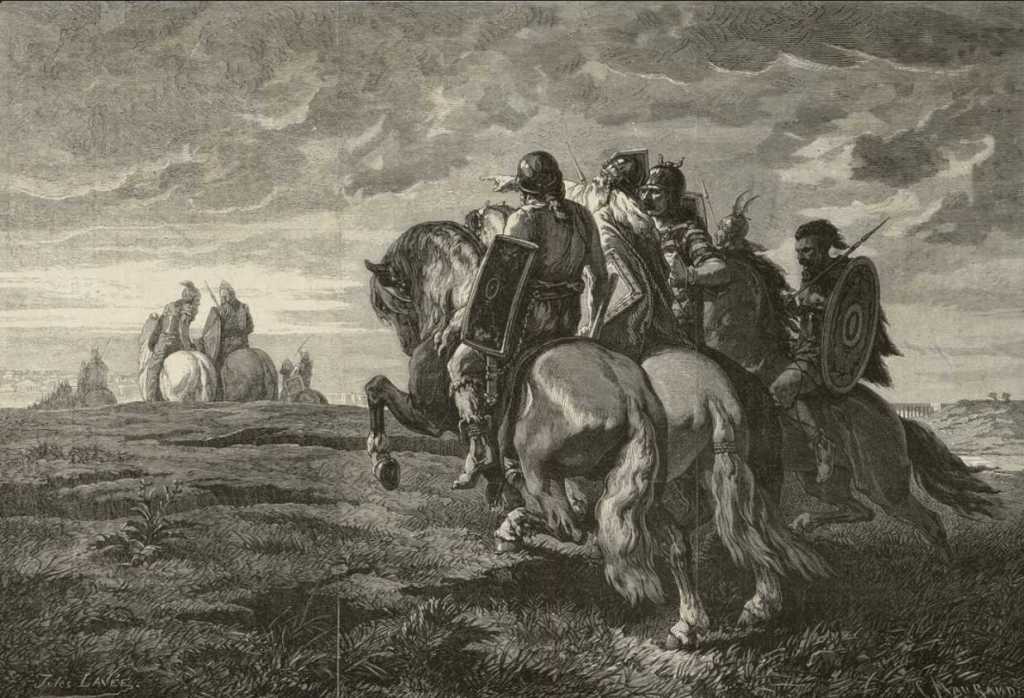
The Barbarians Are Coming! The Barbarians Are Coming!

There are two ways of looking at the Barbarian Invasions of the Roman Empire. For the first, we have Orientius, said to be a cleric from Gascony, in his Commonitorium:

Look at how death has swept through the entire world,
at how many peoples have been affected by the madness of war.
What use are thick forests or high and inaccessible mountains,
what use the raging torrents with violent whirlpools,
carefully located fortresses, cities protected by their walls,
positions defended by the sea, the squalor of hiding places,
the darkness of caves and the hovels among the rocks;
nothing has been of use in avoiding the barbarians hunting in a pack….
In the villages and the villas, in the fields and at the crossroads,
in all the hamlets, on the roads and in every other place,
death, suffering, massacres, fire-raising, and mourning:
the whole of Gaul was burning in a single blaze.

Then there is the view of Greek poet Constantine Cavafy in his wonderful poem:

Waiting for the Barbarians

What are we waiting for, assembled in the forum?

The barbarians are due here today.

Why isn’t anything going on in the senate?
Why are the senators sitting there without legislating?

Because the barbarians are coming today.
What’s the point of senators making laws now?
Once the barbarians are here, they’ll do the legislating.

Why did our emperor get up so early,
and why is he sitting enthroned at the city’s main gate,
in state, wearing the crown?

Because the barbarians are coming today
and the emperor’s waiting to receive their leader.
He’s even got a scroll to give him,
loaded with titles, with imposing names.

Why have our two consuls and praetors come out today
wearing their embroidered, their scarlet togas?
Why have they put on bracelets with so many amethysts,
rings sparkling with magnificent emeralds?
Why are they carrying elegant canes
beautifully worked in silver and gold?

Because the barbarians are coming today
and things like that dazzle the barbarians.

Why don’t our distinguished orators turn up as usual
to make their speeches, say what they have to say?

Because the barbarians are coming today
and they’re bored by rhetoric and public speaking.

Why this sudden bewilderment, this confusion?
(How serious people’s faces have become.)
Why are the streets and squares emptying so rapidly,
everyone going home lost in thought?

Because night has fallen and the barbarians haven’t come.
And some of our men just in from the border say
there are no barbarians any longer.

Now what’s going to happen to us without barbarians?
Those people were a kind of solution.

Now which attitude do we take if Donald Trump and his incel hoards should regain the Presidency of the United States?

“A Kind of Solution”

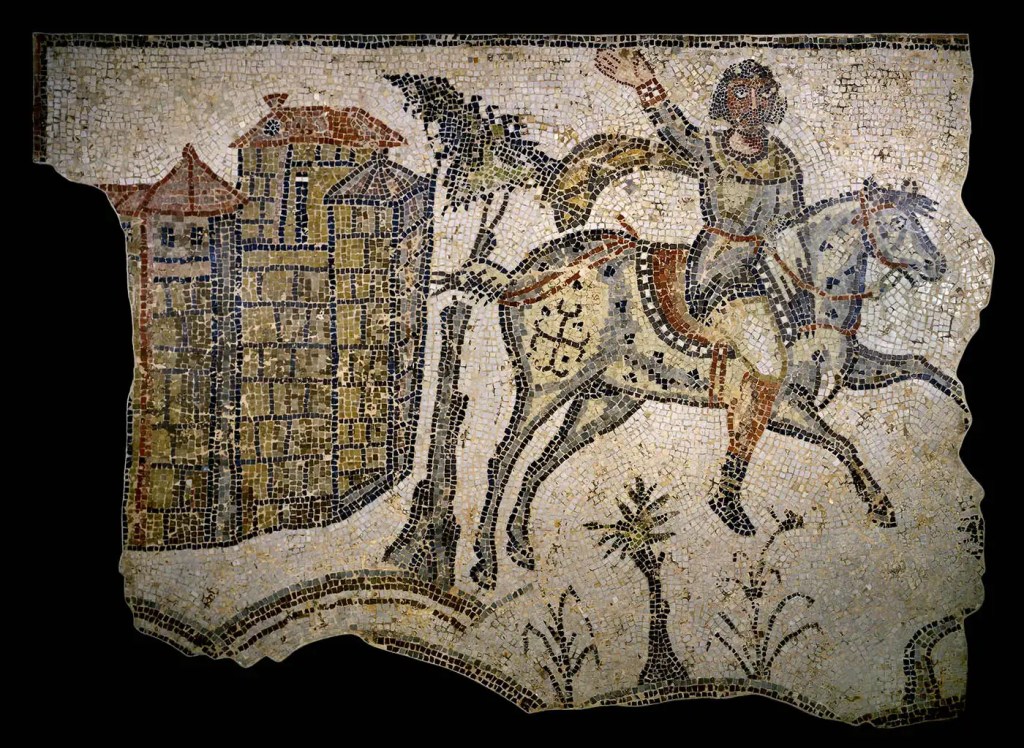
Invading Vandal Horseman

I have just finished reading Volume II of Thomas Hodgkin’s monumental Italy and Her Invaders, which tells of the Hun and Vandal invasions and the Herulian Mutiny that unseated the last of the Western Roman Emperors in CE 476. In essence, it tells of the painful last twenty-five years of the Empire, during which most of the emperors were murdered in a year or two.

There was no benefit to wearing the imperial purple in those last few years. A couple of days ago, I posted a blog in which Apollinaris Sidonius explained why it was no fun in being chosen as emperor.

Those last years of the empire were no fun. Not only were the invading Huns and Vandals brutal, but the empire itself was brutal to its own citizens, taxing them to death to pay for the huge military required to protect the borders.

It makes me think about our own situation. Our problem is not barbarian invasions (unless you don’t particularly like Canadians or Latin Americans), but our seemingly unbridgeable political divisions. The insurrection of January 6, 2021, was, to me, very like Gaiseric and the Vandals’ sack of Rome in CE 455. They may have been barbarians in the end, but they were our very own native-born barbarians. The result, in the end, is no better than the sad end of Rome.

I keep thinking of a poem by the Greek poet Constantine P. Cavafy entitled:

Waiting for the Barbarians

What are we waiting for, assembled in the forum?

      The barbarians are due here today.


Why isn’t anything going on in the senate?
Why are the senators sitting there without legislating?

      Because the barbarians are coming today.
      What’s the point of senators making laws now?
      Once the barbarians are here, they’ll do the legislating.


Why did our emperor get up so early,
and why is he sitting enthroned at the city’s main gate,
in state, wearing the crown?

      Because the barbarians are coming today
      and the emperor’s waiting to receive their leader.
      He’s even got a scroll to give him,
      loaded with titles, with imposing names.


Why have our two consuls and praetors come out today
wearing their embroidered, their scarlet togas?
Why have they put on bracelets with so many amethysts,
rings sparkling with magnificent emeralds?
Why are they carrying elegant canes
beautifully worked in silver and gold?

      Because the barbarians are coming today
      and things like that dazzle the barbarians.


Why don’t our distinguished orators turn up as usual
to make their speeches, say what they have to say?

      Because the barbarians are coming today
      and they’re bored by rhetoric and public speaking.


Why this sudden bewilderment, this confusion?
(How serious people’s faces have become.)
Why are the streets and squares emptying so rapidly,
everyone going home lost in thought?

      Because night has fallen and the barbarians haven't come.
      And some of our men just in from the border say
      there are no barbarians any longer.


Now what’s going to happen to us without barbarians?
Those people were a kind of solution.

Rome in Eclipse

An 1836 Painting Showing the Sack of Rome by the Visigoths in AD 410

I have begun reading Thomas Hodgkin’s magisterial Italy and Her Invaders in the Folio Society edition, which has been retitled The Barbarian Invasions of the Roman Empire. The first volume covers the Visigoths and the Empire as it was from the death of Julian the Apostate in AD 363 to AD 414.

We entertain a false picture of the Roman Empire during the Fifth Century. In the late Third Century, the Emperor Diocletian decided that, insofar as administration was concerned, the Empire was too big for one man to control. He decided to divvy it up into four pieces, creating the Tetrarchy.

By the reign of Julian, the four pieces consisted of Gaul (including France, England, and Spain); Italy (including Italy, Austria, Yugoslavia, and North Africa); Illyricum (including Greece, Macedonia, and Ukraine); and the Orient (including Turkey, Bulgaria, Syria, and Egypt). Note that Egypt, which was the bread basket of the Empire, now shipped most of its grain to Constantinople, leaving Rome high and dry.

In fact, after Diocletian’s Tetrarchy, the city of Rome began to decline. The co-emperor ruled from either Milan or Ravenna. Both cities were closer to the Alps and the routes the Barbarians would take in attacking the Italian Peninsula.

The other “capitals” were Constantinople for the Orient; Augusta Treverorum, or Trier, for Gaul; and Thessalonika or Sirmium for Illyricum.

When I cam across this line in Hodgkin’s first volume, I realized that by this time Rome was toast:

Strange to say, during the whole preceding century, Rome had only four times seen an emperor within her walls, Constantine (312) after his victory over Maxentius, Constantius (357) four years after the overthrow of Magnentius, and Theodosius (389) after his defeat of maximus, and again (394) after his defeat of Eugenius.

Once the Barbarians started invading in numbers, Rome was just too far away from the action. Days were wasted getting to the top of the boot of Italy. So when Rome was sacked by the Barbarians, they were largely attacking a symbol rather than a seat of power.

Rome in God’s Eye

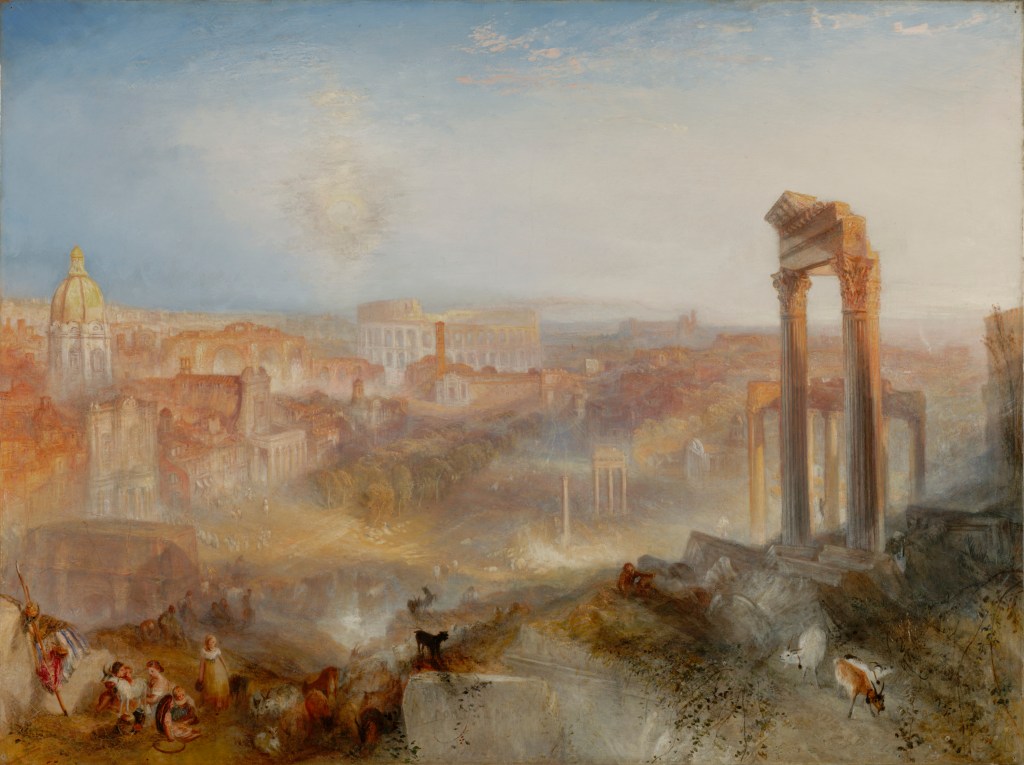
The title of the illustrated painting is “Modern Rome—Campo Vaccino.” It was painted in 1839 by Joseph Mallord William Turner (1775-1851). It is the third of five paintings that moved me during my last visit to the Getty Center in Los Angeles.

There is something about the quality of light in J.M.W. Turner’s work. The painting is described as follows by the Getty’s database:

Ten years after his final journey to Rome, Turner envisioned the Eternal City through a veil of memory. Baroque churches and ancient monuments in and around the Roman Forum seem to dissolve in iridescent light shed by a moon rising at left and a sun setting behind the Capitoline Hill at right. Amidst these splendors, the city’s inhabitants carry on with their daily activities. The picture’s nacreous palette and shimmering light effects exemplify Turner at his most accomplished.

When first exhibited at the Royal Academy in 1839 with its pendant, Ancient Rome; Agrippina Landing with the Ashes of Germanicus, the painting was accompanied by a modified quotation from Lord Byron’s masterpiece, Childe Harold’s Pilgrimage (1818): “The moon is up, and yet it is not night, / The sun as yet divides the day with her.” Like the poem, Turner’s painting evokes the enduring sublimity of Rome, which had been for artists throughout history less a place in the real world than one in the imagination.

Note the characters and livestock in the foreground of the painting. In the background, ancient and contemporary Rome are intermingled as the light at the end of day washes out all the details. It looks almost as if Rome is in flames.

Campo Vaccino literally means cow pasture or cattle field in Italian. For years, the location had been a cattle market. According to the Princeton Art Museum, “Essentially in ruins since the fifth century A.D., by the seventeenth century the still-to-be excavated Roman Forum was popularly known as the Campo Vaccino, or cow field, alluding to its dual role as pasture and cattle market; it was also a popular sketching spot for artists.”