Does This Remind You of Anyone?

An Amazing Coincidence

An Amazing Coincidence

When I read Teffi’s essay on Rasputin in Tolstoy, Rasputin, Others, and Me: The Best of Teffi, couldn’t help comparing the dread Siberian starets to an American political figure in the news. Here are three instances, from which you can draw your own conclusions:

The Black Automobile

According to Teffi:

The “Black Automobile” remains a mystery to this day. Several nights running this car had roared across the vField of Mars, sped over the Palace Bridge, and disappeared into the unknown. Shots had been fired from inside the car. Passers-by had been wounded.

“It’s Rasputin’s doing,” people were saying, “Who else?”

Dealings with Women

Teffi was seated next to Rasputin, who tried to get her to have some wine:

Rasputin was drinking a great deal and very quickly. Suddenly he leaned towards me and whispered, “Why aren’t you drinking, eh? God will forgive you. Drink.”

He kept trying to get her to drink and to come to his place, but she wisely refused.

He “Sows Discord and Panic”

Finally, Teffi writes:

He profits from everything black, evil and incomprehensible. Everything that sows discord and panic. And there’s nothing he can’t explain to his own advantage when he needs to.

Now I could add that he tweets nasty, ad hominem attacks in the middle of the night, but that would be giving it away, wouldn’t it?


Serendipity: A Glimpse of Rasputin


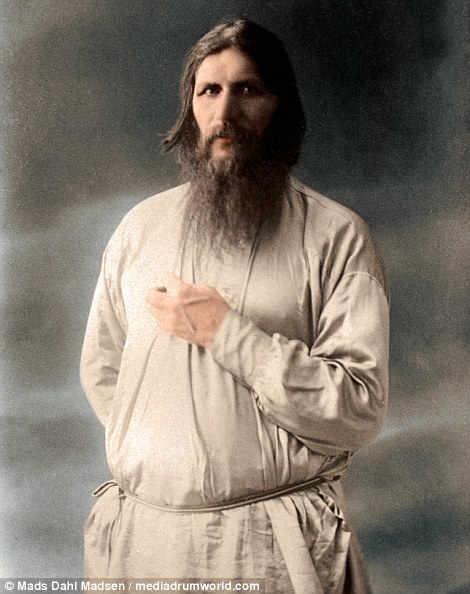
Gregory Rasputin in Color

Gregory Rasputin in Color

The following beguiling sketch comes from Nadezhda Lokhvitskaya—perhaps better known as Teffi—whose essay on the Siberian “holy man” is reprinted in her Tolstoy, Rasputin, Others and Me: The Best of Teffi, published by New York Review:

I had glimpsed Rasputin once before. In a train. He must have been on his way east, to visit his home village in Siberia. He was in a first-class compartment. With his entourage: a little man ho was something like a secretary to him, a woman of a certain age with her daughter, and Madame V—, a lady-in-waiting to the Tsaritsa.

It was very hot and the compartment doors were wide open. Rasputin was presiding over tea—with a tin teapot, dried bread rings and lumps of sugar on the side. He was wearing a pink calico smock over his trousers, wiping his forehead and neck with an embroidered towel and talking rather peevishly, with a broad Siberian accent.

“Dearie! Go and fetch us some more hot water! Hot water, I said, go and get us some. The tea’s right stewed, but they didn’t even give us any hot water. And where is the strainer? Annushka! The strainer—where is it? Oh, what a muddler you are!”

I love the picture of the demonic starets wearing a pink smock.

The photograph above was published by The Daily Mail, along with other interesting color pictures of Rasputin and the Tsar.

Teffi’s essay on Rasputin made me think, and you shall find out later this week exactly what it made me think about.

The Journalist

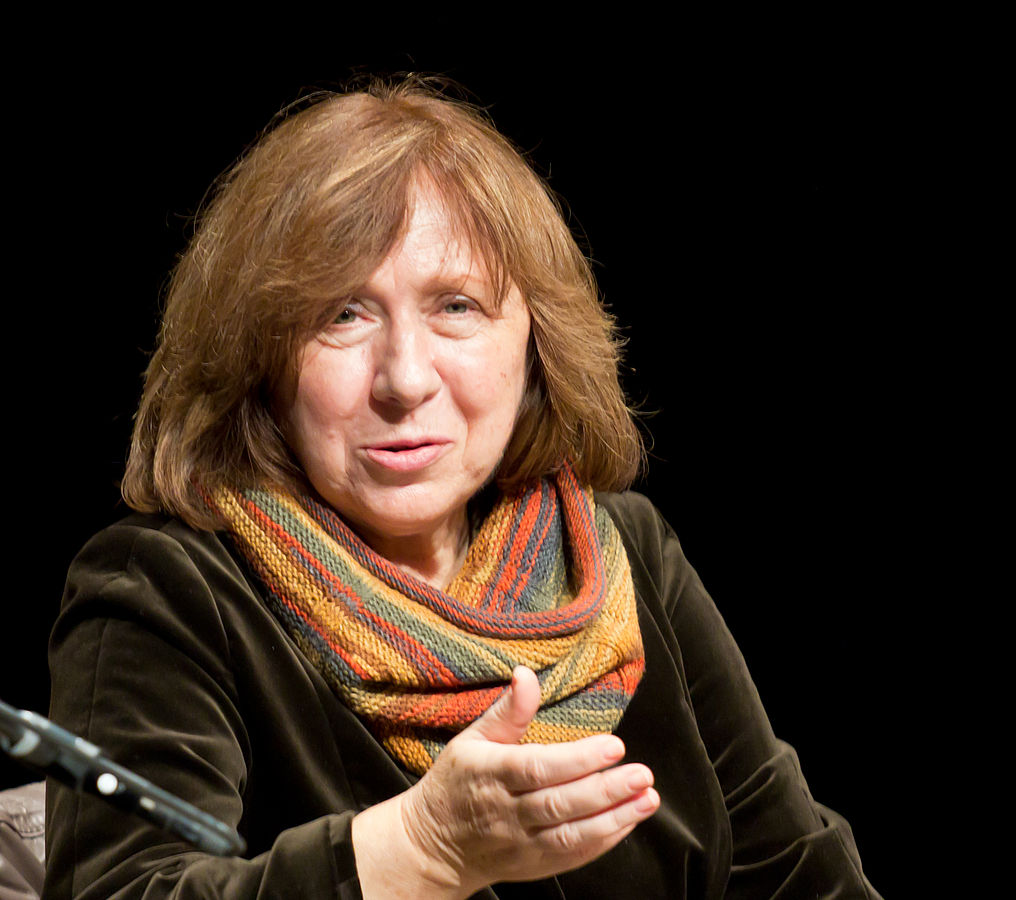
Svetlana Alexievich, Winner of the 2015 Nobel Prize for Literature

Svetlana Alexievich, Winner of the 2015 Nobel Prize for Literature

I have only read two of her books so far, but they were both knockouts. First, there was Zinky Boys (1991), about the Soviet experience in Afghanistan. Now, added to that is Voices from Chernobyl: The Oral History of a Nuclear Disaster (1997). Both books are descriptions of incredible suffering, and they are both powerful disincentives from enlisting in the Soviet military.

Svetlana Alexievich (b. 1948) is usually described as a Belorussian journalist, though she herself rejects the title: She has been known to edit the first person testimonials from one edition to the next, which is a big no-no for oral historians, but the mark of an imaginative writer. I do not mind, because I will accept 99-44/100% accuracy if it involves stylistic or other improvements.

Both Afghanistan and Chernobyl were unspeakable disasters that seemed to go on forever (the latter is still claiming victims), and you cannot hope for a better introduction to both than read Alexievich’s books.

In Voices from Chernobyl, the wife of one Soviet soldier who was involved in the cleanup says:

They say, “Chernobyl,” and they write, “Chernobyl.” But no one knows what it is. Something frightening opened up before us. Everything is different for us: we aren’t born the same, we don’t die the same. If you ask me, How do people die after Chernobyl? The person I loved more than anything, loved him so much that I couldn’t possibly have loved him more if I’d given birth to him myself—turned—before my eyes—into a monster. They’d taken out his lymph nodes, so they were gone and his circulation was disrupted, and then his nose kind of shifted, it grew three times bigger, and his eyes became different—they sort of drifted away, in different directions, there was a different light in them now, and I saw expressions in them I hadn’t seen, as if he was no longer himself but there was still someone in there looking out. Then one of the eyes closed completely.

I do not recommend reading the book on a full stomach. The same with Zinky Boys:

We were combing through a village. You fling open the door and throw in a grenade in case there’s a machine-gun waiting for you. Why take  a risk if a grenade could sort it out for you? I threw the grenade, went in and saw women, two little boys and a baby in some kind of box making do for a cot.

You have to find some kind of justification to stop yourself going mad. Suppose it’s true that the souls of the dead look down on us from above?

I know that we considered the Soviets to be our enemies, but these books describe scenes that one wouldn’t wish upon one’s worst enemy.


Tannu Tuva or Bust!

Very Nice, But There Were No Railroads in Tuva

Very Nice, But There Were No Railroads in Tuva

One of the things I remember most vividly from my stamp collecting days was the availability of postage stamps for non-countries. These were for real places on the map, but not for entities that had their own postal services. The one I remember most vividly is Tannu Tuva (formerly in the Soviet Union).

According to Wikipedia:

Tuva was a region in central Asia between Russia and Mongolia, which in 1921, under Russian instigation, became the Tuvan People’s Republic. A treaty between the Soviet Union and the Mongolian People’s Republic in 1926 affirmed the country’s independence, although no other countries formally recognized it. In 1944, it was annexed to the Soviet Union as part of the Tuvan Autonomous Oblast and in 1961 became the Tuva Autonomous Soviet Socialist Republic. Its successor since 1992, the Tuvan Republic, is a member of the Russian Federation.

I remember reading a book in the 1990s about American physicist Richard Feynman’s failed attempts to visit Tuva, which were detailed in a book by Ralph Leighton entitled Tuva or Bust!: Richard Feynman’s Last Journey. Apparently he never got a visa approval before his final illness.

Some early Tuvan stamps may actually have been used postally, at least in the early days. Most, however, were issued in Moscow with picturesque settings to hard currency from capitalist collectors for Mother Russia. The stamp pictured above of a camel racing a railroad train was a bit fanciful, as there are no railroads in Tuva. Also, why wasn’t the text on the stamp in Cyrillic or even Mongolian letters?

I remember confronting an old family friend about his extensive collection of Tuvan postage stamps. A former postal employee, he became red in the face when told by a little boy that his Tuvan stamps were merely pretty paper.


What’s Happening in Ukraine?

April 2015 Status Map

April 2015 Status Map from New York Review of Books

Americans are confused about the struggle between Russia and the Ukraine. Generally, we think of plucky little Ukraine holding Big Bad Putin at bay. Anyhow, that’s how Europe and the U.S. prefer to see it.

In reality, both Ukraine and Russia are the bad guys, or, as Jorge Luis Borges said about the Falklands conflict between Britain and Argentina, “it’s like two bald men fighting over a comb.” We know Vladimir Putin is a not nice guy who wants to undo Mikhail Gorbachev’s dissolution of the USSR back in1989-1990, which was not a popular move to the man in the street in Moscow or Petersburg. But then, the new government of Ukraine was essentially composed of industrial magnates and common thugs. (But then, so is Russia.)

Ukraine has already lost Crimea, which was a Russian-speaking area. (Not that Russian and Ukrainian are that far removed from one another, but, hey, we’re talking pretexts here!) Let’s compare the above map with a linguistic map of Ukraine ca. 2001:

Is It About Language?

So Is It About Language?

It’s pretty clear that, aside from Crimea, the main Russian-speaking areas are in the Lugansk and Donetsk Oblasts (provinces) of Ukraine, only part of which the freedom-loving thugs of the Russian stripe have conquered after all this time. That’s not a very impressive performance, considering that Russian Spetsnas (спецназ) special forces are mingled with the rebel freedom fighters, and they have access to the latest Russian military technology.

Both sides have been fighting to what looks like a draw. If Putin wins, he’ll get the the two Russian-speaking oblasts to add to the Crimea. Although the eastern rebels have “On to Kiev!” slogans written on their tanks, neither Europe nor the U.S. want to see Ukraine snuffed out. And Germany’s Angela Merkel has hinted that she doesn’t want to see Mariupol in the Donetsk Oblast occupied. (Putin has shelled Mariupol, but has not tried to take it over.)

If Ukraine’s Poroshenko (or whichever magnate replaces him) wins, Russia will just take their winnings and go away. Of course, since Russia supplies Ukraine with natural gas for heating, they also hope not to be frozen out during a bad winter.

I don’t even know how I would want the conflict to end. Perhaps Putin and Poroshenko could fight it out in their underwear, with the loser getting a painful “Dutch rub.”

Putin’s Kleptocracy

Something New from Mother Russia

Something New from Mother Russia

I know that some people think of Vladimir Vladimirovich Putin as the reincarnation of Stalin. Others on the right idolize him because, well, he persecutes gays. The truth is actually to be found elsewhere.

He definitely is a bad dude. Instead of killing people by the millions in Siberian gulags, he uses very targeted assassinations to eliminate some of his more outspoken enemies. In November 1998, soon after he took over the KGB, he had opposition Duma Deputy Galina Starovoitova murdered for her pro-democracy advocacy. As soon as Yeltsin named him Prime Minister a year later, he initiated a bombing campaign in Chechnya which led to hundreds of civilian deaths.

One outspoken critic of the Chechen war was Anna Politkovskaya, whose dispatches on the conflict I have read (and recommend: they are published under the name of A Small Corner of Hell). She paid dearly for her upstanding journalism: She was shot by KGB operatives at the door of her apartment in October 2006.

For a considerably longer list of his targets, click here.

What makes Putin radically different from his Communist forebears is that he is an oligarch in personal control of billions of rubles worth of assets, alone or with a small number of co-conspirators with whom he feels comfortable. There is an excellent review by Anne Applebaum in the December 18, 2014 issue of The New York Review of Books which is a review of Karen Dawisha’s Putin’s Kleptocracy: Who Owns Russia?

No fool, Putin knew that Communism was on the skids while he was still a KGB officer in Dresden, East Germany, and he prepared for the demise of the Soviet empire by beginning to gather people whom he could trust. In St. Petersburg in 1991, he entered in numerous “legally flawed contracts” in which he exported millions of dollars worth of commodities in return for food that never seems to have been delivered. He was in on the rise to power of Bank Rossiya, which he used for his financial and criminal deals. Putin-controlled entities include Ozero Dacha Consumer Cooperative; St. Petersburg Real Estate Holding Company (SPAG), which was involved in Russian and Colombian drug money laundering; the construction company Twentieth Trust; and probably biggest of all—Gazprom.

It is as if an American president controlled Morgan Stanley, Exxon, Cargill, and numerous other massive corporations which combined to do whatever legal or illegal he or she wished to accomplish.

And yet Putin’s popularity is still high among Russian voters at this time. He pays careful attention to cultural and foreign policy choices that are in tune with the Russian man in the street. This includes his support of the Russian Orthodox Church and its hierarchy, and his ham-fisted attempts to support the Russian population of industrialized East Ukraine.


Tarnmoor’s ABCs: Russian Novels

What Country Produces the Best Literature?

What Country Produces the Best Literature?

All the blog posts in this series are based on Czeslaw Milosz’s book Milosz’s ABC’s. There, in the form of a brief and alphabetically-ordered personal encyclopedia, was the story of the life of a Nobel Prize winning poet, of the people, places, and things that meant the most to him.

My own ABCs consist of places I have loved (Iceland, Patagonia, Quebec), things I feared (Earthquakes), writers I have admired (Chesterton, Balzac, Proust, and Borges); locales associated with my past life (Cleveland and Dartmouth College), people who have influenced me (John F. Kennedy), foods I love (Olives), and things I love to do (Automobiles and Books). This blog entry is my own humble attempt to imitate a writer whom I have read on and off for thirty years without having sated my curiosity. Consequently, over the weeks to come, you will see a number of postings under the heading “Tarnmoor’s ABCs” that will attempt to do for my life what Milosz accomplished for his. To see my other entries under this category, hit the tag below marked “ABCs”. I don’t guarantee that I will use up all 26 letters of the alphabet, but I’ll do my best. Today the letter is “R” for Russian Novels.

I’ll come right out and say that, over the last two hundred years, Russia has produced the world’s best prose fiction. (They might well also have produced the greatest poetry, but I cannot judge as I do not know the language.) In addition to the 19th century titans—Dostoyevsky and Tolstoy—there are other greats whose work continues to amaze me. I am thinking of Ivan Turgenev, Nikolai Gogol, Ivan Goncharov, Nikolai Leskov, Alexander Pushkin, Anton Chekhov, and Mikhail Lermontov,

Despite the travails of the Communist Century, Russian novels continued to be the best in the world, what with authors like Maxim Gorky, Anatoly Rybakov, Victor Serge (even though he wrote in French), Vladimir Nabokov, Vassily Grossman, Victor Zamyatin, Boris and Arkady Strugatsky, Aleksander Solzhenitsyn, Andrey Gelasimov, Mikhail Bulgakov, Boris Pasternak, Andrey Platonov, Ivan Bunin, Varlam Shalamov, and Sergei Lukyanenko.

And these are just the ones I’ve read! KI suspect I could find another dozen if only I lived long enough.

The most difficult thing most people find about Russian novels is the names of the characters. Let’s take for example the name of one of the major characters in Dostoyevsky’s The Brothers Karamazov. Alexei Fyodorovich Karamazov is he youngest son of Fyodor Karamazov and bears his father’s first name in his patronymic (Fyodorovich). In addition to being called Alexei Fyodorovich, you are likely to see him called by one of his nicknames, which include Alyosha, Alyoshka, Alyoshenka, Alyoshechka, Alexeichik, Lyosha, and Lyoshenka—all depending on who is speaking. After a few decades, you get used to the nicknames. No longer do I ask myself, “Is Dostoyevsky introducing another character here?”

Also, Russian novels are likely to be l-o-n-g. That’s all right with me, because I usually get so wrapped up in the stories that I almost don’t notice it.

If you want to get started, I suggest you pick something more nearly contemporary, such as Sergeyyi Lukyanenko’s eerie Night Watch, with its vampires and witches. (The Russian movie based on it is also worth seeing.)

So, enjoy yourselves, and give my regards to Nevsky Prospekt!

Post-Soviet Russia

Vladimir Sorokin

Vladimir Sorokin

If you compare the post-Soviet bear to the Soviet one, the only thing they have in common is the imperial roar. However, the post-Soviet bear is teeming with corrupt parasites that infected it during the 1990s, and have multiplied exponentially in the last decade. The are consuming the bear from within. Some might mistake their fevered movement under the bear’s hide for the working of powerful muscles. But in truth, it’s an illusion. There are no muscles, the bear’s teeth have worn down, and its brain is buffeted by the random firing of contradictory neurological impulses: “Get rich!” “Modernize!” “Steal!” “Pray!” “Build Great Mother Russia!” “Resurrect the USSR!” “Beware of the West!” “Invest in Western real estate!” “Keep your savings in dollars and euros!“ “Vacation in Courchevel [in the French Alps]!” “Be patriotic!” “Search and destroy the enemies within!”—Vladimir Sorokin writing in The New York Review of Books

Ilya Repin, Painter

“Unexpected Visitors”—The Protypical View of 19th Century Russian Family Life

“Unexpected Visitors” (1883)—The Protypical View of 19th Century Russian Family Life

The only Russian painters that most of us in the Western World are able to name were likely expatriates, men such as Marc Chagall and Wassily Kandinsky. As for myself, I have a particular liking for the works of Ilya Yefimovich Repin (1844-1930), a Russian realist whose work was exhibited worldwide, but who lived and died in Russia. He was a supporter of the Russian Revolution of 1917 and was, in turn, honored by the Communist leadership.

Among his most famous paintings are “Barge Haulers on the Volga” (1873);  “Unexpected Visitors,” shown above; “Religious Procession in Kursk Province” (1883), shown below; and “Reply of the Zaporozhian Cossacks” (1880-91).

“Religious Procession in Kursk Province”

“Religious Procession in Kursk Province”

The above painting strongly reminds me of the fiction of Nikolai Leskov, one of my favorite (and least well-known) Russian writers.

A Plague on Both Your Houses!

Who Was That Masked Man?

Who Was That Masked Man?

There are so many world conflicts today in which my natural response is negative toward all sides. The Ukraine conflict is one such example. One could be for either of two kleptocracies: Both Russia and Ukraine will do nothing in particular to improve the lives of their adherents. Because the people who live there know this, I have a suspicion that the reason so many of the combatants are masked is that, most likely, the civilian protesters are supported by Russian spetznaz special forces troops who don’t want to break their cover. And why shouldn’t Ukraine do the same? They probably do.

I am in a quandary because I like both the Russian and Ukrainian people. Their governments just happen to suck. My main reason for liking Russia, other than their great literature, is that Pussy Riot performer Nadezhda Tolokonnikova (shown below) is, to my mind, is one of the most beautiful brunettes who have ever lived. (Neither Nadezhda nor I think particularly much of Vladimir Putin.)

Nadezhda Tolokonnikova

Nadezhda Tolokonnikova

Seriously, though, I think Russia is more in the wrong on this issue than Ukraine. Probably the best thing would be for both sides to come to some agreement without getting the whole world’s panties in a bunch.