Vikings

Vikings: They Did a Lot More Than Loot and Pillage

They were the bad boys of early Medieval Europe. From the pulpits of all of Europe and even farther came the prayer “A furore Normannorum libera nos, Domine”—“From the fury of the Norsemen, O Lord deliver us.” Sailing out of Scandinavia, they occupied large parts of Britain, Ireland, France (surely you’ve heard of Normandy), Ukraine, Russia, and Italy. They formed an elite regiment in Constantinople, where they were called the Varangian Guard.

They just happened to be the first Europeans to set foot in the Americas some half a millennium before Columbus sailed the ocean blue. They had a settlement at L’Anse aux Meadows in Newfoundland, which they abandoned only after constant warfare with the Skrælings (Indians).

We call them Vikings, but for them the word was a verb, not a noun. Most of the dread Norsemen raiders were farmers who would “go viking” when their short growing season was over. They were, in effect, part time terrorists.

Also, they just happened to create a great literature in the sagas, particularly those created in Iceland in the 13th century. They included such works as:

  • Njúls Saga,, the greatest of them all, about revenge that gets out of hand
  • Egils Saga, about the bard Egil Skallagrímsson
  • Laxdæla Saga, with its female heroine Guðrun
  • Eyrbiggja Saga, with its berserkers (yes, they actually existed)
  • Grettirs Saga, about a famous outlaw warrior

These were probably the best works of literature to come out of Europe in the period in which they were written. They are all available in excellent translations from Penguin Books.

Incidentally, as a French woman of Norman heritage, my Martine is herself a Viking.

Not So Uncivilized

Carved Door at Reykjavík’s National Mseum

Carved Door at Reykjavík’s National Museum

“From the fury of the Norsemen, Oh Lord deliver us!” This was the cry of Western European churchmen in the 8th through 10th centuries as the Vikings raided coastal areas throughout Europe, seemingly killing and plundering at will. By the time any effective resistance was formed, the marauders had sailed away in their ships.

What many historians neglect to say is that these same marauders were every bid as advanced culturally as their victims. The main difference was that, until around AD 1000, the Scandinavian peoples were still pagans worshiping Thor, Odin, and Freya. By the time they themselves were Christianized, they left us a literature that was in no way inferior to that of the English and French.

The Icelandic sagas were written down in the 13th century, but they celebrated the deeds of their pagan ancestors (with a few Christian touches). In fact, I believe that no one could understand the period until they read the following five sagas: Njals Saga, Egils Saga, Eyrbyggja Saga, Laxdaela Saga, and Grettir’s Saga. (The first two sagas listed have entire museums dedicated to them in Hvolsvöllur and Borgarnes respectively.)

If you visit the National Museum or the Culture House in Reykjavík, you will see the work of a people who do not deserve to be thought of as barbarians.


Tarnmoor’s ABCs: Iceland

Land of Fire, Ice—and Sagas

Land of Fire, Ice—and Sagas

I was so very impressed by Czeslaw Milosz’s book Milosz’s ABC’s. There, in the form of a brief and alphabetically-ordered personal encyclopedia, was the story of the life of a Nobel Prize winning poet, of the people, places, and things that meant the most to him. Because his origins were so far away (Lithuania and Poland) and so long ago (1920s and 1930s), there were relatively few entries that resonated personally with me. Except it was sad to see so many fascinating people who, unknown today, died during the war under unknown circumstances.

This blog entry is my own humble attempt to imitate a writer whom I have read on and off for thirty years without having sated my curiosity. Consequently, over the next few months, you will see a number of postings under the heading “Tarnmoor’s ABCs” that will attempt to do for my life what Milosz accomplished for his. I don’t guarantee that I will use up all 26 letters of the alphabet, but I’ll do my best. Today, we’re at the letter “I”:

I have been to Iceland twice, first in 2001 and then in 2013, both times by myself. (The first time, Martine didn’t want to go; the second time, she couldn’t.) During the two trips, I traveled around almost the entire circumference of the island, and through the interior on the Kjölur route, where we traveled on a long dirt road and forded several rivers between Geysir and Akureyri. Would I go again? Yes, in a heartbeat, but I’d like to go with someone so that we could rent a car and see some of the lush countryside off the main routes.

What led me to Iceland was, not surprisingly for a bookworm like me, was reading the Icelandic sagas. In the 13th century AD, there was no better literature being written anywhere in Europe. Other than a handful of Arthurian legends and a few devotional books, there just was no competition to the “Big Five” Sagas of Icelanders, namely: Njals Saga, Grettir’s Saga, Egils Saga, the Laxdaela Saga, and the Eyrbyggja Saga. I have read all five at least twice; the Njals Saga, the greatest of them all, at least three or four times. The last time I went, I visited two museums dedicated to individual sagas, in Hvõlsvollur (Njals Saga) and in Borgarnes (Egils Saga).

Both times, I did all my traveling by bus. Occasionally I took tours when I had to. Otherwise, I used the public Stræto and Sterna buses. It isn’t terribly difficult, as all bus drivers and just about everyone else under the age of 70 in Iceland speaks English. This is a function not only of education, but of the prevalence of English and American television programming.

At least once a day, I would have delicious fish dinners. At the majority of restaurants where I dined, I was no farther than a couple hundred feet from the fishing boats that had just brought in their catch. Until I went to Iceland, I had no idea of what fresh fish really tasted like. Now I do. I would just order the fish special of the day, even if I never heard of that fish species before. It was always scrumptious, whether it was arctic char, salt water catfish, and most especially my favorite—cod. In Southern California, I am allergic to shrimp and lobster. In the cold waters off Iceland, I had no allergy problems.

Until global warming becomes more prevalent, the tourist season in Iceland is a necessarily short one, lasting only from June to August. Already, at the end of August, many tourist facilities are converted back to school facilities and visiting hours are slashed. People start thinking about the darkness of winter. Toward the end of June, the sun never entirely sets. It is up when you go to bed, and up when you awake. I thought I would not be able to sleep under those conditions: If I tire myself out, which I frequently did, there was no problem.

I would love to fly back to Reykjavík with a Kindle loaded with Icelandic sagas.



Laughing in the Face of Death

A Viking Battle Scene

A Viking Battle Scene

Once again, I am inspired by one of Jóhannes Benediktsson’s “Daily Life” columns on the Iceland Review website. This one appeared on March 7 of this year, while I was involved in a typical tax season imbroglio not unlike the one illustrated above.

The subject of Jóhannes’s column was based on a meditation about the inevitability of death:

I’ve come to the conclusion, that I must somehow cheat death. Like artists do. They live on through their art. And the same goes for politicians. They will always be remembered in history books.

But there is another way to become immortal, I’ve discovered. And it is so much easier.

The trick is, according to the Icelandic Sagas, to say something incredibly witty, right before you die. It doesn’t matter who you are.

Following are some (well, actually most) of the highlights from his column. First up is a messenger sent by some assassins to see whether Gunnar of Hlidarendi was home:

“You’ll have to find that out for yourself. I do know his halberd was home.”

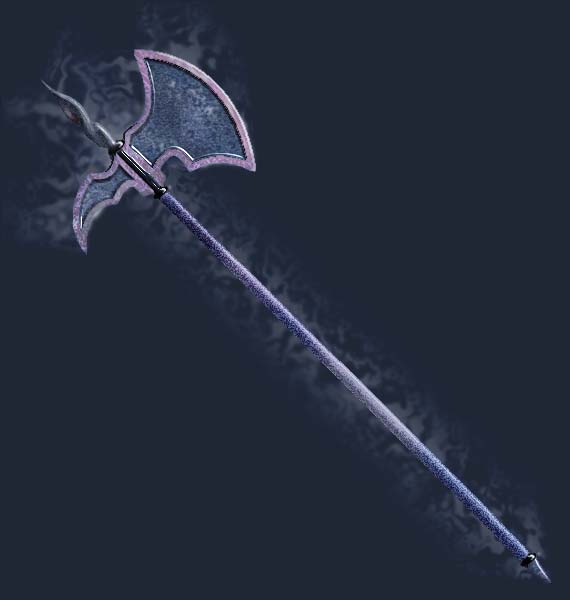
The name of the assassin, according to Njals Saga (the greatest of all the Icelandic sagas), was Þorgrímur Austmaður, and it is his only appearance in the saga. After his famous line, he collapsed in his own blood. Shown below is a halberd:

A Halberd

A Halberd

When gutted by a spear in the Gisla Saga (a.k.a. Gisli Sursson’s Saga), Véstein Vésteinsson cried out, “Bullseye!” (Mighty sporting of him, that!)

Then, in my second favorite saga, Grettir’s Saga, Átli Asmundarson cries out when hit by a broad spear: “Ah! It seems that broad spears have become fashionable.”

Finally, there is poor Þormóður Kolbrúnarskáld in The Saga of the Confederates who is all but disemboweled. Looking at his guts lying on the ground, he exclaims, “The king has fed us well!”

Now there are many reasons to love the sagas, and there is far more than gory violence and unbelievable sangfroid to be encountered in them (though it is by no means absent). I have read all the sagas from which Jóhannes quotes, most of them more than once, and keep finding myself sucked in by a frontier society that strives to arrive at some sort of balance in the absence of a king or any effective hierarchical government.

All the early Icelanders had to rely on was themselves, with the occasional help of some of the more prosperous families who offered their services as intermediaries in the disputes that inevitably arose.

In many ways, it was very much like our own Wild West.

The Last Time I Saw Hvolsvöllur

The Mountains Around the Markarfljót Valley

The Mountains Around the Markarfljót Valley

It was around the end of my 2001 trip to Iceland, one of the first days in the month of September. I was sitting around in my Reykjavík guesthouse paging through my Lonely Planet guide when I decided to check out the Saga Center in Hvolsvöllur. I walked over to the BSÍ bus station on Vatnsmýrarvegur and hopped on a bus to Hvolsvöllur, which is about an hour or two east of the capital.

It was before lunchtime, so I decided to walk around the town—really, it was just a village. I ook a wide loop around the area, seeing Icelandic schoolchildren in uniform being taken for a walk on this uncommonly nice fall day (fall starts early on the island that is Ísland). I saw a couple of pizza places, which looked interesting because for some reason Iceland makes really good pizza. (Good bread, good cheese—that’s more than half the battle.) In the end, I settled in at the gas station named after one of my literary heroes—Hliðarendi—and has a sandwich stuffed with hangikjöt, a tasty lunchmeat made with lamb..

Gunnar Hamundarson of Hliðarendi was one of the heroes of Njals Saga, that greatest of the medieval sagas. Outlawed by the AlÞing, he left his home in the Markarfljót Valley, but made the mistake of taking a look back. At once, he made the decision not to leave, because it the sight was so breathtakingly beautiful. He paid for this decision with his life.

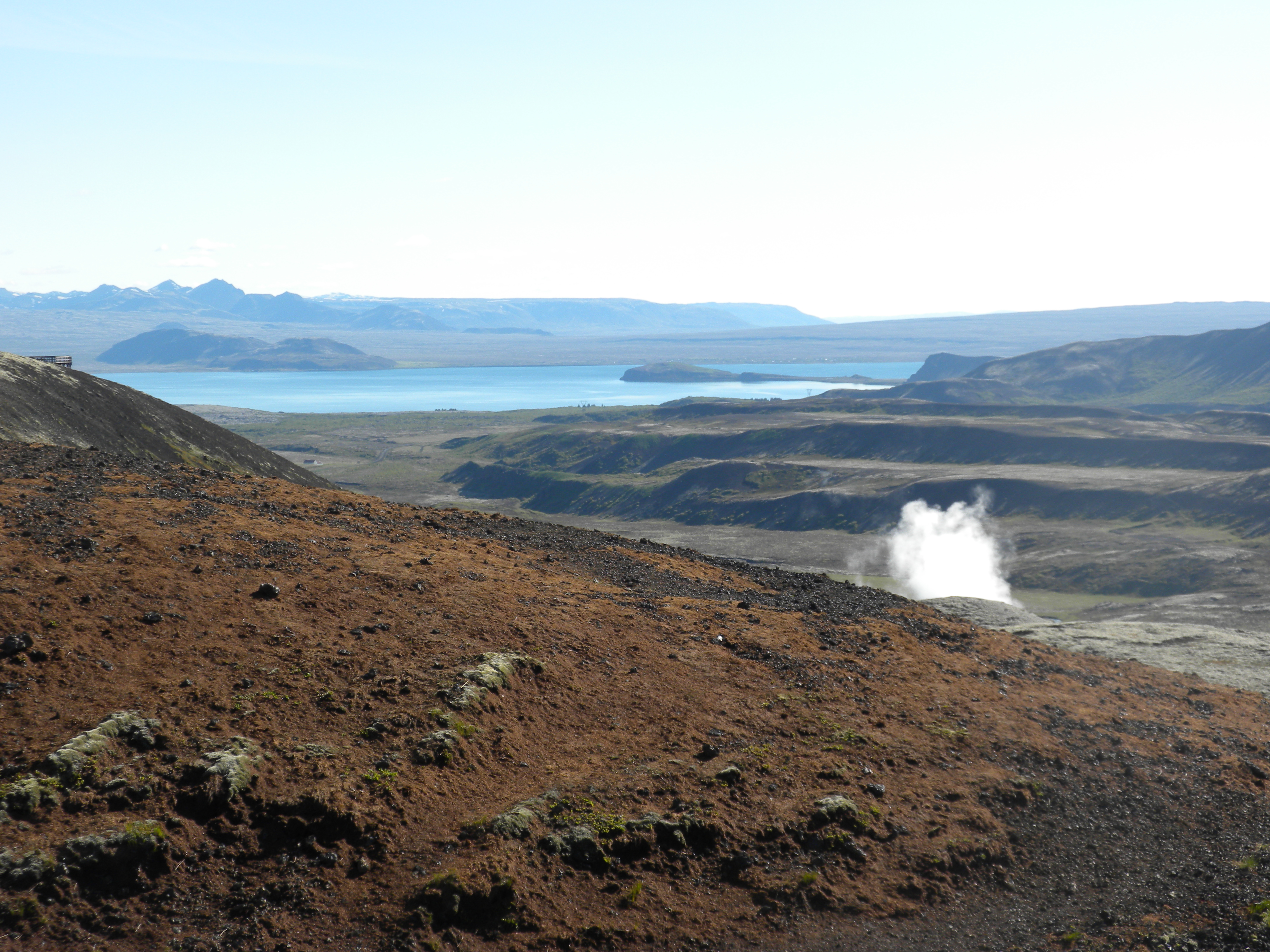
Another View of the Area Around Hvolsvöllur

Another View of the Area Around Hvolsvöllur

The Saga Center in Hvolsvöllur was well worth visiting. It is, insofar as I know, one of only two museums in the world dedicated to a single work of literature, in this case Njals Saga. (The other one is in Borgarnes and is dedicated to Egil’s Saga.) The Saga Center was clearly a labor of love. I spent a couple of hours talking to a beautiful young Icelandic blonde who worked there. She was a very sweet lady who was suffering from some strange stomach ailment. I wonder whether she still works there.

That evening, I picked up my tattered Penguin paperback edition of Njals Saga and started re-reading it. In June, I will read it a third time. Why not? It is one of the greatest works to come out of the Middle Ages. I kept re-reading it until my plane landed in Los Angeles.

White Heroes and Dark Heroes

Egil Skallagrimsson (d. A.D. 990)

Egil Skallagrimsson (d. A.D. 990)

As my need to escape the horrors of tax season grows apace, I am increasingly burying myself in the world of medieval Icelandic sagas. A few days ago, one of my favorite writers for The Iceland Review, Jóhannes Benediktsson, wrote the following in the “Daily Life” column:

I was taught in junior college, that there were two types of heroes in the Icelandic Sagas: White heroes and dark heroes. Mickey Mouse is an example of a white hero. Donald Duck is very dark.

In Njáls Saga, we have a good example of a white hero: Gunnar of Hlíðarendi.

Gunnar is described as being close to perfect. He’s exceptionally athletic and breathtakingly good looking. He’s an honorable man and very popular. Seemingly to me, he has only one flaw: He’s a bit shallow—a common trait found in people that go through life without experiencing any real adversity.

Skarphéðinn Njálsson is a dark hero from Njáls Saga. Like Gunnar, he’s very strong. But his appearance is not as light. His mood is heavy and he often grins when he hears about warfare that may be brewing.

Another good example of a dark hero is Egill Skallagrímsson, from The Saga of Egill. He’s described as being very ugly, but stronger than most men. He’s greedy and can be unfair. Some of his most heroic moments happened when he was the sole witness.  I think that is no coincidence.

These guys are not flawless. They are very complicated and have some serious issues. I have no idea what they’ll do next, and that makes me very excited.

Last night I just finished reading what Jóhannes calls The Saga of Egill, and which British and American publishers call Egil’s Saga. Over a space of about 250 pages, we see him carrying on a brutal war of vengeance against everyone he feels done him wrong, including two Norwegian kings, Harald Fine-Hair and Eirik Blood-Axe.

At the same time he was a redoubtable warrior, Egil Skallagrimsson was also a poet of some distinction, and he went back and forth between composing poems and planting axes in the heads and bodies of his enemies.

Jesse L. Byock, perhaps one of the world’s greatest scholars of Icelandic history during the saga era, wrote an article for The Scientific American in January 1995 about his personal search for Egil’s bones. It appears that Egil may have suffered from an ailment known as Paget’s disease, which may be partly responsible for his fearsome appearance. If you’re interested in the sagas, you should read Byock’s article. And, while you’re at it, you may want to hunt up a copy of his book Viking Age Iceland.

Saga Fiend

Page from One of the Icelandic Sagas

Page from One of the Icelandic Sagas

I am still contemplating going to Iceland this summer—though it may be without Martine. The poor girl has been suffering from what I think is fibromyalgia, which combines roving muscular pain in different parts of the back with the inability to get a good night’s sleep. She is currently undergoing physical therapy, which I hope moderates the symptoms, which have destroyed the last two months for her.

If Martine can come with me, we will concentrate on Southern Iceland. I will rent a car, and we will do all the sights along the southern rim of the island, from the “Golden Circle” of Thingvellir, Gullfoss, and Geysir (yes it’s a place) to the black sands of Breidamerkursandur and Skaftafell National Park. If I go alone, I will concentrate on the remote Westfjords, where I will do some serious bird-watching and hiking—and reading.

I have already loaded a collection of Icelandic sagas on my Kindle and have begun reading more of the same. So far within the last week, I have read Kormak’s Saga and The Saga of Hallfred Troublesome-Poet; I hope to re-read Egil’s Saga (which is one of the best) within the next couple of weeks.

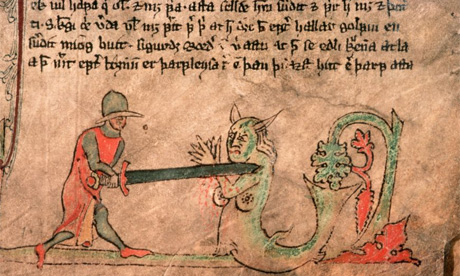
Most of the Icelandic sagas were written in the Thirteenth Century and look back to the early days of settlement ranging from the 9th century to the introduction of Christianity around A.D. 1000 at the behest of King Olaf Tryggvason of Norway. In a way, it can be compared to the Western films that, until recently, have been made in the United States. Except for one thing: Many of the characters in the Icelandic sagas were actual people whose descendants are alive today. Many of the events, however, were quite fanciful, such as the one illustrated above in one of the old manuscripts.

In Reykjavik, I will visit the Arni Magnusson Institute for Icelandic Studies, which has an ongoing exhibit of Icelandic saga manuscripts. It was closed the last time I was in Reykjavik in 2001.

Just to show you how serious the Icelanders are about their literature, there are two museums in the country of 300,000 inhabitants dedicated to individual sagas: The Settlement Center in Borgarnes (with its permanent exhibition on Egil’s Saga) and The Icelandic Saga Center (about Njal’s Saga) at Hvolsvollur. In our nation of some 300 million inhabitants, do we have any museums dedicated to any single works of American literature?