Two Women Alone in the Wild

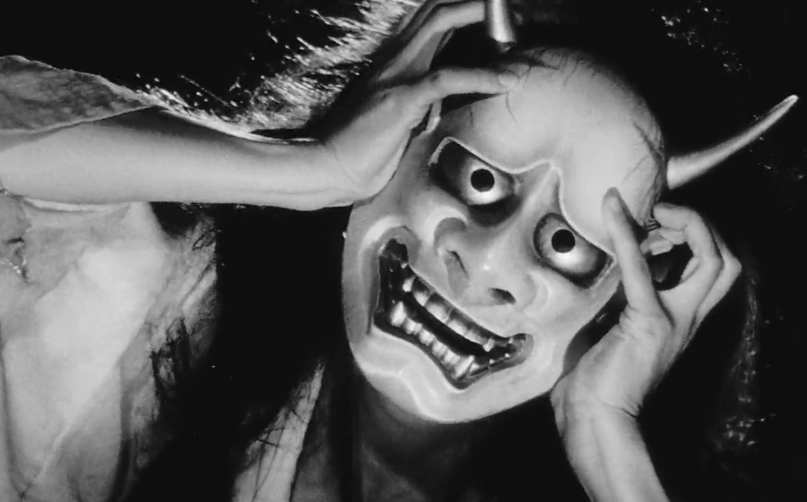
Woman Wearing Demon Mask in Onibaba

Both films begin with the same situation. In Medieval Japan, there is civil war. Men are pressed into one of the competing armies, leaving behind a mother and wife in a hut. The situation is dangerous, what with deserters and roving bands of masterless samurai. And the same actress appears in both films, Nobuku Otawa, who also happened to be the director’s wife.

The two films are Onibaba (1964) and Kuroneko (1968), both by the same director—Kaneto Shindo— and both produced by the Toho Studio. In the former film, the hut is located in a sea of tall reeds; in Kuroneko, in a bamboo forest.

In the 1960s, I believe that the best films produced anywhere in the world were made by a handful of Japanese film studios: Toho, Daiei, Schochiku, Nikkatsu, and Tohei. Although Hollywood pioneered wide-screen films, it was the Japanese who mastered the medium, whether in black and white or in color.
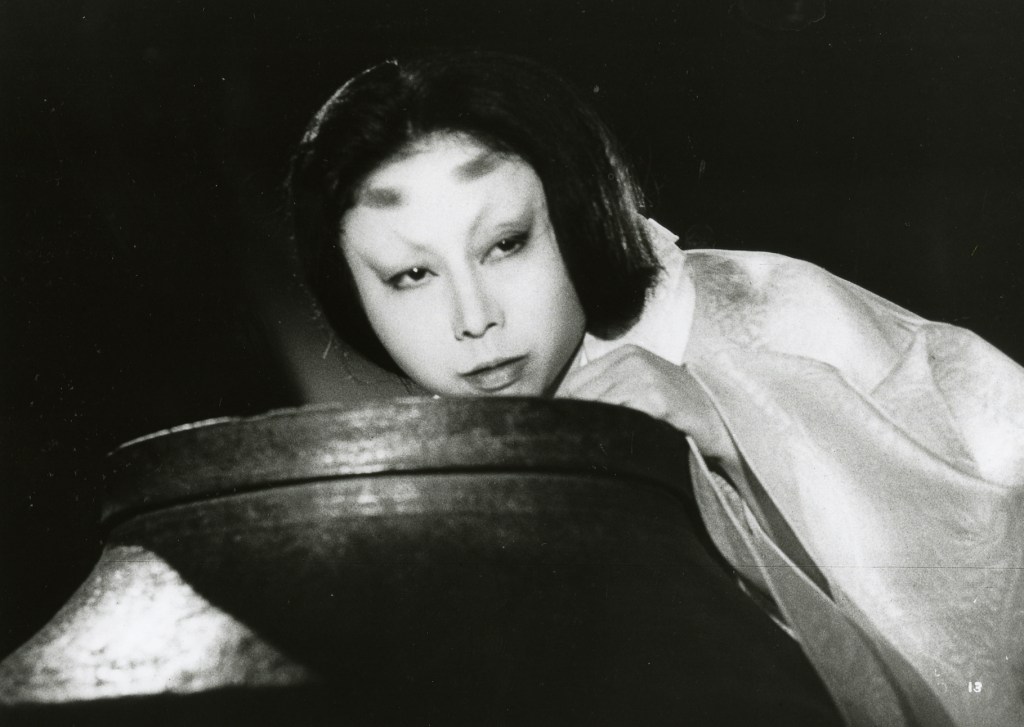
Nobuku Otawa in Shindo’s Kuroneko

Last night I stayed up late watching Onibaba and Kuroneko on the Turner Classic Movies (TCM) channel.

Onibaba is the better of the two films. The tall grass becomes a character in the film, much like the sand dunes in Hiroshi Teshigahara’s Woman in the Dunes (1964). When the daughter runs through the tall grass to tryst with her lover, the viewer feels that anything can happen. And it does: A demon appears in her path blocking the way.

Both films are available from the Criterion Collection.

Jidaigeki

Posters for The Seven Samurai (1954) and Harakiri (1962)

When I first came to Los Angeles in 1967, it didn’t take long for me to fall in love with everything Japanese. That included Japanese films, Japanese food, Japanese literature, and Japanese women. My first long RTD (Rapid Transit District) ride was on the old #83 Wilshire Boulevard route from West L.A. to La Brea Boulevard, where the Toho LaBrea theater was located a couple blocks south. I even remember the film: It was Part One of Hiroshi Inagaki’s Samurai trilogy.

Here I was, a Hungarian kid from Cleveland, finding a kind of home in the Japanese community of L.A. I even moved to Mississippi Avenue in the Sawtelle Japanese district, where there were two Japanese restaurants, the O-Sho and the Futaba Café. They were my first introduction to the cuisine. I was pretty raw at the time: When I had my first cubes of tofu in miso soup, I thought, “I’ll bet these are cut-up shark fins!”

I used to hate seafood. I thought the fish there was picked up from floating debris atop polluted Lake Erie. Now on my own in Southern California, I found myself trying (and loving) sushi after five short years.

What I loved most, however, were Japanese jidaigeki (period films), particularly those set in the samurai era. My friends Alain Silver and Jim Ursini (who collaborated on the first book on samurai films to be published in the U.S.) and I would regularly go to one of the five Japanese movie theaters then existing in Los Angeles:

  • The Toho LaBrea screened films from the Toho Studio
  • The Kokusai and Sho Tokyo theaters played Daiei films—probably my favorite
  • The Kabuki played films from Shochiku
  • The Linda Lea (my least favorite) played films from Tohei

They are all gone now. It’s all part of the growing Americanization of Japanese-Americans.

The Kokusai Theater on Crenshaw South of Adams

In fact, Alain, Jim, an I wrote a column for the UCLA Daily Bruin called “The Exotic Filmgoer.” The articles were all signed Tarnmoor (which, curiously, is the name I go under for this blog). We wrote about the Japanese and other ethnic cinemas that existed back around 1970.

I still love jidaigeki, though they’re not usually to be found around town playing in movie theaters. I have a large collection of DVDs of samurai films, and watch the Japanese films on the Turner Classic Movies (TCM) channel when they are playing.

And I still love Japanese food, though sushi is getting to be priced beyond my means.

Samurai Swordplay

A few days ago, I promised to list my favorite Japanese samurai films. Here I present the annotated list in alphabetical order by eight directors, with my favorite samurai film for each director:

  • Hideo Gosha: Goyokin (1969) See also his early Three Outlaw Samurai (1964) and Sword of the Beast (1965).
  • Kazuo Ikehiro: Trail of Traps (1967). My favorite of the Kyoshiro Nemuri films starring Raizo Ichikawa.
  • Hiroshi Inagaki: Samurai Trilogy, comprising Musashi Miyamoto (1954), The Duel at Ichijoji Temple (1955), and Duel on Ganryu Island (1956).
  • Masaki Kobayashi: Harakiri (1962) starring the great Tatsuya Nakadai.
  • Akira Kurosawa: The Seven Samurai (1954), just one of over a dozen great chambara epics usually starring Toshiro Mifune.
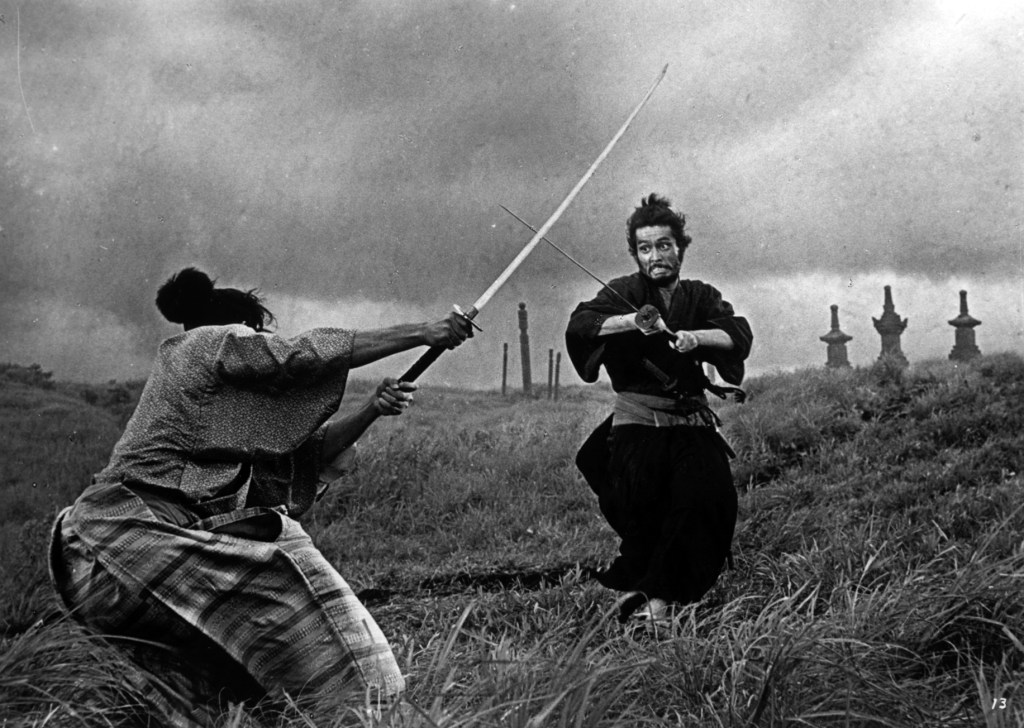
  • Kenji Misumi: Lone Wolf and Cub: Sword of Vengeance (1972). Weird and entertaining.
  • Kihachi Okamoto: Sword of Doom (1965), another great Nakadai role.
  • Kimiyoshi Yasuda: Zatoichi’s Fire Festival (1970), one of a score of films starring Shintaro Katsu as a blind samurai warrior. Very funny.

After the 1970s, the studio system that supported the great Japanese films of the postwar period collapsed because the studios made more money selling their studio space in a real estate bubble than they ever did making movies. There’s a lesson to be learned there.

Ronin

It is without a doubt one of the most incredible shots in the history of the cinema. And yet it was the work of a director, Hideo Gosha, on his first motion picture, Three Outlaw Samurai (1964). Picture to yourself a peasant who with two of his friends kidnapped the daughter of a corrupt local magistrate as part of a protest against his cruel administration. Instead of keeping his promises, this magistrate sends thugs to kill him. As he lies bleeding with his back slashed by a sword, we cut to a closeup up the peasant, dying, looking with wide-eyed wonder at a lone wildflower growing in front of his face.

In the 1950s and 1960s, the Japanese cinema was at its height, one of the most fascinating in the world. The best of their films were in a genre known as jidaigeki, historical pictures set mostly during the Tokugawa Shogunate between 1603 and 1868. Starring most prominently were samurai, particularly masterless or outlaw samurai called ronin. Other films in the genre portrayed gangsters (yakuza), merchants, even peasants.

I had seen Three Outlaw Samurai at least twice before, but this time the film’s pessimism struck home. Aiding the peasants in their protest are three ronin who, one by one, come together. They are unable, however, to help the peasants win. After the three who kidnapped the magistrate’s daughter are killed, the other peasants in the surrounding villages are afraid to present their protest to a wondering clan chief who is due to visit in a few days. It is because of this visit that the magistrate hires waves of goons to attack not only the protestors, but previous goons who are asking for too much money.

The bloodshed is considerable. The three ronin kill at least a hundred of the magistrate’s men, who in turn kill large numbers of peasants. At the end, the three ronin decide to travel together in a direction selected by chance.

Ever since I first fell in love with movies as a student at Dartmouth, I have loved the fast action of chambara (“sword fight”) films. But, like the best Westerns, these “Easterns” can attain the status of high art. In a future post, I will list my favorite samurai films.

Lone Wolf and Cub

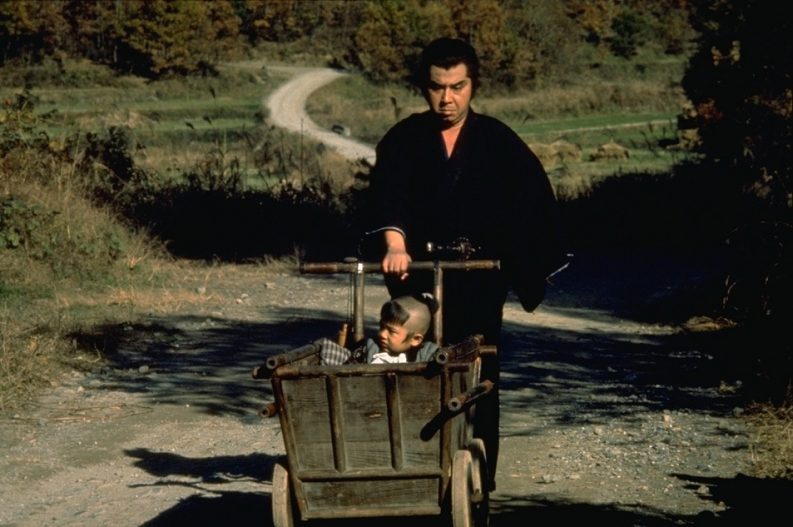
Former Executioner Ogami Itto with Son Daigoro

I have always loved Japanese samurai films. Now, during my quarantine, I have been checking out some of the more marginal samurai series. As of today, I have seen all six of the Lone Wolf and Cub films starring Tomisaburo Wakayama and produced by the Toho studio in the early 1970s. These films include:

  • Lone Wolf and Cub: Sword of Vengeance (1972), dir: Kenji Misumi
  • Lone Wolf and Cub: Baby Cart at the River Styx (1972), dir: Kenji Misumi
  • Lone Wolf and Cub: Baby Cart to Hades (1972), dir: Kenji Misumi
  • Lone Wolf and Cub: Baby Cart in Peril (1972), dir: Buichi Saito
  • Lone Wolf and Cub: Baby Cart in the Land of Demons (1973), dir: Kenji Misumi
  • Lone Wolf and Cub: White Heaven in Hell (1974), dir: Yoshiyuki Kuroda

In all six films, Ogami Itto is pushing a wooden baby carriage which comes complete with an impressive series of armaments, including an early precursor of the Gatling Gun (?!). In White Heaven in Hell, it even turns into a toboggan, enabling Ogami to escape hundreds of attacking members of the Ura-Yagyu clan mounted on skis.

The body count in all six films easily exceeds a thousand, as the combination of Ogami’s swordsmanship and the rapid-fire machine gun built into the baby carriage wreaks havoc on his enemies.

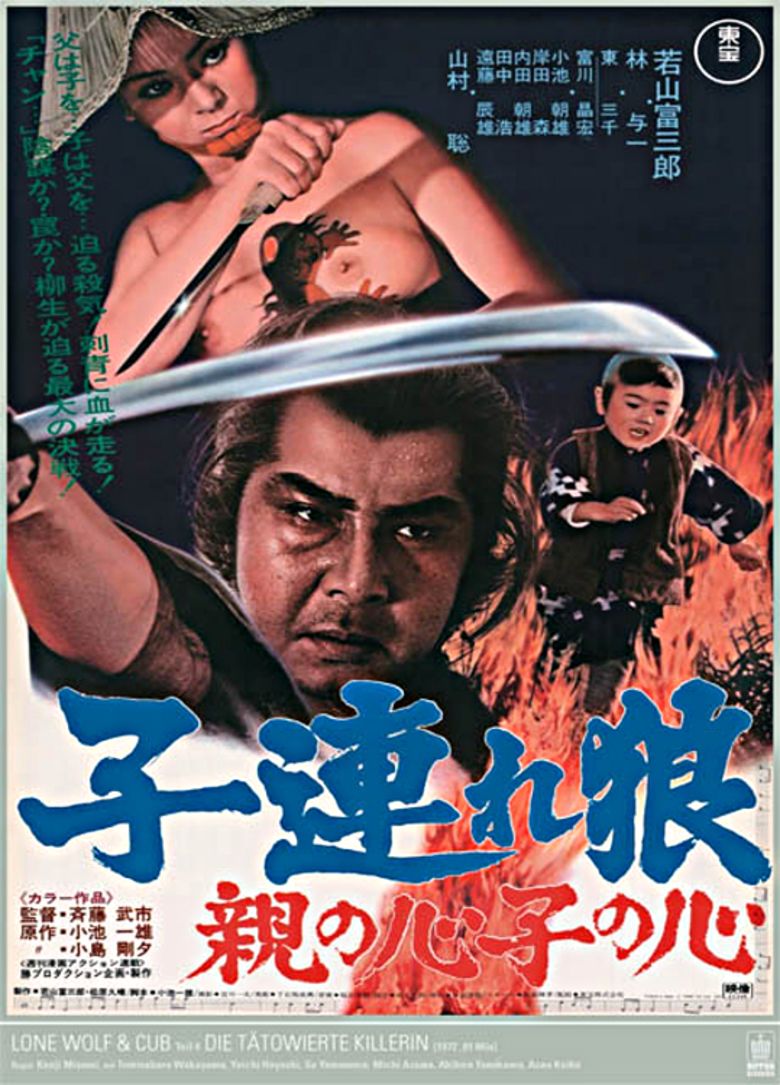
Film Poster for Lone Wolf: Baby Cart in Peril

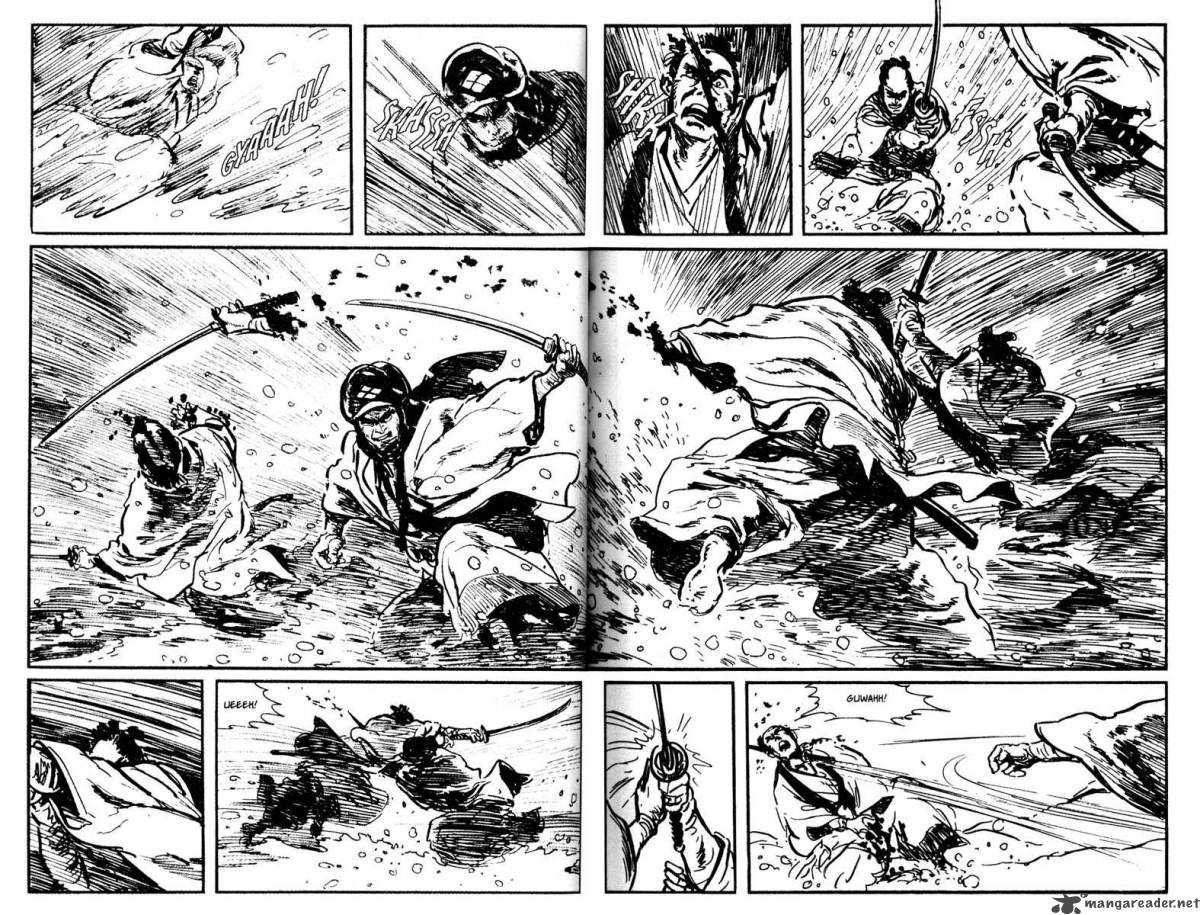
Obviously the source for the films comes from Japanese comic books known as manga. Below is a panel from one of the comics:

A Feeling for the Manga Source of the Films

Although there is no real dedication to realism or even plausibility in either the films or the comic books, the films are all well-crafted Toho Studio productions and immensely entertaining. There is some minor nudity in the films and a great deal of violence.


Musashi and the Flies

You Don’t Have to Draw a Sword to Prove Your Swordsmanship

I had forgotten the movie in which this scene took place until I viewed the DVD this morning. The great masterless samurai, Musashi Miyamoto (played by the redoubtable Toshiro Mifune), is holed up in a cheap inn in which a loud group of gamblers was partying. When Musashi’s disciple, Jotaro, goes out and tells them to shut up, they decide to teach Musashi a lesson. They charge up he stairs to his room, where Musashi is calmly eating a dish of noodles with his chopsticks. He is not much bothered by the gamblers, but he is irritated by the flies buzzing around him and his meal. Without sparing a glance elsewhere, he reaches out with his chopsticks and kills several flies, one after the other. The gamblers are awestruck at Musashi’s demonstration of icy control and quietly back out of his room. In fact, their ringleader, Kumogoro, insists on becoming Musashi’s disciple.

The film is Duel at Ganryu Island (1956), the third film in Hiroshi Inagaki’s Samurai trilogy.

Although the Inagaki trilogy is by no means the greatest of samurai films, I have so many happy memories of seeing the films that I have invested them with perhaps more merit than they deserve. They are, in fact, quite good—particularly at influencing a 21-year-old who had just arrived in Los Angeles and found the whole genre congenial to him.

Samurai Swords

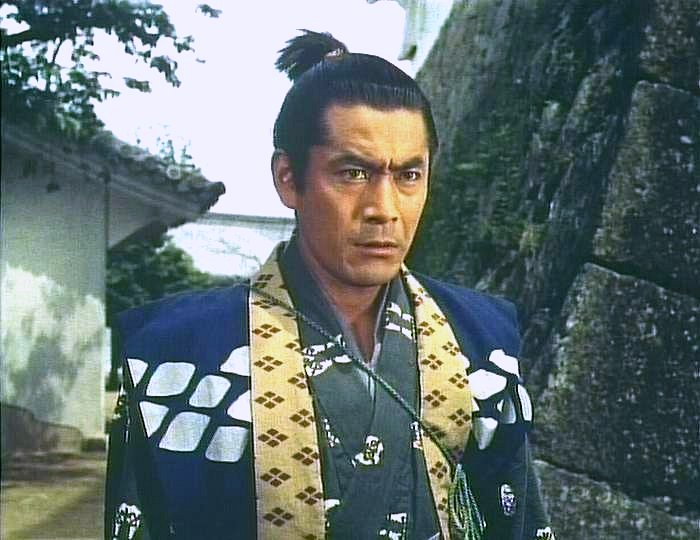
Toshiro Mifune as Musashi Miyamoto

The above scene is an evocative moment in Musashi Miyamoto (1954), the first film in Hiroshi Inagaki’s Samurai trilogy. Musashi, heretofore called Takezo, has been imprisoned in Himeji Castle by the wily (and wise) Buddhist priest Takuan for three years. He has just stepped out of the castle for the first time and takes a look back at the walls that held him while he learned to tame his wild impulses.

I first saw Inagaki’s trilogy at a seminal point in my life. I had just moved to Los Angeles to start studying film history and criticism at UCLA. Before my classes  began in January 1967, the Toho La Brea theater began screening Musashi Miyamoto. In the following months, Duel at Ichijoji Temple (1955) and Duel on Ganryu Island (1956)—the remaining films of the trilogy—were to be shown. Although I had seen many films at Dartmouth College, I was just starting to get into the whole jidai-geki genre.

Also, I fell in love with Kaoru Yachigusa, the perennially frustrated love interest in the trilogy.

In fact, I got so much into it that, in June, I moved to an apartment on Mississippi Avenue, right in the heart of the Sawtelle Japanese-American neighborhood. At that time, there were two Japanese restaurants around the corner, the O-Sho and the Futaba Grill, where I frequently dined, learning how to tame those unruly chopsticks. My ignorance was still pretty much in evidence: I took the squares of tofu in my miso shiru soup to be shark’s fin.

Kaoru Yachigusa as Otsu, the Love Interest in the Trilogy

Before long, I was going with my film friends to all five Japanese movie theaters in Los Angeles: Not only he Toho LaBrea, but the Kabuki (Shochiku Studio) and Kokusai (Daiei Studio) near Adams and Crenshaw, and the Sho Tokyo (Daiei Studio) and Linda Lea (Tohei Studio). Now all five theaters are gone, but back then, I collaborated with two of my friends (Alain Silver and Jim Ursini) in a column for The UCLA Daily Bruin entitled “The Exotic Filmgoer,” which commemorated not only the Japanese theaters, but some of he others. We wrote under the collective pseudonym of Tarnmoor.

The Criterion Collection has released DVD and Blue-Ray editions of the Samurai trilogy, which are well worth your while.

The Black Finger Cult

Indulging in Past Favorites

Indulging in Past Favorites

Not two weeks ago, I wrote a post about one of my favorite Japanese actors, Raizo Ichikawa, particularly as he appeared in a 1960s series called variouslythe Kyoshiro Nemuri films and “The Sleepy Eyes of Death.” Since then, I checked out eBay and found that the whole series of twelve films was available for just over a hundred dollars in Zone 1 DVD format. Naturally, I wasted little time in buying the set.

Tonight, I watched my favorite title, Trail of Traps (1967) directed by the underrated Kazuo Ikehiro. I sat entranced as Kyoshiro walked his way between Tokyo (called Edo in those days) and Kyoto, carrying a statue of the Virgin Mary for safekeeping. Along the way, he is seduced several times—Kyoshiro is, after all, an anti-hero—and attacked by a group of devil worshiping baddies who call themselves the Black Finger Cult.

It’s nice to feel the same way after almost half a century about a film one loved to distraction back in the day. Raizo Ichikawa was indeed an excellent actor, and the Daiei Studio people did a great job putting the series together.

Too bad Raizo had to die so young. I think he was even more promising than James Dean.


Favorite Actors: Raizo Ichikawa

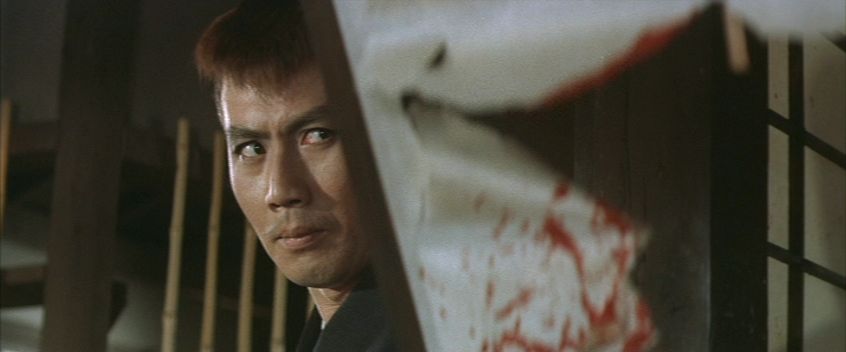
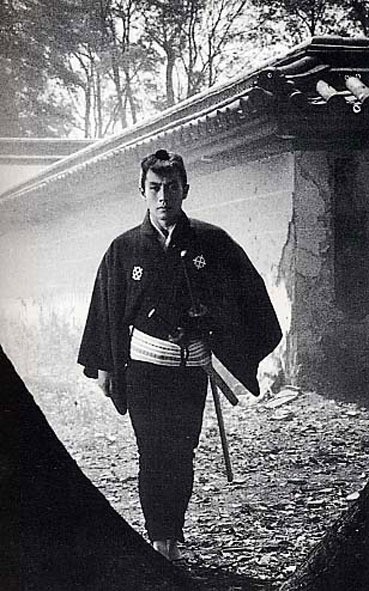
Raizo Ichikawa in His Role of Kyoshiro Nemuri

Raizo Ichikawa in His Role of Kyoshiro Nemuri

The most famous Japanese actors appearing in samurai pictures are Toshiro Mifune and Tatsuya Nakadai. There is also a third name, far less familiar to American audiences: I am thinking of the late Raizo Ichikawa (1931-1969), star of jidai-geki productions from the Daiei Studio.

My favorite character he played was that of Kyoshiro Nemuri, a.k.a. “The Sleepy Eyes of Death,” a Japanese born of a Christian father during a black mass, He is also referred to as a Son of the Black Mass. In his films, he regards the Christians baptized by the Portuguese as hypocrites.

His signature sword move was the Half-Moon Cut, against which his opponents were all but powerless. Note the strange cross symbol on his costume.

Raizo as Kyoshiro Nemuri

Raizo as Kyoshiro Nemuri

Now that I am semi-retired, I would like to pick up as many of the Kyosiro Nemuri films as I can find. It wouldn’t be too difficult, but I would definitely need English subtitles.

During the 1960s and 1970s when I went downtown with friends to the Sho Tokyo and Kokusai theaters (which played nothing but Daiei films) on an almost weekly basis, I always considered myself lucky to see Ichikawa in any role, but especially as Kyoshiro Nemuri. The directors of the series included such names as Kazuo Ikehiro (the best), Kenji Misumi, and Issei Mori.

Unfortunately, Daiei and most of the other Japanese studios disappeared during the obscene run-up in real estate values from 1986 to 1991. More’s the pity. During the 1960s, I believe that the best films that were being made anywhere were the Japanese samurai pictures. And Raizo Ichikawa was, to my mind, the best of the actors.