His poems are written in a difficult-to-read Scottish Lowland dialect, but somehow the intensity shines through. Here the poet expresses his disdain for the horrors of a Scottish winter, ending with a comic proposal to the deity.
Winter: A Dirge
The wintry west extends his blast, And hail and rain does blaw; Or, the stormy north sends driving forth The blinding sleet and snaw: While tumbling brown, the burn comes down, And roars frae bank to brae; And bird and beast in covert rest, And pass the heartless day.
The sweeping blast, the sky o’ercast, The joyless winter-day, Let others fear, to me more dear Than all the pride of May: The tempest’s howl, it soothes my soul, My griefs it seems to join; The leafless trees my fancy please, Their fate resembles mine!
Thou Pow’r Supreme, whose mighty scheme These woes of mine fulfil, Here, firm, I rest, they must be best, Because they are Thy will! Then all I want (O, do Thou grant This one request of mine!) Since to enjoy Thou dost deny, Assist me to resign.
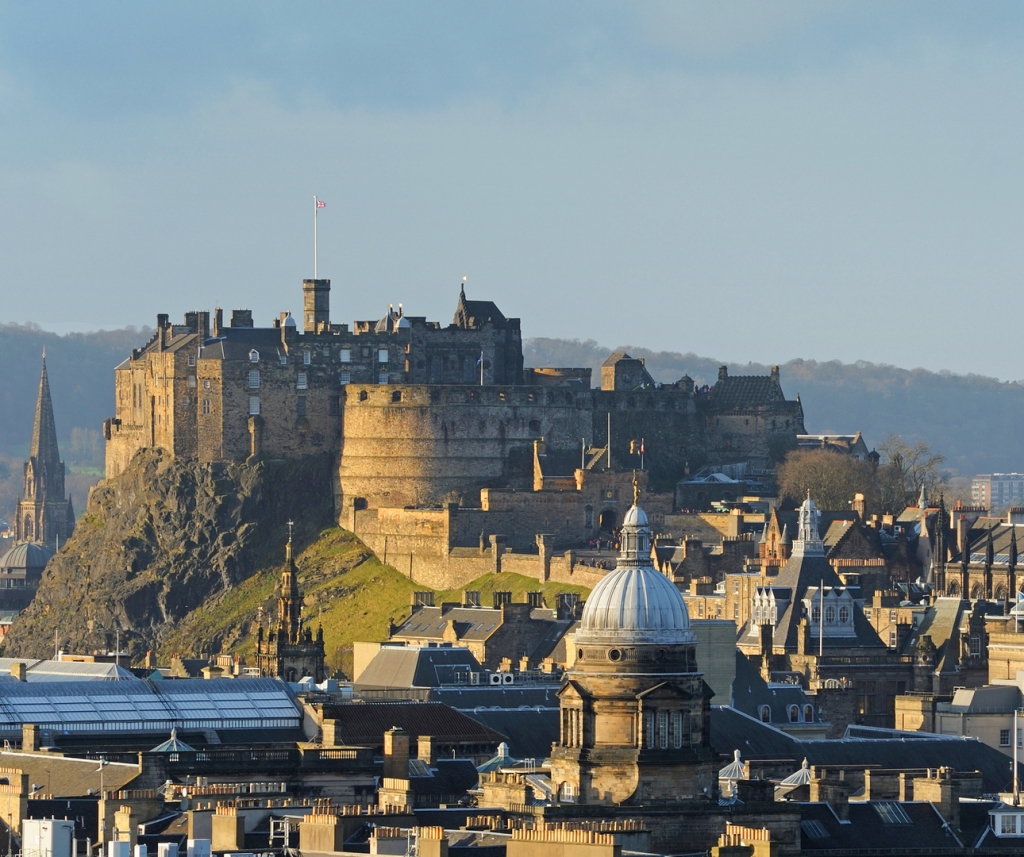
If you want to see the most concentrated real estate in all of tourism, I recommend the Royal Mile in Edinburgh, Scotland. At one end is Edinburgh Castle. One passes historic pubs and fascinating museums, the towering hulk of St. Giles Cathedral in the center, and ending at Holyroodhouse Palace, from where Mary Queen of Scots ruled.
In my visits to Britain, I have always preferred Scotland to England. The food is better, the history more poignant, and the people more friendly. And then there’s the whisky, which can be ethereal. (In one of my boxes of photos is an image of Martine hugging the distillery at Bowmore on Islay.)
I particularly love the Highlands and Islands. My travels north of Edinburgh have included Stirling, Perth, Oban, Loch Ness, Inverness, and the isles of Iona, Mull, Islay, and the Orkney Mainland.
One can’t walk up to Stonehenge and look at it up close, but one can walk up to the Standing Stones of Stenness and the Ring of Brodgar.
As I sit here in Los Angeles during yet another overlong heat wave, I dream of re-visiting some of the places in Scotland Martine and I have seen and having a good meal of haggis and neaps washed down with a wee drappit of Scotch.
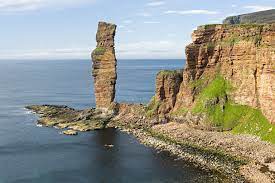
Just off the Northern tip of Scotland lie the Orkney Islands. You could get there by flying to Kirkwall (when the weather permits), or taking the P & O Ferry St. Ola from Scrabster, just west of Thurso. I have been to Orkney twice, both times crossing the stormy seas of Pentland Firth with my stomach not overly sure of its correct position. The second time was with Martine, who took so much Dramamine that I had trouble shaking her awake to see the Old Man of Hoy as we sailed passed it.
My mind is turning once again to those stormy islands as I read a newspaper column penned by the late George Mackay Brown for The Orcadian between 1979 and 1991. I have loved Brown’s prose and poetry ever since I met him on my first visit to the islands, in September 1976.
The Old Man of Hoy
By the time the St. Ola docked in Stromness, the port where George Mackay Brown lived and called by its Norse name, Hamnavoe, the weather was so bad that Martine thought I had brought her to some Arctic hell. The weather moderated—somewhat. But we had a wonderful time viewing the sights, including the Viking Cathedral of St. Magnus in Kirkwall, the Standing Stones of Stenness, the Ring of Brodgar (which is the new header image for my post), the Neolithic burial chamber at Maes Howe (with runic Viking graffiti), and the stone age village of Skara Brae, once buried by the sands of the North Atlantic.
Places like Orkney, Iceland, Tierra del Fuego in South America, and the deserts of the American Southwest fascinate me. Most Americans would opt for sun, sea, and cocktails as the perfect vacation. Not me!
For many years, Scottish writer and poet George Mackay Brown wrote a column for the local newspaper of the Orkney Islands, The Orcadian. The following column from his collection Rockpools and Daffodils: An Orcadian Diary 1979-1991. describes a once-in-a-generation thunderstorm:
I think we have never had a thunderstorm like it this generation in Orkney.
We had almost forgotten what a thunderstorm was. A few warnings lingered in the memory. ‘Cover the mirrors’ … ‘Don’t take shelter under a tree’ … Someone had said to us as children, ‘The lightning won’t strike if you wear rubber boots.’ … (Old wives’ mutterings beside the fire, half-forgotten.)
I suppose we ought to have been prepared for thunder—day after day of sunshine, a still brooding loaded atmosphere, no rain for weeks.
We were so thankful for early tokens of a good summer, no-one was complaining.
It came with dramatic suddenness, between breakfast and lunch. The darkening sky, the first vfew rain-drops heavy as coins, a low growl across the sky (as if Thor wasn’t in the sweetest of tempers). But Thor, in the last two or three decades, has occasionally given a growl or two on a summer day, and turned over to sleep again.
Thor the Thunderer had urgent things to do today, it soon became obvious. He had business on his hands. His mighty hammer thudded on the hills, amid flashings.
The clouds were torn apart. Black bags of water, they emptied themselves upon the town. The gardens, at least, must have loved it, after the long drought. One could sense the roots gorging themselves.
The stones of Stromness [Brown’s home town] could do nothing with the sudden weight of water. The gutters gushed and spluttered. Down the Distillery close came a river of water, and swung south. The lightning was mostly vivid blinks, followed at once by peal upon peal. Hundreds of tons of coal were being shifted along the horizon. There was a mighty furniture removal in the sky: grand pianos and huge Victorian sideboards. And sometimes it was as if a cannon had exploded by accident in a close or down a pier, a hideous ripping of hot metal.
The cosmic electricity had quelled the little expensive electricity that man makes. I switched on the light in the eerie darkling room—nothing doing.
A candle responded with a tranquil flame.
A golden fork stabbed down and singed Hoy Sound!
After a time it seemed that Thor had finished his mighty labours for the day. The sky brightened, the thunder grumbled under the horizon.
But Thor must have forgotten some tool in his sky-smithy. Back he came and blew up his forge and struck the anvil a few more mighty blows: while we nervous earthlings below trembled. By early afternoon it was all over. We looked at each other in the cleansed air, we spoke to each other, like folk who had had some wonderful, frightening new experience.
The most incredible street in the British Isles has to be the Edinburgh’s Royal Mile. At one end, it is anchored by the looming hulk of Edinburgh Castle and, at the other, by the Royal Palace of Holyroodhouse. In between lies the whole pageant of Scottish history.
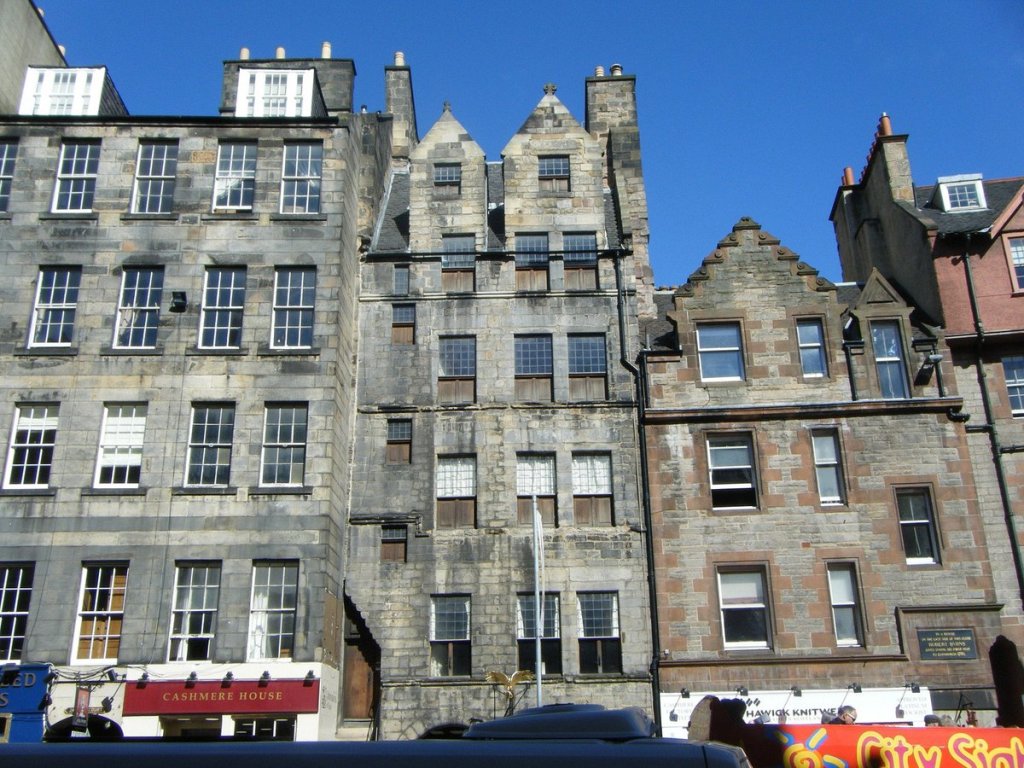
Along the way are St. Giles Cathedral, the High Kirk of Scotland; the tolbooth, or prison, described in Sir Walter Scott’s The Heart of Midlothian (1818); and the house of John Knox. Short dead-end streets known as wynds contain Europe’s first high-rises.
Gladstone’s Land, an Early High Rise Building
England, Wales, and Scotland are all rich in history; but in Scotland there is a particular awareness of history that permeates the culture and literature of the Scots. You find it in the works of Robert Louis Stevenson and the historical novels of Nigel Tranter. You can hardly step out of your hotel without finding yourself in the middle of it.
I’ve been to Edinburgh four times in all dating from 1976, the first two times alone, the second two times with Martine. If I had the money, I would dearly love to go again. There is something about reading one of Scott’s Waverly novels while eating a steaming bowl of cullen skink. And yes, I actually like a plate of haggis and neeps (mashed turnips), probably because haggis tastes like Hungarian liver sausage, or hurka.
The period between Christmas and New Years Day has always been strange. Even among the ancient Mayans, the last five days of the 365-day Haab calendar were called Uayeb, just to fill out the remainder of the year after the 18 months of 20 days each had transpired.
In much of the English-speaking world—but not the United States—today is Boxing Day. It has nothing to do with pugilism and is more a commemoration of certain Victorian practices regarding gifting servants.
It’s also Kwanzaa, a made-up holiday for African-Americans to celebrate their origins and serve as an alternative to that White persons’ holiday known as Christmas.
I was delighted to find a Scottish poem that also celebrates (or debunks) this period. It is “The Daft Days” by Robert Fergusson (1750-1774), written in a broad Scots dialect:
The Daft Days
Now mirk December’s dowie face Glowrs owr the rigs wi sour grimace, While, thro’ his minimum of space, The bleer-ey’d sun, Wi blinkin light and stealing pace, His race doth run.
From naked groves nae birdie sings, To shepherd’s pipe nae hillock rings, The breeze nae od’rous flavour brings From Borean cave, And dwyning nature droops her wings, Wi visage grave.
Mankind but scanty pleasure glean Frae snawy hill or barren plain, Whan winter, ‘midst his nipping train, Wi frozen spear, Sends drift owr a’ his bleak domain, And guides the weir.
Auld Reikie! thou’rt the canty hole, A bield for many caldrife soul, Wha snugly at thine ingle loll, Baith warm and couth, While round they gar the bicker roll To weet their mouth.
When merry Yule-day comes, I trou, You’ll scantlins find a hungry mou; Sma are our cares, our stamacks fou O’ gusty gear, And kickshaws, strangers to our view, Sin fairn-year.
Ye browster wives, now busk ye braw, And fling your sorrows far awa; Then come and gie’s the tither blaw Of reaming ale, Mair precious than the well of Spa, Our hearts to heal.
Then, tho’ at odds wi a’ the warl’, Amang oursels we’ll never quarrel; Tho’ Discord gie a canker’d snarl To spoil our glee, As lang’s there’s pith into the barrel We’ll drink and ‘gree.
Fidlers, your pins in temper fix, And roset weel your fiddle-sticks; But banish vile Italian tricks Frae out your quorum, Not fortes wi pianos mix – Gie’s Tulloch Gorum.
For nought can cheer the heart sae weel As can a canty Highland reel; It even vivifies the heel To skip and dance: Lifeless is he wha canna feel Its influence.
Let mirth abound, let social cheer Invest the dawning of the year; Let blithesome innocence appear To crown our joy; Nor envy wi sarcastic sneer Our bliss destroy.
And thou, great god of Aqua Vitae! Wha sways the empire of this city, When fou we’re sometimes capernoity, Be thou prepar’d To hedge us frae that black banditti, The City Guard.
The following poem is taken from a volume entitled The Wreck of the Archangel. It is from my favorite Scottish poet, George Mackay Brown, whom I met at Stromness on the Orkney Mainland in 1976.
In Memoriam I. K.
That one should leave The Green Wood suddenly
     In the good comrade-time of youth,
     And clothed in the first coat of truth
Set out alone on an uncharted sea:

Who’ll ever know what star
     Summoned him, what mysterious shell
     Locked in his ear that music and that spell,
And what grave ship was waiting for him there?

The greenwood empties soon of leaf and song.
     Truth turns to pain. Our coats grow sere.
     Barren the comings and goings on this shore.
He anchors off The Islands of the Young.
The William Wallace Monument in Stirling, Scotland
Within walking distance of the great fortified mountain that is Stirling Castle sits a monument to William Wallace, Scotland’s great hero and self-taught military genius. It was at Stirling Bridge in 1297 that William Wallace led a force of around 5,500 men, with only 300 cavalry, against 9,000 men, with 2,000 cavalry led by Hugh Cressingham for Edward Longshanks, King of England.
It was Wallace’s unique skill that he knew how to read a battlefield and make the land help him win. It was only when he was forced to fight a typical large scale battle at Falkirk in 1298 that he lost. After that, things went downhill for the Scot, who was betrayed to Edward and executed in 1305 without an actual trial.
Wallace was the son of a knight, who was knighted by Robert the Bruce only after Stirling Bridge. As such, he was looked down upon by the Scottish nobility, many of whom were more comfortable speaking in Norman French than either English or Gaelic. What the nobles were after was not freedom for Scotland, but more power and more wealth for their families. Relative commoners like Wallace didn’t count.
I have just finished reading Nigel Tranter’s historical novel The Wallace, which was likely more accurate than the considerable mythmaking evident in the film Braveheart. I have visited the Wallace monument twice on my travels and was impressed for the monument’s rare tribute to a person not of noble blood—unthinkable in the Middle Ages.
Talk about history: Scotland has had it. Think about how much mythmaking occurred when the Confederacy surrendered at Appomattox Courthouse. Well, Scotland was put through the mill by Perfidious Albion (England) for upwards of a thousand years—and they’re still chafing under the collar.
I am currently reading Nigel Tranter’s The Wallace about William Wallace’s revolt against English rule under Edward Longshanks (alias Edward I Plantagenet). It brings Mel Gibson’s film Braveheart (1995), though it is a much more detailed work about Wallace’s battles at Stirling Bridge (1297) and Falkirk (1298). We get to see in greater detail the treacherousness of the Scottish nobles, who were mostly in it for themselves.
Nigel Tranter (1909-2007)
Over his long career, Nigel Tranter wrote prolifically—not only the historical novels for which he is famous, but a five-volume history of the fortified house (read: castle) in Scotland, children’s books, novels set in the present day, and even Westerns. There is very little of the vast pageant of Scottish history that Tranter did nottouch upon, from St. Columba and Kenneth MacAlpine and MacBeth to the present day.
To date, I have read about a score of his novels, hardly making a dent in his total opus. And not a single one of his books has been a stinker. I regard him as one of the best writers of historical novels who ever lived, and also the most vivid describer of battles throughout history. His description of Wallace’s victory at Stirling Bridge is so vivid that I didn’t feel that I needed a map to follow the action.
I have always loved the prose and poetry of George Mackay Brown, whom I met in 1976 in Stromness on the Orkney Mainland. (They call it the Mainland, even though it’s an island.) I have visited there twice, both times in bad weather, which I think is the only kind of weather prevailing there.
The Finished House
In the finished house a flame is brought to the hearth.
Then a table, between door and window
Where a stranger will eat before the men of the house.
A bed is laid in a secret corner
For the three agonies – love, birth, death –
That are made beautiful with ceremony.
The neighbours come with gifts –
A set of cups, a calendar, some chairs.
A fiddle is hung at the wall.
A girl puts lucky salt in a dish.
The cupboard will have its loaf and bottle, come winter.
On the seventh morning
One spills water of blessing over the threshold.






 Tarnmoor
You must be logged in to post a comment.