In the Shadow of (Male) Genius

French Sculptor Camille Claudel (1864-1943)

The 19th century was not a good time for a female artist of genius to enter the orbit of an older male genius. Can one ever escape that orbit? The above photo was taken of Camille Claudel at the age of nineteen, when she started working in Auguste Rodin’s sculpture studio.

Now there is no doubt that Rodin was one of the greatest sculptors who ever lived. I visited his museum on the Left Bank of the Seine in Paris over twenty years ago. In fact, there was a whole room dedicated to the work of his young protegée.

But she deserved more. Today, I visited the Getty Center, where there was a traveling exhibit of Camille Claudel’s sculpture. Seen by itself, it was nothing short of amazing.
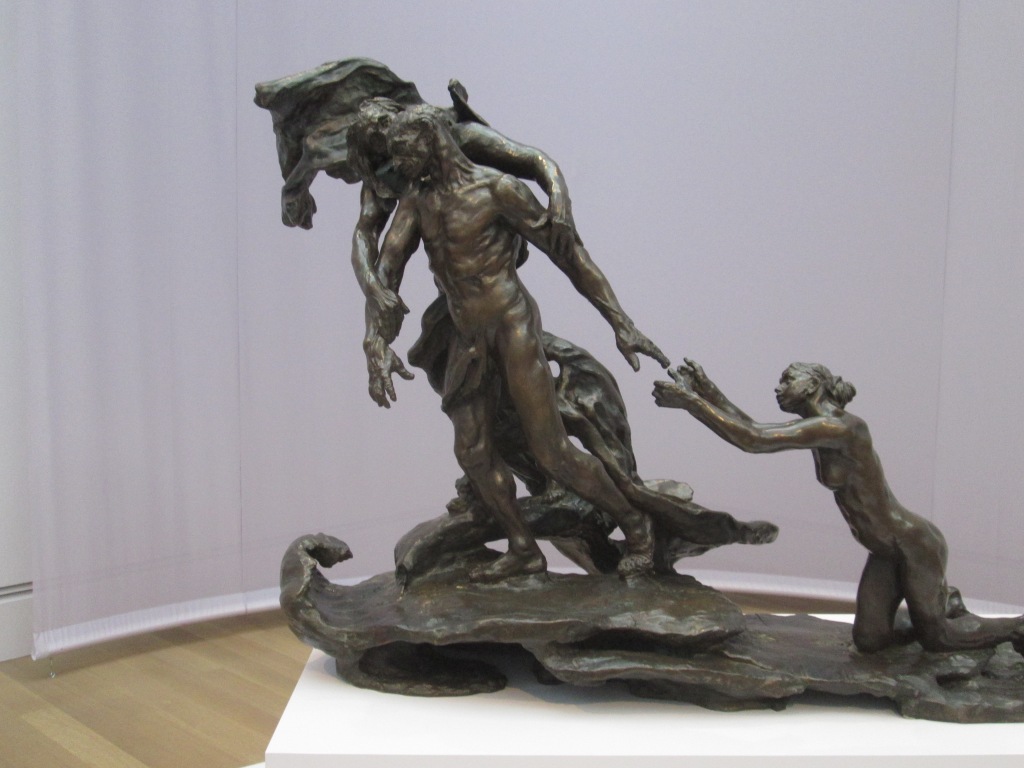
“The Age of Maturity” (1902)

There is something particularly poignant about Claudel’s female nudes. I was particularly struck by the pleading figures such as the nude in “The Age of Maturity” (above). Another impressive nude appears below:

“Wounded Niobid” (1907)

There was also something wounded about poor Camille. Around the time of the above sculpture, she appeared to be suffering from mental illness. In fact, in 1913, her younger brother, the famous French author Paul Claudel, had her committed to an insane asylum, where she lived out the last thirty years of her life. Was she in fact mentally ill? Some say yes and some say no. In any case, it is a tragedy considering what a great artist she was.

In 1988, a film of her life called Camille Claudel was made in France by Bruno Nuytten, starring the lovely Isabelle Adjani as Camille. When I first saw it years ago, that was the first time I had heard of her. Now, with this exhibit at the Getty Center, I think she is one of the all time greatest sculptors whose work I have ever seen.

A Garden in the Desert

Jael Hoffmann’s “Topography of Belief”

No, it’s not a garden of plants, but rather a sculpture garden, right near one of the turnoffs from U.S. 395 to Panamint Springs and Death Valley. It’s off the side of the road on the left as one heads north on the highway. I’ve noticed it several times on my trips to and through the Owens Valley as I passed through the town of Olancha, just south of Lone Pine.

As soon as Martine’s broken wrist heals, I hope to spend a little time studying the metal sculptures of Jael Hoffmann and photographing them. Unlike most modern sculptures, which leave me cold, I find that Jael’s work sets off little explosions in my head. Really great art does that: It makes you a different person than the what you were a few minutes earlier.

There is an excellent video on YouTube in which the artist is interviewed and discusses several of her sculptures—including most especially the one illustrated above. It is called “Internal Scapes,” which is an accurate description of how they affect me.

An Interview with Jael Hoffmann

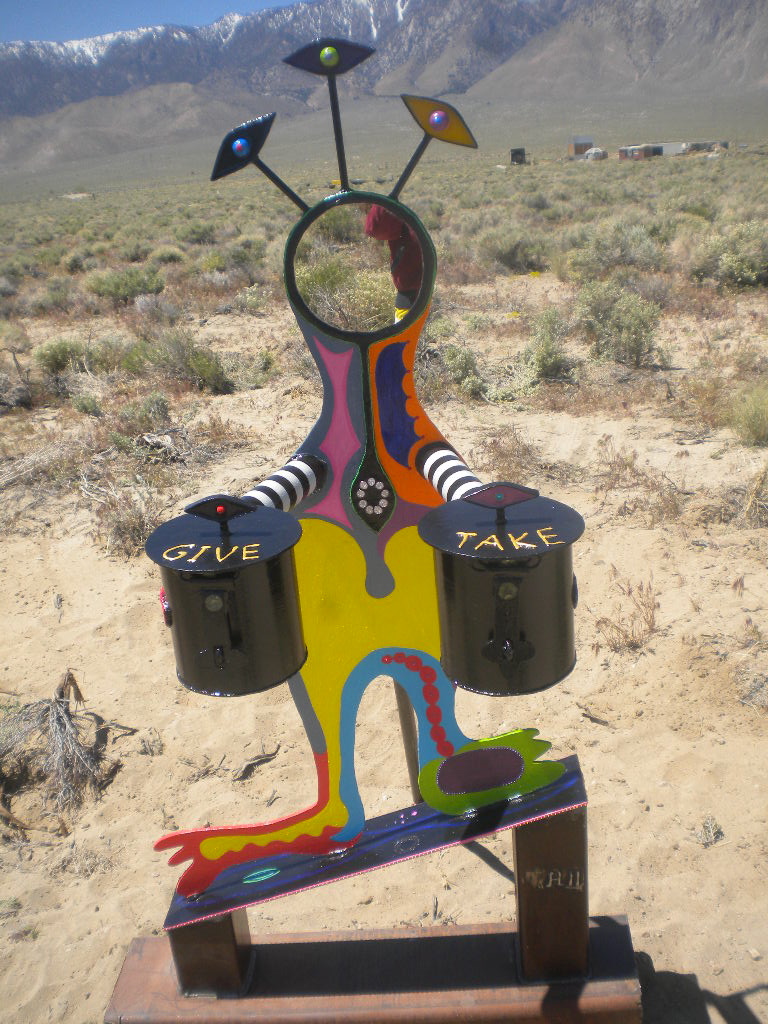
Below is one of her sculptures entitled “Give and Take”: It urges you to donate something in the can marked “Give” and take something from the can marked “Take.” As you examine both cans, your face is reflected in a mirror. Perhaps it will make you feel guilty if you take something without giving.

Jael Hoffmann’s “Give and Take”

Finally, there is another work I like which its creator calls “The Hitchhiker.” All three sculptures shown in this post are discussed in the YouTube video referred to earlier.

Jael Hoffmann’s “The Hitchhiker”

To see more of her work, I suggest you check out Jael’s website at www.jsculpt.com.

Faces from Ancient Rome

Bust of a Byzantine Emperor

I am still thinking of my visit to the Getty Villa yesterday. One thing the ancient Romans knew how to do was sculpt faces. In sculpture, in the images on coins, the goal was to create a recognizable image, even if it was uncomplimentary. And some of the later Roman emperors were nothing to look at. In a previous post, I showed the museum’s statue of Caligula, with his inverted triangle of a face radiating pure evil. I can’t imagine our current emperor—I mean president—accepting such uncomplimentary honesty.

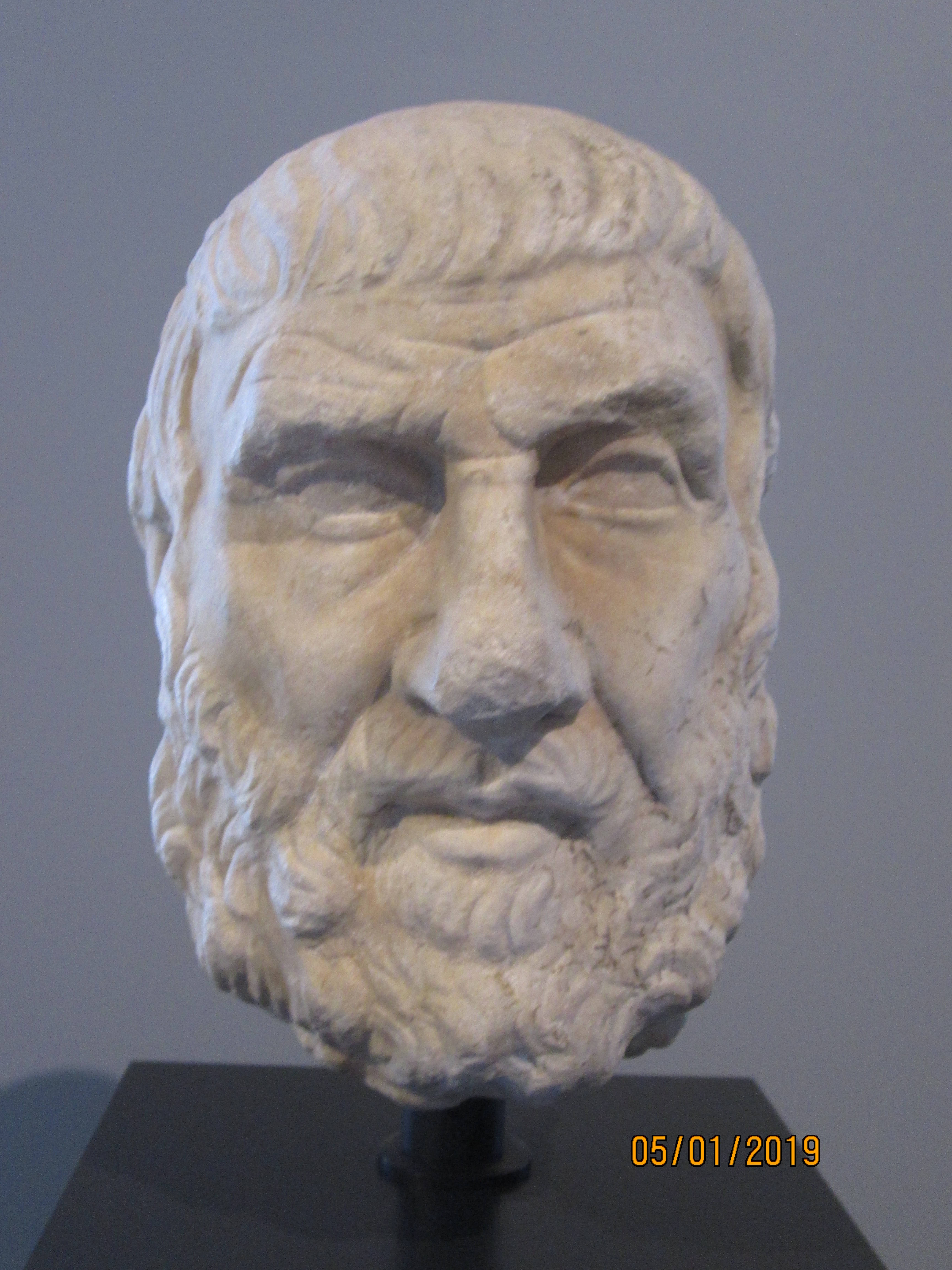
Unidentified Poet or Philosopher

Take a look at this face. The original is unidentified, but the museum thinks he must be a poet or philosopher. In any case, he is old and he has the facial expression of a man who is constitutionally set in his ways. The lines on his face, the slight lopsidedness of his features, the sneer on his lips—this is a man beholden to nobody.

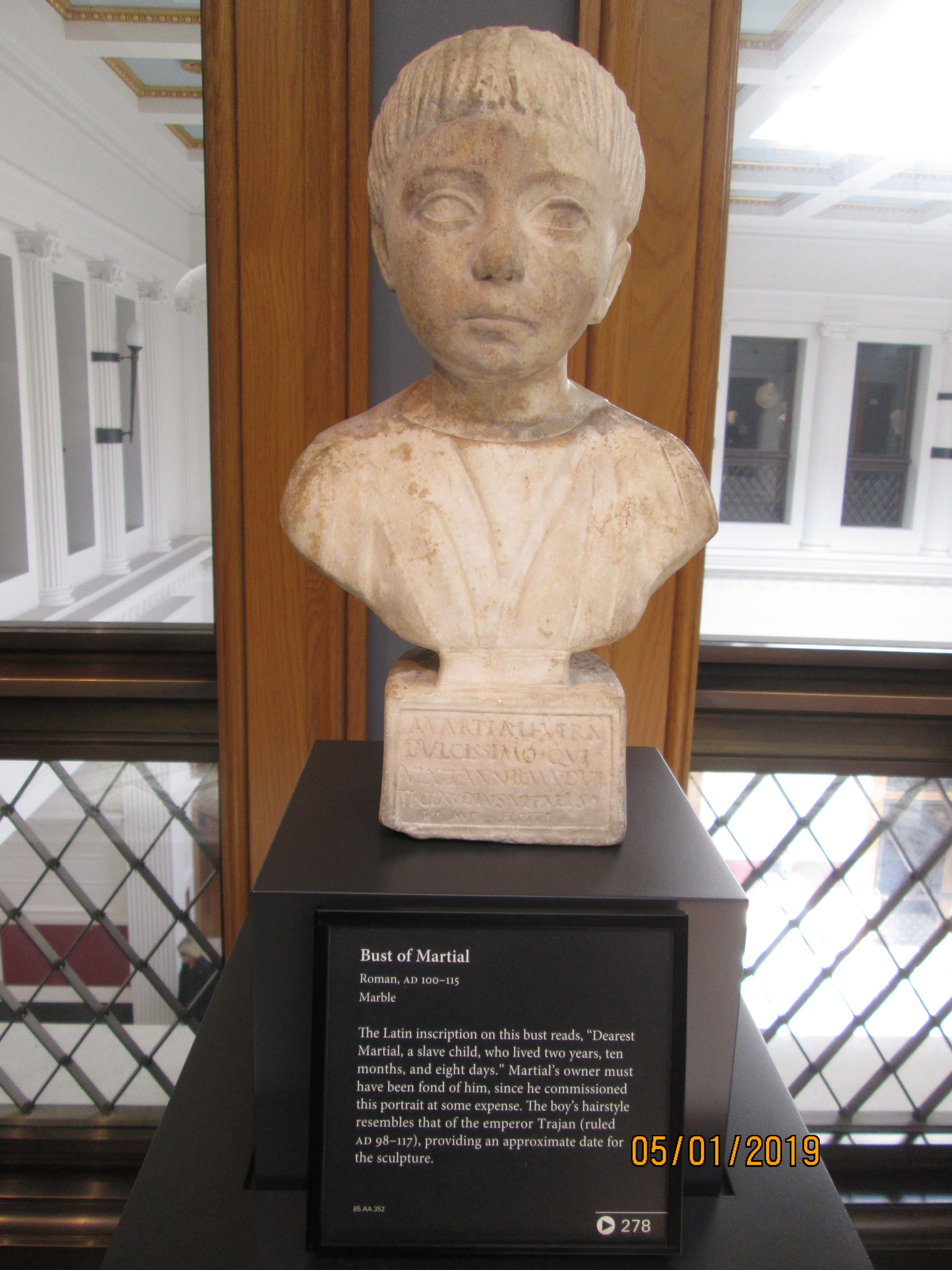
The Slave Boy Martial—Deceased

Finally there is a bust of the slave boy Martial, dead before his third birthday sometime in the second or third century AD. The boy must have been cherished by his owner, because he or she went to the trouble of commissioning this bust for a funerary monument.

Three faces—all very different—all very alive. Walking through the rooms of the Getty Villa, I was acutely conscious that these three individuals were real people. No attempt was made to idealize them. Some two thousand years ago, more or less, they walked the earth looking very much like the busts that commemorated them.


Outliers: Rick Bartow, Mad River Wiyot

Deer Spirit by Rick Bartow (1946-2016)

Today, Martine and I visited the Autry National Center, which was putting on a show of the late American Indian painter and sculptor, Rick Bartow, entitled “Things You Know But Cannot Explain.” I was enthralled by Bartow’s vision of people and the wild animals whose spirits have invaded them. A member of the Mad River Band of Wiyot Indians, Bartow  lived much of his life around Newport, Oregon.

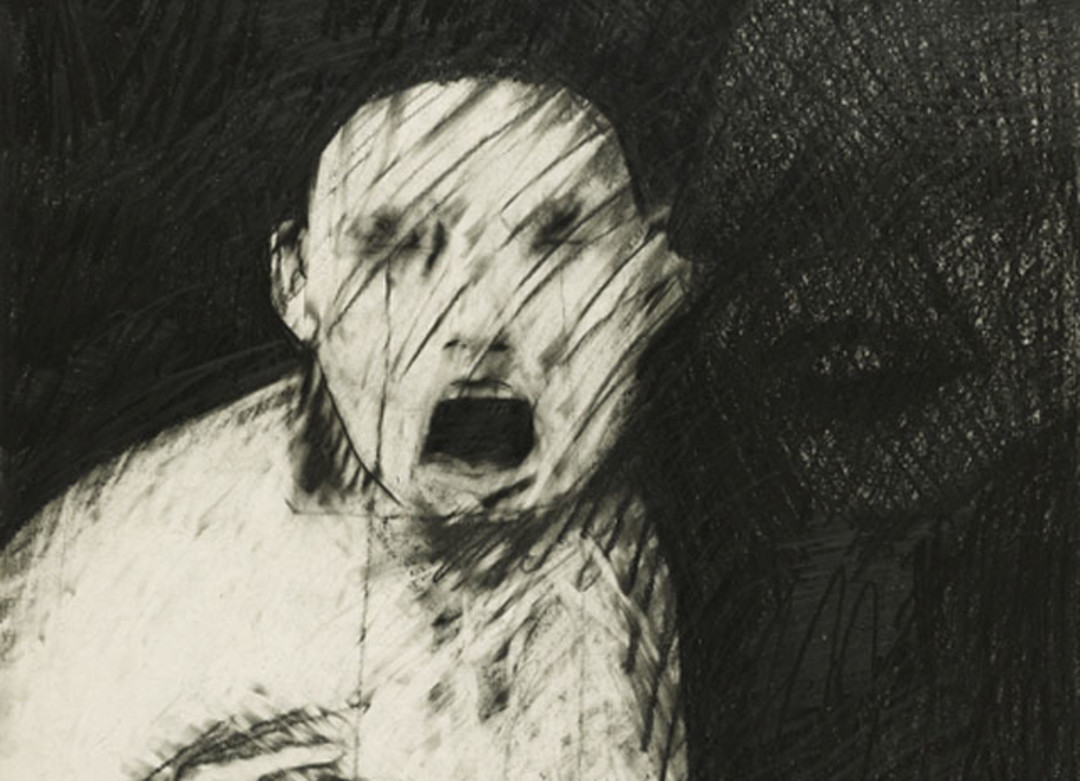
The deer spirit illustrated above is typical of Bartow’s depiction of human verging on totemic animal. Another is the drawing that gave its name to the show:

“Things You Know But Cannot Explain”

Note the face seeming to emerge from the upper right behind the foreground figure, who appears to be paralyzed with fright. Much more traditional is the drawing of three hawks below.

“Three Hawks”

I may not have a drop of Native American blood in me, but I am always delighted to see creative depictions of animals I consider to be my own personal totems, among whom I include the coyote, the raven, and the bear. Because I live at the edge of the desert and Bartow lived in the wet forests of the north, he did not depict my other totems, the frog and the turtle, both of whom I associate with life-giving rain.

Some of Bartow’s most impressive works are his sculptures. Perhaps I will do another posting on those later on. They are usually formed of wood, nails, and various found objects.

At a time when much of the art work is ruled by abstract expressionist garbage, I find Rick Bartow to be rooted in an ancient tradition that manages to speak to me today.


Madame Vleughels

Edmé Bouchardon’s Bust of Madame Vleughels

The Getty Museum in Los Angeles has been putting on an exhibit entitled Bouchardon: Royal Artist of the Enlightenment, which ends in a few days. I was enthralled by both his drawings and his sculptures, of which the above bust of Mme Vleughels is one of my favorites. Edmé Bouchardon (1698-1762) is not well known to most people, but thanks to the Getty, I have made another discovery.

His work that shows the same technical virtuosity of some of the great rococo painters, as in the ornately draped blouse worn by the young woman, yet retains an austere classicism in her facial features and shoulders. Below is one of his drawings:

Head of a Woman Wearing a Scarf

Here again we have a combination of simplicity and technical virtuosity, which seems to be a hallmark of Bouchardon’s style.

Visiting an art museum can be a thrilling experience. But you have to open your eyes and be willing to make comparisons.