Entering the Era of Crummy Technology

(Not So) Smart Phones

Little did I think way back around 1964 when I was fooling around with a General Electric 265 computer at Dartmouth College that computer technology would become so prevalent sixty years later. I moved from being an English Major in 1966 to seeking a Master of Arts in film history and criticism at UCLA in Los Angeles to becoming a self trained computer programmer in 1968 at System Development Corporation (SDC) in Santa Monica, California.

From there I moved on being a computer programmer for Urban Decision Systems in 1971, morphing into a Director of Corporate Communications to avoid working directly under the president’s thumb. When that went bust in 1991, I became an Network Administrator and Office Manager for a Westwood accounting firm, which lasted until the end of 2017.

I am now retired after a lifetime with computers. As I look around me today, I find technology everywhere—from automated attendant services that make it a 45-minute ordeal to telephone a corporation to expensive smart phones that are inferior in quality to the old Bell land lines to error-prone GPS systems to touch-screen interfaces that force you to repeat your keystrokes endlessly.

Tomorrow, I will have to pay a Blue Cross bill over the phone—and I dread the interaction with their automated attendant. They refuse to make it easy to pay them unless I let them auto-fill all my prescriptions. Even when my doctor changes medications or dosages.

I own a flip phone, but not a smart phone. Being a senior, I cannot read the tiny screens without changing to my reading glasses. If I were an eight-armed Hindu deity, it would be no trouble at all. But, alas, I am a mere human.

At SDC, I wrote three hefty user manuals. Now I find that user manuals are hard to come by. If you can’t find a portable data file (pdf) version on the Internet, you have to just fly by the seat of your pants. I guess people just don’t like to read any more.

What frightens me is not that we advance three steps forward and two steps back, but two steps forward and three steps back.

On Being a Troglodyte

I am viewed by some of my acquaintances as something of a cave man, mainly because I do not own a smart phone. When I looked at the technology, I saw several major disadvantages right off:

  • Tiny screens and bad eyesight don’t go well together. I usually wear distance glasses, and I would have to do a quick switch to reading glasses to be able to discern the images and text clearly.
  • I actually have a flip phone which I use for special occasions, but I was disturbed by suddenly being inundated by calls in Mandarin Chinese.
  • Thanks mostly to the 2024 election, I am inundated with text messages begging for donations—with the result that my cell phone is mostly off and rarely travels with me. I find it onerous to manage a whole lot of text messages.
  • Driving around Los Angeles, I am disturbed by drivers who are still texting when traffic signals change to green.
  • At my supermarket, the parking lot is 30% occupied by men and women who are fingering their smart phones, making it hard for legitimate shoppers to park.

Several years ago, my friend Mohan offered to present me with a free smart phone and was shocked that I refused on the grounds that it would make my everyday life more stressed and worrisome in every way.

I might be a cave man, but if so, I am a happy one. There are too many things that I love and that do not require so radical a change of life as the care and feeding of a smart phone.

On Being a Slave to Technology

Something happened to me as I approached retirement age. I mean besides getting old. What I mean is that I began to feel highly critical about several technologies that were beginning to assume a dominant position in our society.

Touch Screen

Although I use an Amazon Kindle to read several books a month, I do not like the imprecision of touch screen interfaces—especially when I have to enter data without a large-sized keyboard. I do not have fingers that measure five millimeters across, so an onscreen keyboard is as difficult for me as using tweezers to move an anvil.

Smartphones

In addition to my dislike of touch screen interfaces, I find smartphones irritating in the extreme. I have a flip cellphone, but I don’t carry it around with me everywhere I go. For one thing, I will not answer the phone while driving, as I wish to continue living and operating an unwrecked car. My cellphone is for outcalling only, except by prior arrangement. Most of the time, it is powered off and sits comfortably on my computer desk.

The other thing is that I already have to carry around a number of things in my pockets:

  • An eyeglass case with reading glasses
  • A ballpoint pen
  • My wallet
  • My keys
  • Change for parking meters
  • Selected medications, including insulin for diabetes

E-Scooters

Why was this ever invented? I have already seen a half dozen nasty accidents involving e-scooters. And besides, I’ve always thought people looked silly operating them.

Artificial Intelligence (AI)

I know that we are living in a world where artificial intelligence is regarded as the coming thing. In my opinion, AI is a way of sacrificing truth for convenience. Please accept my assurance that I do not use AI in producing my blog posts. We have enough half truths and lies all around us without my adding any more to the mix.

GPS

Here I admit I’m on shaky ground. I do not have any GPS device in my car because I do not like to be distracted while driving. Also, I am still a bit skeptical about their accuracy, particularly while traveling in foreign countries. I suppose that for people who don’t know where they’re going, GPS can be a blessing of sorts.

The nice thing about being my age is that I can pick and choose which technologies to adopt. I do not have to turn myself into a rabid fanboy because Apple or some other tech giant is releasing a new product. I believe it was Alexander Pope who wrote the following couplet:

Be not the first by which the new are tried
Nor yet the last to lay the old aside.

The Road Not Taken

When you get to a certain age, you may well decide (like me) to pick and choose from new technologies, new music, and new trends. For instance, I do not own a Smart Phone and especially distrust the notion of using one for economic transactions. I didn’t work at an accounting office for more than twenty years without closely reconciling accounts so that I had a good idea of what I was spending.

As far as new music is concerned, I consider rap to be little better than noise. In fact, the same goes for much current pop music. I like current jazz and even current classical and folk music.

But what I particularly want to talk about are touch screens. There’s something about the imprecision of selecting options that drives me up the wall. That particularly goes for small screens. You hit an option, and it as often as not doesn’t take at first, requiring multiple attempts. Even on my Amazon Kindle, various screens pop up that I did not select.

Perhaps the very worst touch screen activity is using a touch screen keyboard, especially where there is not enough space between characters on the keyboard.

No Way, José!

Fortunately, larger touch screen displays are not quite so objectionable. For instance, the screens one must fill out for an airline boarding pass or upon returning from a foreign country are okay.

I think that, past a certain age, one gets to the point that newer technologies are trickier to manipulate. Younger people who live all day with their small screens develop the proper tiny sharp finger data entry skills. As for myself, I’ll stick to my caveman existence.

Stuck in a Bubble

As we age, we tend to find ourselves stuck in a bubble. Even with the wonders of the smart phone and social media, we seem to have found a new way of isolating ourselves. One of my friends cannot have a conversation without mentioning the politics and culture of America between 1966 and 1976. His talk is of the Kennedy assassinations (he was actually present at Robert Kennedy’s), the FBI vs. the Sioux at Pine Ridge, the Manson Family, and related topics. He goes back frequently to his college days or his Midwestern upbringing.

If one is feeling stressed, I can understand trying to find refuge in the past. It is a particular temptation as one ages, especially if life has not proved satisfactory in some way. And, when you think about it, it rarely does. We are all mortal, and the stresses do not disappear when one is up against the endgame. As we all inevitably are.

My way of fighting the bubble-ization of old age is to try to understand the present. Mind, I didn’t say to accept it. For instance, I do not own a smart phone—though I have a flip phone I use occasionally. I use FaceBook mainly as a content provider: All my WordPress posts are sent to my FaceBook page, and I usually add a couple of funny comics to boot. I do not have any Twitter, Instagram, TikTok, or other social media accounts. (And I don’t feel socially deprived as a result.)

When people try to put me down with an “Okay, Boomer!,” I merely point out that I am pre-Baby-Boom, having been born during the last days of the Second World War. In fact, I was born some six months before the Trinity A-Bomb test, so I’m also pre-Atomic-Age. That only means I am older than dirt. But I am still alive.

Smart Phones and Brussels

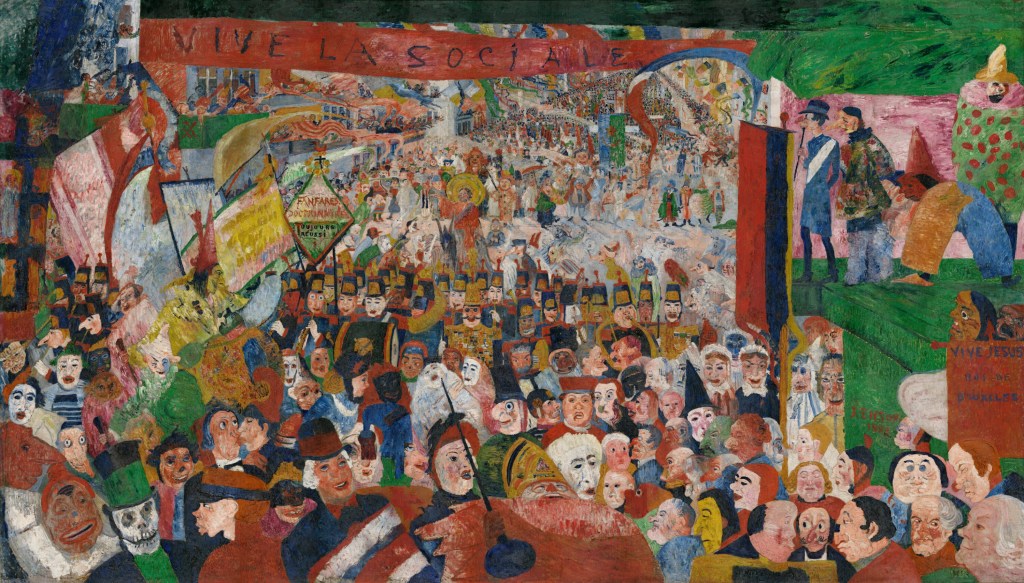
James Ensor’s Christ’s Entry into Brussels 1889

On Friday, I took a bus (to avoid the $20 parking fee) to the Getty Center to view the latest exhibitions and to reacquaint myself with the permanent collection. Unfortunately, the museum was mobbed. Time and time again, I was prevented from seeing a painting because some oversized bozo was stationed in front finger f—ing his smart phone, totally oblivious to the crowds and the magnificent artworks around him.

They reminded me of one of my favorite paintings in the Getty’s permanent collection, James Ensor’s Christ’s Entry into Brussels 1889. Look closely at the crowd entering with Christ who appears (with golden halo) in the center of the painting and slightly to the left. Now imagine each member of the crowd with a smart phone and not giving a tinker’s damn about anything but his or her Facebook or Instagram or whatever.

The Getty’s notes on the painting confirm my opinion:

James Ensor took on religion, politics, and art in this scene of Christ entering contemporary Brussels in a Mardi Gras parade. In response to the French pointillist style, Ensor used palette knives, spatulas, and both ends of his brush to put down patches of colors with expressive freedom. He made several preparatory drawings for the painting, including one in the J. Paul Getty Museum’s collection.

Ensor’s society is a mob, threatening to trample the viewer–a crude, ugly, chaotic, dehumanized sea of masks, frauds, clowns, and caricatures. Public, historical, and allegorical figures, along with the artist’s family and friends, make up the crowd. The haloed Christ at the center of the turbulence is in part a self-portrait: mostly ignored, a precarious, isolated visionary amidst the herdlike masses of modern society. Ensor’s Christ functions as a political spokesman for the poor and oppressed–a humble leader of the true religion, in opposition to the atheist social reformer Emile Littré, shown in bishop’s garb holding a drum major’s baton and leading on the eager, mindless crowd.

After rejection by Les XX, the artists’ association that Ensor had helped to found, the painting was not exhibited publicly until 1929. Ensor displayed Christ’s Entry prominently in his home and studio throughout his life. With its aggressive, painterly style and merging of the public with the deeply personal, Christ’s Entry was a forerunner of twentieth-century Expressionism.

I managed to enjoy my visit despite the crowds. I guess it was Spring Break for too many people, so I should have known better.

The Pause That Doesn’t Refresh

We as a species are particularly susceptible to our technologies. Each commonly used technology is associated with a series of behaviors. I am particularly aware of what the smartphone has done—particularly since I have chosen not to adopt this particular technology. (Tiny screens are not kind to my aging eyes.)

I thought I would mention some of the behaviors I have observed, beginning with this basic root behavior:

When using a smartphone, stop everything else you’re doing.

On the roadway, a particularly annoying corollary is the tendency to play with your smartphone when stopped at a traffic signal, yield or stop sign, and to not move until other motorists beep at you.

In the supermarket parking lots in my neighborhood, approximately 30% of the spaces are occupied, not by shoppers, but by smartphone users checking e-mail, FaceBook, or other social media applications. This makes it more difficult to find parking spaces at busy times.

In the aisles of a store, one finds shoppers stopped dead in an aisle while fingering their smartphones. I have to come up behind them and say BEEP BEEP to get them to be aware of their surroundings.

As a corollary of this corollary, you frequently finds smartphone users annoyed to be interrupted in their use of their digital drug. It is as if they now have earned the right to stop dead in their tracks and that people who attempt to “disturb” them in the exercise of this right are being rude.

I am reminded of the bad old days when half the population smoked most of the time. It was inevitable that when I sat at a restaurant counter, a human chimney would sit next to me burning a particularly foul rope. That, too, was a right that was assumed. Fortunately, no more.

I Agree With Mark Twain

I Am an Unrelenting Enemy of the Smartphone

As far back as 1890, Mark Twain sent out this Christmas message:

It is my heart-warm and world-embracing Christmas hope and aspiration that all of us-the high, the low, the rich, the poor, the admired, the despised, the loved, the hated, the civilized, the savage-may-eventually be gathered together in heaven of everlasting rest and peace and bliss-except the inventor of the telephone.

I have more or less come to terms with my land line. (“What’s that?”) I’m pretty good at sorting out the fakers and phishers who make up most of my calls. (“We’re canceling your Amazon account because [Click]” and “Your account with Apple [Click].”) One just has to be hyper skeptical with all robocalls and perhaps a majority of live callers.

But there is something about the cell phone which makes it irritating in the extreme:

  • It’s ridiculously expensive
  • It turns most callers in public places into boors
  • Particularly with the smart phone, it is dangerously distracting—particularly on the road
  • Too many parking spaces are occupied by idiots fingering their smart phones
  • Everyone assumes you have one
  • The screens are so tiny that, past a certain age, one can’t view them comfortably
  • What passes for a keyboard with cell phones is a sick joke

Today, I couldn’t get into my personal accounting system on QuickBooks Online because Intuit decided I had to change my password. To prove that I am me, they sent a code to my cell phone. I couldn’t view the code because the first text message on my system was corrupted, so I had to restore factory settings and destroy all five text messages. (No problem, that.)

People occasionally call me on my cell phone, but I never answer calls because most of them are in Chinese; so I would rather keep my cell shut off except when I have to place an emergency call. (That’s the only good thing about cell phones.)

Sorry about the rant. Why do I get the feeling with most technical innovations that they are one step forward and two steps back?

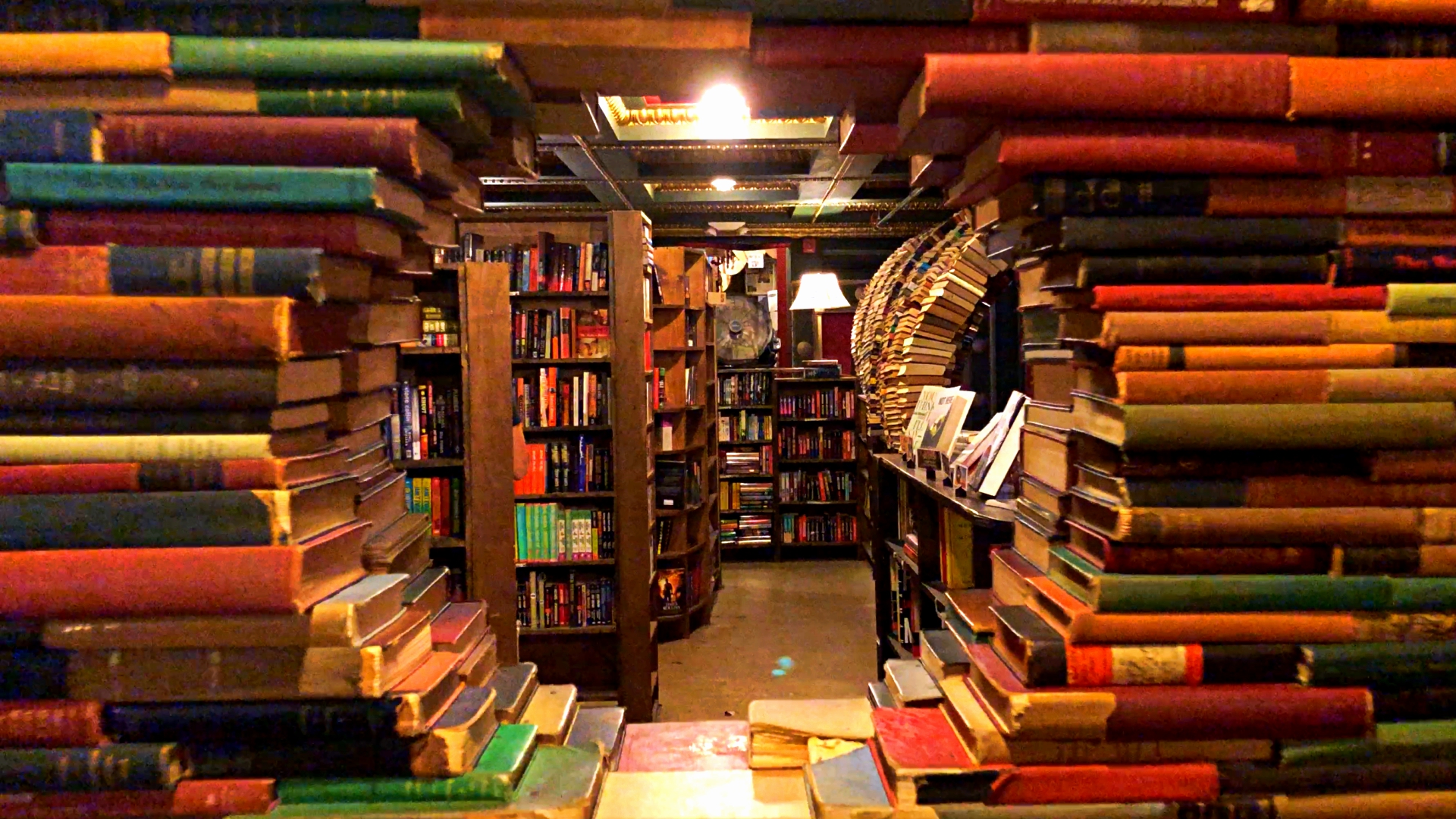
At the Last Bookstore

The Mystery and Sci-Fi Section

Since the beginning of quarantine, I had only been Downtown once. It wasn’t pleasant because I couldn’t find anywhere to eat, and unless I went to Union Station, there were no restrooms around. Today I decided to go again, mainly to return three books to the Central Library. Although they were not technically due until next month, I thought that as I had finished reading them, I might as well take them back.

Also, I put a hold on three more books which I could pick up at the front of the library once I had been e-mailed that they were available. That would be a big plus, even though I still miss sitting down in the literature section for a few hours reading.

Afterwards, I stopped at the Last Bookstore at 5th and Spring Streets. Last time I went, it had been closed due to the coronavirus. Now it was open, but they did one thing that I liked. Before the virus, the place was crawling with young pseudosophisticates who didn’t care about the books, but took hundreds of pictures with their smart phones to document their spavined lifestyles. Now one has to pay five dollars for admission, which is refunded from the price of books purchased.

I can just imagine it now: What? I have to buy books? Reading is so lame compared to the wonders of my smartphone.

It presented no obstacle to me: I bought five paperbacks. They included three Dave Robicheaux mysteries by James Lee Burke, André Gide’s If It Die, and Isaac Bashevis Singer’s Gimpel the Fool.

As soon as I receive notification that my books are being held for me at the Central Library, I’ll make another trip downtown. And I will likely drop in at the Last Bookstore.


Awarding the First MEMFOTY

Mr Mark Zuckerface of BergBook

The MEMFOTY is a new annual award given to the person I deem as the Most Evil Mo-Fo of the Year. It is with great pleasure that the first recipient will be Mark Zuckerface, the nation’s only android CEO (of BergBook). He has resolutely attempted to destroy oncoming generations of humans by replacing human interaction with synthetic digital equivalents.

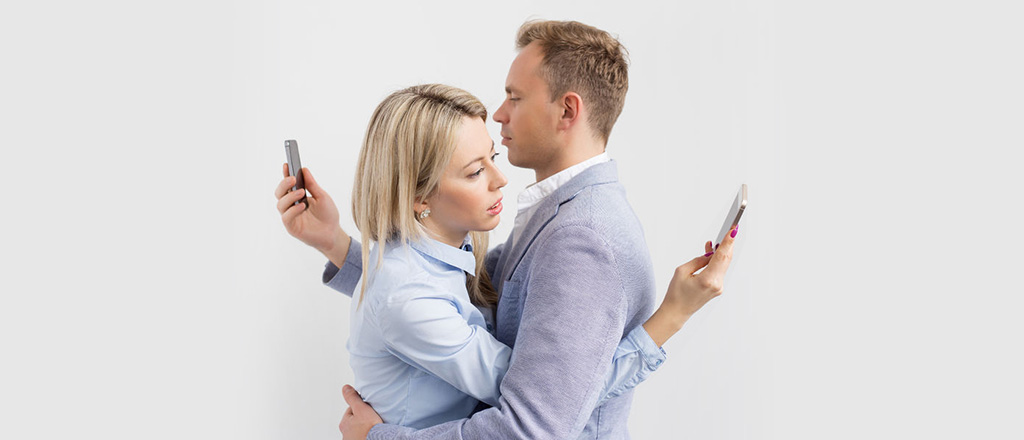
It takes no major effort to see millennials and Gen Z addicts going through life slightly stooped with smart phones held in front of them. Instead of looking up and being aware of their surroundings, Addicts are involved in interacting with phantom “friends” and issuing “Likes”—but not “Dislikes”—to simulacra of interpersonal communications.

The Net Result of Addiction to Social Media Like BergBook

I fully expect that, in future years, social media will be blamed for much of the turmoil of our era. We will have to wait for the children of this generation to react against social media.