My Light Is Spent

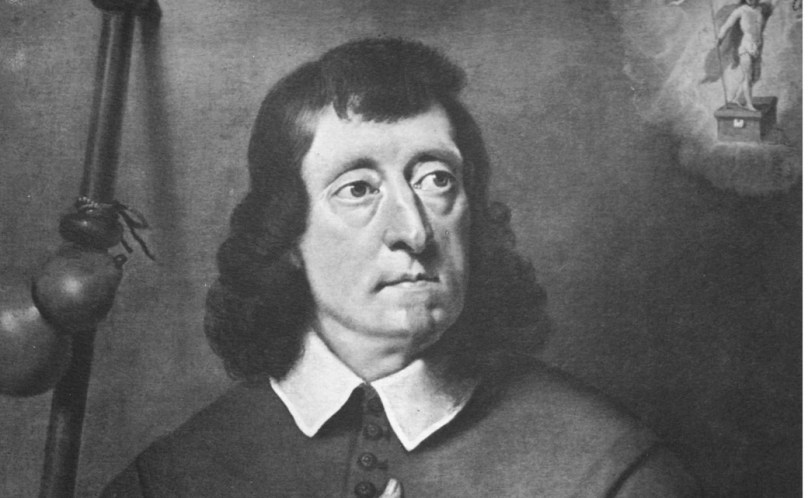
English Poet John Milton (1608-1674)

John Milton was blind, but he did not suffer from blindness. Rather, he did not let it hinder him from producing a body of work that was nothing short of amazing. It reminds me of another blind poet, Argentinian Jorge Luis Borges, who is one of my favorite writers and who wrote about Milton in a sonnet entitled “A Rose and Milton.” Now here is Milton in another sonnet writing about his own blindness:

When I consider how my light is spent,
Ere half my days in this dark world and wide,
And that one talent which is death to hide
Lodged with me useless, though my soul more bent
To serve therewith my Maker, and present
My true account, lest He returning chide;
“Doth God exact day-labor, light denied?”
I fondly ask. But Patience, to prevent
That murmur, soon replies, “God doth not need
Either man’s work or His own gifts. Who best
Bear His mild yoke, they serve Him best. His state
Is kingly: thousands at His bidding speed,
And post o’er land and ocean without rest;
They also serve who only stand and wait.”

Yes, that last line is quite famous and known to virtually everyone. The preceding thirteen lines, however, are not so well known—though they should be.

Sonnet 129

The Waikiki Malia Hotel in Waikiki

It was our second night in Honolulu. We had a room on the 12th floor of the Waikiki Malia Hotel’s Malia Tower. The next room away from the elevator was occupied by a couple of young women who were entertaining young male guests. Because the two rooms were connectable by a locked door, we could hear pretty much everything that was said.

Martine and i were pretty tired by 10 pm, because that was the same as 1 am Los Angeles time. Still we were entertained by the goings-on next door. All four were obviously on on liquor and possibly worse, and the girls were doing a major snow job on the guys. After three quarters of an hour, all four left to go out; but before long one of the couples returned to have very noisy sex.

After about ten minutes, the sounds from the other room were of conflict. The guy was complaining that his driver’s license was missing. After the act, there appeared to be no love lost between the two. As I lay in bed, I could easily have predicted this. After the guy left in a huff, everything went quiet; and we dropped off to sleep.

I was reminded of Shakespeare’s famous Sonnet #129 on the subject of lust:

Th’ expense of spirit in a waste of shame
Is lust in action; and, till action, lust
Is perjured, murd’rous, bloody, full of blame,
Savage, extreme, rude, cruel, not to trust;
Enjoyed no sooner but despisèd straight;
Past reason hunted, and no sooner had,
Past reason hated as a swallowed bait
On purpose laid to make the taker mad,
Mad in pursuit and in possession so;
Had, having, and in quest to have, extreme;
A bliss in proof and proved a very woe;
Before, a joy proposed; behind, a dream.
    All this the world well knows, yet none knows well
    To sun the heaven that leads men to this hell.


“Too Much Liberty”

Nun’s Cell at Santa Catalina Convent in Arequipa, Peru

There is nothing I have ever seen quite like Santa Catalina Convent in Arequipa, Peru. It occupies virtually a square mile with numerous chapels, nuns’ cells, narrow winding streets. One could easily spend a whole day here, as I did. It reminds me of one of Wordsworth’s sonnets:

“Nuns Fret Not at Their Convent’s Narrow Room”

Nuns fret not at their convent’s narrow room;
And hermits are contented with their cells;
And students with their pensive citadels;
Maids at the wheel, the weaver at his loom,
Sit blithe and happy; bees that soar for bloom,
High as the Peak of Furness-fells,
Will murmur by the hour in foxglove bells;
In truth the prison, unto which we doom
Ourselves, no prison is; and hence for me,
In sundry moods, ’twas pastime to be bound
Within the sonnet’s scanty plot of ground;
Pleased if some Souls (for such there needs must be)
Who have felt the weight of too much liberty,
Should find brief solace there, as I have found.


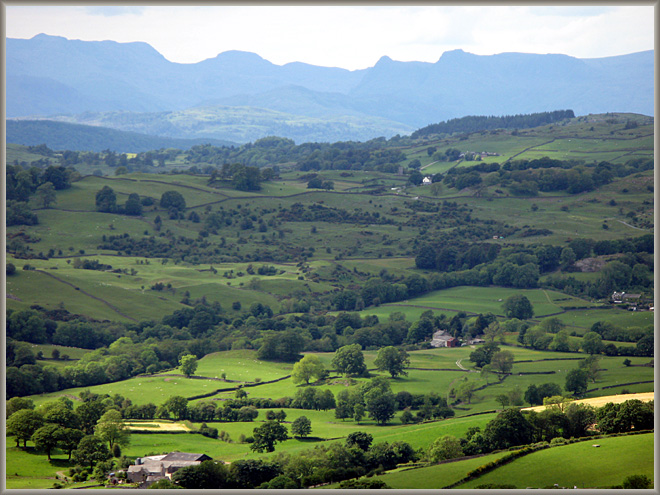
Furness Fells in Lancashire, England

I love what Wordsworth does here, comparing the sonnet’s “scanty plot of ground” with the constricted quarters of a nun, hermit, scholar, or weaver. If I remember, tomorrow I will show some pictures I took at Santa Catalina in Peru, a place that impressed me even more than Machu Picchu.