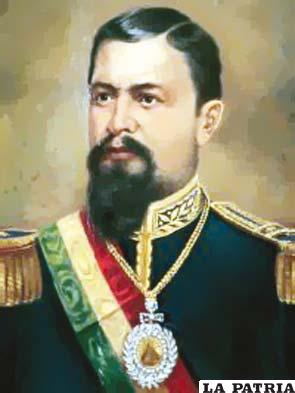
Were the consequences not so tragic, [Bolivian President Hilarion] Daza’s trek through Tarapacá’s hinterland might provoke coarse laughter. From the onset of his campaign, the general demonstrated an almost monumental incompetence: he refused to hire guides to lead his forces through the unforgiving and unknown wasteland. Rather than travel at night, and thus spare his men from the searing desert sun, Daza instead advanced during the day. (Apparently he feared, with good reason, that his troops might desert under the cover of darkness.) The Bolivian general rejected a Peruvian offer of ambulances, and he ordered his artillery to remain in Arica [to the rear]. Perhaps one of Daza’s most criminally negligent acts was that [of] his refusal to bring sufficient water with him. Worse, he permitted his men to fill their canteens with wine or raw spirits, a disastrous mistake given the fact that the nearest supply of water was a substantial distance away from Arica. Col. Narciso Tablares, alerted by a commissary official that Daza’s expedition would carry only eleven water skins, warned the general that his men might run out of water. When Daza haughtily dismissed these fears with the words “You do what you are told,” Tablares had little choice but to obey.—William F. Sater, Andean Tragedy: Fighting the War of the Pacific, 1879-1884
Home » Posts tagged 'south-america' (Page 2)
Tag Archives: south-america
Bloody Wars of the Americas
This post is about three wars fought in South America between1864 and 1935—wars that most people in the United States have never heard of. Yet withal they were extremely bloody, involved transfers of large amounts of territory between the combatants, and set some of the participants back for decades.
The War of the Triple Alliance
Here’s one that’s difficult to even imagine, considering the unevenness of the sides. Arrayed on one side was Paraguay under dictator Francisco Solano López, one of the more imbecilic caudillos in South America’s bloody history. Arrayed against it was Brazil. But wait, there’s more. Argentina and Uruguay jumped in on the side of Brazil. This is also referred to as the Paraguayan War. Before López and 1.2 million Paraguayans, or 90% of the pre-war population, was killed. You can read about it in John Gimlette’s wonderful book about Paraguay called At the Tomb of the Inflatable Pig. After this war, Paraguay pretty much disappeared from the world scene—until it was time for the next war it fought.
The War of the Pacific
We move ahead to period 1879-1884. Bolivia actually had a seacoast with seaports back then, and its lands in the Atacama Desert were a rich source of nitrates. These were mined by a Chilean company called the Antofagasta Nitrate & Railway Company. The adjacent parts of Peru around Tacna and Arica were also being mined for nitre, which was at the time the number one export of Pacific South America. But then Hilarion Daza, the idiot caudillo of Bolivia, decided to levy a tax against the Chileans, and the nitre hit the fan. Chile invaded the Bolivian. Unfortunately for Peru, it had a mutual defense alliance with Bolivia, so it joined the fray.
Although the armies of Peru and Bolivia greatly outnumbered the Chileans, the Chileans were better officered. As William F. Sater wrote in his excellent Fighting the War of the Pacific, 1879-1884:
Peruvian intellectual Ricardo Palma said of the officer corps that “for every ten punctilious and worthy officers, you have ninety rogues, for whom duty and motherland are empty words. To form an army, you have to shoot at least half the military.”
In addition, there was one commissioned officer and one non-commissioned officer for every three privates. That’s not a terribly good ratio.
Anyhow, Bolivia and Peru lost the war and huge amounts of territory, and Bolivia became a landlocked country.
The Chaco War
This one is between the only two landlocked countries in South America, Bolivia and Paraguay—two losers if there ever were any. It was fought over the Gran Chaco, an area that was thought to harbor vast oil reserves. Typically, Royal Dutch Shell supported Paraguay; and Standard Oil backed Bolivia. This war is also called La Guerra de la Sed, or “The War of Thirst,” because so many of the combatants died of thirst fighting among the cacti of the arid region.
Between 1932 and 1935, the Chaco War led to lots of casualties, and a gain for Paraguay, which surprisingly won the war:
By the time a ceasefire was negotiated for noon June 10, 1935, Paraguay controlled most of the region. In the last half-hour there was a senseless shootout between the armies. This was recognized in a 1938 truce, signed in Buenos Aires in Argentina and approved in a referendum in Paraguay, by which Paraguay was awarded three-quarters of the Chaco Boreal, 20,000 square miles (52,000 sq km). Two Paraguayans and three Bolivians died for every square mile. Bolivia did get the remaining territory that bordered Paraguay’s River, Puerto Busch.
Over the succeeding 77 years, no commercial amounts of oil or gas were discovered in the portion of the Chaco awarded to Paraguay, until 26 November 2012, when Paraguayan President Federico Franco announced the discovery of oil reserves in the area of the Pirity river…. The President claimed that “in the name of the 30,000 Paraguayans who died in the war” the Chaco will become the richest oil-bearing region in South America. Oil and gas resources extend also from the Villa Montes area and the portion of the Chaco awarded to Bolivia northward along the foothills of the Andes. Today these fields give Bolivia the second largest resources of natural gas in South America after Venezuela. (Wikipedia)
Again, Gimlette’s At the Tomb of the Inflatable Pig is a good source of the only war that Paraguay could be said to have won, though it was only a booby prize for decades.
The cartoon above is taken from Poliical Cartoon Gallery by Derso and Kelen, which is well worth a look.
South
Let’s face it: Most Americans almost never think about South America. Oh, there are a few exceptions, such as when the World Cup comes around and we are reminded how many great soccer football teams there are “down there.” Also, when Carnival Time in Rio comes close. Also, when we keep hearing about how the forests of the Amazon are gradually being clear-cut.
I think this is a fundamental flaw about being the world’s Number One military power. According to the Stockholm International Peace Research Institute (SIPRI), here are the world’s top ten for 2013:
- United States – $682.0 billion
- People’s Republic of China – $166.0 billion
- Russia – $90.7 billion
- United Kingdom – $60.8 billion
- Japan – $59.3 billion
- France – $58.9 billion
- Saudi Arabia – $56.7 billion
- India – $46.1 billion
- Germany – $45.8 billion
- Italy – $34.0 billion
Note that there are no South American countries in the list, though Brazil comes in at 11th place with $33.1 billion. (When was the last time they fought a war?) In other words, there are no major military players in South America. So we don’t have to worry about them, right? And that is the fundamental flaw about being Number One: You tend not to think about smaller countries because they simply don’t impinge on your way of life. In other words, you lay yourself open for a big unpleasant surprise.
I actually remember my first such unpleasant South America surprise. Dwight D. Eisenhower was President from 1952 to 1960. On May 13, 1958, he sent Vice President Nixon to Caracas, where his motorcade was attacked by an angry mob. As a 13-year-old in Cleveland, I was outraged that a no-name country like Venezuela had the nerve to insult the United States. This plus the subsequent insurgency in Cuba and takeover by Castro led to the creation of the Alliance for Progress during the Kennedy Administration. (But we had to undergo a baptism by fire at the Bay of Pigs first.)
Then there was more bad news to come. We were being inundated by cocaine being smuggled in from Colombia and other nearby countries. Then there was this matter of the FARC insurgency in Colombia and the Sendero Luminoso (Shining Path) in Peru. The whole continent appeared to be unraveling like a cheap suit. The Tupamaros in Uruguay and the disappearances in Argentina under Videla didn’t help either, nor did Pinochet in Chile.
At a certain point along the way, a certain positive influence from Argentina turned my life around. It was my discovery of the writer Jorge Luis Borges. Once I started reading his works, I began to see the world through his eyes. There was this battle called Junin that was fought in Peru. Then there were the Unitarios and Federalistas in Argentina. I began to get more interested, and then I actually went to Argentina in 2006 (only to break my shoulder by falling in a blizzard in Tierra Del Fuego) and 2011. Now I want to go to Peru in 2014, if I can swing it financially.
And, of course, I have been reading ever so much more about South America—so much so, in fact, that I look at the globe in an entirely different light. Perhaps South America will gain by all these years of benign neglect. Perhaps not. We still enforce the Monroe Doctrine after a fashion to keep Europe out, but we pretty much leave the continent alone unless our multinational corporations want to cut down their trees or extract their mineral wealth. Eventually, I see the nations down there nationalizing those industries and, with luck, putting the skids on some of the worst abuses. Until then, our corporations will be a stench in their nostrils.


You must be logged in to post a comment.