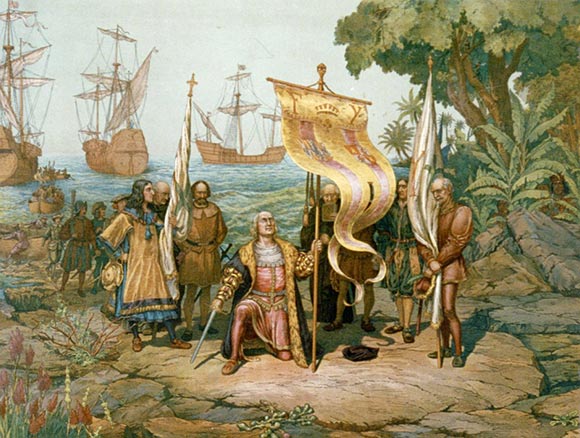
Columbus’s Landing on San Salvador in 1492
Because of my extensive travels in Latin America, I have become interested in the subject of how the discovery of the New World impacted on Europe. Due to the circumstances of my Coronavirus related social distancing, I have been reading up a storm. One thin book I noticed in my history collection was J. H. Elliott’s The Old World and the New 1492-1650 (Cambridge University Press, 1970).
The discovery of America was such a big event with so many aspects to it that Europeans had a difficult time wrapping their heads around it. Even though so much of the economy of Spain and the rest of Europe was affected by the flood of gold and silver brought to Seville by the treasure fleets, and even though so many new foods and social habits (smoking) spread across the continent, Europeans were somewhat nonplussed for the first couple of centuries after the conquest.
Elliott quotes 1 Corinthians 14:10-11 to summarize the effect:
There are, it may be, so many kinds of voices in the world, and none of them is without signification. Therefore if I know not the meaning of the voice, I shall be unto him that speaketh a barbarian, and he that speaketh shall be a barbarian unto me.
In his essay “On Cannibals,” Montaigne speculated on the Brazilian natives through the eyes of the Greek philosophers:
These nations then seem to me to be so far barbarous, as having received but very little form and fashion from art and human invention, and consequently to be not much remote from their original simplicity. The laws of nature, however, govern them still, not as yet much vitiated with any mixture of ours: but ‘tis in such purity, that I am sometimes troubled we were not sooner acquainted with these people, and that they were not discovered in those better times, when there were men much more able to judge of them than we are. I am sorry that Lycurgus and Plato had no knowledge of them; for to my apprehension, what we now see in those nations, does not only surpass all the pictures with which the poets have adorned the golden age, and all their inventions in feigning a happy state of man, but, moreover, the fancy and even the wish and desire of philosophy itself; so native and so pure a simplicity, as we by experience see to be in them, could never enter into their imagination, nor could they ever believe that human society could have been maintained with so little artifice and human patchwork. I should tell Plato that it is a nation wherein there is no manner of traffic, no knowledge of letters, no science of numbers, no name of magistrate or political superiority; no use of service, riches or poverty, no contracts, no successions, no dividends, no properties, no employments, but those of leisure, no respect of kindred, but common, no clothing, no agriculture, no metal, no use of corn or wine; the very words that signify lying, treachery, dissimulation, avarice, envy, detraction, pardon, never heard of.
Sometimes, I still think that Europeans still are trying to wrap their heads around the New World.
34.052234
-118.243685






 Tarnmoor
You must be logged in to post a comment.