
“Keep an Even Mind”

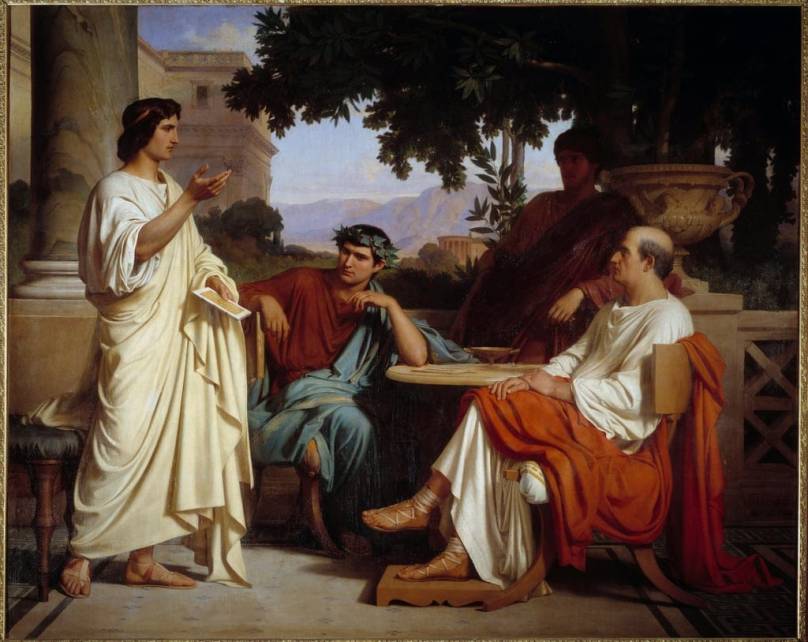
Horace and Virgil with Maecenas

Sometimes I think that philosophy has not progressed substantially since the days of the ancient Greeks and Romans. Here is an excerpt from Horace’s Epistles. Orcus is a god of the underworld, and Charon the boatman who ferries souls across the River Styx.

Book 2 Epistle 3: One Ending

When things are troublesome, always remember,
keep an even mind, and in prosperity
be careful of too much happiness:
since my Dellius, you’re destined to die,

whether you live a life that’s always sad,
or reclining, privately, on distant lawns,
in one long holiday, take delight
in drinking your vintage Falernian.

Why do tall pines, and white poplars, love to merge
their branches in the hospitable shadows?
Why do the rushing waters labour
to hurry along down the winding rivers?

Tell them to bring us the wine, and the perfume,
and all-too-brief petals of lovely roses,
while the world, and the years, and the dark
threads of the three fatal sisters allow.

You’ll leave behind all those meadows you purchased,
your house, your estate, yellow Tiber washes,
you’ll leave them behind, your heir will own
those towering riches you’ve piled so high.

Whether you’re rich, of old Inachus’s line,
or live beneath the sky, a pauper, blessed with
humble birth, it makes no difference:
you’ll be pitiless Orcus’s victim.

We’re all being driven to a single end,
all our lots are tossed in the urn, and, sooner
or later, they’ll emerge, and seat us
in Charon’s boat for eternal exile.
The Real Thing

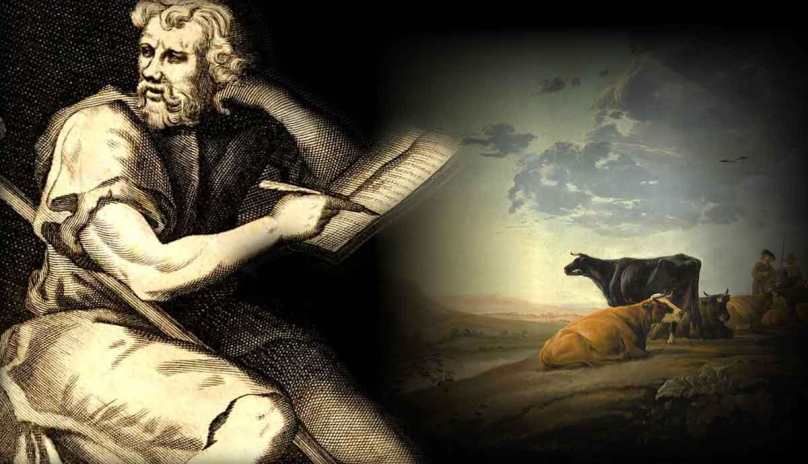
Roman Slave Turned Philosopher Epictetus

In my previous post, I mentioned three Roman Stoic philosophers. One of them was Epictetus (50-135 AD). Here are the opening paragraphs to his most famous work, The Enchiridion:

There are things which are within our power, and there are things which are beyond our power. Within our power are opinion, aim, desire, aversion, and, in one word, whatever affairs are our own. Beyond our power are body, property, reputation, office, and, in one word, whatever are not properly our own affairs.

Now the things within our power are by nature free, unrestricted, unhindered; but those beyond our power are weak, dependent, restricted, alien. Remember, then, that if you attribute freedom to things by nature dependent and take what belongs to others for your own, you will be hindered, you will lament, you will be disturbed, you will find fault both with gods and men. But if you take for your own only that which is your own and view what belongs to others just as it really is, then no one will ever compel you, no one will restrict you; you will find fault with no one, you will accuse no one, you will do nothing against your will; no one will hurt you, you will not have an enemy, nor will you suffer any harm.

Aiming, therefore, at such great things, remember that you must not allow yourself any inclination, however slight, toward the attainment of the others; but that you must entirely quit some of them, and for the present postpone the rest. But if you would have these, and possess power and wealth likewise, you may miss the latter in seeking the former; and you will certainly fail of that by which alone happiness and freedom are procured.

Seek at once, therefore, to be able to say to every unpleasing semblance, “You are but a semblance and by no means the real thing.” And then examine it by those rules which you have; and first and chiefly by this: whether it concerns the things which are within our own power or those which are not; and if it concerns anything beyond our power, be prepared to say that it is nothing to you.

Philosophy for Whom?

The Emperor Marcus Aurelius (121-180 AD)

Ever since I was a high school student, I pictured myself as studying philosophy and thereby improving my life. Very early on, I learned that most philosophers were too abstruse for the likes of me. I ran up against the likes of Kant, Heidegger, Sartre, Wittgenstein, and Hegel—and found myself considerably less smart than I thought. (However, I liked Sartre’s fiction and plays).

Recently I found myself drawn to the philosophers of ancient Greece and Rome. Now it seems that philosophy is several removes from everyday life. Read A. J. Ayer and Wittgenstein, and you’ll have no idea how to live your life. But read the ancient Stoics, and you can indeed feel better about your life.

Particularly interesting are the following Roman philosophers:

  • Lucius Annaeus Seneca (4 BC to 65 AD) practically ran the Roman Empire while he helped to educate the young Nero. Unfortunately, his pupil did not turn out well; and Nero ordered his tutor to commit suicide. Read in particular his Letters of a Stoic.
  • Epictetus (50-135 AD) was a former slave who wrote a very readable treatise entitled The Enchiridion.
  • Marcus Aurelius (121-180 AD) was the last of the benevolent Antonine emperors. (As great a philosopher as the father was, his son Commodus was one of the worst emperors.) The Meditations are a highly readable journal of Marcus Aurelius’s thoughts while ruling a large part of the known world.

The amazing thing about the works of these Stoic philosophers is that they are relevant and highly readable today. Much more so than most of the present day philosophers.