Pedestrians Are Always Suspect

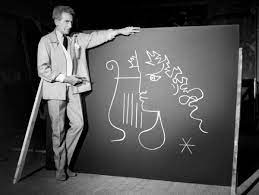
Jean Cocteau (1889-1963) with Drawing of Orpheus

He was, to quote Wikipedia:

French poet, playwright, novelist, designer, filmmaker, visual artist and critic. He was one of the foremost artists of the surrealist, avant-garde, and Dadaist movements and an influential figure in early 20th century art.

He was, to quote one newspaper essay, a Renaissance man.

In the United States, he is probably best known for his films La Belle et la Bête (1946) and Orphée (1950). Although he created some paintings, he is probably better known for his line drawings, many referring to Greek myths such as the drawing of Orpheus illustrated above and used in the titles of his film on Orpheus.

“The Birth of Pegasus” (1953)

With his surrealist and Dada experience, Cocteau’s work is sometimes underestimated because the artist never took himself that seriously. I love the scene in Le Testament d’Orphée (1960) where the poet (played by Cocteau himself) is arrested by motorcycle cops who, when asked what the charge was, say, “Pedestrians are always suspect!”

There is no lack of artists who take themselves very seriously. Even his film masterpiece Orphée is not only profound, but profoundly funny in spots.

“The Absence”

From French surrealist poet Paul Éluard comes this lovely poem called “The Absence.”

The Absence

I speak to you across cities
I speak to you across plains 

My mouth is upon your pillow 

Both faces of the walls come meeting
My voice discovering you 

I speak to you of eternity 

O cities memories of cities
Cities wrapped in our desires
Cities come early cities come lately
Cities strong and cities secret
Plundered of their master’s builders
All their thinkers all their ghosts 

Fields pattern of emerald
Bright living surviving
The harvest of the sky over our earth
Feeds my voice I dream and weep
I laugh and dream among the flames
Among the clusters of the sun 

And over my body your body spreads
The sheet of is bright mirror.

Spilimbergo

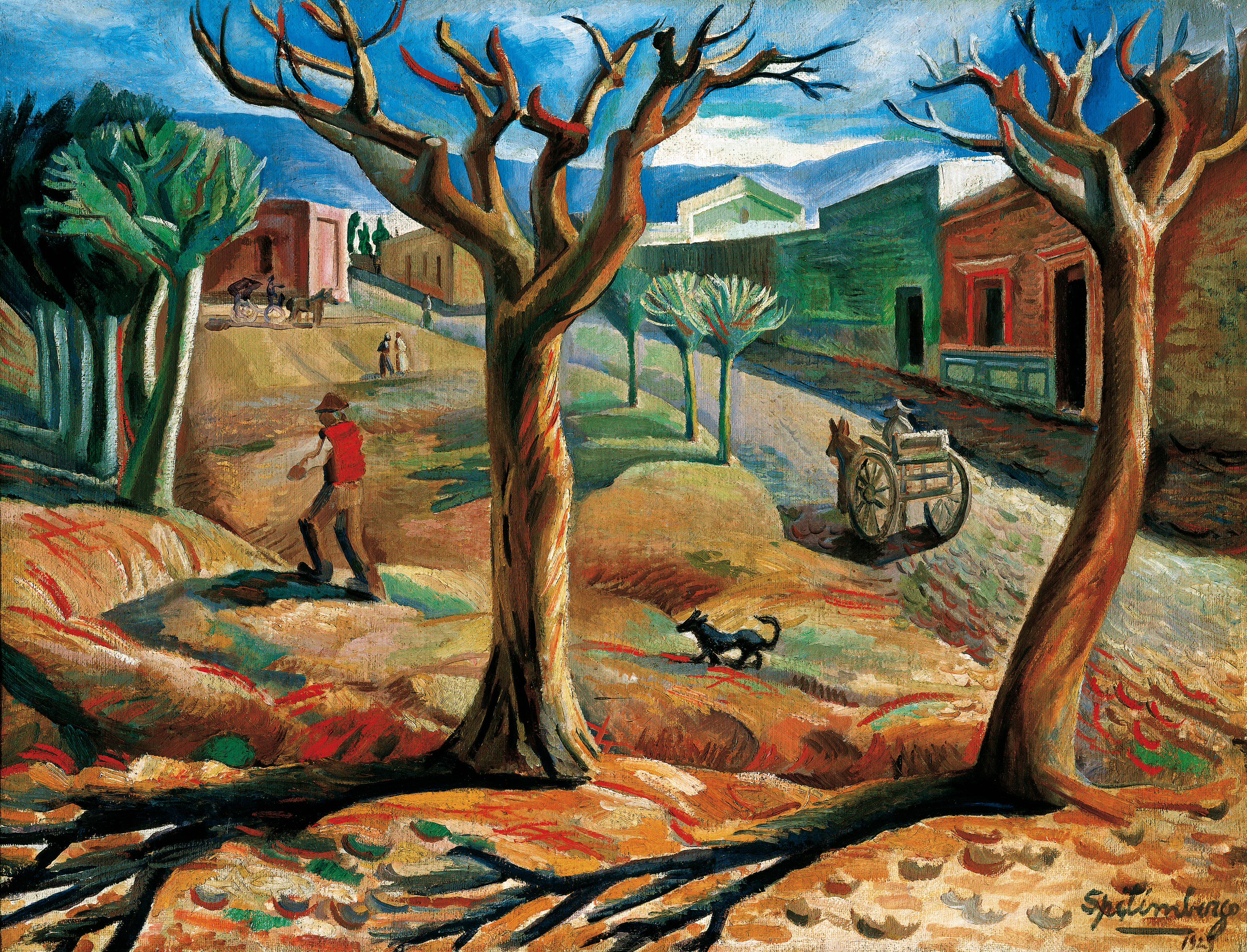
Landscape by Lino Enea Spilimbergo (1896-1964)

I have always thought that the world has never sufficiently appreciated the artists and writers of Argentina. Having paid three visits to that distant country, I have begun to appreciate the artistic vision of its people. This post honors the work of Lino Enea Spilimbergo, the son of Italian immigrants, who was born in the Palermo neighborhood of Buenos Aires, but for health reasons relocated to the drier province of San Juan in the center of the country.

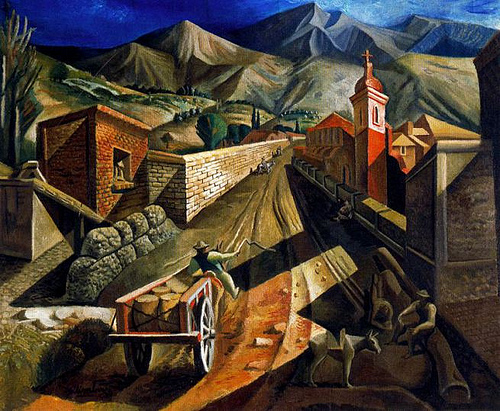
“Pasaje de San Juan” by the Painter

What draws me to Spilimbergo’s work is that his eye seems to capture much of the wonder that is the Argentine landscape. Though the artists work was by no means limited to landscapes:

“Mujer Sobre Paisaje”

The above picture has both surrealistic and straight landscape elements, incorporating the jungles of northern Argentina with a female nude. Unfortunately, relatively little is written about Spilimbergo’s art on the Internet in English, though I think his work deserves serious study.


Giorgio di Chirico, Surrealist Painter

His Surrealist Landscapes Are Endlessly Fascinating

The scene is a port somewhere. You can see the unfurled sails of a ship just over the wall while two muffled figures hover around the entrance of a building. There is a tower just over the wall that could be a lighthouse, but maybe not. Note the conflicting shadows: The building on the left is casting its shadow in the 4 o’clock position, while the unseen structures on the right have shadows that are closer to the 10 o’clock position, I love these strange Mediterranean landscapes which seem to suggest so much but say nothing clearly.

Giorgio di Chirico (1888-1978) was, to my mind, the greatest of the surrealist painters. Although I prefer the landscapes, he painted other subjects as well:

Miscellaneous Objects Suggesting Strange Geometries

In one of his writings, the painter states, “What is especially needed is great sensitivity: to look upon everything in the world as enigma….To live in the world as in an immense museum of strange things.” The above image certainly qualifies.

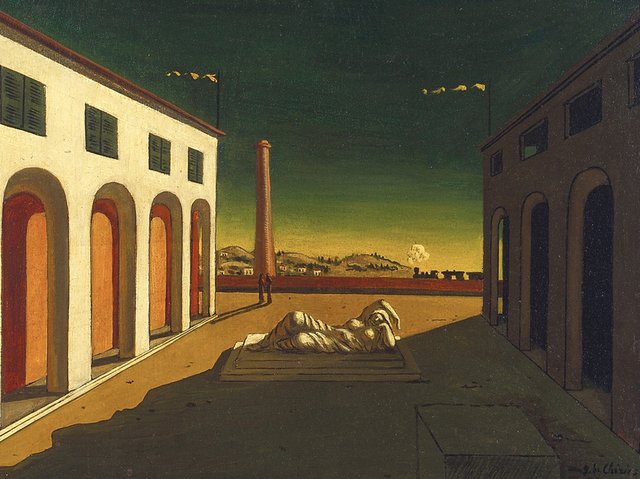
Another Chirico Landscape

The flags atop the facing buildings show a strong wind blowing from right to left. The steam from the locomotive beyond the wall in the background, on the other hand, is going straight up. Again, we have two muffled figures in the middle distance and a strange statue of a reclining male in the middle of the square. Again—not unusual with Chirico—the shadows are a little inconsistent. Where, for instance, is the shadow of the tall phallic tower.


The Architectural Muse

Visitor at a Homage to Roberto Aizenberg’s Paintings

He started out as a student of architecture and ended up being a surrealist painter whose work has an architectural quality. Roberto Aizenberg (1928-1996) is the subject of this post, part of a desultory series on Argentinian painters. In general, I dislike abstract expressionists and love realists and surrealists. A student of Antonio Berni, about whom I have written before, Aizenberg’s work is reminiscent of Xul Solar, another surrealist from the Rio de la Plata.

“Biography of the Author” by Aizenberg

The above painting ties the artist’s love of architecture to the soil of Argentina, with the buildings appearing to be a range of buttes and mesas built atop red earth riddles with caves. This one particularly reminds me of Xul Solar’s surrealist humor.

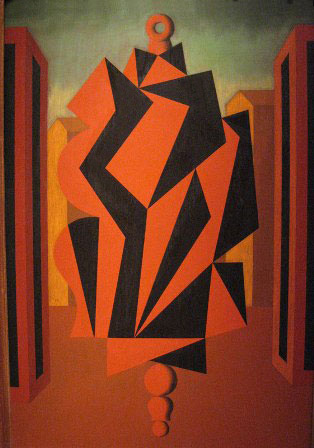
“Harlequin” by Aizenberg

Harlequins typically wear costumes broken into a design of alternating black and white diamonds. Here, Aizenberg suggests the costume and brackets it with architectural elements. Instead of a human figure, the painter’s harlequin is topped with a doughnut-shaped ring and supported by three spheres of descending size—almost as if it were a decorative finial for a staff or scepter of sorts.

I have not seen many original canvasses by Argentinian painters, with the exception of Xul Solar, whose dedicated museum I have visited in Buenos Aires. The next time I go to South America—and I hope there is a next time—I will have to visit MALBA, the Museo de Arte Latinoamericano de Buenos Aires.


The Surrealist Lett

“Palacios en Bria”

I owe my acquaintance with the work of Oscar Agustin Alejandro Schulz Solari (better known as Xul Solar) to Jorge Luis Borges. Now why would I accept the artistic judgment of a blind man? Fortunately, Xul Solar’s association with Borges goes back to the early 20th century, when the writer still had his sight. In fact, the painter is referenced by name in one of his greatest stories—“Tlön, Uqbar, Orbis Tertius.” On page 23 of the Grove Press edition, we find:

The moon rose over the sea would be written hlör u fang axaxaxas mlö, or, to put it in order: upward beyond the constant flow there was moondling. (Xul Solar translates it succinctly: upward, beyond the onstreaming it mooned.)

Also, Xul Solar illustrated three of Borges’s earlier works: El tamaño de mi esperanza (1926), El idioma de los argentinos (1928), and Un modelo para la muerte (1946). The latter was co-authored by another mutual friend, Adolfo Bioy-Casares.

In Buenos Aires, on Laprida, there is a museum dedicated to Xul Solar, situated in his former home. On my last trip to Argentina, I had the good fortune to visit it. When next I go to Argentina—and I dearly hope I can—I intend to visit it again.

“Fiordo”

What I like most about Xul Solar’s work is its depiction of strangely beautiful and bizarre places. I do not recall many (if any) portraits, but I do remember his many landscapes and cityscapes.

Xul Solar is not widely known outside of Argentina, though I think he is one of the world’s greatest surrealist painters. The painter was born in Latvia in 1887 and died in 1963, just as his friend Jorge’s vision went into an irreparable decline.

The Melancholy of Departure (and Arrival)

Giorgio di Chirco’s “Gare Montparnasse: The Melancholy of Departure”

Giorgio di Chirco’s “Gare Montparnasse: The Melancholy of Departure”

I usually do not write about a book until I have finished reading it, but I decided that I had to post this while the ideas were still fresh in my mind. Geoff Dyer’s novel The Search (1993) started out as a genre mystery/detection novel, but has transformed into a Giorgio di Chirico painting.

We are in a non-specific country in an area known as The Bay. A man named Walker (no first name given) winds up at a party with his brother and meets an alluring woman known as Rachel Malory and asks him to track down er ex-husband in order to get some papers signed. Walker finds Rachel seductive, but she does not allow herself to be seduced, which only spurs Walker on. Although he does it ostensibly for money, it is really she who is the goal of his endeavors.

So far, so good. But it is not long before strange things begin to happen. First of all, he meets a man named Carver who wants badly to compare notes with him about Malory. When he refuses, Carver threatens to kill him. So while he is chasing Mallory, he is being chased by Carver. Then even stranger things begin to happen:

There was something strange about the city but he was unable to work out what. Then it came to him. There were no trees or pigeons or gardens. Yet all around were the sounds of leaves rustling and the beating of wings, the cooing of departed birds. He was so shocked that he stood at a street corner, listening.

Then there was a closed bridge that was actually vibrating like a plate of Jello in the wind. Walker goes through a series of tatty cities in this strange nondescript landscape. In one, there are no people; and he is able to get a suit and a car without paying for them. In another, there doesn’t seem to be much of a city, but whatever there is is surrounded by a network of wide freeways on which all the motorists are speeding furiously.

There don’t seem to be any clues about Malory, but Carver or some unknown assailant is still chasing him through a series of random cities.

“Enigma of a Day”

“Enigma of a Day”

That’s when I thought of di Chirico, that painter of mysteriously nonspecific cities. Cities like Meridian, Port Ascension, Eagle City, Usfret, Kingston, Monroe, Durban, Iberia, Friendship—the list stretches on. Each town is different from the other, in a sort of alternate United States with black and Latino ghettos. In one unnamed city, he even finds what looks to be a picture of Malory with Rachel.

As the surrealism grows, I almost want to ration the rest of the book so that I don’t finish it too soon.