“The Long Day Wanes”

Odysseus

Odysseus

You would think after ten years circumnavigating the Mediterranean, losing all of his crew to various disasters, being imprisoned by the witch Circe, and massacring the many suitors of his wife Penelope, that Odysseus would take a rest. According to Alfred Lord Tennyson, he does—for all of three years. In his poem “Ulysses,” Odysseus is eager once again to hit the road:

It little profits that an idle king,
By this still hearth, among these barren crags,
Match’d with an aged wife, I mete and dole
Unequal laws unto a savage race,
That hoard, and sleep, and feed, and know not me.
I cannot rest from travel: I will drink
Life to the lees: All times I have enjoy’d
Greatly, have suffer’d greatly, both with those
That loved me, and alone, on shore, and when
Thro’ scudding drifts the rainy Hyades
Vext the dim sea: I am become a name;
For always roaming with a hungry heart
Much have I seen and known; cities of men
And manners, climates, councils, governments,
Myself not least, but honour’d of them all;
And drunk delight of battle with my peers,
Far on the ringing plains of windy Troy.
I am a part of all that I have met;
Yet all experience is an arch wherethro’
Gleams that untravell’d world whose margin fades
For ever and forever when I move.
How dull it is to pause, to make an end,
To rust unburnish’d, not to shine in use!
As tho’ to breathe were life! Life piled on life
Were all too little, and of one to me
Little remains: but every hour is saved
From that eternal silence, something more,
A bringer of new things; and vile it were
For some three suns to store and hoard myself,
And this gray spirit yearning in desire
To follow knowledge like a sinking star,
Beyond the utmost bound of human thought.

This is my son, mine own Telemachus,
To whom I leave the sceptre and the isle,—
Well-loved of me, discerning to fulfil
This labour, by slow prudence to make mild
A rugged people, and thro’ soft degrees
Subdue them to the useful and the good.
Most blameless is he, centred in the sphere
Of common duties, decent not to fail
In offices of tenderness, and pay
Meet adoration to my household gods,
When I am gone. He works his work, I mine.

There lies the port; the vessel puffs her sail:
There gloom the dark, broad seas. My mariners,
Souls that have toil’d, and wrought, and thought with me—
That ever with a frolic welcome took
The thunder and the sunshine, and opposed
Free hearts, free foreheads—you and I are old;
Old age hath yet his honour and his toil;
Death closes all: but something ere the end,
Some work of noble note, may yet be done,
Not unbecoming men that strove with Gods.
The lights begin to twinkle from the rocks:
The long day wanes: the slow moon climbs: the deep
Moans round with many voices. Come, my friends,
’T is not too late to seek a newer world.
Push off, and sitting well in order smite
The sounding furrows; for my purpose holds
To sail beyond the sunset, and the baths
Of all the western stars, until I die.
It may be that the gulfs will wash us down:
It may be we shall touch the Happy Isles,
And see the great Achilles, whom we knew.
Tho’ much is taken, much abides; and tho’
We are not now that strength which in old days
Moved earth and heaven, that which we are, we are;
One equal temper of heroic hearts,
Made weak by time and fate, but strong in will
To strive, to seek, to find, and not to yield.

I don’t know about the mariners he addresses in the last stanza, considering that all his original crew is no more. Perhaps these are new ones, eager to embark on ticking off their own bucket lists.

Asking the Pilot

Patrick Smith, a Commercial Pilot, Writes a Great Blog

Patrick Smith, an Experienced Commercial Pilot, Writes a Great Blog

Since people have been flying in heavier-than-air machines for over a century, it is amazing how little accurate information one can find in the news whenever there is a fatal crash or—heaven forbid—a missing aircraft. For many years, I had been reading Patrick Smith’s excellent “Ask the Pilot” column in Salon.Com, before that website decided to cut him loose in favor of more celebrity-conscious material. Patrick is the author of a book entitled Cockpit Confidential, which I am adding to my TBR (To Be Read) pile of books. On his excellent website, called Ask the Pilot, he writes:

More than ever, air travel is a focus of curiosity, intrigue, anxiety and anger. In these pages I do my best to inform and entertain. I  provide answers for the curious, reassurance for the anxious, and unexpected facts for the deceived.

I begin with a simple premise: everything you think you know about flying is wrong. That’s an exaggeration, I hope, but not an outrageous starting point in light of what I’m up against. Commercial aviation is a breeding ground of bad information, and the extent to which different myths, fallacies, wives’ tales and conspiracy theories have become embedded in the prevailing wisdom is startling. Even the savviest frequent flyers are prone to misconstruing much of what actually goes on.

Which isn’t surprising. Air travel is a complicated, inconvenient, and often scary affair for millions of people, while at the same time cloaked in secrecy. Its mysteries are concealed behind a wall of specialized jargon, corporate reticence and an irresponsible media. Airlines, it hardly needs saying, aren’t the most forthcoming of entities, while journalists and broadcasters like to keep it simple and sensational. It’s hard knowing who to trust or what to believe.

In the current edition of his website, he launches a broad-based attack on the Huffington Post, which did an article entitled “16 Alarming Secrets That Will Change How You Will Feel About Flying.” I recommend you read the Huffpost article, and then look at what Smith has to say about it entitled “Nonsense from the Huffington Post.”

Not only is Ask the Pilot a great resource for information on flying, but it contains some fascinating travel articles written by a guy who’s been just about everywhere. I like it so much that I am planning to link to it on my own site.


I Would Like to Have Been Him, Part 2

Patrick Lee Fermor (1915-2011)

Sir Patrick Leigh Fermor (1915-2011)

A long time ago—certainly before I moved my blog to WordPress—I wrote about Sir Richard Francis Burton, how I would like to have lived his life.(I’ll look it up for you and re-post it sometime in the next week or two.) The other person whom I admire so much that I would like to have been him is Sir Patrick Michael Leigh Fermor. Both were knighted; both were world travelers; both had superb intellects; and both were superb writers.

At the age of eighteen, Fermor decided to walk the length of Europe, starting from Holland and ending up in Constantinople. Most of his trip was covered by two volumes he wrote years after the fact: A Time of Gifts (1977), covering from Holland to the Hungarian Border, and Between the Woods and the Water (1986), covering Hungary and Romania. When he died in 2011 at the ripe old age of 96, he will still working on the third volume. I was heartbroken at the loss, feeling I would never find out how his trip ended.

Thanks to his good friends Artemis Cooper and Colin Thubron—himself no mean travel writer—the third volume has finally come out. It bears the title The Broken Road: From the Iron Gates to Mount Athos (2013). Fortunately, enough of the text is pure Fermor, which is quite a complement. Take this passage, for example, describing Romanian Orthodox art:

I was fascinated, and slightly obsessed, by these voivodes and boyars as they appeared in frescoes on the walls of the monasteries they were always piously founding — crowned and bearded figures holding up a miniature painted facsimile of the church itself, with their princesses upholding its other corner, each with a line of brocaded, kneeling sons and daughters receding in hierarchical pyramids behind them. Still more fascinating, later portraits,hanging in the houses of their descendants—some by unknown local artists who travelled through the principalities early in the nineteenth century—showed great boyars of the princely divans, men who bore phenomenal titles, most of them of Byzantine origin, some of them Slav: Great Bans of Craiova, Domnitzas, Bayzadeas, Grant Logothetes, hospodars, swordbearers and cupbearers, all dressed in amazing robes with enormous globular headdresses or high fur hats with diamond-clasped plumes, festooned with necklaces, and jewel-crusted dagger hilts.

What a whiff of Eastern Christianity is in this passage from pages 183-184! It is typical of Fermor’s obscurely beautiful lists that can pop up anywhere in the text.

As if his travel and writing were not enough, Paddy Fermor was a legitimate war hero. During the Nazi occupation of Crete, as a member of the Special Operations Executive (SOE), he helped organize the Greek resistance and carried off the German commandant, General Heinrich Kreipe, over several mountain ranges to a waiting British submarine. At one point, the captive Kreipe was so impressed by the scenery, that he quoted some lines by Horace in Latin. Fermor finished the quote, also in Latin, at which the astonished Kreipe could only mutter, “Ah, so!” Fermor commented that both he and Kreipe had “drunk at the same fountains” of learning.

Other books by Fermor include the following titles which I have read:

  • The Violins of Saint-Jacques (1953)
  • A Time to Keep Silence (1957)
  • Mani: Travels in the Southern Peloponnese (1958)
  • Roumeli: Travels in Northern Greece (1966)
  • Three Letters from the Andes (1991)

All are travel books except the first, which is a novel. The only book of his I have not yet read is The Traveller’s Tree (1950), about his sojourn in the Caribbean. Also well worth reading is his wartime colleague W. Stanley Moss’s Ill Met by Moonlight: The Abduction of General Kreipe (1950). Most of Fermor’s books are available in attractive paperback editions from the New York Review of Books.

Fading from View

At Vatnajökull

At Vatnajökull

I have been back in Southern California for three weeks, and only now am I no longer dreaming about Iceland. It is time to get on with the rest of my life. From time to time, I will return with a post about Iceland, but it is no longer occupying the front and center position of my life. (Of course, I would dearly love to return and spend some more time in the Northeast of the island.)

In the above photo, I am standing at the tongue of Heinabergsjökull, one of the extensions of the gigantic Vatnajökull icecap, the third largest in the world after Antarctica and Greenland.

At the same time that Iceland is starting to fade from view, so is Vatnajökull itself. Over the last eighty years, the glacier has pulled back from the edge of the sea for several miles and shows signs of a further retreat. In the 1930s, if I were standing in the same position, there would be perhaps a hundred meters of ice below me (or above me).

What I hope will never fade from view are my memories: Iceland occupies a special place in my heart—along with Patagonia, the American Southwest, Yucatán, and the islands off the coast of Scotland. Visiting those places has, to a large extent, made me the person I am today. I went from being a little kid whose family was too poor to take him anywhere to a grown-up who has developed an insatiable itch for travel.

Who knows what the next few years will bring? My gaze is still skipping around the globe, looking for places that might interest me. And I hope that Martine can accompany me, because her presence and her sense of wonder make everything better.


Packing for Iceland

The Lighter You Pack, the More Fun You’ll Have

The Lighter You Pack, the More Fun You’ll Have

I always shake my head when I see travelers with multiple large suitcases per person. Not only do they pay the airlines a small fortune in fees, but they are severely hampered as to where they can go. When I land at Keflavík Airport on Thursday morning around 6:30 am, the terminal will not be full of native bearers waiting to assume my heavy loads. If I am lucky, I will be able to grab a cart to go through customs. Then I will haul my bags to the Flybus to drive me across the desolate lunar landscape of the Reykjanes Peninsula to Reykjavík BSI Bus Terminal.

There, with my luggage still in tow, I’ll sit down at the travel agency there and obtain maps and bus tickets. Then I’ll take a cab to the Guesthouse Odinn at Óðinsgata 9, where my big bag will be held until check-in time at 1 pm.

I will carry two blue bags, a big one with my clothes, medications, and toiletries, and a small shoulder bag with my electronics, guidebook, and various reservation confirmations. The blue bag is always with me, containing what I need through the day. The big bag generally stays in my room.

For a good guide to packing light, I recommend you check out OneBag.Com, especially their annotated packing lists. They quote a timely lyric from Johnny Cash: “I ain’t takin’ nothin’ that’ll slow down my travelin’ …”

Since I’m on insulin, I’ll have to take particular care packing my medications, especially my insulin, glucose testing supplies, etc. I’ll cut back severely on the nutritional supplements I’ll be taking. I’ll be eating plenty of fish, so no Omega-3. In fact I’ll just take a once a day multi-vitamin plus an antioxidant I’ve been taking for years. Oh, and I’ll be taking a letter from my doctor pointing out to all and sundry that I am a needle medications user.


The Boy Who Loved Maps

Somehow, I Had to Get Out of Cleveland...

Somehow, I Had to Get Out of Cleveland…

Ever since I learned how to speak and read English, I grew to love maps. We had an old atlas whose binding was falling apart. Whenever I had a few spare moments, I would sit down, page through it, and try to memorize the maps that interested me most. Not that I understood what I was looking at: I remember pointing to a Mercator projection map of the world and claiming that Napoleon cheated us in the Louisiana Purchase, as Alaska was so much bigger. And Greenland was gigantic! Was it not one of the world powers?

Even as a boy in Cleveland, I loved the whole idea of far places, of different cultures. In the 1950s, read such obscure books as the Rev. Harold W. Rigney’s Four Years in a Red Hell about the Catholic priest’s imprisonment in Red China, and another book, whose name I have forgotten, about Soviet concentration camps around Vorkuta. What interested me was not so much the attacks on Communism as the books’ exotic locales.

Baudelaire describes me to a tee in “Le Voyage”:

Pour l’enfant amoureux de cartes et d’estampes,
L’univers est égal à son vaste appétit.
Ah! que le monde est grand à la clarté des lampes!
Aux yeux de souvenir que le monde est petit!

Which can be translated as follows (though I prefer the French):

For a child in love with maps and engravings,
The universe is equal to his vast appetite.
Ah, how the world is great by lamplight!
Through the eyes of memory the world is small.

Here I was, simultaneously hooked on the idea of travel and, at the same time, stuck in Cleveland. We didn’t have much money to allow for travel. All I can remember are a few day trips in Ohio, a few days in lovely Detroit, Niagara Falls (but I was only five), and trips to Florida at the ages of five and fourteen. Why do you suppose I wanted to leave Cleveland to go to college? Not only was my parents’ marriage threatening to go on the rocks (it somehow held), but I felt stifled by Cleveland’s provincial ways. All those Hungarian-American homebodies!

But there was always that atlas. You know what? I’m still that way. My mind is a capacious geographic storehouse. I can sketch the outlines of many of the countries on earth and locate their capitals and major cities. And I can tell you what countries border them.

That knowledge has always stood me in good stead. When I go somewhere I have never been before, I make sure that I am prepped for it. Although my vacations only run about two or three weeks, I can s-t-r-e-t-c-h out the time so that the vacation and its preparation take half a year. I started in on Iceland in February, and it won’t be until July that I work it all out of my system.

The Delta of the Paraná

The Delta of the Paraná River near Buenos Aires

The Muddy Delta of the Paraná River near Tigre

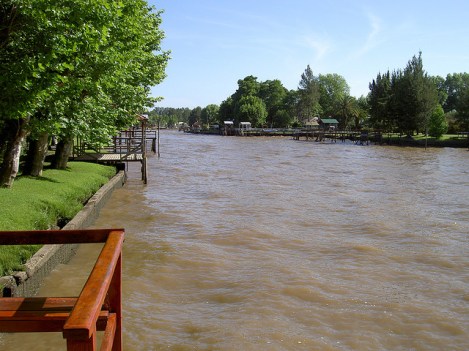
Here I am, within a couple of weeks of lifting off for Iceland; and what is going through my mind? Other places I want to visit. I am far from finished with Argentina. Above is the delta of the muddy Paraná River near where it debouches in the Rio de la Plata near Buenos Aires. I was never able to see Bariloche because of the volcanic eruption at Cordon Caulle in Chile. And Martine did not want to visit the Iguazu Falls along the northeast border with Brazil and Paraguay (those pesky mosquitoes!) nor the old Jesuit missions in Paraguay and Misiones Province (again, the bugs).

I don’t know how many years (or months or weeks or days) are left to me—and I don’t want to know. I just know that my sense of wonder is expanding even as my time is contracting. Will my last breath be inhaled near Ulan-Ude on the Trans-Siberian Railroad or at Machu Picchu in the Peruvian Andes or by the Látrabjarg Bird Cliffs in the West Fjords of Iceland or by the ruins of Petra in Jordan or the Széchenyi Baths in Budapest or … wherever?

It doesn’t much matter to me where. I keep thinking of the words from Witter Bynner’s translation of the Tao Teh Ching by Lao Tzu:

From wonder, into wonder
Existence opens.

If I had the money, and if I were no longer committed by my lack of funds to work in accounting, I would be on the road at least half the time.

Then, and only then, I would buy a good notebook computer to take with me. (Otherwise, it’s more of an onus than a bonus to me.)

Note: Since I originally published this, I saw Robert Louis Stevenson’s poem “The Vagabond,” of which this stanza is the refrain:

Let the blow fall soon or late,
Let what will be o’er me;
Give the face of earth around
And the road before me.
Wealth I seek not, hope nor love,
Nor a friend to know me;
All I seek, the heaven above
And the road below me.


Travel Changes You

Mural Along Rivadavia in Ushuaia, Tierra Del Fuego

Mural Along Rivadavia in Ushuaia, Tierra Del Fuego

I remember my first vacation on my own. Despite protests from my parents, who, of course, wanted me to come to Cleveland and slip into the family ways like putting on a glove. But I was thirty years old, and I wanted to travel.

As a child, my travels were limited to places my parents wanted to go, places like Detroit; Lake Worth, Florida; Niagara Falls; and Passaic, New Jersey. My only choice as a child was a day trip to Schoenbrunn Village in Central Ohio, site of the first settlement in the state. (And the folks did not enjoy it, although my brother and I did.)

So, in November 1975, I decided to spend eighteen days in Yucatán visiting ancient Mayan ruins. It was a great trip, and it turned me around completely. No longer was I going to be satisfied by hanging out in Cleveland, a city from which all my friends had fled after high school.

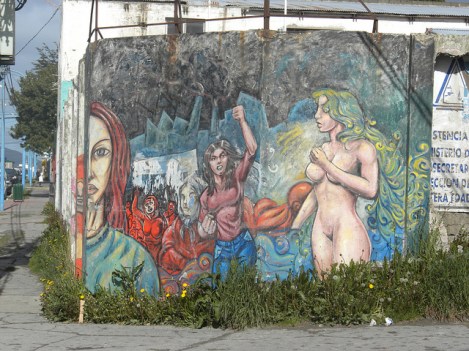
Above is a mural on Rivadavia, a north/south street in the Tierra Del Fuego capital of Ushuaia. It also happens to be the street where I slipped on the ice in 2006 and cracked my right humerus, just one block north. No matter: Five years later I returned with Martine, stayed at the same bed & breakfast (the Posada del Fin del Mundo), and had a wonderful time.

It’s like those Tibetan pictures of devils deliberately intended to frighten you, like the following:

Tibetan Demon

Tibetan Demon

According to the Tibetan Book of the Dead, if you are frightened of the demons, your soul will gravitate toward a copulating couple; and you will be reborn as their child. If you are not moved by fear, there is a chance that you will obtain Nirvana.

That’s why I would have no fear about traveling to Turkey, to Russia along the Trans-Siberian Railway, and any number of places. Of course, I have no intention of visiting Syria, North Korea, Somalia, or Mali. That would not be prudent.


Sehnsucht

At Peyto Lake in Canada’s Banff National Park

At Peyto Lake in Canada’s Banff National Park

I had never heard the German term Sehnsucht before I tried to Google “yearning wild places” a few minutes ago. According to Wikipedia:

Sehnsucht … is a German noun translated as “longing”, “yearning”, or “craving”, or in a wider sense a type of “intensely missing”. However, Sehnsucht is difficult to translate adequately and describes a deep emotional state. Its meaning is somewhat similar to the Portuguese word, saudade, or the Romanian word dor. Sehnsucht is a compound word, originating from an ardent longing or yearning (das Sehnen) and addiction (die Sucht). However, these words do not adequately encapsulate the full meaning of their resulting compound, even when considered together.

Sehnsucht represents thoughts and feelings about all facets of life that are unfinished or imperfect, paired with a yearning for ideal alternative experiences. It has been referred to as “life’s longings”; or an individual’s search for happiness while coping with the reality of unattainable wishes. Such feelings are usually profound, and tend to be accompanied by both positive and negative feelings. This produces what has often been described as an ambiguous emotional occurrence.

It is sometimes felt as a longing for a far-off country, but not a particular earthly land which we can identify. Furthermore there is something in the experience which suggests this far-off country is very familiar and indicative of what we might otherwise call “home”. In this sense it is a type of nostalgia, in the original sense of that word. At other times it may seem as a longing for a someone or even a something. But the majority of people who experience it are not conscious of what or who the longed for object may be, and the longing is of such profundity and intensity that the subject may immediately be only aware of the emotion itself and not cognizant that there is a something longed for. The experience is one of such significance that ordinary reality may pale in comparison, as in Walt Whitman’s closing lines to “Song of the Universal”:

Is it a dream?
Nay but the lack of it the dream,
And failing it life’s lore and wealth a dream
And all the world a dream.

So what is my yearning? I can tell you one thing right from the start: It is for a place where there are no mosquitoes. Sun-drenched beaches are not anywhere in my dreams. Look at some of the places I have visited in the past years: The Hebrides and Orkney Islands of Scotland, Argentina’s Tierra del Fuego and Patagonia, Iceland, the Canadian Rockies, Quebec and the Maritime Provinces of Canada.

My Sehnsucht takes me to cold, wild places, such as Pehto Lake in Banff National Park (above).

I also like deserts, especially those in the American Southwest and Argentina. I would add Mexico if I were more familiar with the states of the North.

Where I part from the Wikipedia definition is any identification of the places for which I yearn with home. I was born in Cleveland, which I will forever associate with dirty red brick buildings and accumulations of snow that exhibit a chronicle of dog piss over time. Nor is Los Angeles my “home” in any real sense. I like it. It’s where I hang my hat. But it represents the place I would like to escape from—at least for the time being.

No, I do not think I could live in Tierra del Fuego or the Outer Hebrides, but I love to visit them. And I love to spend months planning for my visit. The planning can almost be as enjoyable as the actual trip. It seems I am always either planning one of these escapades or actually at my destination.

That tension between where I’m currently living and where I would like to visit is one of the main motivating factors of my life. I must say, it seems to work—at least for me.

Finding Old Books Has Changed

It’s Become Easier to Find Old Rare Books

It’s Become Easier to Find Old Rare Books

There was a time when I would have paid a hundred dollars for even a ratty copy of Sir Francis Galton’s The Art of Travel, or Shifts and Contrivances Available in Wild Countries (1872). This book was a vade mecum for Victorian explorers, such as Sir Richard Francis Burton, whose works I collect and love to read. Other books that Burton and his fellow Victorian explorers took with them on their jaunts into the wild places of the world are Randolph Barnes Marcy’s The Prairie Traveler: The 1859 Handbook for Westbound Pioneers (Burton himself edited later editions) and Harriet Martineau’s How to Observe: Morals and Manners (1838).

Now how much do you suppose these rare titles would cost you today? Remember, these books (even the one on the Prairies of North America) were taken into the darkest parts of Africa and South America. According to Monte Reel’s article entitled “How to Explore Like a Real Victorian Adventurer,” reprinted in The Best American Travel Writing 2012, the answer is Zero. Zip. Nil. Provided, of course, you have a Kindle e-reader.

If you do, you can easily put together a library of works which are no longer under copyright for nothing or next to nothing.

Oh you can expect to pay for the latest Stephenie Meyer twinkling vampire books or the latest New York Times best-sellers.

Now, you ask yourself, why would I be interested in these old general guides on travel to unexplored areas? The fact of the matter is that I love old travel books. Burton’s own First Footsteps in East Africa, or An Exploration of Harar (1855) and his voluminous A Personal Narrative of a Pilgrimage to Al-Madinah and Mecca (1855-56), in which he disguised himself as an Arab and did all the Holy Places of Islam, are two of the most exciting books ever written.

Going farther afield, there are writers like W. H. Hudson on Argentina and Uruguay, H. M. Tomlinson’s The Sea and the Jungle (1912) about a voyage to the interior of Brazil; George Gissing’s By the Ionian Sea (1901) about a trip along the heel and sole of the Italian boot; and Captain Irving Johnson’s The Peking Battles Cape Horn (1932) about the last big sailing ship through the storms of Cape Horn.

These are just a few authors and titles that come to mind. How can I forget Robert Byron’s The Road to Oxiana (1937)? Or Bruce Chatwin’s In Patagonia (1977) or The Songlines (1987)? Or Paul Theroux’s The Old Patagonian Express (1979)?

One of these days, I will put together a more organized list of my favorite travel books—but that will take a little time!