Looking back at the treaties that ended the First World War, it appears that the Hungarian half of the Kingdom of Austria-Hungary was made to pay the heavier price for what was essentially the Emperor Franz Joseph’s decision to go to war against the Serbs for assassinating the heir to the throne in Sarajevo. According to Wikipedia:
The treaty regulated the status of the Kingdom of Hungary and defined its borders generally within the ceasefire lines established in November-December 1918 and left Hungary as a landlocked state that included 93,073 square kilometres (35,936 sq mi), 28% of the 325,411 square kilometres (125,642 sq mi) that had constituted the pre-war Kingdom of Hungary (the Hungarian half of the Austro-Hungarian monarchy). The truncated kingdom had a population of 7.6 million, 36% compared to the pre-war kingdom’s population of 20.9 million.Though the areas that were allocated to neighbouring countries had a majority of non-Hungarians, in them lived 3.3 million Hungarians – 31% of the Hungarians – who then became minorities.
How Trianon Chopped Hungary to Bits
Pieces of Hungary went to Yugoslavia, Romania (the largest chunk, all of Transylvania), Russia, Czechoslovakia, and even Austria. What did Austria lose for its participation in the war? Essentially, Bohemia (to Czechoslovakia) and the much of the Tirol (to Italy). The new borders of Hungary became to larger of the two green areas in the above map.
I can understand separating out the Slovenians, Croatians, Russians, and Slovaks; but a great injustice was done to the Hungarians of Transylvania, who are treated as second-class citizens of Romania.
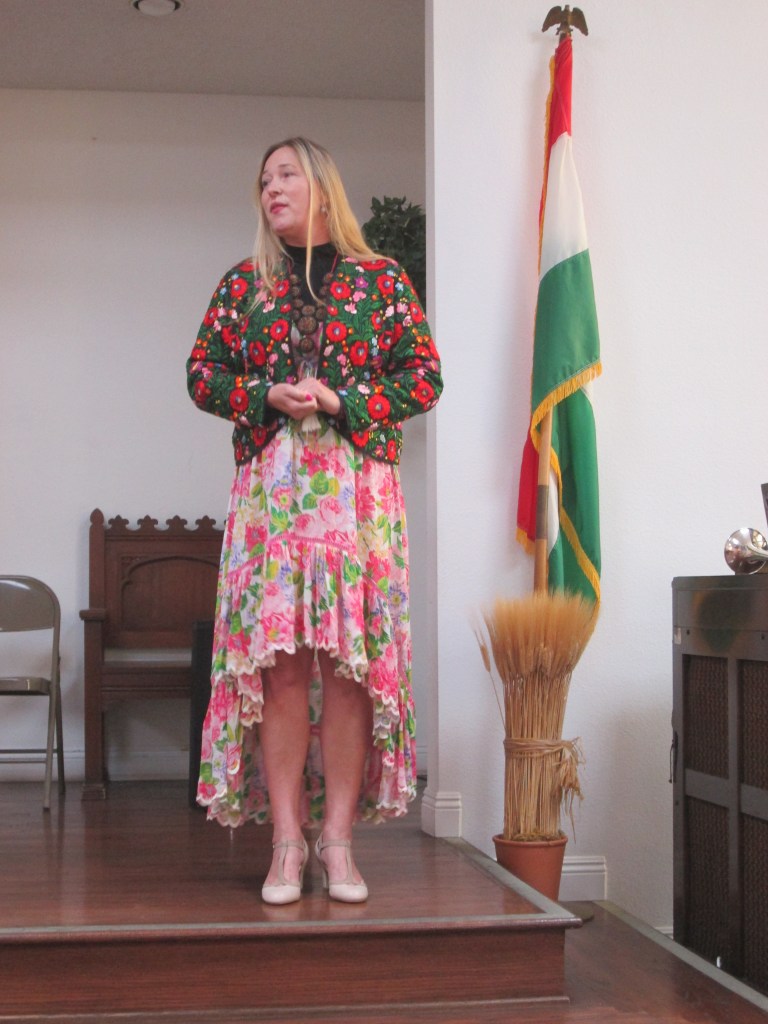
Today was another Hungarian festival, this time it was the Tavaszköszöntő at the First Hungarian Reformed Church of Los Angeles. Although I can speak Hungarian (ungrammatically), I have a difficult time understanding the language when all the long agglutinative words are strung together in paragraph lengths.
Still, just letting the language wash over me, while understanding only bits and pieces, sends me back to my roots. As a child born in the Hungarian neighborhood of Buckeye Road in Cleveland, Ohio, I did not even know that English existed as the language of my home and neighborhood was strictly Magyar. Listening to spoken Hungarian makes me feel as if I were being washed by the gentle waves of the Danube as it flows through Budapest.
This is the 100th anniversary of the Treaty of Trianon, which resulted in millions of Hungarians being assigned to Czechoslovakia, Romania, the Soviet Union, and Yugoslavia. One cannot go to a Hungarian gathering without seeing a map of the pre-Trianon borders of Hungary. It has led to a mythology of the lost cause, which is perfectly enshrined in the Himnusz, the Hungarian national anthem. Here is a YouTube video of the Himnusz:
Here are the lyrics in all the stanzas of the Himnusz:
Verse 1 O God, bless the nation of Hungary With your grace and bounty Extend over it your guarding arm During strife with its enemies Long torn by ill fate Bring upon it a time of relief This nation has suffered for all sins Of the past and of the future!
Verse 2 You brought our ancestors up Over the Carpathians’ holy peaks By You was won a beautiful homeland For Bendeguz’s sons And wherever flow the rivers of The Tisza and the Danube Árpád our hero’s descendants Will root and bloom.
Verse 3 For us on the plains of the Kuns You ripened the wheat In the grape fields of Tokaj You dripped sweet nectar Our flag you often planted On the wild Turk’s earthworks And under Mátyás’ grave army whimpered Vienna’s “proud fort.”
Verse 4 Ah, but for our sins Anger gathered in Your bosom And You struck with Your lightning From Your thundering clouds Now the plundering Mongols’ arrows You swarmed over us Then the Turks’ slave yoke We took upon our shoulders.
Verse 5 How often came from the mouths Of Osman’s barbarian nation Over the corpses of our defeated army A victory song! How often did your own son aggress My homeland, upon your breast, And you became because of your own sons Your own sons’ funeral urn!
Verse 6 The fugitive hid, and towards him The sword reached into his cave Looking everywhere he could not find His home in his homeland Climbs the mountain, descends the valley Sadness and despair his companions Sea of blood beneath his feet Ocean of flame above.
Verse 7 Castle stood, now a heap of stones Happiness and joy fluttered, Groans of death, weeping Now sound in their place. And Ah! Freedom does not bloom From the blood of the dead, Torturous slavery’s tears fall From the burning eyes of the orphans!
Verse 8 Pity, O Lord, the Hungarians Who are tossed by waves of danger Extend over it your guarding arm On the sea of its misery Long torn by ill fate Bring upon it a time of relief They who have suffered for all sins Of the past and of the future!
It is a powerful anthem. Hearing it sung at the festival today, I felt like taking my sword and riding to the border to stop the Turkish invader in his tracks. It is such a powerful hymn that it is forbidden to be sung at international sporting events—which just adds to the Hungarian sense of grievance.



 Tarnmoor
You must be logged in to post a comment.