“A Great Earthquake”

In his novel Dombey and Son (1848), Charles Dickens had a striking passage about the effect that railroad construction was having on parts of London. I remember this passage vividly from when I first read the book decades ago.

The first shock of a great earthquake had, just at that period, rent the whole neighbourhood to its centre. Traces of its course were visible on every side. Houses were knocked down; streets broken through and stopped; deep pits and trenches dug in the ground; enormous heaps of earth and clay thrown up; buildings that were undermined and shaking, propped by great beams of wood. Here, a chaos of carts, overthrown and jumbled together, lay topsy-turvy at the bottom of a steep unnatural hill; there, confused treasures of iron soaked and rusted in something that had accidentally become a pond. Everywhere were bridges that led nowhere; thoroughfares that were wholly impassable; Babel towers of chimneys, wanting half their height; temporary wooden houses and enclosures, in the most unlikely situations; carcases of ragged tenements, and fragments of unfinished walls and arches, and piles of scaffolding, and wildernesses of bricks, and giant forms of cranes, and tripods straddling above nothing. There were a hundred thousand shapes and substances of incompleteness, wildly mingled out of their places, upside down, burrowing in the earth, aspiring in the air, mouldering in the water, and unintelligible as any dream. Hot springs and fiery eruptions, the usual attendants upon earthquakes, lent their contributions of confusion to the scene. Boiling water hissed and heaved within dilapidated walls; whence, also, the glare and roar of flames came issuing forth; and mounds of ashes blocked up rights of way, and wholly changed the law and custom of the neighbourhood.

In short, the yet unfinished and unopened Railroad was in progress; and, from the very core of all this dire disorder, trailed smoothly away, upon its mighty course of civilisation and improvement.

But as yet, the neighbourhood was shy to own the Railroad. One or two bold speculators had projected streets; and one had built a little, but had stopped among the mud and ashes to consider farther of it. A bran-new Tavern, redolent of fresh mortar and size, and fronting nothing at all, had taken for its sign The Railway Arms; but that might be rash enterprise—and then it hoped to sell drink to the workmen. So, the Excavators’ House of Call had sprung up from a beer-shop; and the old-established Ham and Beef Shop had become the Railway Eating House, with a roast leg of pork daily, through interested motives of a similar immediate and popular description. Lodging-house keepers were favourable in like manner; and for the like reasons were not to be trusted. The general belief was very slow. There were frowzy fields, and cow-houses, and dunghills, and dustheaps, and ditches, and gardens, and summer-houses, and carpet-beating grounds, at the very door of the Railway. Little tumuli of oyster shells in the oyster season, and of lobster shells in the lobster season, and of broken crockery and faded cabbage leaves in all seasons, encroached upon its high places. Posts, and rails, and old cautions to trespassers, and backs of mean houses, and patches of wretched vegetation, stared it out of countenance. Nothing was the better for it, or thought of being so. If the miserable waste ground lying near it could have laughed, it would have laughed it to scorn, like many of the miserable neighbours.

The Ghost of New Years Past

Lucky New Year’s Postcard

I’ve said on many occasions, usually around this time of year, that only a fool celebrates the passing of time. Every January 1, take a picture of yourself in your bathroom mirror and note the thinning and graying of your hair, the mottling of your skin, and the network of spidery lines demarcating the zones of your face. Oh, well, it’s all a natural process.

On a more positive note, let’s see what the youthful Charles Dickens wrote about New Years Day in his first book, Sketches by Boz:

Next to Christmas-day, the most pleasant annual epoch in existence is the advent of the New Year. There are a lachrymose set of people who usher in the New Year with watching and fasting, as if they were bound to attend as chief mourners at the obsequies of the old one. Now, we cannot but think it a great deal more complimentary, both to the old year that has rolled away, and to the New Year that is just beginning to dawn upon us, to see the old fellow out, and the new one in, with gaiety and glee.

There must have been some few occurrences in the past year to which we can look back, with a smile of cheerful recollection, if not with a feeling of heartfelt thankfulness. And we are bound by every rule of justice and equity to give the New Year credit for being a good one, until he proves himself unworthy the confidence we repose in him.

This is our view of the matter; and entertaining it, notwithstanding our respect for the old year, one of the few remaining moments of whose existence passes away with every word we write, here we are, seated by our fireside on this last night of the old year, one thousand eight hundred and thirty-six, penning this article with as jovial a face as if nothing extraordinary had happened, or was about to happen, to
disturb our good humour.

Hackney-coaches and carriages keep rattling up the street and down the street in rapid succession, conveying, doubtless, smartly-dressed coachfuls to crowded parties; loud and repeated double knocks at the house with green blinds, opposite, announce to the whole neighbourhood that there’s one large party in the street at all events; and we saw through the window, and through the fog too, till it grew so thick that we rung for candles, and drew our curtains, pastry-cooks’ men with green boxes on their heads, and rout-furniture-warehouse-carts, with cane seats and French lamps, hurrying to the numerous houses where an annual festival is held in honour of the occasion.

We can fancy one of these parties, we think, as well as if we were duly dress-coated and pumped, and had just been announced at the drawing-room door.

Acton Bell

The Three Brontë Sisters from Left to Right: Anne, Emily, and Charlotte

No family anywhere had three such eminent novelists, though they wrote at a time when women novelists were looked down upon. Consequently, they published under the names of Acton Bell (Anne), Ellis Bell (Emily), and Currer Bell (Charlotte).

I have read and enjoyed the work of the two elder sisters, but until this week I had never read anything by Anne Brontë. I was delighted to find that she was as competent a writer as her sisters and perhaps a bit more modern in her outlook. Her novel Agnes Grey tells the story of a young governess dealing with the spoiled children of the well-to-do.

When one of her former charges (Rosalie) denigrates her eminent husband in front of a footman, she shows Agnes exactly what she thinks of servants:

Oh, no matter! I never care about the footmen; they’re mere automatons: it’s nothing to them what their superiors say or do; they won’t dare to repeat it; and as to what they think—if they presume to think at all—of course, nobody cares for that. It would be a pretty thing indeed, it we were to be tongue-tied by our servants!

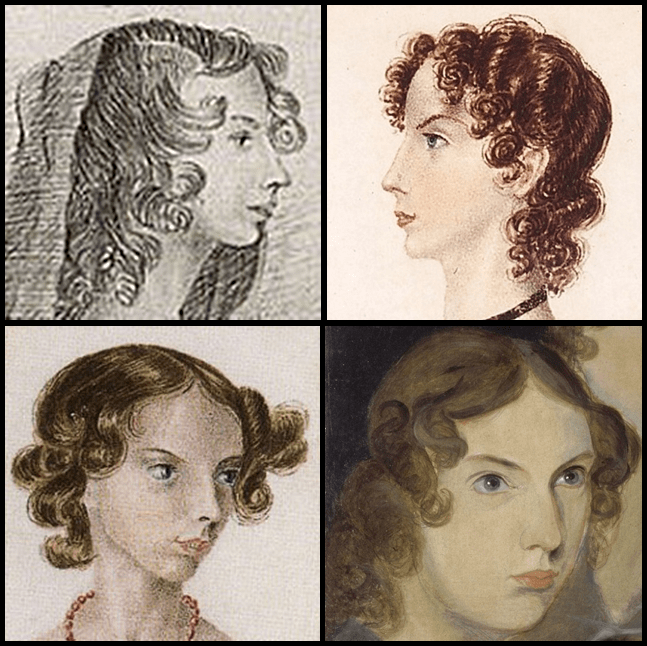
Four Images of Anne Brontë Drawn by Her Brother Branwell

Rosalie is nothing, however, compared to the little monsters of her first experience as a governess:

My task of instruction and surveillance, instead of becoming easier as my charges and I got better accustomed to each other, became more arduous as their characters unfolded. The name of governess, I soon found, was a mere mockery as applied to me: my pupils had no more notion of obedience than a wild, unbroken colt. The habitual fear of their father’s peevish temper, and the dread of the punishments he was wont to inflict when irritated, kept them generally within bounds in his immediate presence. The girls, too, had some fear of their mother’s anger; and the boy might occasionally be bribed to do as she bid him by the hope of reward; but I had no rewards to offer; and as for punishments, I was given to understand, the parents reserved that privilege to themselves; and yet they expected me to keep my pupils in order. Other children might be guided by the fear of anger and the desire of approbation; but neither the one nor the other had any effect upon these.

This is quite different from the angelic Victorian children depicted in most novels, especially in those of Charles Dickens. So I was quite pleased to see that the youngest Brontë has some sand in her, and she was an excellent writer to boot—as good as her older siblings.

Sherlock Holmes et al

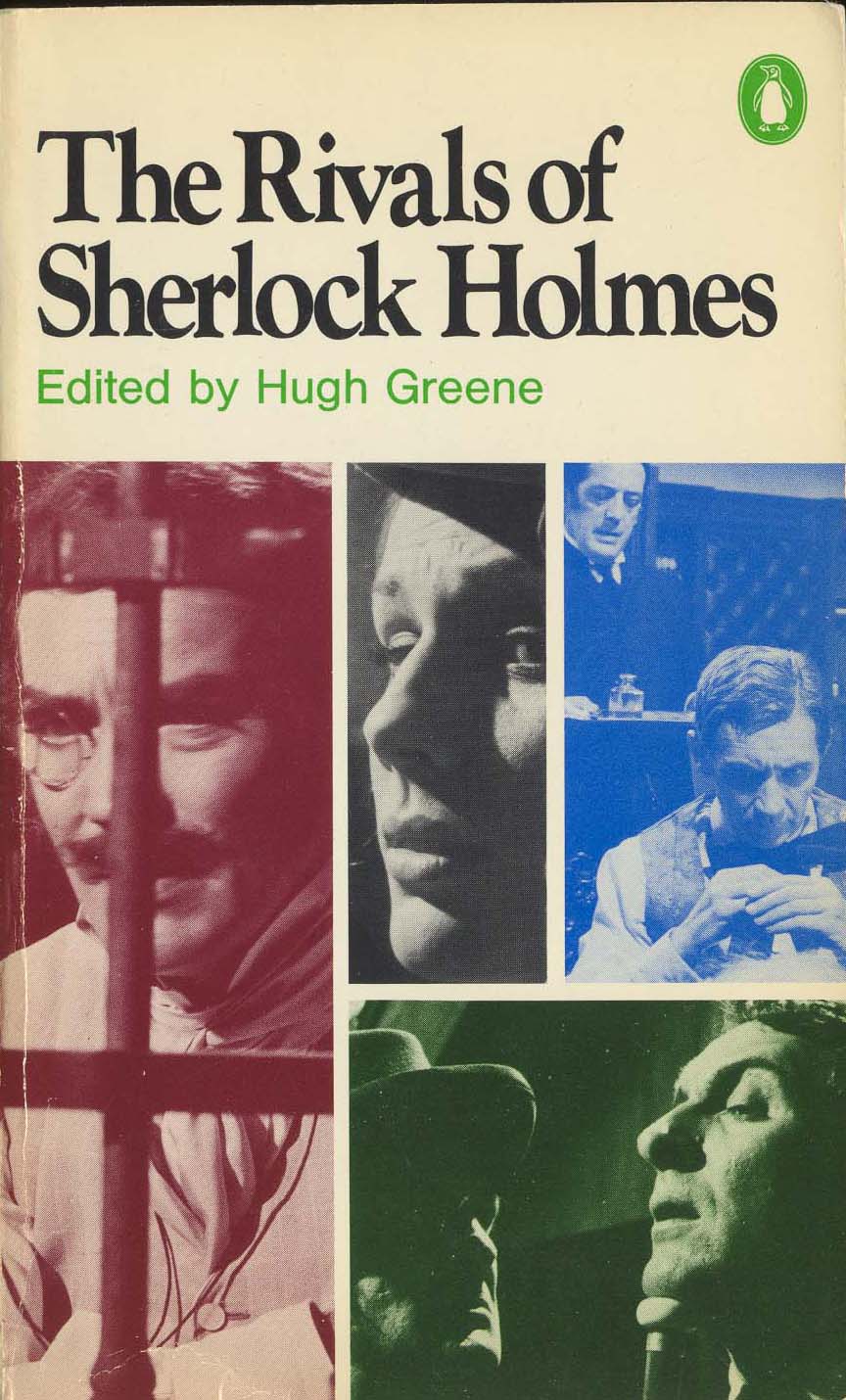
A Book That Introduced Me to Some Great Writers

Sherlock Holmes was never the only game in town. Granted, he was easily the best of the Victorian and Edwardian detectives; but there were a number of others worth reading. When I came upon the above book years ago, I was introduced to a whole constellation of British crime-fighters. The book was edited by Sir Hugh Greene (1910-1987), brother of novelist Graham Greene and director-general of the BBC during the 1960s. In all, he produced four books honoring lesser-known British and American detectives:

  • The Rivals of Sherlock Holmes (1970)
  • Cosmopolitan Crimes: Foreign Rivals of Sherlock Holmes (1971)
  • The Further Rivals of Sherlock Holmes (1973)
  • The American Rivals of Sherlock Holmes (1979)

The original volume was by far the best of the series. The only author I followed from the three later volumes was Jacques Futrelle, creator of the Thinking Machine detective stories, who drowned in the Titanic disaster of 1912.

For a number of years, I sought collections of several authors recommended in The Rivals of Sherlock Holmes. The ones who interested me the most were:

  • Arthur Morrison, who, in addition to his Martin Hewitt stories wrote the very Dickensian The Hole in the Wall and the excellent Dorrington Deed Box
  • Clifford Ashdown, author of the Romney Pringle stories
  • Baroness Orczy, the Hungarian woman author who gave us The Scarlet Pimpernel also wrote a series about a lady journalist in London named Polly Burton (The Old Man in the Corner stories)
  • R. Austin Freeman’s Edwardian Doctor Thorndyke forensic investigation stories appeared in several volumes
  • William Hope Hodgson wrote a series of stories about a ghost investigator named Carnacki
  • Ernest Bramah, a tea merchant, gave us a blind detective named Max Carrados, who was actually able to read newspapers by feeling the ink on the newsprint

My favorites from the above list are Bramah and Morrison, with Orczy and Freeman not far behind. Unfortunately, most of their books are devilishly hard to find.


Victorian Genre Fiction

Sherlock Holmes Was Not the Only Game in Town

Sherlock Holmes Was Not the Only Game in Town

The paperback whose cover is illustrated above first came out in 1972, followed by three other volumes of non-Sherlock detective stories written during the same period. Edited by Hugh Greene, brother of Graham Greene, the books were a revelation to me. I started Reading Richard Austin Freeman’s Dr. Thorndyke stories; Ernest Bramah’s Max Carrados stories (Carrados was blind, and could read the London Times by feeling the elevation of the ink on the paper); the novels and stories of the vastly underrated Arthur Morrison; Jacques Futrelle’s “Thinking Machine” stories (Futrelle died on the Titanic); and Baroness Orczy’s The Old Man in the Corner Stories.

And that was only the beginning! I also noticed that the Victorians and Edwardians wrote excellent horror stories as well, and that many of them were available from Dover Publications, including such luminaries as Algernon Blackwood, M. R. James, Arthur Machen, Mrs. J. H. Riddell, and Wilkie Collins. Now, in the age of the Kindle and other e-books, one could pick up virtually all of Blackwood’s short stories in two “megapacks” for a mere $1.98. There are even two well-known “psychic detectives” investigating hauntings and possessions, namely Algernon Blackwood’s John Silence, the self-styled “psychic doctor,” and William Hope Hodgson’s Max Carnacki, the ghost detective.

The stories are, for the most part, available readily and inexpensively now that their copyright protection expired years ago. It may still be difficult to find some Arthur Morrisons such as the Martin Hewitt detective stories and the stories in The Dorrington Deed-Box.

Even G. K. Chesterton got into the act somewhat later with his Father Brown stories, which are in a slightly different vein, but which owe much to Arthur Conan Doyle and his “rivals.”

A good way to start is to find Hugh Greene’s collections on eBay or Amazon.Com and, if you like them, dig around in used book stores, or, if you are on a budget, Amazon Kindle and its “rivals.”