Shock and Awe

So Easy To Get In ... So Hard To Get Out

So Easy To Get In … So Hard To Get Out

If we weren’t born yesterday, we know by now that it is so much easier to start a war than to end one. Our military talks about going into a war with an “exit strategy,” but what makes us think that we know enough about the situation in the country we are invading to devise an exit strategy that is based on any kind of reality, Take Iraq, for example. We stepped into that tar baby (or was it something equally sticky, but more pungent?) with a display of what George W. Bush called “shock and awe.” It made for good newsreel photography, but don’t you think that once people figured out was happening, they burrowed deep into their warrens and, except for a few unlucky souls, managed to survive.

For a while, things looked pretty good. But then something happened that the Pentagon never imagined: The invasion forced the irreconcilable elements of Iraqi society to splinter apart so quickly that, before we knew what was happening, we found ourselves in a civil war. After the first victories, we bottled ourselves up in the Green Zone. Whenever our boys ventured out, they risked being blown to smithereens by Improvised Explosive Devices (IEDs). Wars tend to accelerate the rapid transformation of societies. Take a look at what happened with all the displaced persons who found themselves stateless at the end of the Second World War.

We are not the only ones to find ourselves in this situation. Take Hitler’s Operation Barbarossa—the invasion of Russia—in 1941. Hitler and his General Staff thought that after some quick one-sided victories, Stalin would sue for peace. After all, the Soviet leader had no idea what was coming. When a Nazi deserter crossed into Russia to warn of an impending mass invasion the day before Barbarossa, Stalin casually had him executed as a spy attempting to sow disinformation. The Germans won their rapid victories and, for two years, came close to taking it all. They had an exit strategy, however, that bore no relation to reality. They thought Stalin would quickly sue for peace. Hitler would then take over Belarus and the Ukraine, send the Slavic riff-raff to death camps, and re-settle the area with prosperous German farmers. So ingrained was this image in the Germans’ minds that they made three slight errors:

  1. They did not plan to repair or replace the tanks, trucks, artillery, and other war machinery that would bog down on muddy Russian roads.
  2. They did not equip their troops with winter clothing.
  3. They did not have enough gasoline and oil to power their working war machinery.

When the Russians began their counter-offensive, they found the roads littered with frozen Wehrmacht corpses. Only 10-20% of the vaunted Nazi tanks were still working. And Paulus’s Sixth Army could not take Stalingrad because they didn’t have the fuel to get a sufficient number of their war machines into battle.

And as for the transformations wrought in Russian society, they were extensive. The war unified the Russians behind Stalin: They called it the Great Patriotic War. They moved their manufacturing capabilities out of range of the German bombers. Unlike Hitler, Stalin actually listened to his generals … in the long run, anyhow. On the negative side, Stalin assumed that every Russian who was ever behind German lines was suspected of collaboration: Hundreds of thousands were sent to the Gulag.

Japan’s exit strategy was to form a Greater East Asian Co-Prosperity Sphere consisting of China, Korea, Indonesia, Burma, the Philippines, and whatever other country they were able to overcome. No one told the Imperial Japanese Army, however, to be nice to the conquered peoples of East Asia. The net result was that no one voluntarily wanted in to Japan’s scheme.

Even Germany’s Schlieffen Plan (see Barbara Tuchman’s book The Guns of August) in the First World War was defective. It was no longer 1870, when Bismarck and von Moltke crushed France in a cakewalk. They forgot to consider that this might turn out to be a long war which they were not sufficiently endowed with the natural wealth to endure.

And so it goes. I am grateful that we did not take the opportunity to invade Syria. I can just see it now: After both sides whine for American help, no sooner would we show up than both sides would say, “Let’s get ’em” and proceed to blow us into kingdom come.

The Jeep Moment

It’s in All the 1950s Sci-Fi Films

It’s in All the 1950s Sci-Fi Films

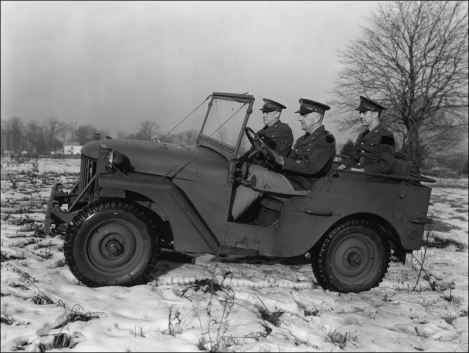
You probably remember The Day the Earth Stood Still (1951): A flying saucer lands in the park in our nation’s capital, and a worried crowd begins to gather. Not to worry, however, a Jeep full of Army officers pulls up, and everyone in the audience breathed a sigh of relief. Our boys are here! They’re invincible. The G.I.’s will take care of the alien menace.

Except, they don’t. Michael Rennie and his robot accomplice Gort have weapons at their command that could turn people and their property into something resembling a tuna melt.

I find it interesting that, after we’ve won a two-front war, we should suddenly feel fear. Was it because of the uncertainty generated by the atom? Hiroshima and Nagasaki appeared to have deeply affected the American psyche. All of a sudden, this relativity thing that no one seemed to understand could not only kill people, but do it in a way that was strangely alien. (Was that why Professor Barnhardt, the Alfred Einstein lookalike, was played by Sam Jaffe in the movie.)

We were right to feel fear—and not only because of the A-Bomb. With the end of the Second World War, we were entering a world we did not understand. First there was Communism, which scared the bejeezus out of us until it all unraveled like a cheap suit in 1988-89. But we didn’t get any kind of respite, because all of a sudden there was all this weird violence in the Middle East.

American Hawks were still around, except now they were called Neoconservatives. They kept having this “Jeep Moment,” where they would meet any crisis by sending in our troops with their Jeeps (though now I guess they ride Humvees). We’re still dealing with something alien that we can’t understand. We keep fighting wars with people who speak a strange language and worship strange gods and in general behave in bizarre ways. And they think nothing of blowing themselves to bits if they could take a bunch of us with them. (In the Arab world, being a suicide bomber is considered to be a good career move.)

It strikes me that there is a mathematical formula for success in a military action against a peoples we don’t understand: K/F=C, or Knowledge divided by Force equals the Chance of Victory. Either that, or a recipe for fried chicken.


The Hamfisted Military of America

Infantry in Viet Nam

Infantry in Viet Nam

The United States has probably the most powerful military in the world—provided, of course, that it is used to fight the battles of the Second World War over again. You know what I mean: Those large set-piece battles with penetrations, encirclements, flanking maneuvers, the whole West Point 101 ball of wax.

Too bad that the wars we have gotten entangled in since the Second World War do not play to our strengths. One doesn’t need a college degree in military science to appreciate the following factors:

  1. Whereas the people of the United States know nothing about foreign languages and cultures, all cultures know a great deal more about us than we know about them.
  2. Because our news media blares all around the world, guerrilla fighters know when the American people are tired of a war and want to end it.
  3. If the “bad guys” a.k.a. “freedom fighters” want to win, they just have to blow up one or two Americans to smithereens every day or so. Just so long as every news cycle has some bad news in it.
  4. The nationals who have allied themselves with the American forces are highly suspect as to their allegiance. The ARVN (Army of the Republic of Viet Nam), for instance, acted as intelligence for the North Vietnamese. (Guess why so many incidents of “terror” in Afghanistan are committed by fighters wearing the uniforms of Karzai’s army and police.)
  5. Before long, the American forces will be confined to “Green Zones” or “strategic hamlets” or other fortified places where they could be picked off at will—usually just one or two at a time.

The thought keeps hitting me between the eyes: If we’re so stupid about it all and keep making the same mistakes over and over again, why do we even bother? What do we accomplish?

It Will Never Be Easy

Sir Winston Churchill

Never, never, never believe any war will be smooth and easy or that anyone who embarks on that strange voyage can measure the tides and hurricanes he will encounter. The statesman who yields to war fever must realize that once the signal is given, he is no longer the master of policy but the slave of unforeseeable and uncontrollable events… incompetent or arrogant commanders, untrustworthy allies, hostile neutrals, malignant fortune, ugly surprise, awful miscalculations.—Sir Winston Churchill