Beware of Awards

Yesterday, Martine and I attended a screening of old cartoons from Walt Disney, the Fleischer Studio, MGM, and United Productions of America (UPA). Much was made of fact that several of the cartoons had won Oscars for animation.

It was at that point that my hackles began to rise. Academy Awards? You mean those awards voted on by industry members who bore grudges against the studio for which they worked or for competing studios. Granted, some Oscar winners deserved their awards. Knowing the film industry as I do, however, many votes are cast based on pure spite.

There is no doubt that the Walt Disney Studio made some great cartoons. But did “The Old Mill” (1937) deserve an Oscar? See your yourself: The Old Mill. There were some very arty effects, but zilch in the way of story or characters.

On the other hand, a controversial Donald Duck cartoon entitled “Der Fuehrer’s Face” (1943) was banned for decades because it showed the Quackster having a dream that he was a Nazi in Hitler’s Germany. It was a fascinating look at American war propaganda. Was it a little racist? Hmm, could be….

In the speaker’s idolization of Disney, he totally left out Warner Brothers’ Looney Tunes and Merrie Melodies. No Bugs Bunny, no Tweety or Sylvester, no Roadrunner, no Porky Pig, and no Daffy Duck. And he said very little about the 1930s productions of Max and Dave Fleischer. I am referring to Popeye, Betty Boop, and a host of great cartoons, such as Poor Cinderella (1934) or Raggedy Ann and Raggedy Andy (1941).

As a low rent film scholar, I am suspicious of awards. I never watch the Academy Awards on television, and I never take awards into consideration when planning my viewing. I may not have the so-called prestige of the Oscars behind me, but I am more likely to see films for other reasons than industry backbiting.

Here’s Looking at You Kid

“Round Up the Usual Suspects”

It was appropriate on this Valentine’s Day to see Warner Brothers 1942 classic Casablanca for the umpteenth time. As TV host Ben Mankiewicz said when he introduced the film for tonight’s Turner Classic Movies (TCM) showing, it was the most perfect film produced by the Hollywood studio system.

As a love story, one is not sure until the end whether Rick (Humphrey Bogart) will give the letters of transit for Lisbon to Victor Laszlo (Paul Henreid) and his wife Ilsa Lund (Ingrid Bergman). And will Captain Renaud (Claude Rains) arrest Rick and turn him over to Major Strasser of the Third Reich (Conrad Veidt)?

I have seen Casablanca so many times in my life that it is almost like Holy Writ. Even when Ilsa Lund pleads, “Victor, please don’t go to the underground meeting tonight,” I forgive the clunky line because it is an integral part of a film that I love as is. I even like all the recurrences of “Here’s looking at you kid.”

Sometimes I think one of the things that makes the film great are all the actors from Mitteleuropa that were in the cast, including Peter Lorre, Conrad Veidt, Leonid Kinsky, S. Z. Sakall, Ludwig Stössel, Hans Heinrich von Twardowsky, Trude Berliner, Ilka Grünig, and Wolfgang Zilzer. And don’t forget Hungarian director Michael Curtiz and Austrian music director Max Steiner. It gives the whole “stuck refugee” theme a major boost, with the daily plane to Lisbon and freedom as its ultimate desideratum.

Spear and Magic Helmet

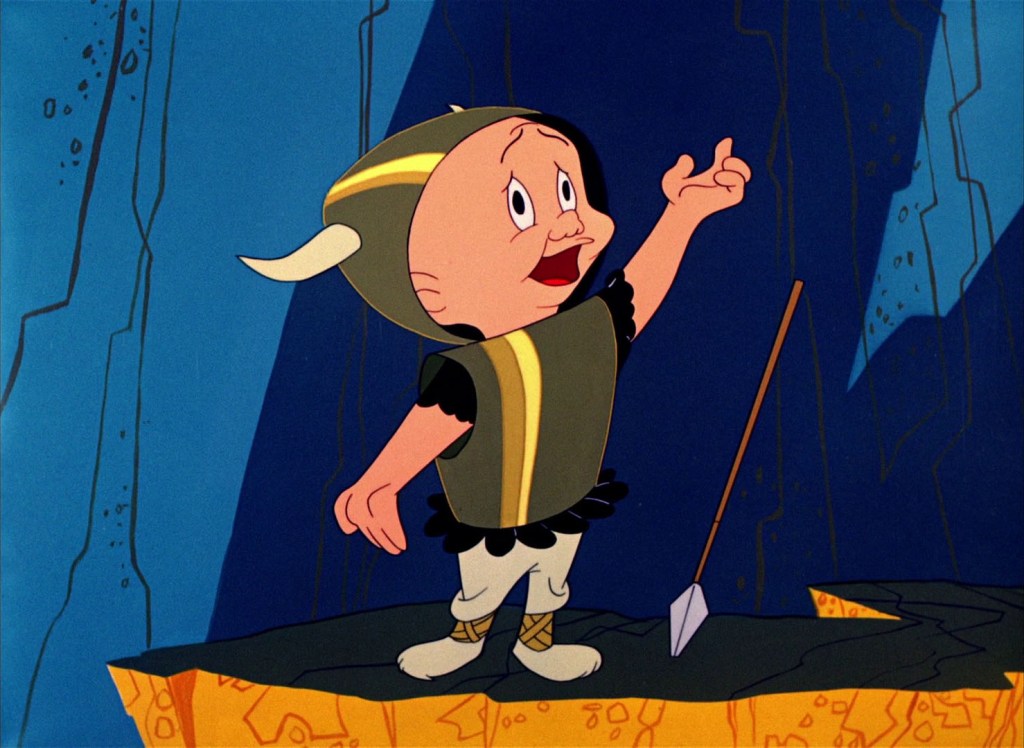
Elmer Fudd in Warner Brothers’ “What’s Opera Doc?”

It was, to my mind, the greatest short cartoon ever made. In 1957, Warner Brothers released a Wagner opera parody (of Die Walküre, no less) featuring Bugs Bunny and Elmer Fudd. You can see it, with commentary, by clicking on:

I have written before about my suspicion that the United States has (d)evolved from a Bugs Bunny nation to an Elmer Fudd nation. Always immaculately garbed in hunting clothes, or in the case of this film spear and magic helme, Fudd nonetheless doesn’t know what he wants. He says he wants to kill the wabbit. But he also, in his strange incel way, loves the wabbit. And Bugs knows it and takes advantage of him.

Of course, in this film Bugs dies. His last line as he is carried off by Elmer is something to the effect that operas always end sadly.

Elmer Carries Off the Body of His Doomed Love/Hate Object

When Elmer first encounters Bugs in the film, he is poking his spear into a rabbit hole shouting “Kill the Wabbit!” while Bugs, standing off to the side, munches on a carrot. Only after a few moments does Elmer realize that Bugs is taunting him. He erupts in rage and uses his magic helmet to conjure up a storm. Whereupon Bugs as Brunhilda rides down a hill from a Greek temple lounging on the back of a fat white horse.

Naturally, Elmer falls immediately in love with Bugs/Brunhilda and his golden braided wig. They dance a pas de deux until—horrors!—Bugs/Brunhilda’s wig falls to the ground. Enraged again, he uses his magic helmet to whip up a storm that kills the object of his hate/love. Remorse follows as Elmer exits carrying the limp Bugs.

The film was directed by Chuck Jones, one of my favorite animators.

Bosko the Doughboy

Bosko the Doughboy (1931): Violence and Absurdity

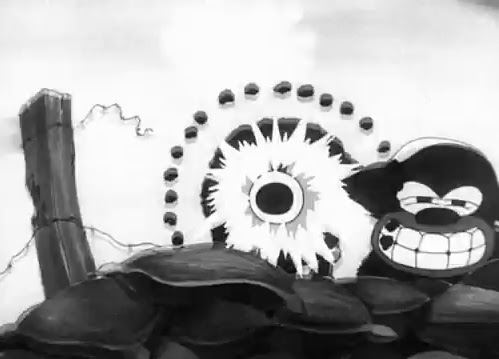
Before the Hays Code was widely adopted around 1934, Hollywood produced a number of wild films that would be frowned upon even in today’s Quentin Tarantino environment. One of the wildest is a Bosko cartoon released by Warner Brothers in 1931 which shows the horrors of World War I in a graphic and yet insanely cheerful manner. Oddly, it was directed by Hugh Harman, whose Harman-Ising cartoon productions usually showed cute animals innocently singing and cavorting on farms and in the wilds.

In “Bosko the Doughboy,” one of the first shots is a brutal machine-gunner who turns his weapon to the camera and shoots the audience.

Machine-Gunning the Audience

I have seen numerous World War I films such as Stanley Kubrick’s Paths of Glory (1957) and the recent They Shall Not Grow Old (2018). Yet neither of these films can hold a candle to “Bosko the Doughboy,” whose experiences would shame the Good Soldier Schweik or Bertolt Brecht or Eugene Ionesco. This is a cartoon which remains on a manic and chirrupy plane even when many of its cute animal characters are shot to pieces by machine guns, cannon, or aerial bombardment. Nobody is sad, even when in articulo mortis.

You have to see this film to believe it. It’s only seven minutes long.

In the very last scene, a bomb explodes right by Bosko, turning him black. His response? He spreads his arms wide and shouts “Mammy!” a la Al Jolson.