
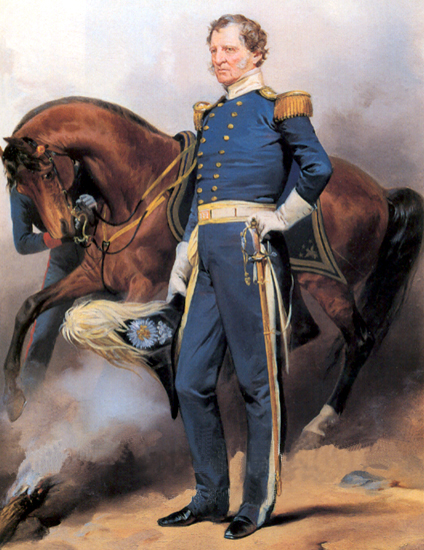
General Winfield Scott (1786-1866)
While he was a cadet a West Point, Ulysses S. Grant admired the spit and polish of General Winfield Scott, under whom he was to fight in the Mexican War that followed. For a while, Grant emulated him, but changed his mind when the local rubes would make fun of him for looking like a toy soldier.
Then, when the Mexican War began with Grant as a brevet lieutenant, he saw an entirely different kind of general. According to Bruce Catton in his book U.S. Grant and the American Military Tradition:
[Zachary] Taylor was a natural. A professional soldier but not a West Pointer, he had fought in the War of 1812 and subsequently in many a campaign against the Indians. He had an ostentatious and wholly sincere dislike for military formality. By custom, he wore blue jeans, a long linen duster and a floppy straw hat, and he would lounge around headquarters like a seedy backwoods farmer. On the parade ground, when he sat on his horse to review troops or to watch drill or maneuvers, he was as likely as not to sit sidesaddle, chewing tobacco and behaving like a man who casually watches the field hands harvest a crop.
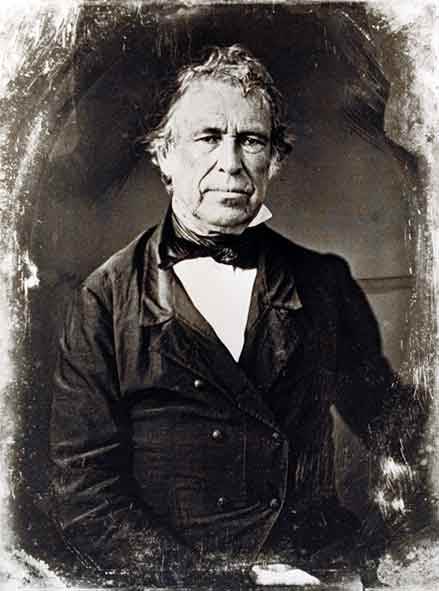
General Zachary Taylor (1784-1850)
Both Scott and Taylor wir first-rate generals. When Fort Sumter was fired on in 1861, Winfield Scott was in charge of the Federal Army, but he was too ridden with dropsy and gout—not to mention obesity—to be able to mount a horse, so he offered his command to Robert E. Lee. Of course, when Virginia seceded from the Union, Lee went over to the Rebs, and Irvin McDowell got the nod to head the Army of the Potomac.
Interestingly, Winfield Scott’s master plan for starving the Confederacy into submission was the so-called “Anaconda Plan,” which called for a naval blockade and the capture of the Mississippi. He may have been called “Old Fuss and Feathers” toward the end of his life, but Scott knew what he was doing; and Grant copied his Western strategy from him.
Grant had two excellent role models, which he needed, because the array of timid military ignoramuses who headed the Army of the Potomac before him did not have much to offer their successors other than a long string of defeats.
 Tarnmoor
You must be logged in to post a comment.