
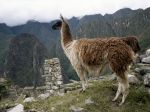
Llama
A similar arrangement prevailed with respect to the different manufactures as to the agricultural products of the country. The flocks of llamas, or Peruvian sheep, were appropriated exclusively to the Sun and to the Inca. Their number was immense. They were scattered over the different provinces, chiefly in the colder regions of the country, where they were intrusted to the care of experienced shepherds, who conducted them to different pastures according to the change of season. A large number was every year sent to the capital for the consumption of the Court, and for the religious festivals and sacrifices. But these were only the males, as no female was allowed to be killed. The regulations for the care and breeding of these flocks were prescribed with the greatest minuteness, and with a sagacity which excited the admiration of the Spaniards, who were familiar with the management of the great migratory flocks of merinos in their own country.
At the appointed season, they were all sheared, and the wool was deposited in the public magazines. It was then dealt out to each family in such quantities as sufficed for its wants, and was consigned to the female part of the household, who were well instructed in the business of spinning and weaving. When this labor was accomplished, and the family was provided with a coarse but warm covering, suited to the cold climate of the mountains,—for, in the lower country, cotton, furnished in like manner by the Crown, took the place, to a certain extent, of wool,— the people were required to labor for the Inca. The quantity of the cloth needed, as well as the peculiar kind and quality of the fabric, was first determined at Cuzco. The work was then apportioned among the different provinces. Officers, appointed for the purpose, superintended the distribution of the wool, so that the manufacture of the different articles should be intrusted to the most competent hands. They did not leave the matter here, but entered the dwellings, from time to time, and saw that the work was faithfully executed. This domestic inquisition was not confined to the labors for the Inca. It included, also, those for the several families; and care was taken that each household should employ the materials furnished for its own use in the manner that was intended, so that no one should be unprovided with necessary apparel. In this domestic labor all the female part of the establishment was expected to join. Occupation was found for all, from the child five years old to the aged matron not too infirm to hold a distaff. No one, at least none but the decrepit and the sick, was allowed to eat the bread of idleness in Peru. Idleness was a crime in the eye of the law, and, as such, severely punished; while industry was publicly commended and stimulated by rewards.—William H. Prescott, History of the Conquest of Peru
 Tarnmoor
You must be logged in to post a comment.