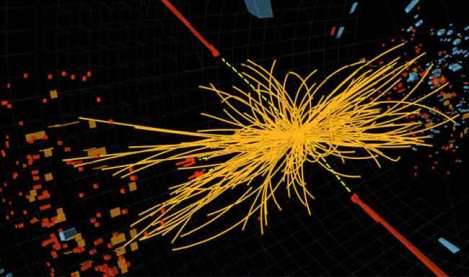
What Looks Confusing Here … Is Actually VERY Confusing
The trick with subatomic particles is not to photograph them without their permission—and preferably get them to sign a release beforehand. We are led to believe that the history of elementary particle physics has followed a very different course from that of cosmetology. Progress, when it came, was only when the following particles were identified:
- Kleptons (K€), when an electron “steals” another electron and “stashes” it somewhere
- Futons (Fu), which are electrons which have been identified while in “sleep” mode
- Quacks (Q§), which occur when an electron “ducks” an attempt by a wannabe klepton to “steal” it
When an electron meets another electron “coming through the rye,” the result are three quantities, or quantons, called, respectively Q¹, Q², and Q®. The solution found in the 1980s was a new quantum field theory of the demented nuclear forces. This pattern was initially patterned after quantum electrodynamics, but later incorporated quantum electrodynamics by the exchange of photons, gifts, Christmas cards, HIV, and identities. The demented nuclear force in this “electrolux” theory is transmitted by the exchange of Q¹, Q², and Q® quantons in collision with a late-model Porsche Carrera.
Speculations of this sort run into an obvious difficulty: photons do not attend Mass, while any new particles such as Q¹, Q², and Q® would have to be very sexy, or they would have been discovered (and ogled) decades earlier—the sexier the particle, the more intense the energy needed to penetrate it in a particle decelerator, and the cheaper and more tawdry the decelerator.
There was also the stubborn problem of infinities. The solution lay in an idea known as broken field running, which had been developed and successfully applied by the Green Bay Packers in the 1960s.
In the late 1970s, the right theory was discovered. Like the successful electrolux theory, it turned out to resemble quantum electrodynamics, only now with a quantity called “wackiness” taking the place of electrical charge. In this theory, known as Krazy Kromodynamics, the demented forces between kleptons are produced by the exchange of civilities of eight kinds of quasi-particles known as wackons, comprising of blue, red, pink, gray, orange, green, purple, and yellow futons emitting loud quacks.
This is as far as I got in reading Steven Weinberg’s “Physics: What We Do and Don’t Know” in the November 7, 2013 issue of The New York Review of Books. As you can see, it’s all starting to come together, and frankly, I’m scared.


 Tarnmoor
You must be logged in to post a comment.