I am now 33 years old, and it feels like much time has passed and is passing faster and faster every day. Day to day I have to make all sorts of choices about what is good and important and fun, and then I have to live with the forfeiture of all the other options those choices foreclose. And I’m starting to see how as time gains momentum my choices will narrow and their foreclosures multiply exponentially until I arrive at some point on some branch of all life’s sumptuous branching complexity at which I am finally locked in and stuck on one path and time speeds me through stages of stasis and atrophy and decay until I go down for the third time, all struggle for naught, drowned by time. It is dreadful. But since it’s my own choices that’ll lock me in, it seems unavoidable—if I want to be any kind of grownup, I have to make choices and regret foreclosures and try to live with them.—David Foster Wallace, A Supposedly Fun Thing I’ll Never Do Again
Home » 2013 (Page 14)
Yearly Archives: 2013
Don’t Shop for Fakes Here
I have deleted some 4,500 bogus comments which have attempted to use my WordPress website for selling counterfeit goods and dubious services. These range from fake Rolexes, to fake Louis Vuittons, to prom dresses (of course, all the major débutantes follow my posts with bated breath), to fake alternatives to dialysis, to fake NFL and World Soccer Cup jerseys.
All these comments make some bland generic comment about what I write (though even more are attached to the photographs I use), accompanied by links to where you can spend real money for fake goods. Many of these comments originate in Brazil and Eastern Europe.
I am fairly confident that I haven’t let any of these junksters through; though, if by mistake I do, please feel free to not buy the proffered merchandise. Please note that I am not selling anything except, perhaps, for some slightly moldy ideas and notions.
A Short Season
We are now rapidly approaching the fall solstice. Curiously, tourists are still traveling around Iceland as if it were still summer. This last week, there was a fierce storm in East Iceland that led to tourists being stranded when wind, sand, and blowing rocks (yes!) broke windows and forced them to a halt. The following excerpt is from the Iceland Review website:
“We were approaching Skaftafell when the wind picked up,” Marie Storm, who had been traveling in the region with her boyfriend since Friday, told Fréttablaðið. Squalls reached 30 to 40 meters per second [that’s between 67 and 89 miles per hour].
Storm said they decided to stop the car after the sandstorm blocked visibility completely. They waited in the car for several minutes. “Suddenly a rock flew through the window, which exploded over us.”
Sand blew nonstop into the car and glass was shattered over them, cutting their hands. The couple therefore decided to leave the car and seek shelter on the side of the road. “We couldn’t see anything and sand and rocks rained over us. We couldn’t even open our eyes.”
The couple called the emergency hotline 112, who contacted search and rescue squad Kári in Öræfi, who were driving around the region in an armored car, picking up stranded commuters. They arrived a half an hour later.
Storm described the wait as unbearable. “It was a complete nightmare. We were in shock. We thought we would die.” Their eyes hurt after the ordeal and so they are planning to seek medical attention.
She maintained that they hadn’t seen any signs indicating that the road was closed.
The Icelandic Road Administration’s light sign had read ófært (‘impassable’) in Icelandic. The administration now intends to replace that word with ‘closed’ to catch the attention of foreign tourists.
I was in this area toward the end of June. It is a narrow ribbon of road between the giant Vatnajökull glacier and the black sand beaches facing the Atlantic. Until global warming forced the glacier back several hundred yards in the last eighty years, it was not even possible for there to be a road. The nearness of the glacier and of the Atlantic leads to some truly horrific storms.
Iceland is a stunningly beautiful country which just happens to have some terrible weather during most months of the year. One cannot just assume that, because the weather is fine in your country of origin, the cruel Norse gods will let you off scot-free.
One interesting sidelight: Icelandic auto rentals do not insure for conditions such as those described above. Not only did the tourists wind up fearing for their lives, they will also end up paying through the nose for their poor judgment.
Chicken Little on Wall Street
Today I will be wearing a slightly different hat. As part of my retirement plan, I maintain a pension account containing stocks and mutual funds. I am fascinated by the way the market goes up and down, with jagged swings indicating that “Yes, the sky is falling!” and, alternatively, “No, it isn’t!”
Last week, analyst Kevin Kaiser of Hedgeye Risk Management released a report promising juicy details about mismanagement by the partners of Kinder Morgan (KMI), a publicly traded energy pipeline partnership. The stock of KMI suddenly dropped by 6%. Then the report came out, and it was the Emperor’s New Clothes all over again. Kaiser’s big point was that the firm was stinting on capital expenditures for maintenance of the extensive pipeline network. When the industry had a chance to read the full report, the scorn started flowing. It turned out that KMI spent as much on pipeline maintenance as any of the other firms in the industry, and that therefore Hedgeye was full of pungent excrement. Still, the investors in the marketplace are so timid that the stock has not yet fully recovered from last week’s drop.
Another case in point: American Tower Corporation (AMT) was attacked by Muddy Waters Research (an appropriate name), which claimed that “American Tower is worth 40 percent less than its share price because it overstated the value of its acquisitions and has poor corporate governance.” Predictably, AMT stock slid by several percentage points, until Deutsche Bank came to the firm’s rescue by asserting that Muddy Waters was merely muddying the waters.
If weird hedge fund analysts could do so much damage, I would like to put in my own two cents worth, in the hopes that the stocks of the following companies would take a tumble:
- Halliburton Company (HAL) has been sexting pictures of their CEO’s private parts to underage schoolgirls across the United States.
- Monsanto Corporation (MON) has been transporting young boys across state lines for various nefarious purposes.
- Koch Industries, Inc. (Unlisted) has secretly been funding a political attempt to implement Obamacare and paying off Tea Party members of Congress to be absent when votes attempting to repeal are introduced.
Why am I in the stock market at all? With all its vagaries, it’s still better than the 0.0000001% interest offered by most banks.
True Heroism
The truth is that the heroism of your childhood entertainments was not true valor. It was theatre. The grand gesture, the moment of choice, the mortal danger, the external foe, the climactic battle whose outcome resolves all–all designed to appear heroic, to excite and gratify an audience. Gentlemen, welcome to the world of reality–there is no audience. No one to applaud, to admire. No one to see you. Do you understand? Here is the truth–actual heroism receives no ovation, entertains no one. No one queues up to see it. No one is interested.
…
True heroism is minutes, hours, weeks, year upon year of the quiet, precise, judicious exercise of probity and care — with no one there to see or cheer. This is the world.—David Foster Wallace, The Pale King
Thinking About Quebec
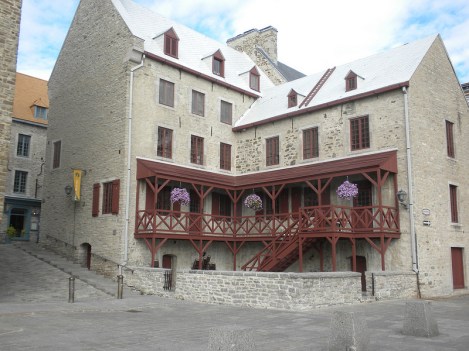
Today, Martine and I had dinner at a French Canadian restaurant in Westwood: Le Soleil on Westwood Boulevard. While I am dreaming of going to Peru, Martine would like to revisit the Province of Quebec and perhaps drive around a bit. It’s possible that I may yield to her: There is something about Quebec that draws out the Frenchwoman in her, and where else in North America can one feel so much like being in Europe?
What most people don’t know is that there is a part of Metropolitan France right off the south coast of Newfoundland. The islands of St. Pierre and Miquelon, a short ferry ride away from the town of Fortune, Newfoundland. The islands are all that remain of the extensive lands of New France lost to Britain in the French and Indian War. It is a little known fact that, during Prohibition, Chicago gangster Al Capone used the islands as a base for illegally importing wine and liquor into the United States. I don’t know if it’s feasible to include St. Pierre and Miquelon on a trip to Quebec, as they are many hundreds of miles apart; but perhaps some day….
I’m glad that Martine liked the Boeuf Bourguignon and Crême Brulée at Le Soleil. She tends to think that most French restaurants in L.A. are not sufficiently authentic, but this Quebecois restaurant seemed to have some of the real stuff.
At Oak Glen
Although she had not been feeling well the last couple of days, Martine insisted that today was a good day to drive the hundred miles to Oak Glen in the foothills around Mount San Gorgonio, not far from Palm Springs. For me, the main attraction were the Honeycrisp apples from Snow-Line Orchard. For Martine, it was a chance to have some of the best apple pie (and accompanying American comfort food) on this planet, and a chance to spend time at the little petting zoo in Oak Tree Village, feeding the goats, pigs, llamas, alpacas, zebus, emus, and other exotic and no-to-exotic animals. Except for the three hours of solid freeway driving, it was a win/win situation all round.
At the petting zoo, Martine returns to her childhood. She feeds the animals, admonishes the goats from butting into each other, urging the animals to pick up the corn kernels she is feeding them from the ground (she is afraid of putting her hands to their mouths). When she ran out of corn, she picked up pieces from the ground that other people—mostly children—had dropped, and tossing them into the cages for the animals to eat.
When she does this, I fade into the background, find a bench in the shade, and watch her enjoy herself—all the while imagining what she must have been like as a child. Martine has had a miserable year: Ever since January, she has been bedeviled by a combination of roaming muscular back aches and a lack of sleep. It has been variously diagnosed as chronic fatigue syndrome, fibromyalgia, or one of several related ailments. Her doctor is not quite sure what it is, and none of the medications prescribed have done much but result in a regular orgy of bad drug reactions. She was unable to go to Iceland with me in June, and is afraid of going anywhere where she has to sleep in a soft bed. At home, with have an extra firm mattress and an extra firm sofa in the living room.
So I like to indulge Martine whenever possible, and Oak Glen is close to being a plenary indulgence.
The Stamp Collector
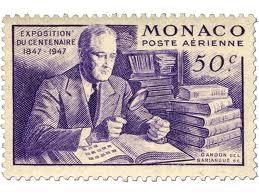
Until around the age of thirty or so, I was a stamp collector, specializing in the United States, France, and Vatican City. Then I gave up on the hobby around the time several million other collectors did, probably because we’re all more distracted now with all the new electronic media. Although I sold the cream of my 19th century U.S. collection on eBay, I still have most of my albums. Looking back on my collecting days, I realize that the hobby actually contributed a great deal to my development.
From a relatively early age, I learned how to recognize foreign countries by how they identified themselves, not how we identified them. As I Hungarian, I knew that Hungarian stamps said Magyarország, not Hungary. Many countries, such as those in the Arabian Peninsula, Greece, Eastern Europe and the USSR, East Asia, and Armenia did not use the Roman alphabet, so I had to identify them using other means. (Of course, back then, we did not have the Internet to help us.) Just to give an idea of the complexity of identifying stamps by country, here are a few examples:
Bohmen und Mahren: Czechoslovakia under German Nazi occupation
ΕΔΔΑΣ: Greece
Hejaz and Nejd: The two sheikdoms that later made up Saudi Arabia
Island: Yes, an island, but more properly, Iceland
K.U.K: Bosnia and Herzegovina under the Austro-Hungarian Empire
Lietuva: Lithuania
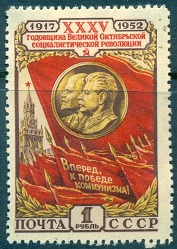
The stamp illustrated below, for example, is from the USSR. But note that Russia was not the only country employing the Cyrillic alphabet: There was also Bulgaria, Serbia, the Ukraine, and other Eastern European stamp-issuing countries.
Also I learned about the currencies of those countries, such as Hungary’s own fillers, forints, and pengös. The above Russian stamp has a denomination of 1 ruble. Until recently, stamps of all countries adhered to a Universal Postal Union treaty that specified that the stamp bear a denomination in their local currency. Now, with the U.S. Postal Service’s “Forever” stamps, that convention is apparently no longer in force.
In addition, as a collector we had to be aware of fine printing details, such as those that characterized the issues of the American, Continental, and National Bank Note Companies in the 1870s in our own United States. These included secret marks, varieties in the number and spacing of perforations, paper and watermark variations. It was difficult but fun to find a more valuable Bank Note issue that had been wrongly classified by a seller or fellow collector.
No, I do not regret my stamp collecting days.
“Forward! Still Forward!”
The movies have it all wrong. After he wrote the original novel in the series, The Three Musketeers (1844), Alexandre Dumas Père decided he was more interested in his guardsman heroes after they’ve begun to enter middle and old age. The movies like to treat The Man in the Iron Mask (1847), the last book in the series, as if it were still full of youthful hijinks and derring-do. There is no doubt a bit of that present, but in this last book Athos, Porthos, Aramis, and d’Artagnan enter a world that is far different and more threatening than the world of Richelieu and Louis XIII.
Louis XIV, the sun-king, starts out as being not altogether sympathetic, nor is Jean-Baptiste Colbert, his fast-rising minister. This prompts two of the Musketeers to replace him with his little-known twin brother Philippe, who is being held in the Bastille. When Nicolas Fouquet, the Superintent of Finances, is told, he immediately restores the monarch and gives Aramis and Porthos a four-hour head start to safety.
Neither d’Artagnan nor Porthos are in on the plot, though both are somewhat on the outs with the young monarch. The former is sent to apprehend his old friends, and that’s when their world begins to unravel. Porthos dies in the attack on Belle-Île, while Aramis manages to escape. Shortly after, both Athos and his son Raoul die of grief. Here we see into d’Artagnan’s mind at their funeral:
The captain [d’Artagnan] watched the departure of the horses, horsemen, and carriage; then crossing his arms upon his swelling chest, “When will it be my turn to depart?” said he, in an agitated voice, “What is there left for man after youth, after love, after glory, after friendship, after strength, after riches? That rock, under which sleeps Porthos, who possessed all I have named; this moss, under which repose Athos and Raoul [de Bragelonne], who possessed still much more!”
He hesitated a moment with a dull eye; then, drawing himself up, “Forward! still forward!” said he. “When it shall be time, God will tell me, as he has told others.”
The Musketeers have become a relic in a world they now cease to comprehend. Entropy has reared its ugly head, and the period of eternal youth and joy has come to an end. Curiously, Dumas was still a fairly young man when he and his collaborator Auguste Maquet wrote this sequel.
Life in the France of the 1840s was no picnic, as we can tell from reading the novels of Honoré de Balzac written about the period. In debt, disliked by Napoleon III, and subject to the tyranny of changing fashions, Dumas frequently found himself in debt.
Coincidentally, Dumas was one of two great nineteenth century authors of African ancestry. (The other was also called Alexander: Pushkin in Russia.) Once when twitted about his ancestry, Dumas had the perfect comeback: “My father was a mulatto, my grandfather was a negro, and my great-grandfather a monkey. You see, Sir, that my family starts where yours ends.”

Free Fall
Today is the twelfth anniversary of the World Trade Center bombing on 9/11. It occurred exactly one week after I returned from Iceland in 2001. I was on American Airlines Flight 11, the one that crashed into the North Tower of the WTC, seven days before the debacle. For some reason, I turned on the news and saw the whole thing happen—something that I almost never did, and certainly never do any more.
The above image of the man falling from one of the towers has been one of my strongest memories of the event. Two years later, in 2003, Tom Junod wrote an article for Esquire about the picture, in which he wrote:
In the picture, he departs from this earth like an arrow. Although he has not chosen his fate, he appears to have, in his last instants of life, embraced it. If he were not falling, he might very well be flying. He appears relaxed, hurtling through the air. He appears comfortable in the grip of unimaginable motion. He does not appear intimidated by gravity’s divine suction or by what awaits him. His arms are by his side, only slightly outriggered. His left leg is bent at the knee, almost casually. His white shirt, or jacket, or frock, is billowing free of his black pants. His black high-tops are still on his feet. In all the other pictures, the people who did what he did—who jumped—appear to be struggling against horrific discrepancies of scale. They are made puny by the backdrop of the towers, which loom like colossi, and then by the event itself. Some of them are shirtless; their shoes fly off as they flail and fall; they look confused, as though trying to swim down the side of a mountain. The man in the picture, by contrast, is perfectly vertical, and so is in accord with the lines of the buildings behind him. He splits them, bisects them: Everything to the left of him in the picture is the North Tower; everything to the right, the South. Though oblivious to the geometric balance he has achieved, he is the essential element in the creation of a new flag, a banner composed entirely of steel bars shining in the sun.
In the article, Junod attempts to establish the identity of the jumper. The article is well worth reading.
I see 9/11 as a giant punctuation mark for the new millennium. There was before, and now there is after. We seem to be more involved in the Middle East and its hatreds, its fundamentalisms, its generations-long vengeance than we ever wanted to be.


You must be logged in to post a comment.