OK, Who Cut the Cheese?

It’s Best to Be Slow and Through on This Issue

It’s Best to Be Slow and Thorough on This Issue

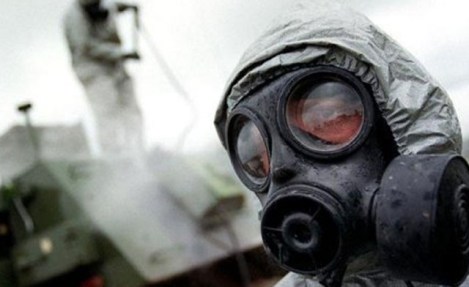
I don’t really mean to be facetious about this, but there exist several possibilities regarding the use of nerve gas in Syria:

  • Most people think that Bashar al-Assad is responsible, and he might very well be
  • Arrayed against Bashar and his Baathists are a lot of Al-Qaida baddies, who might well have gotten their hands on some Sarin from Chemical Ali’s stock of it in Iraq
  • It could be that both sides are releasing nerve gas, which is not as outlandish as it may seem

Remember that George W. Bush had us going to war against Saddam in Iraq based on “weapons of mass destruction” that were never found. We cannot risk making assumptions that will lead to a massive loss of lives among Syrians or among our own armed forces.

Even if we are able to identify which side is employing nerve gas, I am reluctant about committing ourselves to bombing raids or, worse yet, “boots on the ground.” If we send in our bombers and Cruise Missiles, how do we know what targets to hit, considering that our military intelligence is god-awful or nonexistent. And do we want to set up another Green Zone, this time in Damascus or Homs or Aleppo, from which we cannot venture out without being blown to bits by roadside bombs?

And if we commit to either course, who stands to gain? Who stands to lose? Are we even asking ourselves these questions, or do we just assume that we’re still the world’s policeman after all these failed forays?


Kills Wife, Children, Self

I’m Beginning To Think It’s Well Beyond Gun Control

I’m Beginning To Think It’s Well Beyond Gun Control

Something highly incongruous is happening around the country. On one hand, the total rate of crime, including murder, is decreasing nationwide. On the other hand, what murders there are are becoming more spectacular:

  • The random killing in Duncan, Oklahoma, of a young Australian baseball player by teens who were “bored”
  • The murder of a World War II veteran who is beaten to death by teens in Spokane
  • The shooting of four co-workers by a North Florida man who then took his own life

And that’s just within the last couple of days. Whether guns are involved or not, there seems to be a dangerous anomie among teens, and a total lack of conflict resolution skills among many of their elders.

So frequent are these stories that sometimes it is difficult to distinguish one occurrence from another: They merge into one another, with the result that it seems everyone is out there senselessly killing people—all the time!

For one thing, the news media obviously batten on to these stories so that people watching the news or reading the paper (wait—they don’t do that any more) are sickened. Each is accompanied by a news media orgy that continues until it is time for the next news media orgy to begin.

Since I have given up on watching the news, I don’t get as badly hammered by bad news as most people. But even following stories on the Internet causes sufficient consternation.

What must other people think when they watch our news program? I am reminded of Mexican newspapers giving gory details of murders and showing photos of the bodies. At least, that’s the way it was when I used to travel through Mexico in the 1980s.

Will Petrograd Fall to the Whites?

Victor Serge

Victor Serge

“Never, perhaps, have I lived in such total serenity. There is great happiness in being detached from everything and understanding everything. The happiness I feel is immense, bitter, painful, and calm. Life appeared suddenly before me stripped of everything that encumbered it: habits, conventions, duties, worries, superfluous relations. We end up abandoning our souls almost entirely to these things. Do you remember that story by Kipling we read together at Vevey: ‘The Miracle of Purun Bhagat’? It’s the tale of an old Westernized Hindu who retires high up in the mountains in order to finish out his life there with the earth, plants, tame animals—eternal reality. I’m an occidental. I have no wish to remove myself from men or from action: these too belong to eternity. I wish only to overcome my own impotence and to finally understand the curve described in the sky by the hurricane which is carrying all of us along with it.

“All man’s miseries are reduced to naked simplicity here. We live the life of the poor. And I understand the poor, their direct vision of reality, their power to hate, their need to overturn the world. I have no hate, except, perhaps, in the end, for the things I love the most—I believe we are almost all of us without hate in this prison. I may be mistaken, for I don’t observe the others enough. I don’t have the time, would you believe it?

“They say the terror is going to end; I don’t think so. It is still a necessity. The storm must uproot the old trees, stir the ocean to its depths, wash clean the old stones, replenish the impoverished fields. The world will be new afterward.”—The Counterrevolutionary Professor Lytaev in Victor Serge’s Conquered City

The Perils of Chelsea

Interesting Timing

Interesting Timing

I find it amusing that Bradley (a.k.a. Chelsea) Manning has changed his/her gender preference right around the time he/she received a 35-year prison sentence. Now that raises several interesting possibilities. If he (I will continue with the masculine gender for now, only because it’s just too cumbersome handling the pronouns otherwise) were going to spend his time in San Quentin or one of the other California prisons, it would very likely mean that he wants to be on the receiving end of some rough trade. I don’t know what the situation is at Leavenworth and other Federal penitentiaries, but I suspect that the sexual scene is relatively more sedate.

If I were an indie filmmaker, I can picture half a dozen scenarios of what happens from this point on; but I have no intention of going into detail in this blog.

At the back of my mind, I suspect that the former Bradley Manning’s release of information to WikiLeaks was at least somewhat motivated by his frustrations serving in the U.S. military given his gender orientation.

But why reveal that information now?


Heads I Win, Tails You Lose

Yeah, Let’s Clean It Up and Rid Ourselves of More American Fighting Men and Women

Yeah, Let’s Clean It Up and Rid Ourselves of More American Fighting Men and Women!

Even at this late date, we can find Neocons and Universal Hawks like John McCain advocating that we intervene militarily in Syria. After all, it worked so well for us in Iraq, Afghanistan, and Libya.

Now first of all, whom do we support? The cruel Baathist dictatorship of Bashar al-Assad, or the Islamofascists of Al-Qaida? Come on, quick! It’s one or the other. Or maybe we can just kill everyone and turn the country into a parking lot for future wars.

I am beginning to think that one characteristic of Americans is that they do not have the ability to learn from experience. Do you suppose it could be all that Oxycontin, or maybe there’s something in that bad beer that most Yanquis drink while watching (un)reality shows on the idiot box? In any case, as soon as the opportunity for another war in a country that we don’t understand (and—really—do we understand any of them?) presents itself, there’s a large contingent all gung ho for getting G.I. boots on the ground.

Let me look in my crystal ball: If we intervene on behalf of Bashar, we will be treated with contempt the world over. If we intervene on behalf of the rebels, we will be allying ourselves with Al-Qaida—and we will be treated with contempt the world over. If we don’t intervene at all, we will be treated with contempt the world over … but we wouldn’t have to bury the charred, exploded remains of thousands of young American men and women. I don’t know, but number three is looking mighty good to me.

The Arab Spring has shown us that the Middle Eastern man in the street wants to live in a democracy like Americans, but they have absolutely no idea of how to get there. The only people who are well organized are either the Islamofascists or the tyrants and their stooges. There are maybe a handful of others, but they are constantly disheartened by the actions of their coreligionists.

I think that the best thing we can do is not rely on the Middle East for anything and just let the people kill one another. Sure, we can send them Band Aids and antiseptics and such, but no weapons and none of our military personnel.

What I Will Remember Most

Under Attack by Arctic Terns

Under Attack by Arctic Terns

Now that I’ve been back from Iceland for six weeks now, what do I remember most about that remote and somewhat wild island? The place that keeps coming back to me are the West Fjords. Only some seven thousand people live on a large peninsula punctuated by basaltic ridges and broad fjords. It is quite possibly one of the most isolated parts of Europe, even though one can reach it from Reykjavík by bus in about eight hours.

Above is our little guide Thelma (which she pronounces as Talma) walking with a tourist surrounded by an angry cloud of arctic terns who are aggressively defending their nearby nests. I can understand them, in a way. It’s been a bad year for Icelandic birds, what with the puffins of Vestmannæyjar being unable to produce a bumper crop of little pufflings, and arctic terns likewise having problems due to global warming.

The Little Town of Isafjörður

The Little Town of Isafjörður

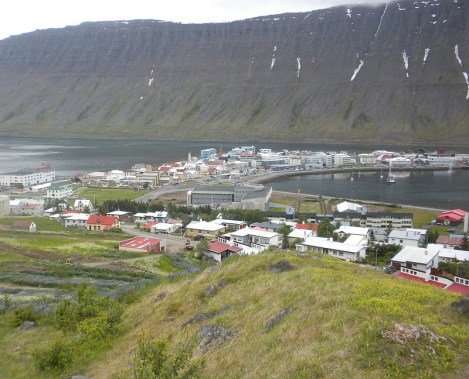
Not that I felt particularly warm in the West Fjords “capital” of Isafjörður” (shown above) which has only some two thousand inhabitants. It’s on a little sandy spit of one of Iceland’s largest fjords, and it is fully about ten degrees Fahrenheit colder than any other part of Iceland that I visited, with the exception of the glacier Vatnajökull.

Why does the image of the West Fjords stick with me so much? And not only with me, but with other travelers as well. Most of them go to backpacking to Hornstandir, a desolate peninsula with spectacular views jutting out into the Denmark Straits that separate Iceland from Greenland. I myself did not go there, but most of the European kids who stayed at the youth hostel made that their number one destination. I’d like to see it some time, but I doubt I am up for a multi-day trek with tent, sleeping bag, camp stove, and food.

No, I will remember the long bus rides on gravel roads past spectacular waterfalls and cute little villages like Thingeyri and Patreksfjörður. I will remember the bird cliffs at Latrabjarg, where a gale-force wind was trying to blow me to my death on the rocks several hundred feet below. I will remember the island of Vigur (top photo), where a single family ekes out a living gathering eider down and welcoming summer tourists with coffee, tea, and homemade cakes.

These places are all etched in my memory. The beauty will remain with me forever.

Act Like It’s a Victory

Schematic of the Battle of Cold Harbor

Schematic of the Battle of Cold Harbor

I think I am coming to the end of my Civil War enthusiasm. But then, it can suddenly be revived at a moment’s notice—so don’t count too much on it.

My chief interest has been Ulysses S. Grant, who finally figured out how to win the Civil War for Lincoln. There had been so many failures in the leadership of the Army of the Potomac. A noxious pattern was established, which consisted of rampant braggadocio followed by condign defeat followed by a retreat to lick their wounds.

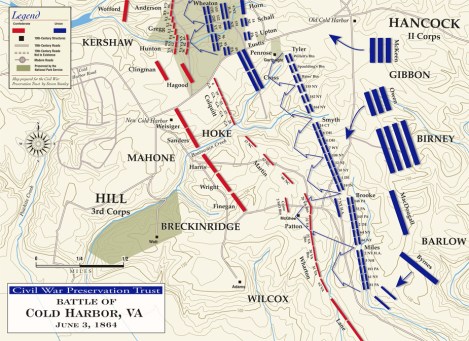
Look at that schematic of the Battle of Cold Harbor. Like all the victories of Grant’s 1864 Overland Campaign, it was by no means a rout. It could even be viewed as a defeat. The Army of the Potomac suffered more casualties than the Army of Northern Virginia—except for one key difference. Grant stayed put and prepared for the next battle, and Lee inexorably backed toward the Confederate capital at Richmond. (This is exactly the opposite of Lee vs. previous commanders of the Army of the Potomac, who always backed toward Washington in case they had to defend it.)

Between the Battle of the Wilderness and the Siege of Petersburg, Grant kept applying the pressure, and Lee kept responding. Casualties almost didn’t matter. If Lee lost a man, he had great difficulty replacing him. For Grant, there was a pool of two and a half million men of military age who had not yet served (though it was difficult at times getting them to enlist).

By acting as if the battle were a victory and getting ready for the next one, Grant guaranteed a Northern victory.


Two Role Models

General Winfield Scott (1786-1866)

General Winfield Scott (1786-1866)

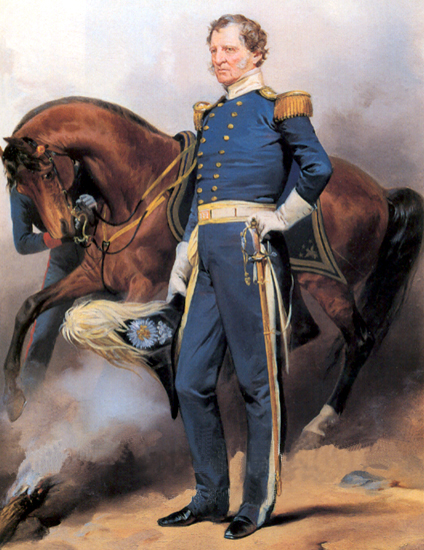
While he was a cadet a West Point, Ulysses S. Grant admired the spit and polish of General Winfield Scott, under whom he was to fight in the Mexican War that followed. For a while, Grant emulated him, but changed his mind when the local rubes would make fun of him for looking like a toy soldier.

Then, when the Mexican War began with Grant as a brevet lieutenant, he saw an entirely different kind of general. According to Bruce Catton in his book U.S. Grant and the American Military Tradition:

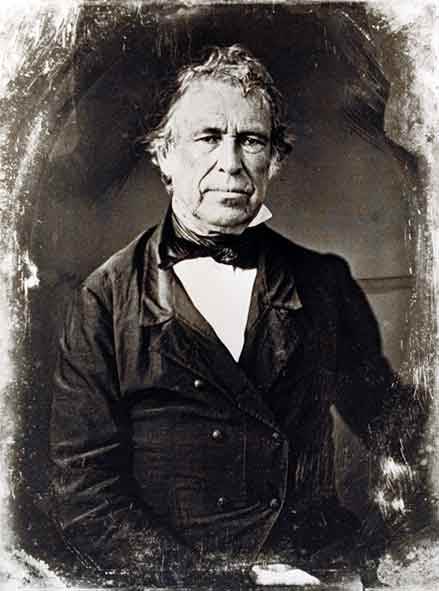
[Zachary] Taylor was a natural. A professional soldier but not a West Pointer, he had fought in the War of 1812 and subsequently in many a campaign against the Indians. He had an ostentatious and wholly sincere dislike for military formality. By custom, he wore blue jeans, a long linen duster and a floppy straw hat, and he would lounge around headquarters like a seedy backwoods farmer. On the parade ground, when he sat on his horse to review troops or to watch drill or maneuvers, he was as likely as not to sit sidesaddle, chewing tobacco and behaving like a man who casually watches the field hands harvest a crop.

General Zachary Taylor (1784-1850)

General Zachary Taylor (1784-1850)

Both Scott and Taylor wir first-rate generals. When Fort Sumter was fired on in 1861, Winfield Scott was in charge of the Federal Army, but he was too ridden with dropsy and gout—not to mention obesity—to be able to mount a horse, so he offered his command to Robert E. Lee. Of course, when Virginia seceded from the Union, Lee went over to the Rebs, and Irvin McDowell got the nod to head the Army of the Potomac.

Interestingly, Winfield Scott’s master plan for starving the Confederacy into submission was the so-called “Anaconda Plan,” which called for a naval blockade and the capture of the Mississippi. He may have been called “Old Fuss and Feathers” toward the end of his life, but Scott knew what he was doing; and Grant copied his Western strategy from him.

Grant had two excellent role models, which he needed, because the array of timid military ignoramuses who headed the Army of the Potomac before him did not have much to offer their successors other than a long string of defeats.

The Joys of Friendship

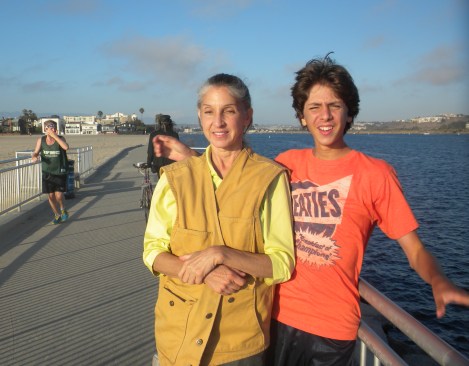
Mona and Wilder

Mona and Wilder

This evening, I got together with old friend Mona, with whom I used to work more than ten years ago. At the time, her little son Wilder was still an infant. No more, it seems. (It must be those Wheaties.)

Although my friends and I are all growing older, it is good to see their children thriving.

Because I lack a pituitary gland, I could never have children of my own. (And no, I was never very positive in my replies to people who said I could “just adopt,” as if all I had to do was put in a deposit at the neighborhood baby store.) So I take particular pleasure in seeing the children of my friends.

Martine was unable to join us, because her back was hurting her; so she was lying flat on her back wearing a brace when I returned from the Marina after seeing Mona.


Lobster Town

Lobster Restaurant in Höfn

Lobster Restaurant in Höfn

They’re not lobsters as we think of them in the United States or Canada, but the langoustine or Nephrops norvegicus (Norwegian Lobster) of Iceland is every bit as good. The Maine Lobster is a giant, but the langoustine fits the same great flavor into a smaller package.

The lobster capital of Iceland is the town of Höfn, which is pronounced very much like a hiccup. Let’s take it slowly: HOEP, with the oe sounding like the oe in French oeil, “eye.” And where did that “p” sound come from? It seems that, in Icelandic, certain diphthongs change the pronunciation of the first consonant. Just like the name of Iceland’s International Airport. It looks as if it should be pronounced KEFF-lah-vick, but it’s actually KEP-lah-vick or KEB-lah-vick, with the “f” sounded halfway between a “p” and a “b.” And if that confuses you, don’t bother going to Hafnarfjörður, or the elves will do evil things to your vocal chords.

Getting back to lobster, Höfn is a relatively recent town that owes its growth to its location midway between East Iceland and the towns of the Southwest, including Reykjavík and Selfoss. In addition, it has one of the better harbors in the Southeast, if a little treacherous because of shifting shoals. But it is spectacular to wake up in the shadow of Europe’s biggest glacier, Vatnajökull.

Also, for some reason, the langoustines are especially plentiful and tasty around Höfn. If you visit the place, as you should when coming to Iceland, be sure to try the langoustines. They are especially good at the Humarhöfnin Restaurant pictured above. And please don’t ask me to pronounce it.