Archangels of the Andes

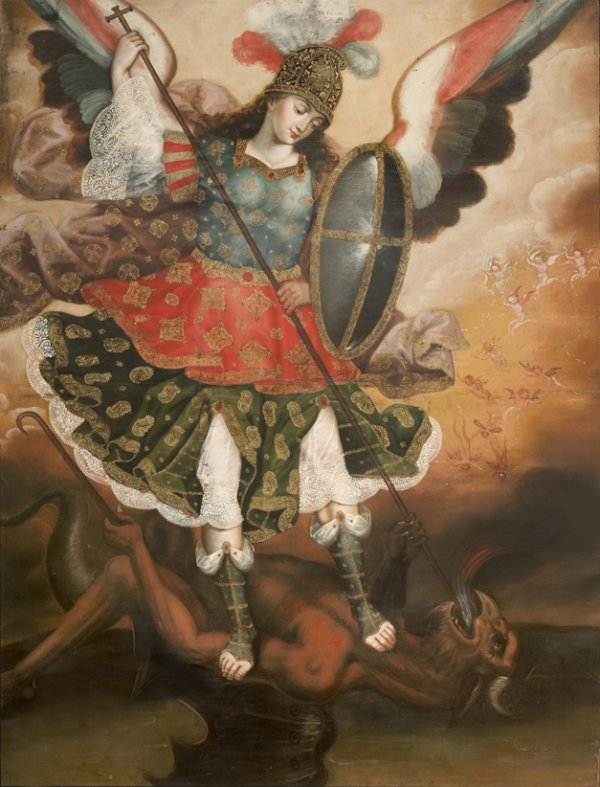
The Archangel Michael Vanquishing Satan

The Archangel Michael Vanquishing Satan

They are young, elegant, and handsome. Their wings are bi-colored, like the wings of mature condors. Yet they are all powerful and conquer their enemies with surpassing ease. They are the archangels depicted in paintings of the Cusco School of Art.

One has to imagine what it was like to be an Inca facing a compact phalanx of Spanish conquistadores mounted on horseback. At Cajamarca, many thousands were slaughtered by Pizarro and his hundred or so men. They barely even used their muskets, which were pretty useless in hand-to-hand combat in any case. No, it was Spanish steel and the strangeness of seeing warriors on horseback. Were they a single creature, man and horse? The Incas tried to kill the horses and display their corpses, thinking that now they would win with ease.

It was not to be so. The Incas were ultimately conquered, even though it took the better part of a century to complete the conquest. To the defeated, it didn’t look as if their gods were of much help to them. There must be something to this Christianity!

You can see it in the native painters’ depiction of angels, such as the one above. Michael defeats the demon without breaking a sweat or staining his doublet. He might just as easily be crocheting a doily or cleaning his nails. All throughout Peru, I saw hundreds of these archangels in the churches and archiepiscopal palaces, all with the same characteristics. The artists are usually indigenous Quechuans who painted multiple images of the same religious figures for distribution to churches all around the country.

When the Incans saw these angels, did they think of how easily they themselves were bested by the Spanish?


Ollantay

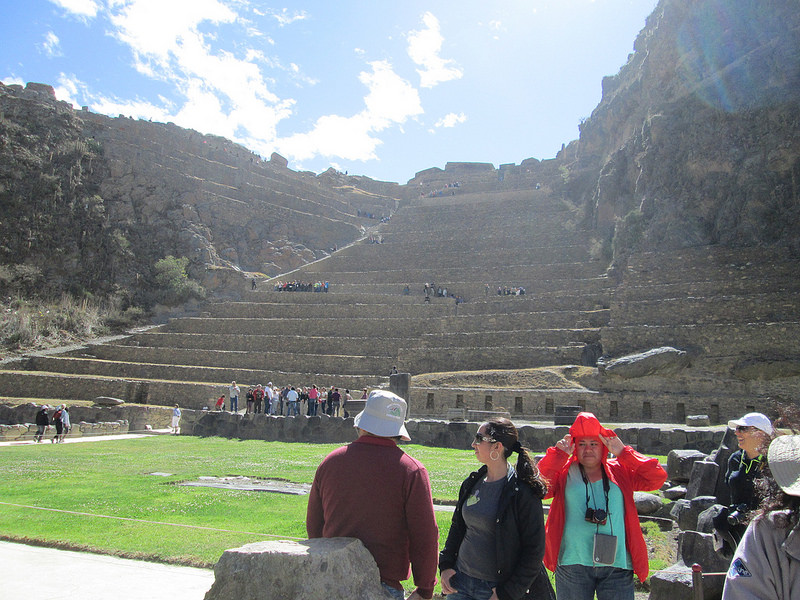
Inca Ruins at Ollantaytambo

Inca Ruins at Ollantaytambo

Built into a hillside, the ruins at Ollantaytambo was the site of the last Inca victory over the Spanish. Manco Inca defeated a force captained by Hernando (brother of Francisco) Pizarro by diverting the Urubamba River and flooding the battlefield. The thrill of victory didn’t last long, because Manco Inca withdrew his forces to Vilcabamba in the jungle of Espiritu Pampa, where it was lost until rediscovered in the 20th Century.

Most tourists don’t spend much time visiting the Incan sites in the Sacred Valley, preferring instead to either take the train to Machu Picchu or hike the 35 km of the Inca Trail without further delay. (When people asked if I was taking the Inca Trail, I always answered by saying that I was taking the Inca Train.)

Other than Machu Picchu and the sites immediately around Cusco, the main tourist destinations in the valley are Pisac and Ollantaytambo. Pisac is known for its Sunday crafts market and “Ollantay,” as the starting point for most of the trains to Machu Picchu. The ruins at Ollantay are extensive, including temples, terraces for farming, and granaries several hundred feet up in the Andes.

At the ruins, I hired a guide named William who did a good job of explaining, albeit in broken English, the features of the site. In fact, I liked him so much, I hired him for an all-day tour of Moray, Maras, the Salineras, and Chinchero the next day. That trip (about which more later) proved to be one of the highlights of my trip to Peru.

Who Was More Civilized?

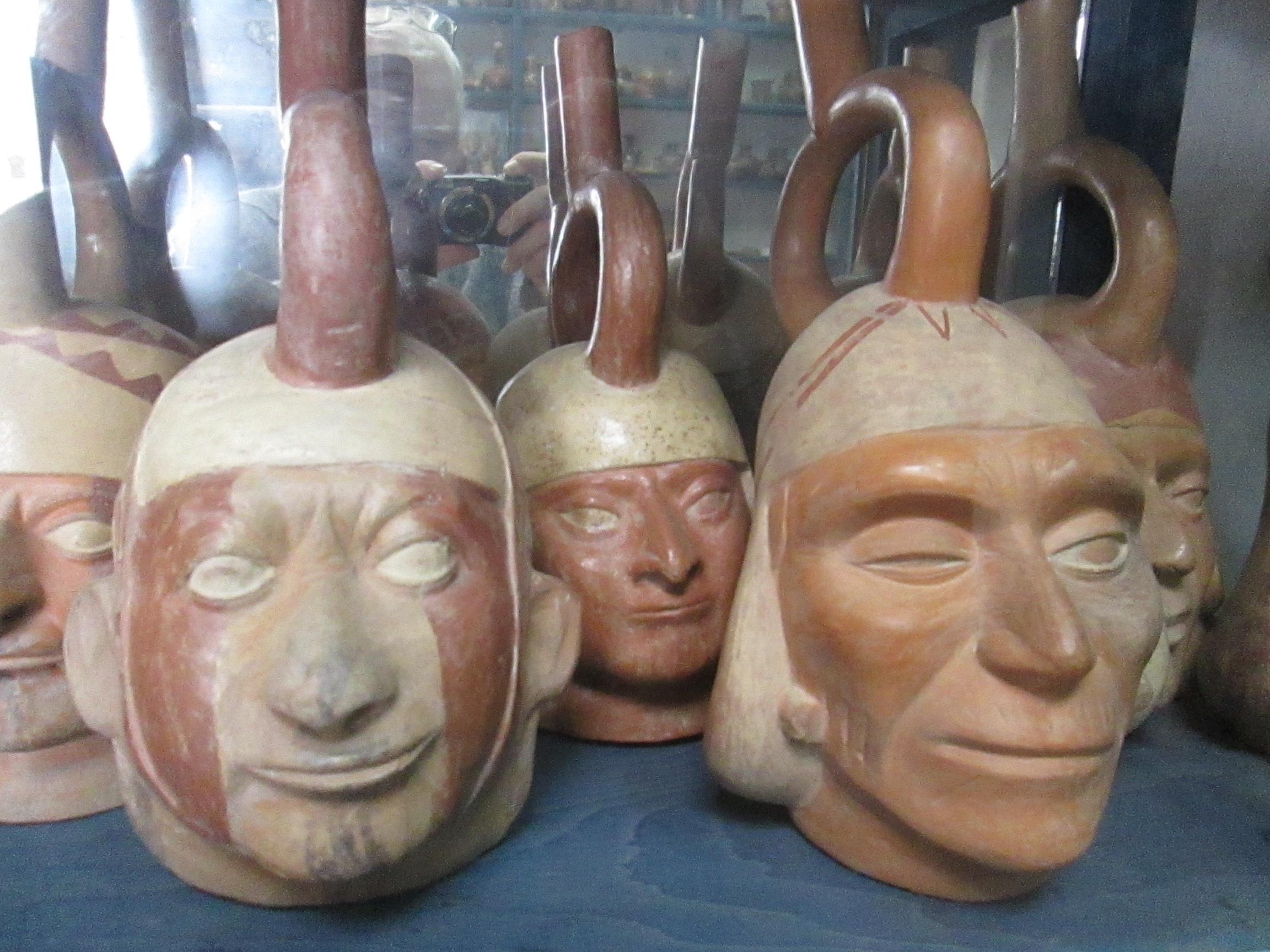
Moche Ceramics at Lima’s Museo Larco

Moche Ceramics at Lima’s Museo Larco

Who really was more highly civilized—the Incas or some of the peoples who preceded them? While it is unquestionable that the Incas were the greatest stonemasons and road builders, they could not hold a candle to the Moche in their artwork. Look at the faces above: They are remarkably individualized, especially the one to the right.

If you should find yourself in Lima, I would highly recommend a visit to the Museo Larco in Pueblo Libre. Dedicated primarily to Moche ceramics and metal-working, it is a phenomenal collection, originally put together by Rafael Larco Hoyle in Northern Peru. It is a delightful place to spend several hours, especially if one eats at the museum’s excellent restaurant. (Try the tiraditos.) After visiting the Museo Larco, you could follow the painted blue line on the sidewalk for some twenty minutes or so and end up at the Museo Nacional de Arqueología Antropología e Historia del Perú, with its excellent exhibition on the Paracas Culture.

The Incas were, in their time, an up-and-coming military power that conquered most of Peru, Bolivia, Ecuador, and parts of Chile. In the process they supplanted many talented peoples who were set to working raising crops and building roads and structures. Gone forever were the brilliant ceramics. Fortunately, enough was left to leave a brilliant picture of a culture that flourished from 100 to 800 AD, centuries before the Inca rose to power.


Serendipity: A Dog, a Cat, and a Mouse

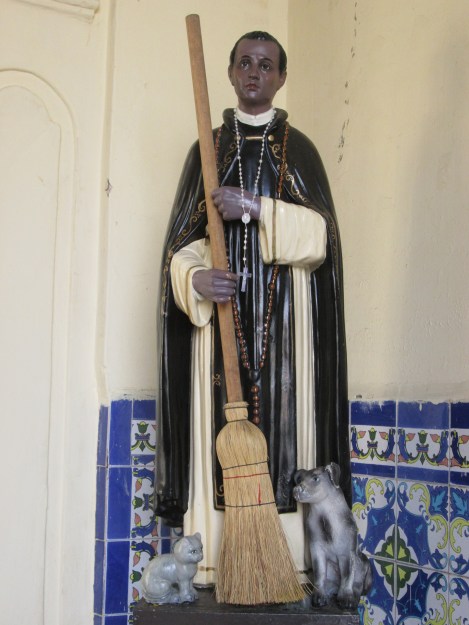
St. Martin de Porres

St. Martin de Porres

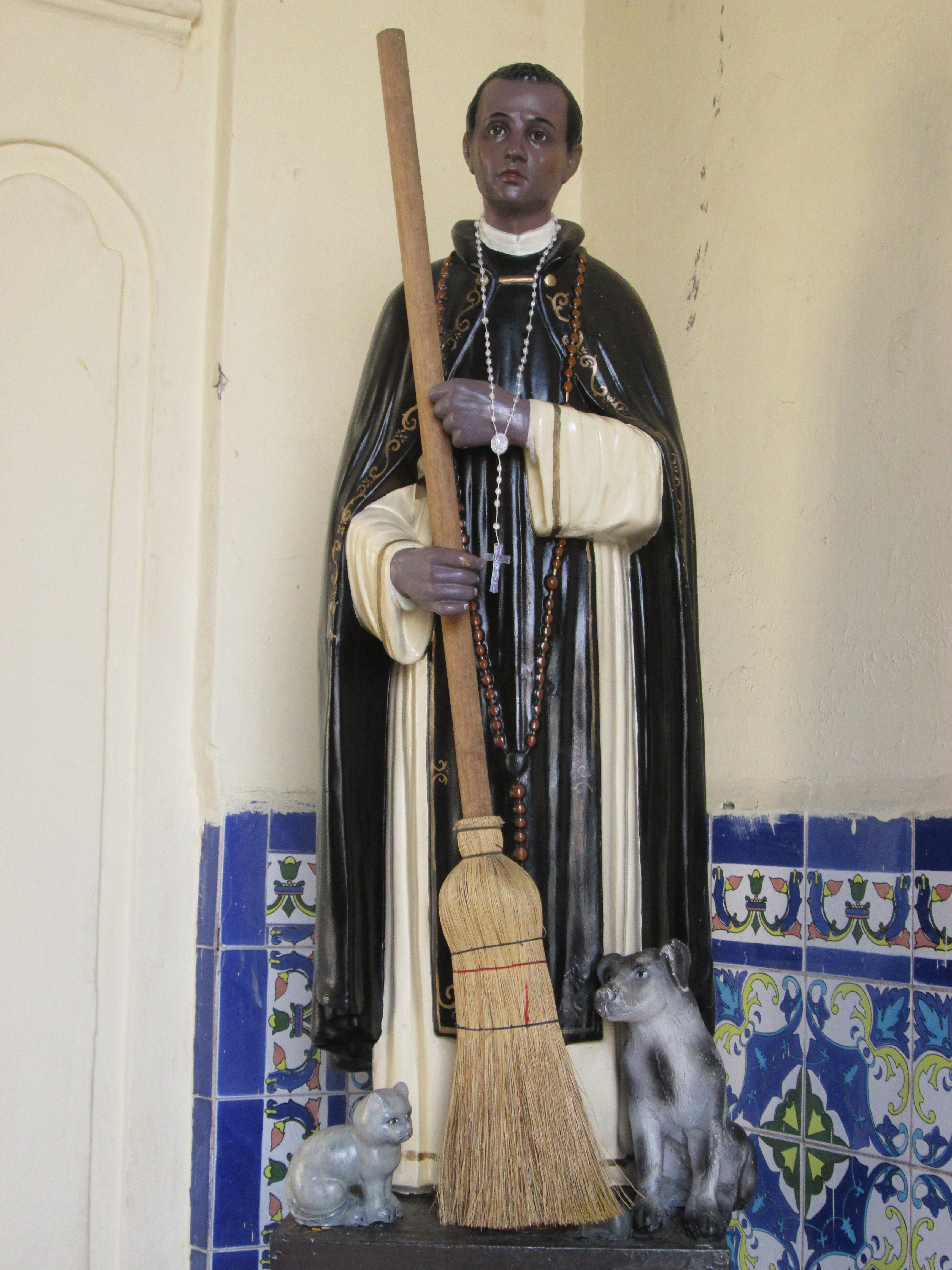
He is usually depicted in the garb of a Dominican lay brother, holding a broom, and with a dog, a cat, and a mouse at his feet. St. Martin de Porres is one of my favorite saints. My memories of him go back to grade school, years before Pope John XXIII canonized him in 1962.

The following is taken from Ricardo Palma’s Peruvian Traditions and tells the story of his three pets:

And from the same dish
ate a dog, a cat and a mouse.

With this couplet we come to the end of an account of the virtues and miracles attributed to Friar Martín de Porres. It was actually a broadside that was circulated in Lima about the year 1840 for the purpose of celebrating in our cultured and very religious capital city the solemn activities related to the beatification of this miracle worker.

This holy man, Friar Martín, was born on December 9, 1579, the natural son of the Spaniard Don Juan de Porres, Knight of Alcántara, and of a Panamanian slave. When he was still very young little Martín was taken to Guayaquil, where in a school in which the teacher made good use of the whip, he learned to read and write. Two or three years later his father and Martín returned to Lima and the boy was placed as an apprentice, learning the trade of barber and bloodletter in a barbershop on Malambo Street.

Martín wasn’t very adept with the razor and the lancet and this kind of work didn’t appeal to him so he opted for another career—that of sainthood, for in those days the career of a saint was just as legitimate a profession as any other. He took the habit of a lay brother at the age of twenty-one in the Monastery of San Domingo and remained there until he died in the odor of sanctity on November 3, 1639.

While he lived, and even after death, our countryman Martín de Porres performed miracles on a wholesale scale. He performed miracles as easily as others compose verses. One of his biographers (I don’t remember if it is Father Manrique or Doctor Valdés) says that the Prior of the Dominicans had to prohibit his continuing to perform miracles or milagrear (forgive me the use of the word). And to prove how deeply rooted in Martín the spirit of obedience was, on one occasion while he was passing a mason working on some scaffolding the worker fell a distance of some twenty-five to thirty feet. But while he was still in mid-air Martín stopped his fall—and there was the man suspended above the ground. The good Friar shouted, “Wait a moment, brother,” and the mason remained in the air until Martín returned with permission from his superior to complete the miracle.

That’s a doozy of a little miracle, don’t you agree? Well, if you think that one is great, wait until you read the next one.

The Prior sent the extraordinary lay brother on an errand to purchase a loaf of sugar for the infirmary. Perhaps he didn’t give Martín sufficient money to buy the white refined type so he returned with a loaf of brown sugar.

“Where are your eyes, Brother Martín,” said the Father Superior. “Can’t you see that it is so dark that it’s more like unrefined sugar?”

“Don’t get upset, Reverend Father,” answered Martín slowly. “All we have to do is wash this loaf of sugar right away and everything will be fine.”

Without allowing the Prior to argue the point the Friar submerged the loaf of sugar in the water in the baptismal font, and when he pulled it out it was white and dry.

Hey! Don’t make me laugh! I have a split lip!

Believe it or make fun of it. But let it be known that I don’t put a dagger at anyone’s breast forcing him to believe. Freedom must be free, as a newspaperman of my country once said. And here I note that because I had intended to speak of mice under Martín’s jurisdiction, I went off on a tangent and forgot what I was doing. That’s enough for the prologue; let’s get right down to business and see what happened to the mice.

* * *

Friar Martín de Porres had a special predilection for mice, unwelcome guests who came for the first time, it appears, with the Conquest, because until the year 1552 no mention of them was made. They arrived from Spain in a boat carrying codfish that had been sent to Peru by a certain Don Gutierre, Bishop of Palencia. Our Indians gave them the name hucuchas, which means creatures that came from the sea.

During the time that Martín was serving as a barber a mouse was still considered a curiosity, for the mouse population had just begun to multiply. Perhaps it was during that period that he began to concern himself with the welfare of the little animals, seeing in them the handiwork of God; that is to say he could see a relationship between himself and these small beings. As a poet put it:

The same time that God took to create me
He also took to create a mouse,
or perhaps two, at the most.

When our lay brother served as a male nurse in the Monastery the mice overran everything and made a nuisance of themselves in the cells, the kitchen and the refectory. Cats, which made their presence known in 1537, were scarce in the city. It is a documented fact that the first cats were brought by Montenegro, a Spanish soldier who sold one in Cuzco for 600 pesos to Don Diego de Almagro, the Elder.

The friars were at their wits’ end with the invasion of the little rodents and invented various kinds of traps to catch them, but with little success. Martín put a mouse trap in the infirmary and one rascal of a mouse who was inexperienced, attracted by the odor of some cheese, found himself trapped. The lay brother freed him from the trap, and then placing him in the palm of his hand said to him, “On your way, little brother, and tell your companions not to bother the friars in their cells. From now on all of you stay in the garden and I promise to take food to you every day.”

The ambassador complied with his mission and from that moment the mob of mice abandoned the cloister and took up residence in the garden. Of course Martín visited them every morning carrying them a basket of leftovers and other food and they would come to meet him as if they had been summoned by a bell.

In the cell Martín kept a cat and a dog. Through his efforts he had succeeded in having them live together in fraternal harmony, to such an extent that they both ate from the same dish.

One afternoon he was watching them eat in holy peace when suddenly the dog growled and the cat arched its back. What had happened was that a mouse had dared to stick its nose outside of its hole, attracted by the smell of the food in the dish. When Martín saw the mouse he said to the dog and cat, “Be calm, creatures of God. Be calm.” He then went over to the hole in the wall and said, “Come on out, brother mouse, have no fear. It appears that you are hungry; join in with the others. They won’t hurt you.” And speaking to the dog and cat he added, “Come on, children, always make room for a guest; God provides enough for the three of you.”

And the mouse, without being invited, accepted the invitation, and from that day on it ate in love in the company of the cat and dog.

And…, and…, and… A little bird without a tail? What nonsense!

Volcano Land

Mount Sabancaya Erupting

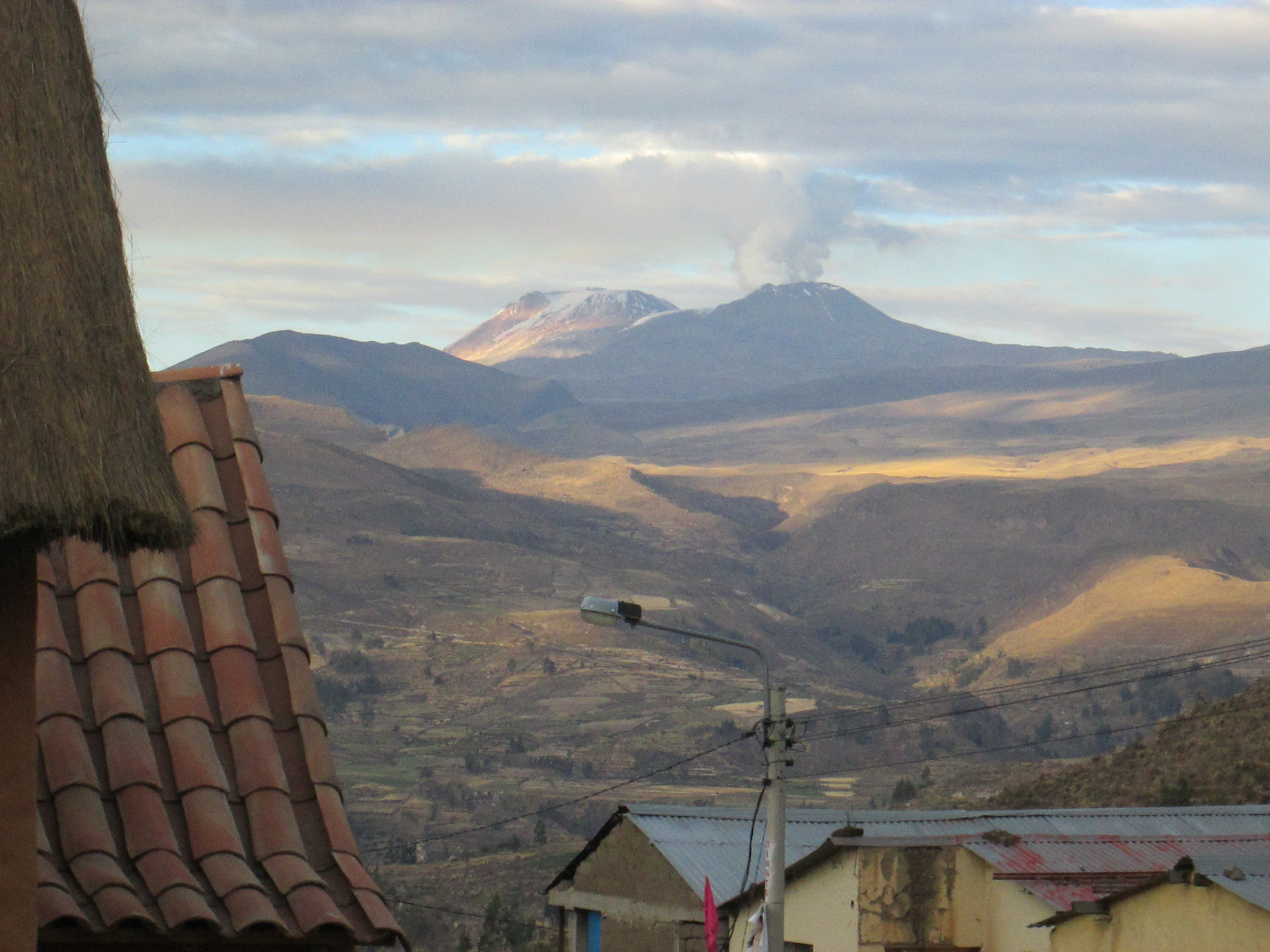
Mount Sabancaya Erupting—Seen from Coporaque

The State of Arequipa is full of active volcanoes. Two of them in particular—Sabancaya and Ubinas—have been in eruption for weeks, if not months.

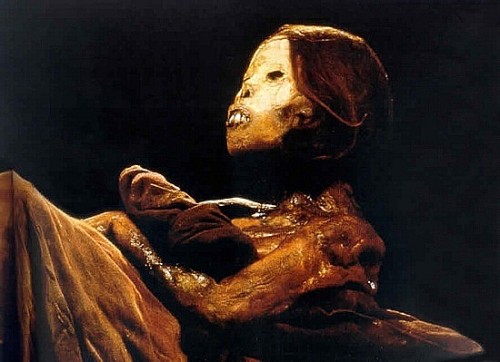
In fact, before the Spanish ever made it to Peru, an eruption of Sabancaya triggered the sacrifice of an Inca maiden (named by archaeologists as Juanita) on neighboring Nevada Ampato to satisfy the angry earth gods. A 12-year-old girl of good family, “Juanita” was marched up Ampato with an escort of priests, given some chicha to drink to calm her nerves, and clubbed to death. It was only in 1995 that Johan Reinhard discovered her remains and brought her body down to Arequipa, where it is on display in the city’s Museo Santuarios Andinos, where I saw it.

The Remains of the Inca Maiden Called “Juanita”

The Remains of the Inca Maiden Called “Juanita”

When I stayed in Arequipa, I awoke every morning to see the city ringed by the volcanoes Chachani, El Misti, and Pikchu-Pikchu. Going north to Colca Canyon, I saw perhaps a score of other volcanic peaks. This is a volatile section of the Pacific Ring of Fire, where the Nazca Plate is slipping under the South American Plate and making the Andes rise and providing pathways for the fires under the earth to rise to the top on occasion.


Don’t Let Machu Beat You!

At the Ruins of Machu Picchu

At the Ruins of Machu Picchu

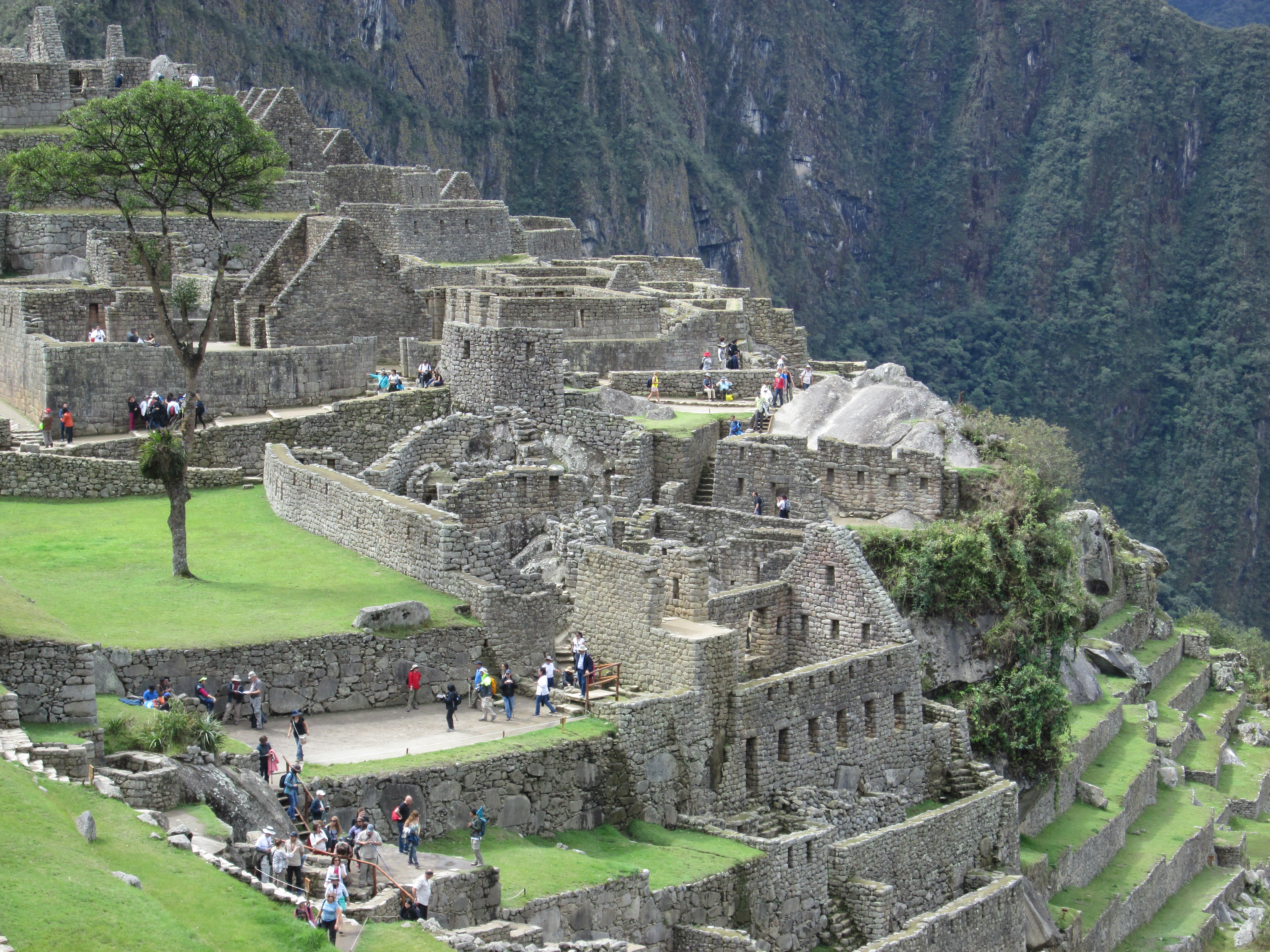
Yes, the ruins at Machu Picchu are probably the premier tourist attraction in all of South America, followed by Iguazu Falls between Argentina and Brazil.

There were only two problems with my visit there on September 25:

  1. It was raining
  2. I could only see apart of the ruins because I was terrible of the irregular stone steps (without guard rails) that connected the different levels, of which there were many. Also, because of the rain, they were slippery.

See the picture below for a view of some of the steps.

Irregular Stone Steps at Machu Picchu

Irregular Stone Steps at Machu Picchu

I could see myself taking a step the wrong way and tumbling down a couple thousand feet into the Valley of the Urubamba. So excuse me if I was petrified for much of the three hours I spent at the ruins.

In a way, I anticipated the possibility that Machu Picchu was not going to be the be-all and end-all of my trip: There was so much else going on, not only with regard to the ancient Incas, but to the numerous indigenous cultures (Quechua, Aymara, and Collagua, among others) and the spectacular churches—about which more anon. I made the reservation for the ruins in June, not knowing what the weather would be like.

Did I like Machu Picchu? For sure! It was in a phenomenal setting, with spectacular views along two ranges of the Andes. Was it the highlight of my vacation? By no means. In the weeks to come, you will understand why.


Support Your Local Chifa

My Local Chinese Restaurant in Miraflores

My Local Chinese Restaurant, the Chifa Jin in Miraflores

I got back from Peru on Tuesday night—as usual in the middle of a blistering heat wave. Finally, I have enough energy to take up with my blog again, even though it’s hot enough to melt prestressed concrete outside.

Although Peruvian food is, by and large, excellent, I was surprised to see so many Chinese restaurants all over the country. In Peru, they are called chifas. Why are there so many of them? As I wrote in my blog entitled The Guano Economy, many Chinese are descended from the coolies brought over from mainland China in the 1800s to mine bird droppings from the islands off the coast of Peru.

It’s a far cry from guano to won ton soup and fried rice (called chaufa in Peru), and there are interesting differences for what passes for Chinese fare in the United States, but the quality runs from the acceptable to the delicious. The best I had was my fun with pork at the Wa Lok restaurant in Miraflores on Angamos Oeste. I liked Peruvian won ton soup better than American, because although the won tons are not wrapped around any meat, there are usually big pieces of pork and chicken along with the lasagna-like noodles.

I ate Chinese in Lima, Puno, and Machu Picchu Pueblo. In every case, the food was inexpensive and well prepared. It was nice to have a familiar backup to the usually omnipresent Peruvian cuisine.