Fútbol

Better Than American Football?

Better Than American Football?

Frankly, I think that most American spectator sports are there strictly for the commercial breaks. There is a brief spurt of intense activity, followed by several interminable ads directed at selling junk to macho males and hip females. The only exception is baseball, which is too much like watching grass grow. There is a pitcher, a batter, a catcher; and, very occasionally, some other players are briefly involved.

While I was in the hospital on Saturday, I watched the Argentina-Iran game in the morning. I was impressed. Despite the fact that the Argentinians won it 1-0 (superstar Lionel Messi finally came alive), it was beautiful to see the ball handling. The Iranian goalkeeper, Alireza Haghighi, frustrated all of Argentina’s many shots at goal until late in the Second Period. It was beautiful to watch the action, from the setup in the backfield to the elegant passing back and forth, along with the numerous interceptions that forced the other side to begin all over again.

The thing I loved was that something was always happening, like waves starting far out in the ocean and crashing on the shore.

Why do I love soccer football so much? For one thing, it was a tie to my father which I remember with great fondness. Elek (Alex) Paris and his brother Emil were identical twins who played the same position in the semi-pro nationality club teams of the 1930s. There were stories from my youth about my father forcing a referee to swallow a whistle (while inhaling to blow it), requiring him to pull it out by the lanyard while choking. Numerous players told me of my father’s powerful kicks that broke other players’ legs.

In the long run, I think that soccer football will replace the mayhem of American armored football. Parents just don’t want their sons to have to deal with concussions leading possibly to death or other serous head injuries. The next generation will be much more receptive to the game—unless they have to play someone like Elek Paris.

There are three reasons why, for the time being, soccer will take second place to the prolate spheroid pigskin, at least for the time being.

The main reason is that games can end in ties. Americans don’t like ties. When the USA-Portugal match ended in a 2-2 tie, newspapers around the country weighed in and harshly criticized the American effort. That was too bad, because the US really outplayed Portugal: Unfortunately, they left a brief opening for Ronaldo to set up a strike at the net. It didn’t matter to me: The Americans played a great game that showed that they deserve their 11th place world ranking. (“What only 11th place?” say the critics.) They’ll be better anon. Whether they ever reach the top spot is a different matter. First they have to pay some dues.

Another thing that drives many American fans crazy is the “expandable clock” of regulation play. A game runs 90 minutes, but referees can add minutes at the end for injuries and whatnot. In the US-Portugal game, there was a time-out at the end of the First Half as a water break. The jungle city of Manaus was hot and sticky, and the players were seriously drenched and dehydrated. In the end, the game ran approximately 95 minutes. It’s not over until the referee whistles the game over.

Finally, many Americans want more bathroom and snack breaks. Well, then, they can watch baseball, which is a lot of nothing—or some other sport with numerous breaks for ads.

 

Slipping Off the Pedestal

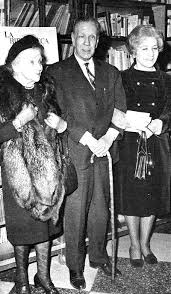
Jorge Luis Borges Flanked by His Mother and His Wife Elsa

Jorge Luis Borges Flanked by His Mother and His Wife Elsa

It was bound to happen sooner or later: After worshiping the man for over forty years, I am finally beginning to have my doubts about Jorge Luis Borges the man. But not, by any means, of Borges the poet and writer of short stories and essays. I still think he deserved the Nobel Prize for Literature on merit alone, but I begin to understand why he cheesed off the liberal-minded Nobel Prize Selection Committee.

Perhaps my favorite translator of Borges is Norman Thomas di Giovanni, whose book Georgie and Elsa: Jorge Luis Borges and His Wife, The Untold Story has just recently been published. Di Giovanni worked closely with Borges during the 1960s, shortly after he married Elsa Astete Millán, and through the divorce. What Di Giovanni discovered was that Borges was fatally naive when it came to women, politics, and social life. In fact, he was incredibly feckless in many ways. Di Giovanni writes:

[I]n later years, he travelled to Chile to receive a medal from the hands of Augusto Pinochet. This was one of the worst decisions of his life. But, he maintained, in his digging-his-heels-in mode that no one was going to tell him what he could or could not do. I imagine that it would never have occurred to Borges to question and be horrified by Pinochet’s well-oiled programme of eliminating Communists and other left-wingers. Borges was so universally condemned for his action that I think he came to realize his colossal mistake. But to justify it and himself, when I mentioned his folly to him, he said, ‘But I thought the medal was a gift of the Chilean people.’

Equally, if not more disastrous, was Borges’s marriage to Elsa. Years earlier, he had mooned over her; but, typically, someone else married her. (“Georgie” was not prime marriage material, as he lived with his mother well into his old age.) Then, one day, he met her again and—discovering that she was now widowed—took up with her again. By now, Borges was a famous literary figure; and, Elsa, being a social climber, thought that she was now about to enter the high life.

Her behavior during visits to the United States was execrable. She would steal silverware and other “souvenirs” from Borges’s friends and associates. During a visit to the Rockefellers, she insisted in photographing every room and asking about all the furnishings. It got to the point that people stopped inviting Borges lest Elsa come along. When she accidentally left a nutria coat in Cambridge after one trip, she made the return of the coat into an international incident involving U.S. and Argentinian ambassadorial and consular staffs.

Not that Borges was an ideal husband. He was an elderly blind man who happened to be impotent (which Elsa had known earlier) and incredibly old fashioned, a sort of Anglo-Argentinian who was neither all one thing or all the other. Finally, with di Giovanni’s help, Borges divorced her. He later re-married, with Maria Kodama, who now controls his esate.

Di Giovanni’s book is mandatory reading to supplement all the hagiographical biographies of the author who never quite get at the man’s character.


(Almost) Never at a Loss for Words

Ho I Wound Up in the Emergency  Room This Weekend

How I Wound Up in the Emergency Room This Weekend

It all started at work 45 minutes before quitting time. Our deranged boss had left, and I was chatting with one of the accountants about accommodations and food service at Death Valley National Park.

All of a sudden, although I knew very well what I wanted to say, it all came out as inarticulate babbling of the village idiot variety. For about three minutes, I could not translate my thoughts into words. That frankly freaked me out. The accountant suggested I call 9-1-1, which is exactly what I did. Within twenty minutes, I was hauled out of my workplace in a gurney and taken by ambulance to UCLA Medical Center, which is only about five blocks away.

No sooner was I wheeled into the emergency room than I was surrounded by doctors questioning me and testing my reactions. I thought I had suffered a mild stroke, but there was no drooping of one side of my face or difference how I felt being touched on my right or my left. I was asked to touch my nose, touch the doctor’s finger. (Fortunately he did not ask me to pull it.) The tests kept on for several hours and were even resumed this morning. UCLA is a teaching hospital, and my case appeared to be a good instructional vehicle.

I was given an MRI scan, X-Rayed, electrocardiogramed, and marinated. in olive oil The upshot was that I had not in fact suffered a stroke, but merely a temporary clot that had deprived me of the ability to speak and be understood. The whole thing lasted only about three minutes. By the time the Fire Department paramedics came, I was able to pronounce terms like panhypopituitarism and chromophobe adenoma without batting an eyelash.

The way I see it, I was once again nicked ever so slightly by the Grim Reaper’s scythe as it whooshed by me and hit someone else. What I had was called a Transient Ischemic Attack (TIA). I know  now that I have to watch my step carefully. The next whoosh of the scythe could wind up removing my head from my shoulders.


The Runaway Trolley Dilemma

What Is the Right Decision?

What Is the Right Decision?

We tend not to discuss ethical dilemmas in the abstract, if for no other reason that they usually tend to be real posers.Take this famous dilemma: There is a runaway trolley headed in your direction, and in its path there are five people tied to the track. You find you are standing right next to a switch which could shunt the trolley off on a siding. You proceed to pull the switch, only to find there is a single person tied to the track on the siding.

The Utilitarians would say that it is a better thing to sacrifice one life rather than five—all other things being equal. But are they really equal? What if the five people tied to the track are all serial child molesters, and the single person tied to the siding is Pope Francis? Also, are there any people on the trolley? If so, wouldn’t they all risk dying in any case?

There is a variant of this dilemma, but without a switch and a siding. Again, we have a runaway trolley, again with five people tied to the track. You are standing on a footbridge over the track with a fat man whom you don’t know. You are between the runaway trolley and the five persons on the track. Should you push the fat man off the footbridge so that he lands in the path of the trolley, leading to a derailment upon impact?

Is This an Easier Decision?

Is This an Easier Decision?

In the first case, most people would throw the switch in the first case, but few would push the fat man to his death in the path of the trolley.

My own preference is to avoid situations where I am anywhere near any runaway trolleys, especially since I could be considered a fat man myself.

Serendipity: The Singing Letter

Mural of Inca Indians

Mural of Incas and Spanish

I have read some experts that say that the Incas had possessed a form of phonetic writing with knotted cords called quipus, whereas others say that these cords were used only for inventories and such—much as the Minoan Linear A and B was used in Ancient Crete. Last night, I ran into a tale from around 1541 quoted by Peruvian writer and antiquarian Ricardo Palma, which sheds some light on the whole issue:

The time came when the first harvest of melons was taking place in the Barranca melon fields and that marks the beginning of our story.

The overseer selected ten of the best melons, packed them in two boxes and put them on the shoulders of two of the Indians serving there and gave them a letter for the master.

The two Indians had carried the melons a few leagues when they sat down to rest near a wall. As one would expect, the aroma of the fruit awakened the curiosity of the Indians and a battle began between fear and their appetite.

“Do you know something, brother?” said one of them to the other in his Indian dialect. “I have discovered a way to eat some melons without anyone finding out. All we have to do is hide the letter behind the wall. It won’t be able to see us eat so it won’t be able to accuse us of anything.”

The naiveté of the Indians attributed to writing a diabolical and marvelous prestige. They didn’t believe that the letters were only symbols but that they were spirits, which functioned not only as messengers but also as watchmen or spies. [Italics Mine]

The second Indian thought that his companion’s idea was a very good one, so without saying a word, he placed the letter behind the wall, put a rock on top of it and then the two proceeded to devour, not eat, the inviting and delicious fruit.

As they were nearing Lima the second Indian gave himself a blow to the head and said, “Brother, we are making a big mistake. We need to make our burdens equal, because if you carry four and I carry five our master will suspect something.”

“Well said,” replied the other Indian.

And so once again they hid the letter and then they ate a second melon, that delicious fruit that according to the saying is gold before breakfast, silver at noon and death in the evening, for it is true that there is nothing more indigestible and causes more upset stomachs after a full meal.

After the Indians arrived at Don Antonio’s home they delivered to him the letter that announced the fact that the overseer was sending ten melons.

Don Antonio, who had promised to give some of the first melons of the harvest to the archbishop and several other individuals, began to examine what the Indians had brought.

“What do you think you are trying to do, you good-for-nothing thieves?” bellowed the irate landowner. “The overseer sent ten melons and two are missing.” Whereupon Don Antonio read the letter once more.

“There were only eight, master,” protested the two Indians.

“The letter says ten and you have eaten two of them on the road. You over there! Give these scoundrels a good beating—a dozen blows for each one.”

And the poor Indians, after receiving a thorough thrashing, sat in the corner of the patio gloomily considering what had happened to them.

Then one of them said, “You see, brother? The letter sings.”

Don Antonio happened to hear what the Indian had said, whereupon he shouted, “Yes, you rascals. And you better watch your step and not try any more funny business because now you know the letter sings.”

And Don Antonio related the incident to his friends at the next tertulia. The saying became popular and eventually made its way to the Mother Country.

The quote is from Palma’s Peruvian Traditions (1872-1910).

Listening to Irish Music

Playing the Celtic Harp

Playing the Celtic Harp

The Big Irish Fair that Martine and I attended last Sunday was mainly for the music (and not to be catapulted into the afterlife by a rampaging sheep—about which see yesterday’s post). Martine and I spent most of our time listening to Celtic harp solos and ensemble playing by a group primarily from Orange County. Soloists included Dennis Doyle and Joanna Mell, who were excellent. Martine was particularly eager to listen to attend as she had never heard any live before. And I enjoyed it as much as she did.

Kathy Sierra and Maggie Butler of Golden Bough

Kathy Sierra and Maggie Butler of Golden Bough

On the same stage where the harps were played, there was also a talented trio from Modesto that performs Celtic music under the name of Golden Bough. I couldn’t get a good photo of all three playing at the same time, so I inadvertently cut out the multi-talented Paul Espinoza. In addition to playing the harp, they also played half a dozen other instruments in their concert of music from Ireland, Scotland, Brittany, and Spanish Galicia. I was impressed at the fact that they kept their end up for more than an hour and a half without taking a break and with no diminution of quality.

Irish Stepdancing

Irish Stepdancing

Finally, because I am a dirty old man at heart, I convinced Martine to watch the Irish stepdancing competition so that I could stare at the young legs of the bewigged teen dancers. I do not profess to understand the popularity of stepdancing. (It doesn’t hold a candle to Hungarian folk dancing, such as practiced in L.A. by the Kárpátok Hungarian Folk Ensemble—though I may be prejudiced—but the young Irish girls did have cute legs.)

There was also a lot of bagpiping, but nothing close to the standard of what we heard in Scotland.

Death by Charging Sheep?

Bad Dog!

Bad Dog!

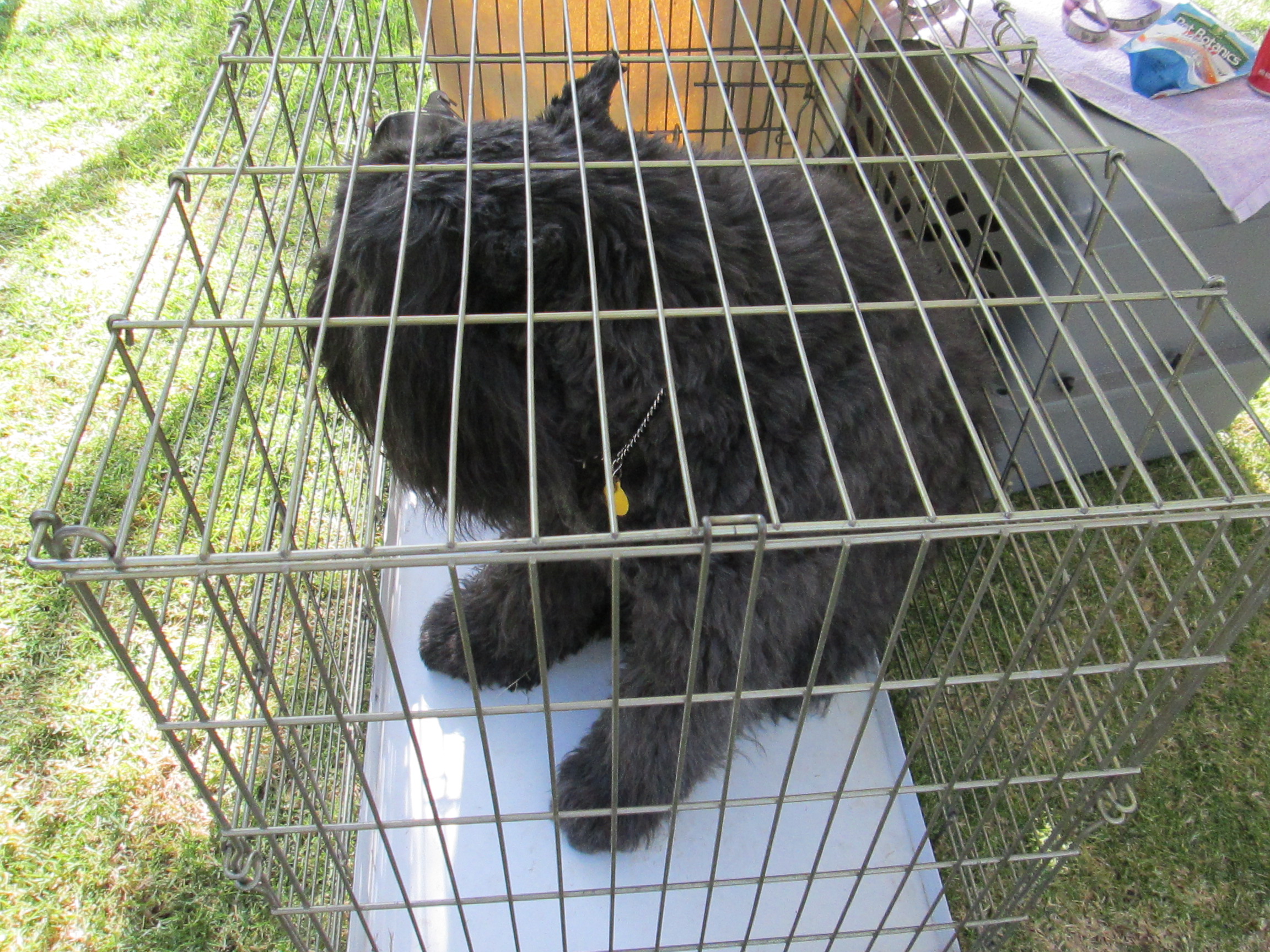
Yesterday, Martine and I went to a large Irish Fair held at El Dorado Park in Long Beach. Thanks to an extremely fine perception of space, I was missed by a fraction of an inch by a charging sheep during the sheepherder dog demonstration.There I was, standing on the sidelines between two tents when, suddenly, someone let the Bouvier des Flandres out of his cage (above), and he charged the sheep, sending them scattering at top speed in all directions. Although the Bouvier was at the show, he was not yet trained to herd sheep without representing a threat to them. The upshot was, I saw my life pass in front of my eyes while being charged by one of the sheep. Before I knew it, all of them had disappeared behind a line of port-a-potties.

Within ten minutes, however, the real trained sheep dogs had rounded up the miscreant lambchops (see photo below) and brought them back to the demonstration area. The Bouvier was likewise found and promptly caged.

One of These Sheep Came Close to Head-Butting Me into the Next World

One of These Sheep Came Close to Head-Butting Me into the Next World

In the end, I found the sheepherding demonstration so interesting that I forgot my former peril. The music at the fair was great (more about that later). The only thing I didn’t like was the food. I never thought of cajun franks, funnel cakes, and kettle corn as being particularly Irish. There wasn’t a trace of lamb stew in evidence, nor even baked tatties. But that’s to be expected when there was a single caterer who brought along a fleet of highly miscellaneous food trucks.

With the Warbirds

Warbirds

At the Estrella Warbirds Museum in Paso Robles

At various points across the United States, there are little flying museums usually tended to by retired military aviators and their families. One such is the Estrella Warbirds Museum in Paso Robles, which is located along the south edge of the local general aviation airport. In addition to the old fighter jets and prop planes, helicopters, jeeps, and ammo, there is adjoining all the weaponry a car exhibit called the Woodland Auto Display.

After leaving my brother and sister-in-law in Paso, Martine and I headed east on Route 46, stopping first for a couple of hours to see the displays. We weren’t able to give much time to the exhibits parked outside, largely because the temperature was 106° Fahrenheit (or 41° Celsius). Martine loves to visit these old military museums (including the one at Palm Springs, by the Santa Monica Airport, and the Torrance airport). It’s sad to think that the vets who flew these aircraft are beginning their own inexorable journey toward the setting sun. Very likely many of these museums won’t be around in a few years.

Considering the news from Iraq, the bomb photographed below might well become more topical:

Leftover Bomb from 2003 Invasion of Iraq

Leftover Bomb from 2003 Invasion of Iraq


After our visit to see the warbirds, Martine and I headed further east on 46 and 41 until we joined Interstate 5 around Kettleman City. Our destination for the night was the Harris Ranch Inn at Coalinga, where we spent the night in air conditioned comfort and gorged ourselves on prime beef.

Ugly But Magnificent

Andean Condor

Andean Condor

Andean Condors, like all members of the vulture family, are not exactly cute; but with their 10-foot wingspans, they are awe-inspiring. The only time I ever saw Vultur gryphus was on in Argentinian Patagonia, on my way to the dock to take a cruise to see the glaciers that feed into Lago Argentino. There were two of them a few miles out of El Calafate visible from the left side of the bus. Of course, by the time I got my camera out, they had swooped around the hill and out of sight.

In Peru, I hope to photograph them at Colca Canyon, about a hundred miles northwest of Arequipa. The Canyon has a depth of 13,650 feet (4,160 meters), making it twice as deep as the Grand Canyon in Arizona. I will try to take a tour that stops at Cruz del Condor, where they tend to glide in large numbers past a viewing point looking for their favorite carrion. I hope I can get a few pictures to bring back and post on this blog site.

Colca Canyon is probably the third most popular tourist destination in Peru, after Machu Picchu and Lake Titicaca.


The Real Reason Cantor Lost

Read On for My Peerless Analysis

Read On for My Peerless Analysis

This may strike you as being unscientific, but the reason Eric Cantor lost his seat in Virginia is that no one liked him. He was always a whiny presence on the Washington scene.

Of course, the fact that he may be replaced by an even more dangerous Tea-Party-type is certainly no cause for celebration. The fact is that people who live in Confederate sh*thole districts are not likely to vote for anyone who will do anything but attempt to govern by hijacking or obstructionism. We live in the Disunited States of America and will continue to do so for the foreseeable future.

You may recall the whole “Left Behind” Evangelical myth that, in the End Times, the saved are wafted to Paradise while everyone else has to suffer the various beasts of the Apocalypse while the saved are eating Corn Nuts and drinking Duff Beer while fluffing their wings and cheering on the Four Horsemen. I think that the people who vote for insufferable right-wing nutjobs have been “left behind” by science, the economy, technology, and everything associated with good sense. All they’re left with is Jesus and their guns.

God help the rest of us!