Serendipity: Graham Greene Dreams of Khrushchev

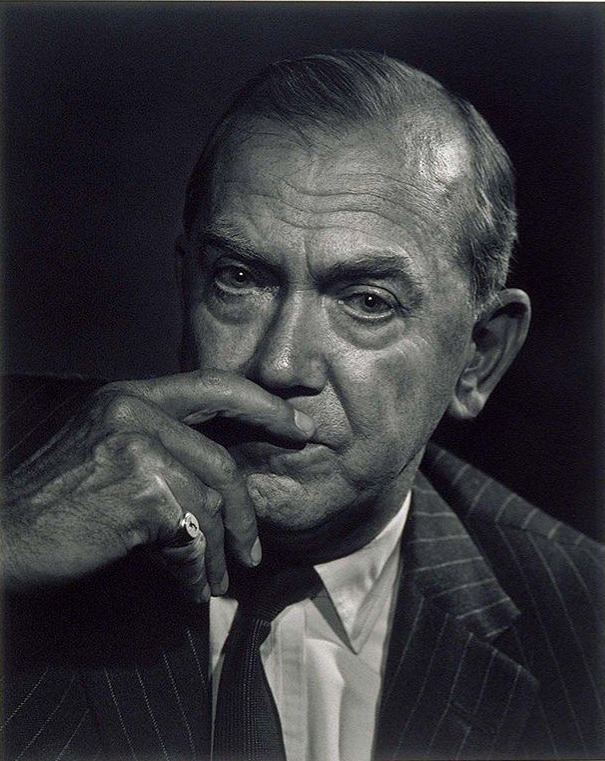
Graham Greene

Graham Greene

I have just finished reading a fascinating little book of dreams that British writer Graham Greene had transcribed and edited. It is called A World of My Own: A Dream Diary, which I had just picked up by chance yesterday at L.A.’s The Last Bookstore. Here are a number of short dreams the author had about former Russian leader Nikita Khrushchev:

In the Common [i.e., Real] World I always felt a certain affection for Khrushchev in spite of his invasion of Hungary. In the Cuban crisis I felt he had made a favourable bargain with John F. Kennedy—no further invasion in return for no defensive nuclear weapons for Cuba, which in any case would have reached no farther than Miami. I liked the way he had slapped he table with his shoe at a meeting of the United Nations. Perhaps I was influenced in my affection by the meetings I had with him in My Own [i.e., Dream) World in 1964 and 1965.

My first meeting with him was at the Savoy, with a group of Russians including Mr. Tchaikovsky, whom I had met in the Common World when he was the editor of Foreign Literature magazine. Khrushchev looked cheerful, healthy, and relaxed, and he was only amused when two of his party disputed noisily. We talked together about the method of financing films in England and the bad influence of the distributors. I said that this is one difficulty the Russians did not suffer, but Khrushchev told me that films in Russia were often delayed for six months as a result of overspending and then waiting for bureaucratic permission to increase the budget. He was very cordial and invited me to lunch the next day.

On the next occasion … I sat next to him at dinner and he spoke no word to me until near the end, when he remarked that I had left a lot of my chicken uneaten. ‘So much better for the workers in the kitchen,’ I said. ‘Surely a Marxist believes in charity.’

‘Not in Vatican charity,’ he replied with a smile.

At our last meeting he was personally dealing with visas for the Soviet Union. He noticed that my profession was listed as ‘writer’, and he expressed the hope that I would write about his country. I noticed how clear and blue his eyes were, and when I rejoined my friends I told them, ‘When you see him close, he has a beautiful face, the face of a saint.’
 

Hill Street Blues

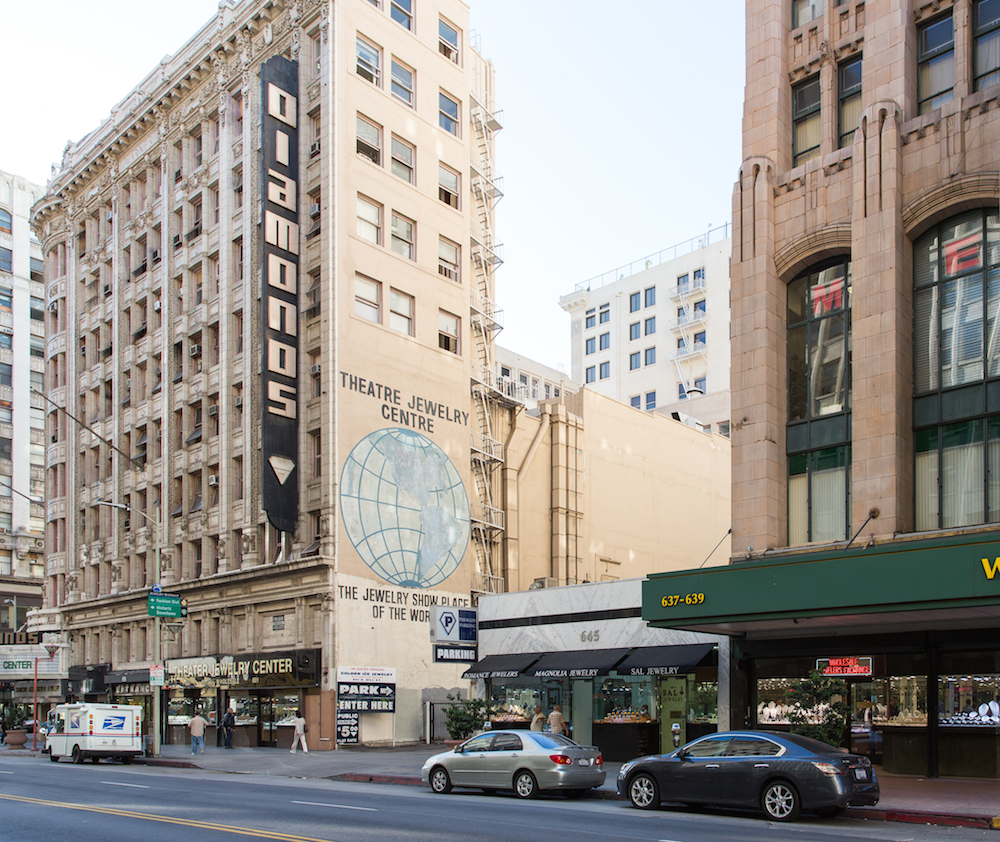
I Am Talking About the Real Hill Street—Not the One from the TV Series

I Am Talking About the Real Hill Street—Not the One from the TV Series

Basically, I should have stayed in bed. I have one of those nagging, persistent summer colds characterized by a raw throat and coughing. Still, I decided to go downtown to the Central Library, have lunch at the Grand Cenral Market, and even stop in at the Last Bookstore at 5th and Spring.

It all started as our train approached the second last stop before getting to the 7th Street Metro Station. We were all let out some 15 blocks south of our final destination because a train from either the Blue or Expo Line was stuck in the tunnel. By the time I got to the Pico Boulevard station, I noticed that the trains were running again; so I boarded and made it all the way to the 7th Street Metro Station.

So far, not too bad. Then, after stopping at the bookstore, I took the Dash bus to Union Station. Instead of boarding the Santa Monica #10 Freeway Bus, I decided at the last minute to take the Red Line subway to 7th Street Metro and transfer to the Expo Line. But that was not to be. As the Red Line approached the Pershing Square Station, an announcement was made that because of “police activity,” the Red Line would not be stopping at 7th Street Metro.

I jumped off at Pershing Square and trudged several blocks south on Hill Street, even as I felt my sore throat becoming rawer and more insistent. When I got to 7th Street Metro, I saw that the whole area was cordoned off by the LAPD and that included the Metro Rail station.

That precipitated the second part of my afternoon trek. I knew that the Santa Monica #10 bus would have to make a detour around the police cordon, so I walked down to Grand Avenue and 9th Street, where I waited … and waited … and waited. Finally, a bus came and I got on, actually getting a seat, and made it home about an hour and a half later than when I planned—and in rush hour traffic.

When I searched the Internet for the nature of the police action, I discovered that someone had left an unattended package in the station, probably some homeless person jettisoning a part of his junk load. It figures.

Frida Kahlo: “A Ribbon Around a Bomb”

Frida Kahlo Self Portrait

Frida Kahlo Self Portrait

In all of the New World, there was never so beguiling and striking a painter as Frida Kahlo. Today is her birthday. If she were alive today, she would be 109 years old. But, alas, she died in pain at the age of 47.

At the age of 6, Frida came down with polio. For the rest of her life, her right leg would be thinner than her left—a fact she disguised by wearing only pants or long dresses. At the age of 18, she was in a bus accident in which she suffered, according to Wikipedia, “a broken spinal column, a broken collarbone, broken ribs, eleven fractures in her right leg, a crushed and dislocated right foot, and a dislocated shoulder.” Also she was able to walk again, she suffered excruciating pain, had multiple surgeries, and became a world-famous painter.

She married the painter Diego Rivera, had numerous affairs, including with Leon Trotsky, and was, despite her health issues, beautiful and proud. Of her, André Breton said of her art that it was “a ribbon around a bomb.”

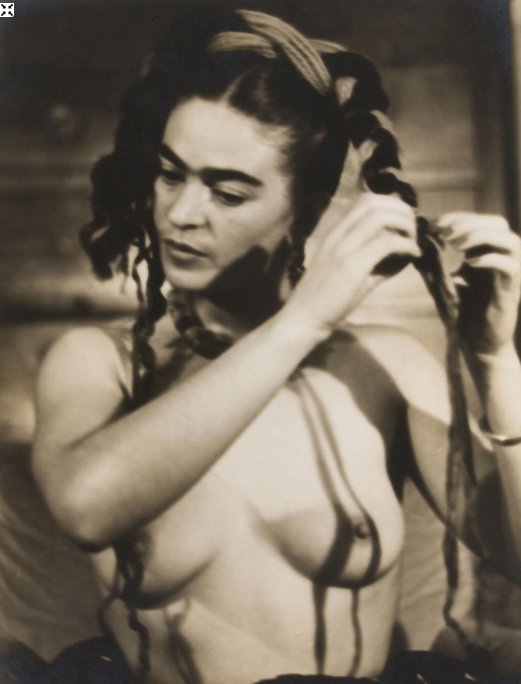
Nude Portrait of Frida Kahlo by Julien Levy

Nude Portrait of Frida Kahlo by Julian Levy

In the end, after she died, Frida’s fame only grew, such that her work is more recognized today than that of any of her contemporaries. If ever I should return to Mexico City, I would like to visit the Casa Azul, the Blue House, in Coyoacán, where she was born and where she died. Today it is a museum dedicated to her life and work.

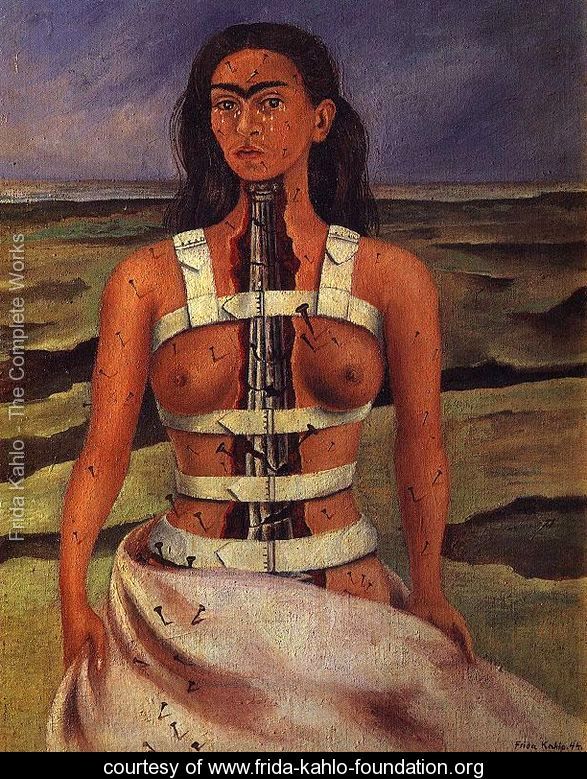
Frida’s Self Portrait with Broken Column

Frida’s Self Portrait with Broken Column and Nails


Asked why she appears as the subject of so many of her paintings, the artist said “I paint myself because I am so often alone and because I am the subject I know best.”

Divisive Politics and Friendship

Even Greater Than Before

Even Greater Than Before

Alexandre Dumas Père wrote several novels starring the D’Artagnan and the Three Musketeers. The original novel was The Three Musketeers (1844)—in which all the musketeers were in their youth—followed by Twenty Years After (1845) and the multiple volumes of The Vicomte de Bragelonne (1847-1850).

I am currently re-reading Twenty Years After and find that D’Artagnan and the Musketeers have not only grown older by twenty years: They have also matured in other ways. The novel takes place during the Wars of the Fronde (1648-1653) in which the nobility resists the penny-pinching Cardinal Mazarin, who with Anne of Austria (widow of Louis XIII) is acting as regent for the young Louis XIV.

As lieutenant of the King’s Musketeers, D’Artagnan is pledged to support the royal party. Mazarin discovers how the Musketeers has performed so valiantly two decades earlier and requests that D’Artagnan bring together his former companions. But time has passed. He succeeds in recruiting Porthos to his cause, especially as all he really wants is to become a Baron.

But Aramis and Athos are loyal to the Fronde. Even D’Artagnan’s old servant Planchet is of that party. What I find so interesting in this sequel is that the political disunity does not dissolve the old friendship: It is still “all for one and one for all.” I am constantly reminded of parallels to our own political situation in this grisly Presidential Election of 2016. The vagaries of national politics seem to have no effect on the friendship of these four valiant fighters.

Even though Twenty Years After is more crowded with incident than The Three Musketeers, I find it to be a better novel, if for no other reason than its insight into the nature of friendship—especially of friendships that last.

Reykjavík

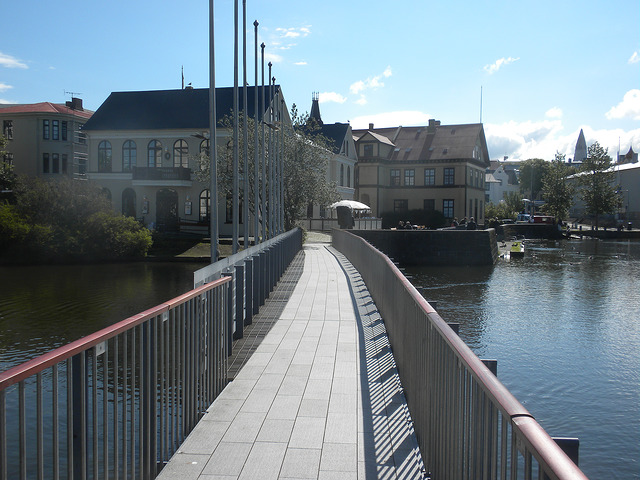
“Downtown” Reykjavík Scene

“Downtown” Reykjavík Scene

As I write this, my friends Bob Alonzi and Suzanne Holland are spending a few days touring in Iceland. And, as for me, I cannot think about Iceland without wishing to return—and soon. There is something about a brave little country, whose total population is some 330,000, which has had such an outsize influence on world history:

  • An Icelander, Leif Ericsson, landed in and colonized the New World some 500 years before Columbus.
  • The Icelandic sagas were probably the greatest European literature of the time, with the exception of the Italian Dante Alighieri.
  • The “Cod Wars” against Britain in the 1970s led to Iceland winning, without a single bullet fired. Subsequently, most countries joined Iceland in declaring a 200-mile coastal sovereignty limit.
  • The Iceland soccer football team defeated powerful England 2-1 (before losing honorably to France).

One of the things that keeps me going is my love for so many lesser-known parts of the world, parts that are wild and fascinating, as Iceland surely is.

Serendipity: Books and Brain Pickings

“A Marvellously Noble and Transcendent Chimera”

“A Marvelously Noble and Transcendent Chimera”

I do not follow many blog sites; though every once in a while, I find one that is superb. Such is Brain Pickings, which I have now included among my links.

The following observation on reading comes from Hermann Hesse’s My Belief: Essays on Life and Art, by way of Brain Pickings:

The great and mysterious thing about this reading experience is this: the more discriminatingly, the more sensitively, and the more associatively we learn to read, the more clearly we see every thought and every poem in its uniqueness, its individuality, in its precise limitations and see that all beauty, all charm depend on this individuality and uniqueness — at the same time we come to realize ever more clearly how all these hundred thousand voices of nations strive toward the same goals, call upon the same gods by different names, dream the same wishes, suffer the same sorrows. Out of the thousandfold fabric of countless languages and books of several thousand years, in ecstatic instants there stares at the reader a marvelously noble and transcendent chimera: the countenance of humanity, charmed into unity from a thousand contradictory features.

A Book of Essays I Will Have to Read

A Book of Essays I Will Have to Read

Good books lead everywhere, but especially to places worth going.


Belgian Cats Against Terrorism

General Bonkers Will Explain the Situation

General Bonkers Will Explain the Situation

When Brussels was placed under a terrorism alert in November, security officials requested that the public remain silent regarding ongoing counter-terrorism operations lest they alert potential targets of police raids. So how did the Belgians react? With cat pictures … hundreds of them! All relate in one way or another to the terror alert, but with a sense of humor that no one knew the Belgians had.

They Said to Stay Inside!

They Said to Stay Inside!

These are just three images for your enterrainment. For more images, I suggest you click here.

All Clear Yet?

All Clear Yet?


I wish to thank Martine for bringing these pictures to my attention.