Making Withdrawals from the Rage Bank


There I was, sitting at Lee’s Kitchen in Torrance by my lonesome eating a plate of spicy Szechuan eggplant when it all suddenly fell into place for me. I have been struggling since election night in November 2016 to determine what suddenly happened to my country. It took a German philosopher named Peter Sloterdijk to point at a few things I have been missing. The article was in the February 26, 2018 issue of The New Yorker, entitled “A Celebrity Philosopher Explains the Populist Insurgency”:

Sloterdijk deplored the rise of the right, but he couldn’t resist seeing something salutary in the spectacle. “It’s been coming for a long time,” he said. “It’s also a sign that Germans are more like the rest of humanity than they like to believe.” He started talking about “rage banks,” his term for the way that disparate grievances can be organized into larger reserves of political capital.

He described this concept in his 2006 book Rage and Time, an examination of the loathing of liberal democracy by nativist, populist, anarchic, and terrorist movements. The book follows his usual detour-giddy historical method, comparing political uses of anger, and of related emotions such as pride and resentment, from Homer to the present. In premodern societies, he argues, vengeance and blood feuds provided ample outlet for these impulses. Later, loyalty to the nation-state performed a similar function, and international Communism managed to direct class rage into utopian projects. But modern capitalism presents a particular problem. “Ever more irritated and isolated individuals find themselves surrounded by impossible offers,” he writes, and, out of this frustrated desire, “an impulse to hate everything emerges.” It was this kind of rage, Sloterdijk believes, that was on display in the riots in the banlieues of Paris in 2005.

In Rage and Time, Sloterdijk writes that the discontents of capitalism leave societies susceptible to “rage entrepreneurs”—a phrase that uncannily foreshadows the advent of Donald Trump. When we spoke about Trump, Sloterdijk explained him as part of a shift in Western history. “This is a moment that won’t come again,” he told me. “Both of the old Anglophone empires have within a short period withdrawn from the universal perspective.” Sloterdijk went so far as to claim that Trump uses fears of ecological devastation in his favor. “The moment for me was when I first heard him say ‘America First,’ ” he said. “That means: America to the front of the line! But it’s not the line for globalization anymore, but the line for resources. Trump channels this global feeling of ecological doom.”

There is no doubt in my mind that this rage has been building for years and reached a peak during the two Obama terms. It became so intense to certain segments of society that have felt increasingly left out of the political process—by an uppity nigra no less—that they exercised their “impulse to hate everything.” The rickety Electoral College did the rest.

Since Trump has taken office, a new rage has been building, mostly in the states that voted for Clinton. It can be expressed in the T-Shirt from Redbubble that reads, “FUCK TRUMP AND FUCK YOU FOR VOTING FOR HIM.”

Tomorrow, when I take the train to go downtown to the Central Library, I plan to take out Sloterdijk’s book Rage and Time, if I can find it.

Bookstores and Greedy Landlords

“Book Window” in Downtown L.A.’s Last Bookstore on 5th and Spring

Sometimes I think the silent movies had it right. The landlord was always a miser who thought nothing of evicting widows and orphans for late payment of rent. Now as bookstores are shutting their doors forever because some landlord was a richer tenant and a more upscale clientele. Let’s face it, selling books is not the easy way to wealth. And, what is more, many bookstores have a scruffy air about them. Not the sort of people who would be invited to Mar-a-Lago or the Trump Tower.

In most bookstores, the top price for an item is usually around $30 for a hardback and $20 for a paperback. Compare that with the money that could be made by selling a fashionable handbag or a stylish outfit to some empty-headed poltroon. Of course, even fashionable boutiques have off days, because there are not enough rich clients around to make owners of commercial real estate happy.

PICLandlords

Curiously, I don’t even like to visit a retail establishment unless there is a nearby bookstore to make the trip worthwhile. I used to walk into Santa Monica on Sunday mornings to go to Barnes & Noble. Now that it has closed down, I would not be put off if the whole 3rd Street Promenade slid into the ocean. It is well known that I don’t care for anything fashionable or stylish, and I do not throw money around to buy fancy bling-bling or even gourmet meals.

If more malls had good bookstores, one result would be more sales in the surrounding stores. There is always likely to be some dinosaur like me who disappears into the bookstore while the wives and children exercise their credit cards buying frou-frou.


Meatapalooza

A Carnivore’s Delight

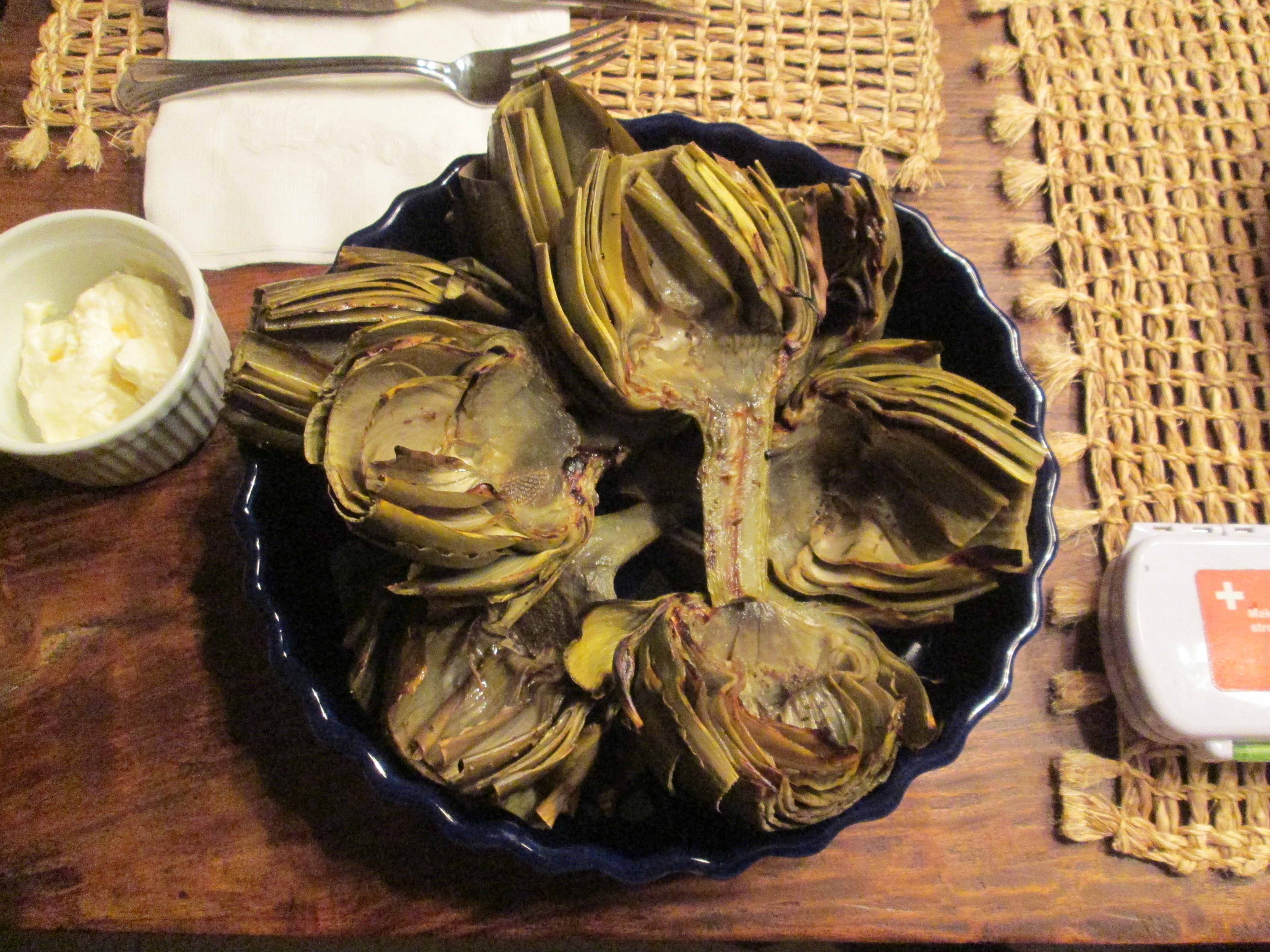
Last week at this time, I was in Palm Desert with my brother, my sister-in-law Lori, my niece Hilary and her family, and my niece Jennifer. We were looking in amazement at what Dan had prepared for us: a feast featuring various cuts of meat that would make any carnivore drool. There were also several varieties of roasted vegetables, such as the artichokes pictured below. To make it a truly gourmet experience, Dan had prepared a batch of homemade Béarnaise sauce which was so good that it seemed to go with everything.

Since the onset of my Type II diabetes about ten years ago, I have been more of a part-time vegetarian. But there is something about my brother’s cooking that cannot be denied. The last time I overindulged in meat was in Buenos Aires, when I went to a parrilada, ate a huge steak, and got picturesquely ill from several of orifices, missing my bus the next afternoon to Puerto Iguazu. This time, I merely sampled the cuts on display and suffered no untoward effects.

Roasted Artichokes

It was a delicious meal. I consider myself a passable cook, but not fit the touch the hem of Dan’s garment when it comes to a comparison. If I am overweight, it is fo a good reason. My great-grandmother Lidia Toth was an excellent cook. My mother was also good, but most notable for her soups and baked goods. (I am wearing those baked goods to this day.) I take after my mother in making good soups—the one area I might be able to give Dan a run for his money.

People have always told Dan he should open a restaurant. He is much too canny for that form of slavery. He has at times prepared dishes for restaurants and made friends of restaurateurs, but he was never tempted to go into that profession. Why should he? He is a superb home builder and has just finished building a log home in Idyllwild that he completed the sale of just this last week. Too bad: I would give much to live in a house that he built.


Maximón

Votive Figure of Maximón in Santiago Atitlán

I laugh when ignorant people wonder what happened to the Maya. They are still around, and still occupying the parts of Mexico (Chiapas and Yucatán), Guatemala, Belize, and Honduras that constituted the original Maya homeland at its height. There are millions of Maya around. They speak some thirty different major dialects of the Mayan language, most of which are not understandable to Maya speaking other dialects.

When Cortés arrived in 1519, he made short work of the Aztecs. Moctezuma and his people were conquered within a few years. (Their language, Nahuatl, still exists.) It took a considerable while longer for all the Maya polities to fall. The last one, Tayasal, located on the Lago de Petén near present-day Flores in Guatemala, fell in 1695.

But the Maya are still Maya. They managed to survive with their culture not quite intact, yet robust enough to survive under new circumstances, namely Spanish conquest. There are still isolated Maya villages where non-Maya are not welcome. In others, there are strange new Maya gods, such as Maximón (mah-shi-MOAN) whose image appears above.  When I visit Santiago Atitlán, I plan to visit him and offer a gift, typically a bottle of aguardiente, cigars, or a pack of cigarettes.

This Maximón is a sort of evil god, midway between the underworld (Xibalba) and the heavens. The Tzutujil-speaking Maya, who inhabit the area, pay homage to him, particularly during Holy Week. According to Peter Canby in his The Heart of the Sky: Travels Among the Maya:

In Santiago Atitlán, Maximón is the god of destructive nature, of floods, earthquakes, and storms. A traveler and walker, he is associated with snakebites, is the inflicter of madness, and is worshiped at the mouths of caves. [Anthropologist] Michael Coe associates Maam (Maximón) with the Yucatec god Pauhatun, also known as God N, one of the most powerful underworld gods. In fact, Pauhatun is the quadripartite god taking part in a hallucinogenic enema-ritual depicted on the funerary vase in Michael Coe’s Lords of the Underworld…. It was strange, therefore, to see atitecos [Maya residents of Santiago Atitlán] treating Maximón with such tender reverence, but I knew that this merely reflected the different concepts of evil held by ourselves and the Maya.

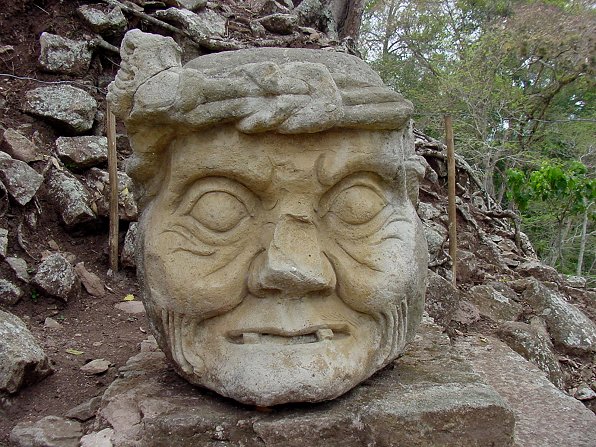
Figure of Pauhatun from the Ruins at Copán

To us, evil is something absolute, something to be resisted at all costs. To the Maya, evil is the principle of death and decay in nature and therefore an integral part of life. Gods like Maximón are terrifying, but they’re also part of the earth’s fertility. [Archeologist J Eric S] Thompson notes that “there is a widespread Maya belief that darkness and the underworld are evil, but as [the underworld] reaches up to immediately below the surface of the earth, it also produces crops.”

Among the attributes worshiped in Maximón are those of Judas Iscariot and Pedro de Alvarado, cruelest of conquistadores. I cannot help but think that there is something in the Maya conception of evil that has led them to survive as a culture—if not 100% intact, then at least substantially intact. Compare that with America’s vision of itself as “a city on a hill” acting as a beacon for all peoples, while we slaughter our own children with military automatic weapons.


Serendipity: Where Did The Maya Go?

Our Picture of the Ancient Maya, But Is It the Only One?

I can still remember the historical pundits of the 1950s and 1960s, with their cockamamie claims that the Egyptians came to the New World and built the pyramids for the Maya, because, naturally, they were too primitive to learn how to pile one stone on top of another. I can hear their voice-overs in dozens of spurious documentaries (imagine Lowell Thomas’s voice): “What happened to these people? Where did they disappear to?”

One answer comes from Christopher Shaw, in his uneven but occasionally brilliant book Sacred Monkey River: A Canoe Trip with the Gods:

If a golden age existed, it included—along with art and writing, highly developed religious and political systems, artificers and scribes, ritual torture and human sacrifice—cayucos [canoes] floating in waterlily beds, canals thick with protein-rich fish, and the finite cosmos reflected in the waters. If it “fell,” as mny scenarios insist it did, the region became crowded and degraded at the denouement of the classical era. Drought came and apocalyptic wars ensued. In their aftermath, people forgot the old ways and connected them to the past. With the cities reeling, merchant nobles from the coast—putun—imposed themselves and took power. Some of them, in their bourgeois, sentimental fashion, tried to maintain the trappings of grandeur. But the thread had been cut. In the great pyramid temples of the centralized state, the gods fell silent, though not in the houses of the campesinos.

The putun—simultaneously “barbarian” intruders and “merchant warriors,” to [archeologists] Linda Schele and David Freidel—apparently tried to keep alive the connections to tradition, dynasty, and place that lay at the root of the classic peple’s success. But the collective consciousness had moved on. The people “turned their backs on the kings to pursue a less complicated way of living,” as Schele and Freidel put it. hey turned to the forest. In the words of the Popol Vuh, the retreated “under the vines under the trees.”

Tomorrow I will return to this subject with a slightly different point of view.

The Moorten Botanical Garden 2

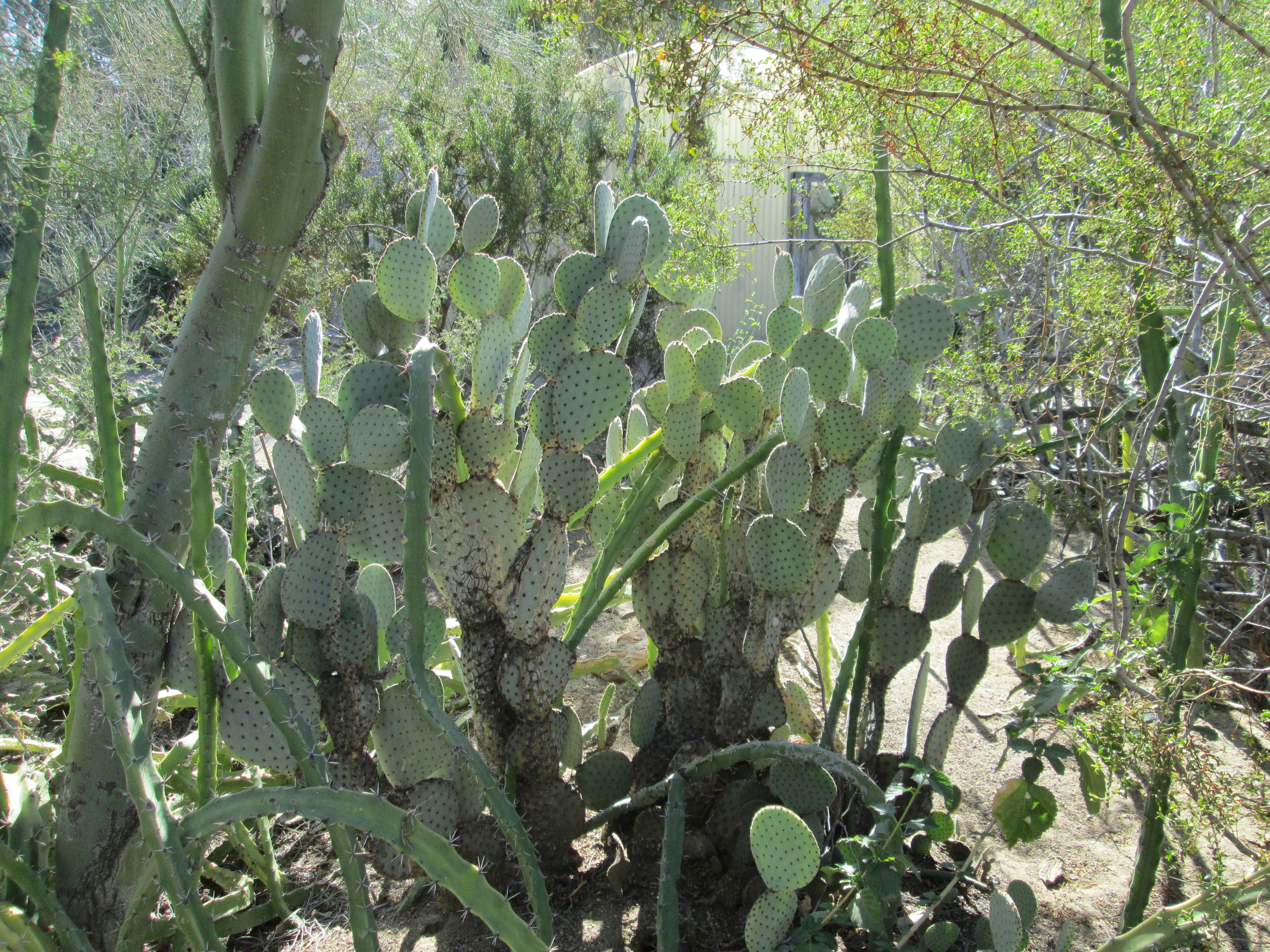
A Dense Array of Cacti

Ever since I first started spending time in the desert, back in the 1970s, I have loved cacti. Mind you, the beauty of the plant is a little harder to appreciate when the temperature goes into the high nineties and above. At such a time, I tend to avoid the desert: It’s just too damned hot. My first experiences were in Desert Hot Springs (just a few miles north of the Moortens Botanical Garden). I used to stay at one of the motels and go back and forth from the sauna to the cold pool. I even took my parents there, and they enjoyed it as much as I did. Of course, what made their enjoyment peak was a decent Hungarian restaurant in town named, I think, the Budapest.

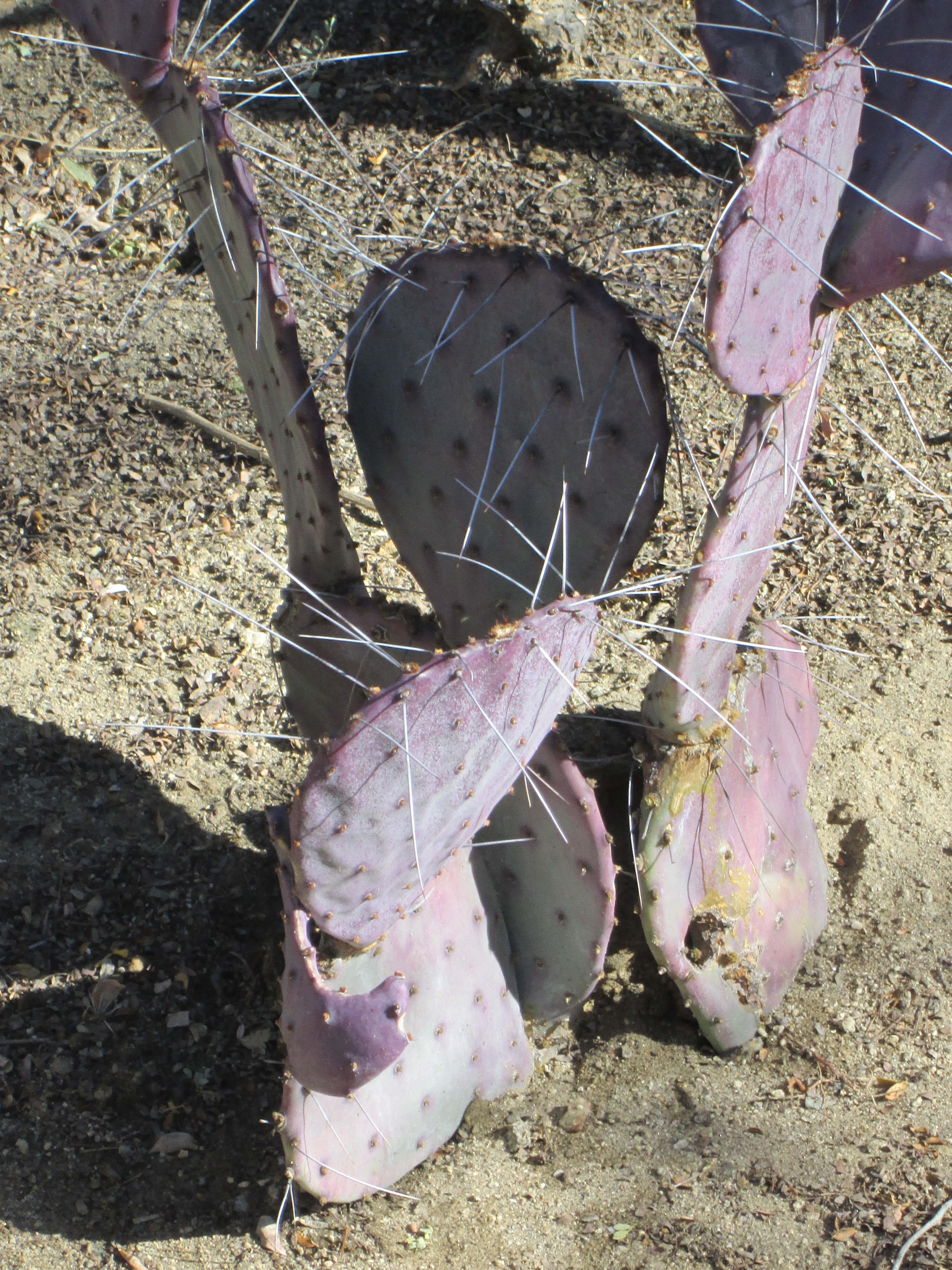
Opuntia Cactus with Purple Coloration

The Moorten cactus collection was so good that I can see myself visiting it every time I go to see my brother in Palm Desert. Dan has driven by the Garden at various times and even stopped to marvel at it—though from the outside only.

A World of Cactuses

Sometime this spring, I will also re-visit the Huntington Gardens in San Marino. What I like about their cactus collection is that so much of it comes from Latin America, Africa, and Asia.