Post-Production Blues: Major Dundee

Scene from Major Dundee (1965)

Hollywood is full of stories of battles between the director and the producers. One of the most tragic occurred between Sam Peckinpah and the money men behind Major Dundee. It was only Peckinpah’s third outing as a director of feature films, and he was given a budget of $4.5 million to shoot the film in Mexico. The original director’s cut came in at 4 hours and 38 minutes, and several million dollars over budget. Producer Jerry Bresler promptly denied the director any decision in the post-production process.

He had the film edited down to 123 minutes, which was the version I originally saw at a downtown L.A. theater around 1970. Today, I watched a 136 minute version, which calls itself “The Extended Version,” though is still a bit rough around the edges.

Director Sam Peckinpah

It is a pity that men of no artistic ability like Bresler have such an ability to mar a major work of art. Even with all its jagged edges, Major Dundee is a captivating film. Set in the final years of the Civil War, it tells of a Union officer (Charlton Heston) stationed to New Mexico Territory putting together a unit to revenge a massacre of men, women, and children by Apaches led by one Sierra Chariba. With few regulars on hand at Fort Benlin, he recruits a squad of black Buffalo Soldiers, a few cowboys and outlaws and the usual reprobates, and a group of Confederate prisoners led by Captain Benjamin Tyreen (Richard Harris). When the Apaches cross the Rio Grande into Mexico, Dundee and his men follow them and come into conflict with French troops which then controlled Mexico under the Emperor Maximilian.

Peckinpah always had a special feeling for Mexico. During the shooting of Major Dundee, he fell in love with one of his actresses, Begoña Palacios, and married her. Shown below is a Mexican fan magazine of the period with her picture on the cover.

Begoña Palacios

I will never forget when I saw the rough cut of Peckinpah’s The Wild Bunch (1969) at Warner Brothers Studios. There was a scene of Bill Holden and his men leaving a Mexican village that seemed to go forever. There is a similar scene in Major Dundee, where Charlton Heston captures a small French garrison and finds that the villages does not have enough food to survive. He immediately orders that two of his mules be butchered. There is a long fiesta scene. When Heston and his men leave, the whole village comes out to see him off.

I rather like the special feeling that the director had for Mexico. It gives his films set there a certain glow. It is a pity that Peckinpah died at the age of 59 in 1984. He had indulged in booze and drugs, and they greatly weakened him at a time when he still had a lot to give as one of the greatest artists in the genre of the American Western.

 

The Long Shadow of Egypt

Torso of Harchebi (Archibios), Ptolemaic, 170–116 BC, Granite

The most interesting special exhibit at the Getty Center currently is the one entitled “Beyond the Nile: Egypt and the Classical World.” And the one work that caught my interest was a strange sparkling granite torso of Harchebi. I tried to take a photo with my camera, but was prevented by the guard, who pointed out that this was one of the items in the exhibit that bore a small cartouche in the corner of the description forbidding photography. No matter, I hijacked a photo from the Getty website.

The above photo does not do justice to the statue, which actually seems to sparkle. Was there mica in the granite? Perhaps.

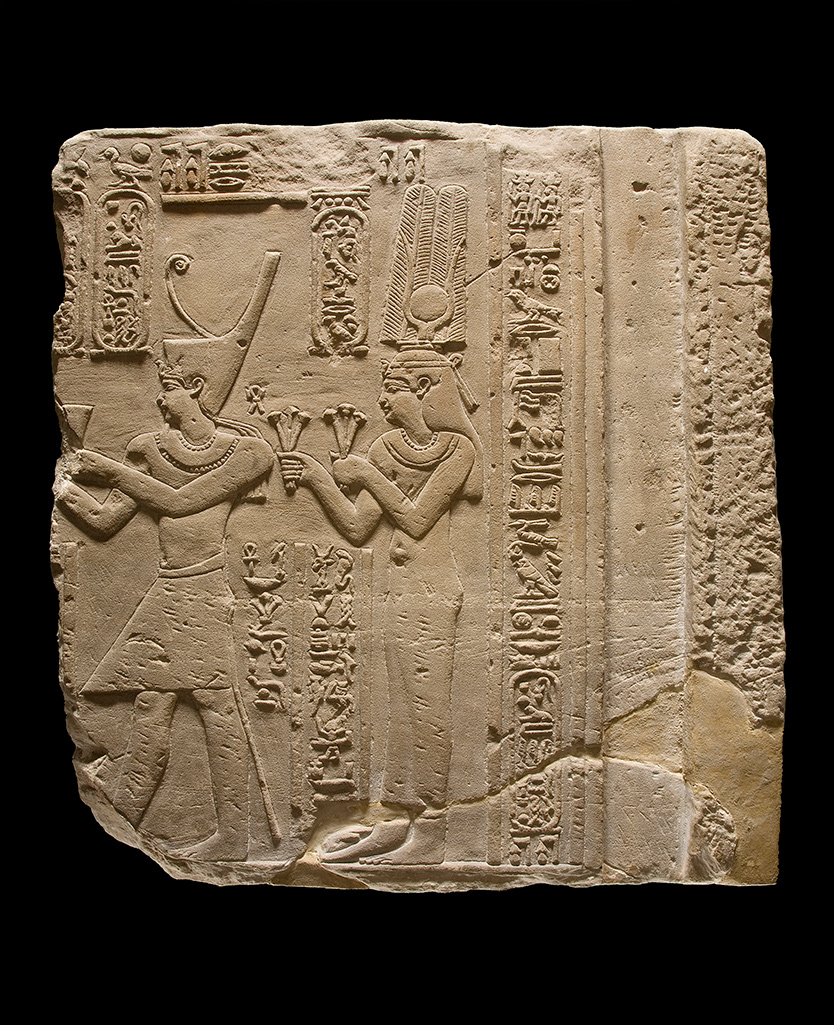
Ptolemy VIII and Cleopatra II or III Making Offerings

I loved this exhibit, even though it was excessively crowded. Saturdays at the Getty, particularly during the summer months, can be trying. In any case, the exhibit concentrated on Egyptian art during the Greek and Roman rule of Egypt. The works were gathered from a number of sources, including the Vatican Museum, and were of consistently high quality. I may sneak back to the Getty on a weekday to take a second look.

What draws me to Egyptian art is the simplicity of the figures. When I compare them to the comparable Mayan figures, which also accompanied by hieroglyphs, the Mayan images are usually more ornate, and their hieroglyphs are more difficult to read.

Lintel 16 Yaxchilán, Mexico. In The British Museum


“A Faun and His Family with a Slain Lion”

Lucas Cranach the Elder’s Image of a Wild Man and His Family (ca. 1526)

Today Martine and I went to the Getty Center and spent an afternoon viewing the art. Above is one of those late Medieval paintings whose backgrounds are almost as interesting as their foregrounds. In the background of this particular painting is a mountainous rock with a castle perched on top. It seems as if the painting were divided vertically in two equal parts. In the darker half of the painting, the male faun sits on a rock with splayed toes beside the lion he has just killed. He wields a thick quarterstaff and has large pointed ears. He looks slightly haggard.

On the right hand side, we have his wife and two children—on the same side of the painting as the castle, lake,village, and mountains in the background. All three are gentle looking and seem to belong more to the world of civilization on the right hand side of the painting than to the husband and his prey.

I love paintings like this, because one could go on forever analyzing them and trying to understand their inner meaning.


A Quandary

What Do I Do About This F*cking Clown?

What I would really like to do is write about the things that interest me. Our president, leader of the notorious Trumpf crime family, interests me about as much as the Big Macs and Chicken Buckets that sustain him. As you can probably tell if you’ve been reading my posts, I would be delighted to see him disgraced and out of the picture, preferably with a half raw chicken leg blocking his esophagus.

On the other hand, who wants to read about my hatred of the person who, by accident, is our president. I am so upset, that I deliberately boycott purchases from the states whose electoral votes put him into the White House?

I have written along this line before, because I don’t really want to write about this moron. And I won’t unless I have something original to say, something that the usual news media have not previously published.

If you don’t see as many future articles about the political mess this country is in, just note that my position on him has not changed, other than intensifying.


Silent Cal

Calvin Coolidge, the 30th President of the United States

Before the word Republican became a term of opprobrium, there was a quiet man who served as President of the United States and who became something of a joke for his silences, but who said the right things when he spoke up.

In 2005, Martine and I visited his birthplace, Plymouth Notch, Vermont. It was a modest place near Woodstock and rather fun to visit. Coolidge was born in a white clapboard house on the premises (see photo below); and he is buried a few steps away under an unassuming tombstone in the local cemetery (see second photo below).

The House in Which Coolidge Was Born

As president, Coolidge dared to take on the Ku Klux Klan, which was a major political force in the America of the 1920s. Addressing an American Legion convention in Omaha, Nebraska, in October 1925, Coolidge said:

If we are to have … that union of spirit which is the foundation of real national genius and national progress, we must all realize that there are true Americans who did not happen to be born in our section of the country, who do not attend our place of religious worship, who are not of our racial stock, or who are not proficient in our language. If we are to create on this continent a free Republic and an enlightened civilization that will be capable of reflecting the true greatness and glory of mankind, it will be necessary to regard these differences as accidental and unessential. We shall have to look beyond the outward manifestations of race and creed. Divine Providence has not bestowed upon any race a monopoly of patriotism and character.

And that is more profound than any subsequent president has ever tweeted.

Calvin Coolidge’s Unassuming Grave Site in the Local Cemetery

I would like to close with two things Silent Cal said that I have always remembered.

The first is a kind of joke, but not far from what actually occurred:

President Calvin Coolidge was known as “Silent Cal” because of his extraordinarily laconic speech. A famous anecdote tells of a dinner party during which the person sitting adjacent to the Coolidge said: “Mr. President I’ve made a large bet that I would be able to make you say more than two words.” Coolidge considered this proposition carefully and then replied slowly and emphatically, “You lose.”

The other is a quote I often use whenever I begin to feel fearful that circumstances are conspiring against me: “If you see ten troubles coming down the road, you can be sure that nine will run into the ditch before they reach you.”


Lemons and Limes

A Bowl of Lemons and Limes

This is a story that begins almost sixty years ago. As a student at Chanel High School, I occasionally took college-level courses in English at Western Reserve University during the summers. I would take two buses to East 105th Street and Euclid Avenue. At the southwest corner, there used to be a drug store that has a soda fountain. I became addicted to a menu item that they called a “fresh lime rickey,” except that this version contained sugar and had no gin, bourbon, or other liquors. It was delicious.

Some ten years plus pass. I assert my independence from my parents by taking trips to Mexico. I note that, unlike on our side of the Rio Grande, there are virtually no lemons available—but lots of limes. When one asks for limones in Mexico, one gets limes.

Another twenty years pass. During cool weather in Los Angeles, I always take my hot tea with a squeeze of lime.

I could not help noticing that Mexican fruit vendors have a little plastic device they use to squeeze out all the juice from halved limes onto the fruit salads they sell. My mind, which had been working extraordinarily sluggishly suddenly flashed a bright “Aha!” I found one of these squeezie devices at the supermarket. Limes, which run for half a dollar each at Gringo supermarkets can be obtained for a dollar a bag from a little old Chinese woman who sells them on the streets of Chinatown. And there is a Mexican market just a couple blocks from me, the Eden Mercado, that sells them for a reasonable price.

The result: I have rediscovered lime rickeys, though made slightly differently because of my diabetes. I press out the juice from a lime half into a glass, add water, ice, and artificial sweetener, and I have a delicious drink that is much better by far than lemonade.

Talking About the Homeless

Homeless Encampment in Los Angeles

There are several ways of talking about the homeless. For one thing, I do not think they can be all lumped into one category. Therefore, I rarely speak about “the homeless” as a whole. Some are temporarily without an address and have some reasonable hope of finding one, especially if they are a family. One does not usually encounter these transient homeless on the streets. More likely, one runs into a mostly male population of homeless that fit into one or more of the following categories:

  • The mentally ill, estimated by the City of Los Angeles to comprise some 40% of the total.
  • Veterans of the armed forces who were unable to make the transition to civilian life. As I live within a couple miles of a large Veterans Administration hospital, I see quite a few of these.
  • Hardcore bums who like living on the street and are unwilling to have any of their perceived rights and privileges abridged. Some of these are involved in drug dealing and theft.

There is a tent encampment right across the street from my apartment consisting of some ten hardcore bums. They usually do not bother the street residents unless to steal a bicycle or small grill, or to beg for cash. Since there are a number of charities that provide meals, I almost never give cash to a street person. Cash received by the hardcore homeless usually falls in the category of CBD money: in other words, for cigarettes, booze, and drugs.

I have seen a few hardcore female bums, mostly on the bus, and usually find them to be sad cases, frequently mentally ill and fiercely unapproachable. Martine saw one of them defecate on the sidewalk of our street in the open. Seeing Martine’s facial reaction, she called her a racist.

Given the variety of motives that moves this population, I shake my head in despair when journalists persist in talking about “the homeless” as if there were a single solution for all. There just isn’t.


The Fenyes Estate

The Fenyes Estate on Pasadena’s “Millionaires Row” with Back Yard Gardens

Yesterday Martine and I toured the Fenyes (Hungarian for “Bright,” pronounced FEN-yesh) Estate on Pasadena’s Orange Grove Boulevard. We had wanted to go a couple weeks earlier, but there was an intervening event that closed the tours for that day. Fortunately, the docent couple who gave the tour knew their subject cold, so we had a great time. It is always interesting to visit a millionaire’s mansion built over a hundred years ago. One obtains a view of what life was like not only for the family of the owner, but also the servants. The Fenyes Estate is only a few hundred feet of the more famous Gamble House, built by the Gambles of the Procter & Gamble fortune.

The Parlor of the Fenyes Mansion

In the photo of the parlor above, several of the chairs have little footstools. They were an aid to modesty so that the long dresses would cover every inch of bare skin on the women’s legs, er, I mean, limbs. Eve Fenyes, wife of Dr Adalbert Fenyes was a noted painter in her own right, and specialized in plein aire subjects. In addition to the usual portraits, which are of high quality because of Eve’s talents.

Dr Fenyes had his own talents besides medicine. He was the first to use X-Rays in his practice. In addition, he was a noted entomologist (whose collection now sits in a San Francisco museum) and an expert gardener. The grounds on which the house sits are beautifully landscaped.

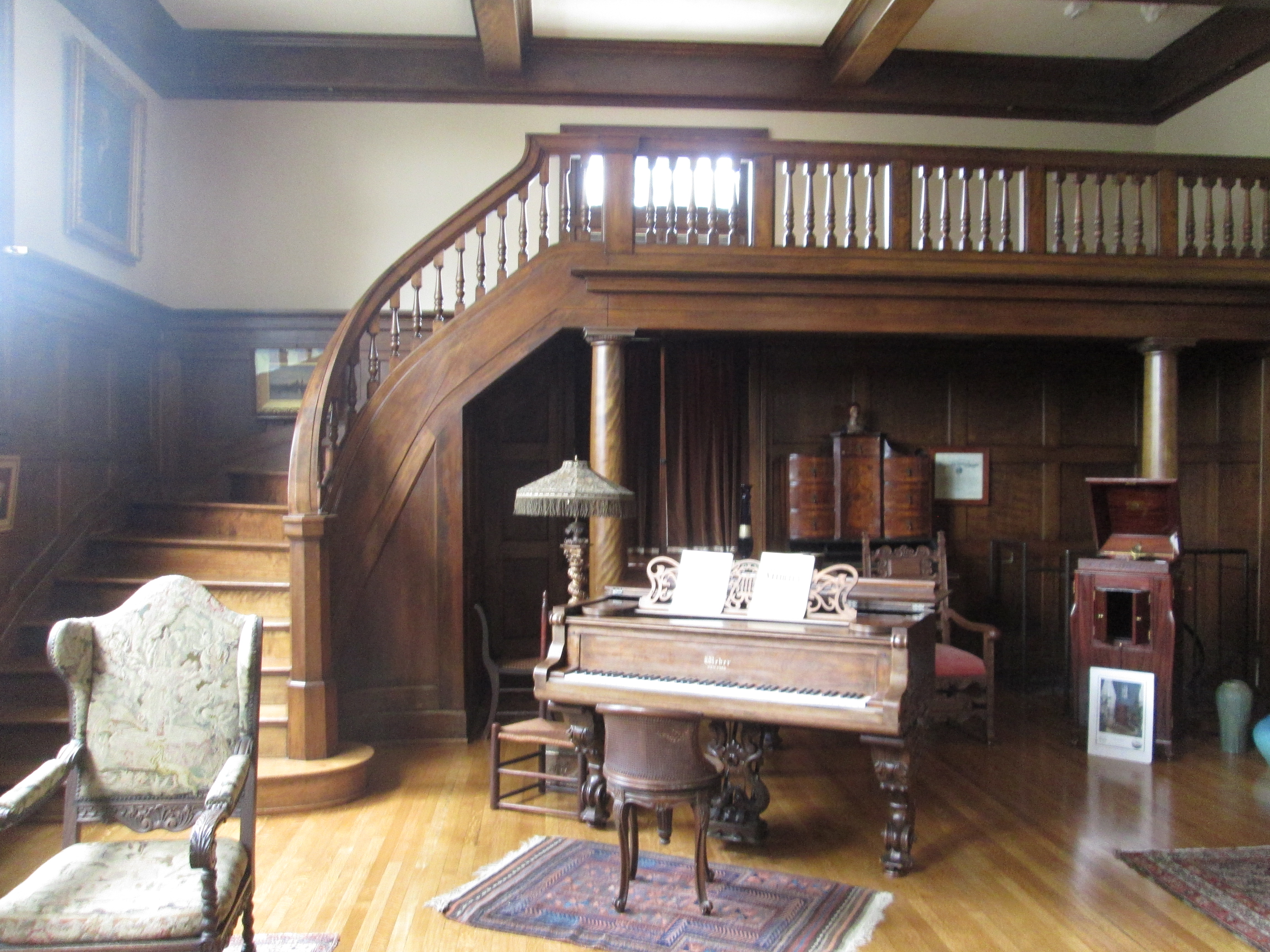
The Music Room of the Estate

In addition to the piano and early Victrola shown in the above photo, notice the elegant stairway to a mezzanine-level for singers. There is no door to the right on this level. There is also a trap door set in the floor for entrances by actors engaged in various entertainments put on by the family.

Even though there are only two houses of this sort on Orange Grove Boulevard that one can tour, it is clearly worth visiting them to understand how we all got where we are today.


The Father of Modern Space Art

View of Saturn Seen from Titan

As I was growing up in Cleveland, I was deeply influenced by what I call space art. And by space, I mean outer space. For instance, the backgrounds in Forbidden Planet (1956) were a major influence on me. I was also influenced by the work of Father of Modern Space Art, Chesley Bonestell (1888-1986), who was born before the flight and Kitty Hawk and lived to see American astronauts walk on the surface of the moon. The paintings shown here are all by Bonestell.

According to the article on him in Wikipedia:

His paintings are prized by collectors and institutions such as the National Air and Space Museum and the National Collection of Fine Arts. One of his classic paintings, an ethereally beautiful image of Saturn seen from its giant moon Titan [see above illustration], has been called “the painting that launched a thousand careers.” Wernher von Braun wrote that he had “learned to respect, nay fear, this wonderful artist’s obsession with perfection. My file cabinet is filled with sketches of rocket ships I had prepared to help in his artwork—only to have them returned to me with…blistering criticism.”

Exploring Mars

In some cases, such as in the above painting, the image is contradicted by actual space photography, in this case from the Mars Rovers. Still, Bonestell’s painting is so gorgeous that maybe there is someplace else in the universe that looks like this.

Image of Chicago With a Dry Lake Michigan

Perhaps the work of Bonestell doesn’t do much for many art critics, but it showed me that there were more things on heaven and earth than were dreamt of in my philosophy. And in most cases, they were starkly beautiful.


If You Say So!

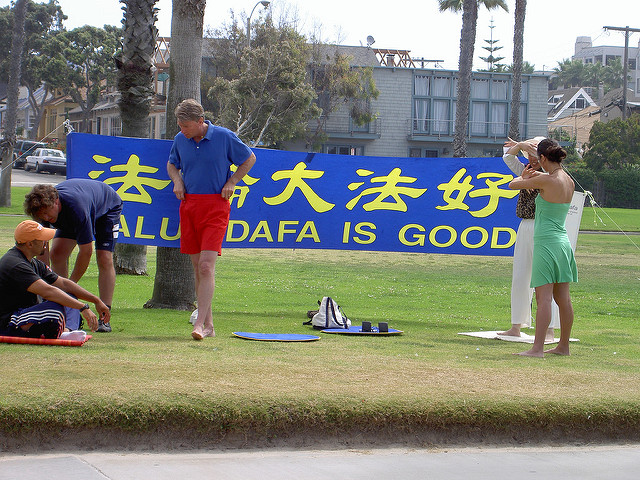
We’ll Take Your Word for It

As I took this picture some twelve years ago, I have no idea what this picture is all about. In those days, I used to take a lot of beach walks as a form of exercise. What really motivated me, however, is that there was usually a book store either on the way or serving as the final destination. Now that most of the bookstores in the area have been shut down to satisfy the itching of palms of greedy landlords. The only two that remain—Sam: Johnson in Mar Vista and Small World Books on the Venice Boardwalk—have survived only because the bookstore either owns the building, or a family member of the owner runs the bookstore.

I need to do more walking, though I feel some apprehension as the hot season begins raise beads of sweat on my forehead. No matter. I could wake up early on Sunday and time my walk to get to Small World Books as it opens at 10 am. The things I have to do! Apparently the walk is not sufficient motivation on its own.

As I continue to stare at the picture above, I realize what the photo is about. I strongly suspect that it refers to some benefit conferred by Falun Gong, the Chinese spiritual practice currently outlawed by the Communist Party in Beijing. How did I figure it out? After I wrote the second paragraph above, I looked up Falun Gong on Wikipedia and noticed that the first character in Chinese on the banner is the first character in the name of Falun Gong. Check it out for yourself here.