It was eight years ago. My friend Bill Korn told me about a house he had discovered during one of his long walks. The front yard of this Pasadena property was a triumphant statement of a home-grown artist. I made the mistake of not noting the address, and I wonder if what we saw then is still there.
The art reminds me of the Watts Towers created by Simon Rodia out of various found objects. In this case, most of the objects were multicolored ceramics, toys, and other small items which were carefully cemented together by the owner of the house.
Broken Ceramics Cemented Together
I guess the front yard structures can be classified as a kind of gonzo art. Yet the effect is curiously pleasing. I’m sure that hundreds of hours went into creating these effects.
Some of the Trees and Succulents in the Yard
When we are able to travel once again and get together with friends and dine inside at a restaurant, I will have to find this place. It really struck a nerve with me.
The Politique des Auteurs started in France with the writers of Cahiers du Cinema. André Bazin and a young cadre of rising filmmakers and critics felt that the French cinema was becoming too literary and that much was to be learned from the vitality of the American film industry. With almost every issue, they were discovering scores of new film artists such as John Ford, Howard Hawks, Nicholas Ray, and even such downmarket geniuses as Edgar G. Ulmer.
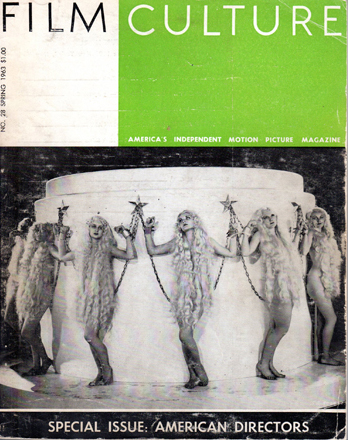
By 1962, the auteurists found an American disciple in Andrew Sarris, film critic for The Village Voice in New York. For the Winter 1962-1963 issue of Film Culture, Sarris created a whole issue dedicated to the auteur theory. As a student at Dartmouth College, I paid to photocopy the entire issue and used it religiously as a guide until Sarris came out a few years later with the greatly expanded American Cinema: Directors and Directions 1929-1968.
The Notorious Auteur Issue of 1962-1963
Circles and Squares: In the interim, Pauline Kael published a blistering attack in Film Quarterly called “Circles and Squares: Joys and Sarris.” Many of her attacks hit home, and they certainly exposed Sarris’s weaknesses as a film theoretician. I had met Pauline Kael and liked her work, but as a young man I was a budding auteurist.
Now, half a century and thousands of films later, I still see myself as having been influenced by the Cahiers crowd and Sarris, but I think there is a lot more to film than an a priori theory imposed from above. On the plus side, the auteurists opened me to the incredible riches of the American film—but I started liking films by such card-carrying non-auteurs as Felix Feist, Edward L. Cahn, Robert Florey, and Charles Vidor.
I give the credit to the auteur theory for introducing me to the idea that American films can also be great. I started my love of film by watching such foreign productions as Carl Dreyer’s Day of Wrath (1948) and Wojciech Has’s The Saragossa Manuscript (1962); but by the late 1960s I was beginning to give Hollywood its due and loosened up considerably.
View of Apartments in the Villa 31 Shantytown in Buenos Aires, Argentina, on April 25, 2017
I had a long conversation with my friend Suzanne about the homeless earlier this evening. The increasing poverty displayed by the rising numbers of tent-dwelling homeless bothered both of us, especially as we did not find any easy solution to the situation.
During my travels, I have seen some grinding urban poverty, mostly in Buenos Aires. That was only because the train and bus stations in Retiro border on one of the worst slums in South America, namely Villa 31, one of the Villas Miserias in the Argentine capital. In BA, the ugliest slums tend to be prefaced by the word Villa in their names.
The following YouTube video will give you an idea of the place:
YouTube Video About Villa 31
In 2015, I was at the edge of Villa 31 while walking between the train station and the bus terminal. At the time, I was carrying over $2,000 in Argentinean pesos I had just obtained. A couple in their thirties came up behind me and sprayed me with a combination of steak sauce and mustard. Suddenly, they started wiping the mess with tissues that appeared miraculously in their hands. They tried to get me to go to a restroom where they would help me clean up and strip me of anything of value. But as they were urging me to my left, I suddenly cut right toward a waiting taxi and made my escape. The taxi driver was not happy with a passenger that smelled of steak sauce, but I tipped him well to clean up the upholstery after I left.
I did not visit any of the other famous favelas or shantytowns of South America, but I did get a good look at Villa 31 as my bus sped me toward Puerto Iguazú near the border with Brazil and Paraguay.
The Crowding has Made Villa 31 a Covid-19 Hot Spot
If you have any sort of conscience, you can only feel uncomfortable dealing with so much raw poverty. In the gospels (specifically Matthew 26:11), we are told “The poor you will always have with you.” But we are not told how we can eradicate poverty. Maybe we can’t, but I think it is only right that we be disturbed about it.
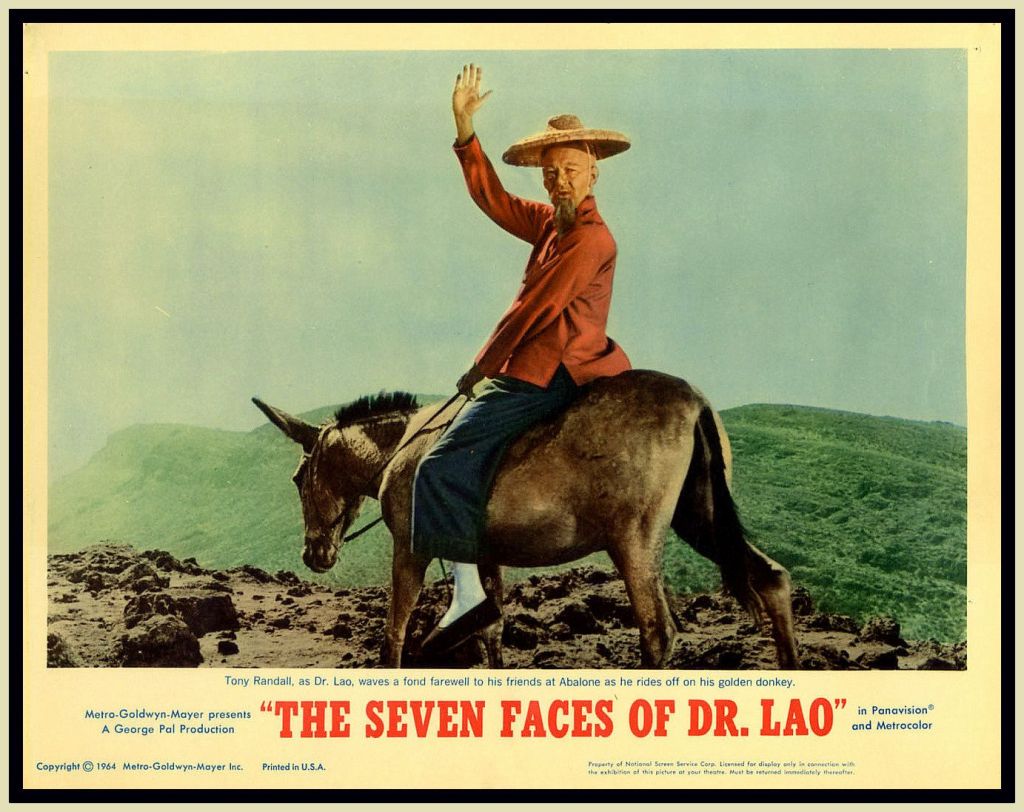
Tony Randall as Merlin in 7 Faces of Dr. Lao (1964)
There is a category of things which one loves even if one knows they are not objectively good. This is particularly true of films, food, people, articles of clothing, and any number of things. For some reason, there is no single word in the English language that conveys the unreasoning attraction for certain things that one loves unreasoningly. (“Campy” is in the ballpark, but not close enough.)
I had been using the word twonky, though I find that my use of the term is common to no one but me. What the hell, I’ll use it anyhow.
One of my favorite twonky films is 7 Faces of Dr. Lao, directed by George Pal, better known for his sci-fi films like Destination Moon (1950) and When Worlds Collide (1951).
It is the tale of a small town in Arizona called Abalone (an odd name for a desert burg.) A little old Chinese fakir called Dr. Lao (pronounced LOW) comes to town advertising a circus. All the characters in the circus are played by Tony Randall (except for the Abominable Snowman, a nonspeaking part played by George Pal’s son Peter). The circus takes place in the desert in a small tent which, on the inside, is miraculously roomy.
Tony Randall as Dr. Lao
The odd thing about Dr. Lao’s circus is that the townspeople learn about themselves, especially Barbara Eden (Angela Benedict) and Arthur O’Connell (Clint Stark, who is trying to buy up the town for profit). Merlin, the Medusa, Pan, Apollonius of Tyana, and the serpent—all act in strange offbeat ways to bring self-knowledge to the people of Abalone. And, in the process, the circus leaves Abalone a happier town.
The Tent Where the Circus Takes Place
I will not go to my grave insisting that 7 Faces of Dr. Lao is a great film, but I will see it again if I can. It always leaves me with a warm feeling. Other films that are among my twonky favorites are:
Most classical old sci-fi films
James Bond films
Earth Girls Are Easy (1984)
Danny Elfman’s The Forbidden Zone (1980)
Robin Williams’s Popeye (1980) directed by Robert Altman
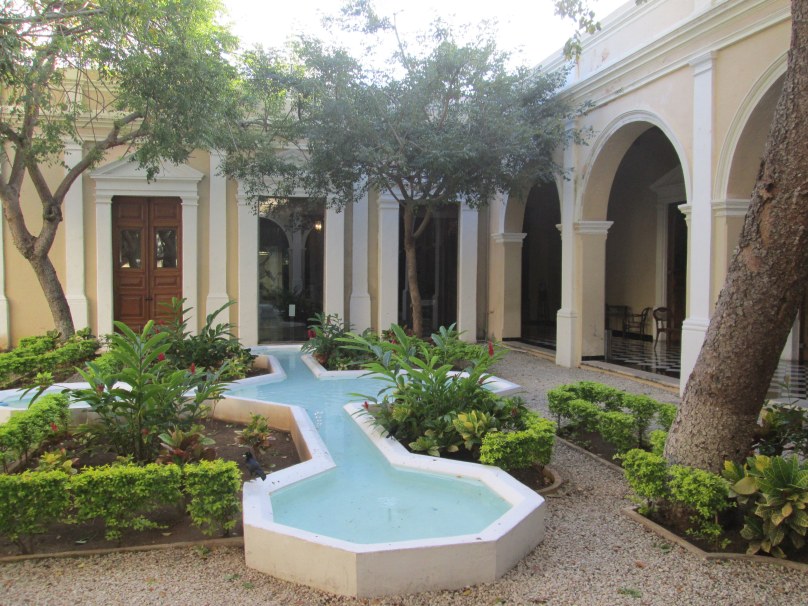
When most Americans think of the ideal house, they always see it as set back from an immaculately manicured front lawn. Perhaps owing to my hatred of mowing lawns, I much prefer the Mexican house, which presents a blank face to the street—no windows, one regular-sized door—and with a delightful courtyard which can’t be seen from the street.
I cannot for the life of me see myself doing anything on a front lawn other than working my butt off. But a courtyard, that is a different matter altogether. I could set out a chair and read there, or talk to my friends, or even have breakfast.
Courtyard of the Former Archbishop’s Palace in Mérida
In Latin America, you can live in a beautiful house—as seen from the inside—and not have to worry about what the neighbors think. When I think of sliding glass doors opening onto decks, I wonder if most American houses are secure from theft and home invasions.
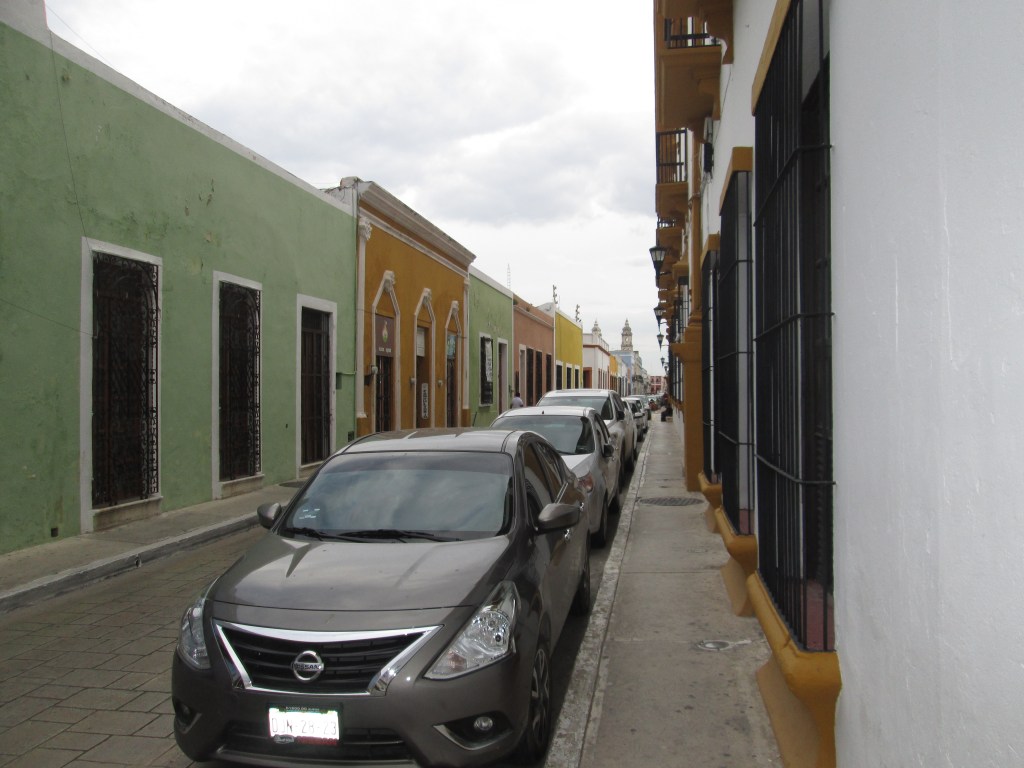
Street in Campeche: No Front Lawns Here
Above is a typical street in the center of Campeche. Some of the buildings are businesses; other, homes of the well-to-do. There isn’t much zoning in effect.
Truth to tell, unless I win the lottery, I cannot see myself as owning a house. And if I could somehow afford one, my idea of the perfect house would come into conflict with zoning regulations and local customs. I will probably continue to live in an apartment, where I don’t bother my head about perfection in any sense of the word.
Back in the early twentieth century, Venice was planned as California’s answer to Venice, Italy. There were numerous canals with some nice (and some not-so-nice) houses. The following post is repeated from April 16, 2017.
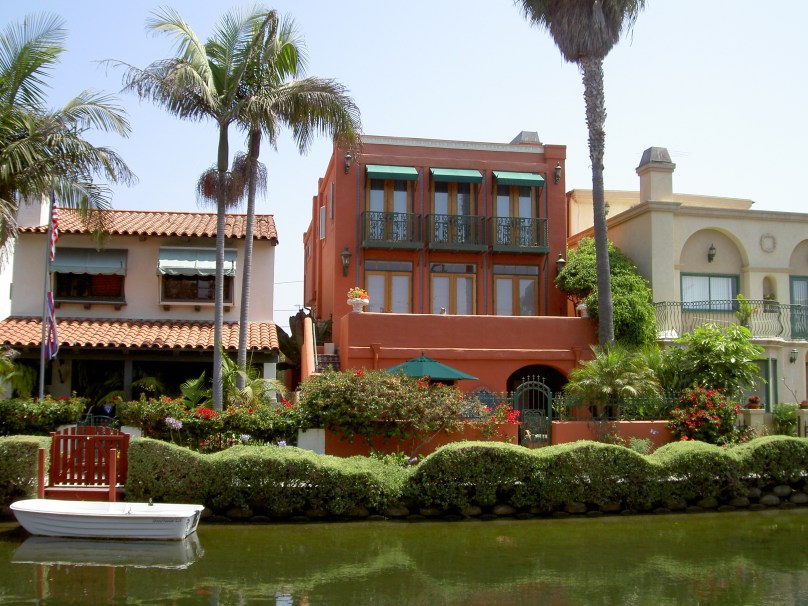
It being another beautiful day, Martine and I took a walk along the Venice Canals. The six remaining canals are what remains of Abbot Kinney’s original 1905 plan for the area. In addition to the vertical Grand Canal and the Eastern Canal, there are four horizontal canals that link them. To remember them, I use the mnemonic ScHLoCk—for Sherman, Howland, Linnie, and Carroll.
In the past, we would visit the area only around the holidays, especially Halloween and Christmas, to see the decorations. But suddenly, one year, the decorations all but disappeared. The area is interesting, nonetheless, because of the residents’ attempts to create gemlike little gardens and house fronts. There were more than a few vacancies and notices portending structural modifications. There are numerous types of succulents and flowering plants on display, and not a few architectural monstrosities, especially of the modern variety.
I have a feeling that the neighborhood can go either way at this point, either becoming a slightly disreputable slum or a major tourist draw. Most of the other walkers were speaking French and other foreign languages, so it is obviously hitting the European and Asian guidebooks. In any case, it’s a pleasant walk.
The following poem is how novelist Nelson Algren ends his best-known novel, The Man with the Golden Arm (1949). It is a tale of lowlifes, mostly of Polish ancestry, trying to eke out a living in postwar Chicago with no money and a hankering for drink, drugs, and gambling. It is perhaps the most compassionate novel ever written about the lower strata of American urban society. Its hero is Frankie Machine, a war vet who is a card dealer in a gambling club who has an unfortunate addiction to morphine.
Epitaph: The Man with the Golden Arm
It’s all in the wrist, with a deck or a cue, And Frankie Machine had the touch. He had the touch—and a golden arm— “Hold up, Arm,” he would plead, Kissing his rosary once for help With the faders sweating it out and— Zing!—there it was—Little Joe or Eighter from Decatur, Double trey the hard way, dice be nice, When you get a hunch bet a bunch, It don’t mean a thing if it don’t cross that string, Make me five to keep me alive, Tell ’em where you got it ’n how easy it was— We remember Frankie Machine And the arm that always held up.
We remember in the morning light When the cards are boxed and the long cues racked Straight up and down like the all-night hours With the hot rush hours past.
For it’s all in the wrist with a deck or a cue And if he crapped out when we thought he was due It must have been that the dice were rolled, For he had the touch, and his arm was gold; Rack up his cue, leave the steerer his hat, The arm that held up has failed at last.
Yet why does the light down the dealer’s slot Sift soft as light in a troubled dream? (A dream, they say, of a golden arm That belonged to the dealer we called Machine.)
A steerer is a person hired to lure customers into a gambling den.










 Tarnmoor
You must be logged in to post a comment.