It’s Not Like Flicking a Switch

Abandoned City on Hashima Island, Near Nagasaki

Let me start by saying that I am no Pollyanna-ish prognosticator of Good News. The worldwide COVID-19 plague has wounded all economies to varying degrees, some of which may not return to “normal” for decades. I cannot help but think that most Americans in flyover country think that all the government has to do is flick a switch for us to return to the good old days before March 2020. I for one do not think it’ll be that easy.

What will inevitably happen is that the plague will settle most heavily on states which have gone off social distancing and quarantine too early. The people that Trump is most trying to help—his supporters in the South and Midwest—will die by the thousands, if not tens of thousands. Any attempt to return to “normal” too quickly will re-energize the plague as people go back to being in close contact with one another.

The governors of states like New York and California are for a more gradual approach. States with anti-science GOP governors, like Florida and Georgia, will suffer the consequences disproportionately.


Plague Diary 20: More Books and Films

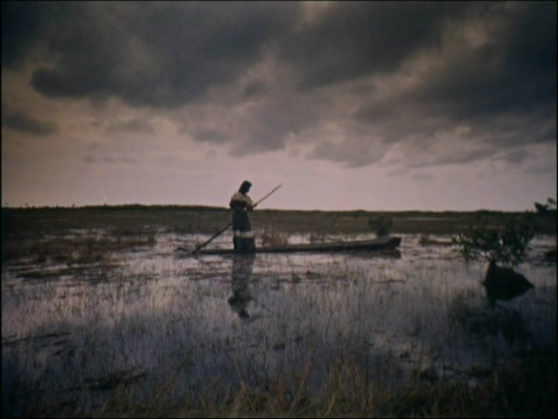
Christopher Plummer in Nicholas Ray’s Wind Across the Everglades

It was yet another day in quarantine (I am not keeping count). I started by making hot chocolate with the premium chocolate I had purchased in Mexico during my vacation. When produced in a double boiler the chocolate comes out perfect every time.

Then I decided to take a walk to the mailbox on Barry, about a mile east of here, to return a Netflix DVD of two Japanese samurai films I had seen over the previous two days. (I will write more about them in a future post.) I also wanted to stop in at the local Target store, but I had forgotten to bring my face mask with me—something I do about half the time. I notice a lot of people wear face masks all the time. They remind me of people who sleep alone with condoms draped over their jewels.

I returned to eat lunch with Martine. Mine was a couple of Chinese beef buns accompanied by frozen peach slices. While Martine went for her afternoon walk, I watched Nicholas Ray’s Wind Across the Everglades (1958) starring Burl Ives and Christopher Plummer. There were some beautiful shots of the Everglades and its bird life, and some highly dubious plotting, even if Budd Schulberg wrote the script.

Martine had wanted us to order Japanese from the Aki Restaurant on Santa Monica Blvd, so I phoned in an order and picked it up. It was a tasty reminder of when we used to eat our weekend meals in restaurants.

After dinner, I began reading Anthony Marra’s A Constellation of Vital Phenomena (2013), set during the Chechen wars. It looked like a good read.

Which brings me near to the end of another day. I will watch another episode of “Deep Space 9” and hit the sack.


Arthurian Spring

Perceval Arrives at the Castle of the Fisher King

Although I have always liked the philosophical and historical insights of Joseph Campbell, I have suddenly struck a particularly rich vein while reading his Romance of the Grail: The Magic and Mystery of Arthurian Myth. It is not unusual for me to suddenly change directions based on my reading. In this case, I foresee an Arthurian Spring.

By that I mean not just the Christian interpretation of the so-called “Matter of Britain,” but the nexus between that and a semi-Druidical interpretation allied to primitive, Islamic, and East Asian influences. In my book collection are a number of volumes of the originals in translation which I have either never read or read strictly through the eyes of later monastic sources.

The stories of the Holy Grail, the Knights of the Round Table, the Fisher King, and the Waste Land (including T. S. Eliot’s interpretation as influenced by Jesse L. Weston‘s From Ritual to Romance) are a rich treasure trove with interesting links to global sources. Most of the original works were written during a hundred-year period comprising parts of the eleventh and twelfth centuries A.D.

The Holy Grail of Indiana Jones

When most of us think of Camelot and the Arthurian legends, we think of Thomas Malory’s Morte d’Arthur or—worse yet—Howard Pyle’s 1903 re-telling in The Story of King Arthur and His Knights, which was my first introduction. Both are thoroughly influenced by the monastic hijacking of the legend that took place beginning late in the twelfth century.

So I am on my way to an absorbing world that should see me through much of the remaining quarantine and the transition to the worldwide economic depression that will inevitably follow.

The 190th Rule of Acquisition

The Ferengi Have Begun to Influence Me

The quarantine has resulted in my watching television more than usual. The one show that I like most is Deep Space 9 with its plethora of interesting characters, one of which is Quark (played by Armin Shimerman), shown above. If you are familiar with the series, you may have heard of the Ferengi “Rules of Acquisition” of which there are some 300, which can be viewed here. (Interesting that the website comes from Belgium.)

These Rules of Acquisition would be much loved of Ayn Rand and most Tea Party conservatives. They include such admonitions as:

  • Once you have their money, you never give it back.
  • The best deal is the one that brings the most profit.
  • Never spend more for an acquisition than you have to.
  • A woman wearing clothes is like a man in the kitchen.
  • Never allow family to stand in the way of opportunity.
  • Keep your ears open.
  • Small print leads to large risk.
  • Opportunity plus instinct equals profit.
  • Greed is eternal.

My favorite is one of the most simple (and most true):

190. Hear all, trust nothing.

In these days of False News—both real and imagined—that is excellent advice.

Trust Nothing from This Notable Liar

I will continue to watch Deep Space 9 with interest.


Plague Diary 19: A Busy Day

Masks … Masks … Masks

This is a short post because the Internet has slowed to the speed of a rheumatic snail with bunions. This morning, I had to take my car in for repairs related to A/C and ventilation—especially as it’s about to get hot soon. Then I had to drive Martine for an EKG in preparation for a colonoscopy scheduled for next month. I finished one book (Terry Pratchett’s Jingo) and read most of a second (Tony Hillerman’s The Shape Shifter). Within a few minutes, I will watch on old Deep Space 9 re-run hoping for a glimpse of Jadzia Dax or Major Kira Nerys. Then, bed.


The Social Distancing Film Festival

It’s Not the Big Screen, But It’s Still Good

First, my apologies for hijacking a photo from the University of California at Santa Barbara website. Secondly, I didn’t do several years of graduate study in film history and criticism without it having a lasting influence on me.

While Martine has been taking long walks to no particular destination (the destinations are all closed, anyway) and noting the takeover of the streets of L.A. by bums, I have been reading and watching a ton of movies. In twenty-six days this month, I have watched twenty-five movies:

04/03/20 Boorman, John Emerald Forest, The 1985
04/04/20 Menzies, William Cameron * Address Unknown 1944
04/05/20 Resnais, Alain Hiroshima Mon Amour 1959
04/06/20 Kurosawa, Akira * Rashomon 1950
04/07/20 Jackson, Peter Hobbit, The: An Unexpected Journey 2012
04/08/20 Jackson, Peter Hobbit, The: The Desolation of Smaug 2013
04/10/20 Jackson, Peter Hobbit, The: The battle of the Five Armies 2014
04/11/20 Forster, Marc * Quantum of Solace 2008
04/11/20 Lang, Fritz * Beyond a Reasonable Doubt 1954
04/12/20 Wise, Robert * Set-Up, The 1949
04/14/20 Hertz, Nathan Attack of the 50 Foot Woman 1958
04/15/20 Dean, Alexandra Bombshell: The Hedy Lamarr Story 2017
04/16/20 Totten, Robert Sacketts, The: Episode 1 [Made for TV] 1979
04/17/20 Totten, Robert Sacketts, The: Episode 2 [Made for TV] 1979
04/19/20 Siodmak, Robert * Phantom Lady 1944
04/20/20 Park, Chan-wook I’m a Cyborg, But That’s OK 2006
04/21/20 Robson, Mark/Val Lewton * Isle of the Dead 1945
04/21/20 Misumi, Kenji * Sword of Vengeance 1972
04/22/20 Misumi, Kenji Baby Cart at the River Styx 1972
04/23/20 Tarantino, Quentin * Jackie Brown 1997
04/24/20 Parajanov, Sergei * Color of Pomegranates, The [Sayat Nova] 1969
04/24/20 Parajanov, Sergei Hagop Hovnatanian 1967
04/25/20 Rouse, Russell * Wicked Woman 1954
04/26/20 Keaton, Buster * Sherlock Jr 1924
04/27/20 Rapper, Irving * Now Voyager 1942

More than half of them, I really liked. Those are noted with an asterisk just before the title of the film. Predictably, most were either American film noir productions or Japanese jidai-geki (samurai films). A few were outright dogs.

As long as the quarantine/social-distancing rules remain in place, I will probably continue to see at least one film per day. Some of them are on DVD from Netflix; some from Turner Classic Movies (TCM); others from Spectrum Cable’s On Demand service.


No Expert at Facebook

I Have Shown Myself to Be Ignorant of Facebook Security


If you have tried to follow the links to my brother’s recipes, you will have found out you can’t see any of them because you are not a friend of Jennifer’s. I have not given up hope: I will investigate how to get around Mister Zuckerface’s security. Stay tuned to this spot in the coming days.

Plague Diary 18: The COVID Cooking Series

My Brother Dan with Grandson Oliver

Spending time with my brother Dan and sister-in-law Lori is my niece Jennifer, who has wisely chosen to quarantine with her family. Fortunately for me, and for everyone who loves good food, Jen has filmed Dan giving cooking instructions for some of his favorite dishes. Now I have mentioned before that I admire Dan’s cooking and am somewhat jealous that I am nowhere near so proficient as he is in the kitchen.

So, straight from Dan’s kitchen in Palm Desert, here are some wonderful dishes you can prepare at home:

  1. Hungarian Chicken Paprikás: Part 1 and Part 2. You can see the completed meal in Part 3.
  2. Vietnamese Lettuce Wrap with Skirt Steak.
  3. Quiche with Potato Crust.
  4. Da Bomb Eggplant Parmigiana. This is my favorite. If I can get Martine to try it, I’ll make this within a week or two.

My Niece Jennifer, Who Shot the Videos

Having enjoyed Dan’s cooking numerous times, I think you will find these a real treat. Let me know if you have tried any of the recipes.


Letters: In Search of a Bolt-Hole

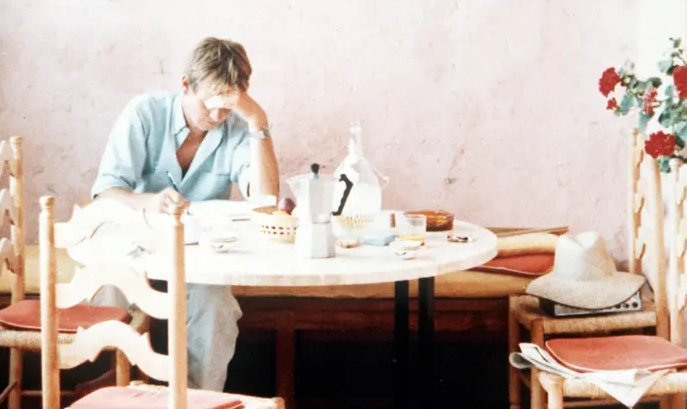
Bruce Chatwin Writing

This is the first in a series of posts on literary letters. I have just finished reading Under the Sun: The Letters of Bruce Chatwin, edited by Chatwin’s wife Elizabeth and his biographer Nicholas Shakespeare.

When I started reading Bruce’s work, he was a hero to me. One of the mixed blessings of biography is that you are likely to find out some uncomplimentary facts about your heroes. This is definitely the case with Bruce, who lived an oddly compartmentalized kind of life. He was married, yet carried on numerous affairs with men and women, some of which were predatory. Although I still love his writing, I would feel uncomfortable with the man himself. (For more on this subject, I would refer to two postings by his late friend, Patrick Leigh-Fermor entitled Bruce Chatwin: Letters from a Fallen Angel (or, A Woman Scorned and Bruce Chatwin’s Journey to Mount Athos.

Reading his letters, I find almost half of them deal with Chatwin’s search for a comfortable place to live, where he can read and write—separately from his semi-estranged wife Elizabeth—and carry on affairs. There was no love lost between him and the land of his birth, England. In a letter to Patrick Leigh-Fermor, he writes:

At least I thought that going to England in August might lessen the shock, climatically. But no! Nothing but rain. Freezing cold. I went wind-surfing on a scummy little reservoir near Oxford, and my hands were white and numb after ten minutes. But what I miss the most are the mountains! The country round here is tolerably attractive, immaculately kept: but then you keep running up against the cooling towers of the Didcot [nuclear] power-station; the antennae of Greenham Common; the nuclear installations at Harwell—all of which give me the feelings of claustrophobia.

But then there doesn’t seem to be anyplace that suits. It’s either too hot or too noisy or too crowded with tourists or yadda-yadda-yadda. To his in-laws, he complains:

But I’m afraid this gypsyish life cannot go on. I shall have, whether I like it or not, to get a proper bolt-hole to work in. Otherwise I find I can fritter away six months at a time without achieving anything, and that only makes me very bad-tempered. In a way, I like being in Italy, but the climate’s quite tough in winter, and the villages (because I’m sure it must be in a village) are usually quite depressing. Our old stamping ground in the Basses-Alpes is not half bad. Uzès is another possibility. What it’ll mean, I’m afraid, is that the London flat will have to go. I’m after 3 rooms: one to sleep and work in; one to live in, and a spare room. It’ll have to have a terrace, somewhere to sit out at least; and walks in neighborhood.

Alas, Bruce died without finding his perfect bolt-hole in a land with perfect climate. Every place has its disadvantages, even Los Angeles. Last night, I was jolted awake at 12:03 am by a Richter 3.7 earthquake whose epicenter was only a few miles south of me. And so it goes!


Plague Diary 17: A Film About the Plague

There Is Only One Film I Know About Quarantining from the Plague

In the early 1940s, a Hollywood movie producer named Val Lewton (his real name was Vladimir Ivanovich Leventon) was responsible for a handful of great horror films in which the effects were more psychological than crude, which placed him pretty much in a one-man category.

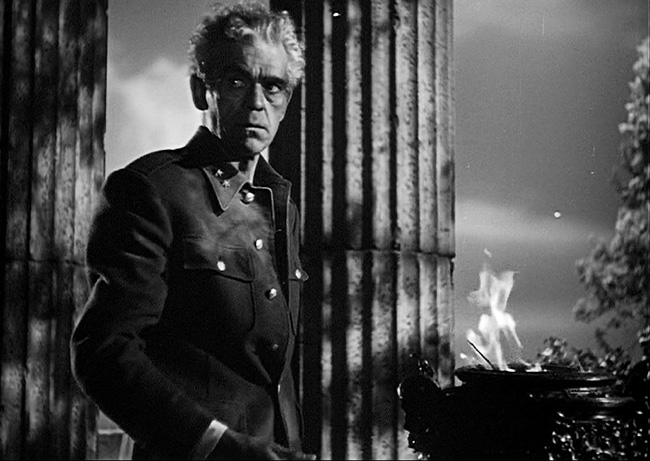
Today, I saw (for the nth time) his film Isle of the Dead (1945), set on a strange Greek island during the First Balkan War (1912-13). Boris Karloff plays the Greek General Nikolas Pherides who, together with an American journalist, rows to an offshore island to visit the grave of his wife. He finds that her grave had been broken into and her body stolen. Worse yet, he lands on the island only to find that one of the guests in the house where he is staying has died of the plague.

Karloff and the other people on the island must quarantine until the wind changes. Once the hot, dry sirocco wind begins to blow, that particular strain of the plague dies off.

Boris Karloff as General Pherides, “The Watchdog”

The psychological element introduced by Lewton is a superstition of a vampire-like creature called a vorvolaka which is promulgated by a Greek peasant woman named Kyra serving in the house. Karloff, who prides himself by his nickname of “The Watchdog,” buys into the possibility of the truth of this superstition, blaming a young serving woman who is enjoying rubicund good health for being a vorvolaka.

The film is a scant 72 minutes long and would be an excellent choice for a Quarantining-at-Home Film Festival, even if it is one lone title. There is also an Elia Kazan film called Panic in the Streets (1950) which involves the plague but has no claustrophobic quarantining.