Serendipity: London 1665 Bubonic Plague

The Bubonic Plague in London

As bad as the coronavirus is. it is nothing compared to the Bubonic plague. In 1722, Daniel Defoe published a superb work of reportage about the 1665 Bubonic plague in London entitled A Journal of the Plague Year. At the actual time of the plague, Defoe was only five years old; so it is actually a carefully researched work of fiction.

It was known to us all that abundance of poor despairing creatures who had the distemper upon them, and were grown stupid or melancholy by their misery, as many were, wandered away into the fields and Woods, and into secret uncouth places almost anywhere, to creep into a bush or hedge and die.

The inhabitants of the villages adjacent would, in pity, carry them food and set it at a distance, that they might fetch it, if they were able; and sometimes they were not able, and the next time they went they should find the poor wretches lie dead and the food untouched. The number of these miserable objects were many, and I know so many that perished thus, and so exactly where, that I believe I could go to the very place and dig their bones up still; for the country people would go and dig a hole at a distance from them, and then with long poles, and hooks at the end of them, drag the bodies into these pits, and then throw the earth in from as far as they could cast it, to cover them, taking notice how the wind blew, and so coming on that side which the seamen call to windward, that the scent of the bodies might blow from them; and thus great numbers went out of the world who were never known, or any account of them taken, as well within the bills of mortality as without.

This, indeed, I had in the main only from the relation of others, for I seldom walked into the fields, except towards Bethnal Green and Hackney, or as hereafter. But when I did walk, I always saw a great many poor wanderers at a distance; but I could know little of their cases, for whether it were in the street or in the fields, if we had seen anybody coming, it was a general method to walk away; yet I believe the account is exactly true.

Smoking Was Considered a Way to Avoid the Plague

As this puts me upon mentioning my walking the streets and fields, I cannot omit taking notice what a desolate place the city was at that time. The great street I lived in (which is known to be one of the broadest of all the streets of London, I mean of the suburbs as well as the liberties) all the side where the butchers lived, especially without the bars, was more like a green field than a paved street, and the people generally went in the middle with the horses and carts. It is true that the farthest end towards Whitechappel Church was not all paved, but even the part that was paved was full of grass also; but this need not seem strange, since the great streets within the city, such as Leadenhall Street, Bishopsgate Street, Cornhill, and even the Exchange itself, had grass growing in them in several places; neither cart or coach were seen in the streets from morning to evening, except some country carts to bring roots and beans, or peas, hay, and straw, to the market, and those but very few compared to what was usual. As for coaches, they were scarce used but to carry sick people to the pest-house, and to other hospitals, and some few to carry physicians to such places as they thought fit to venture to visit; for really coaches were dangerous things, and people did not care to venture into them, because they did not know who might have been carried in them last, and sick, infected people were, as I have said, ordinarily carried in them to the pest-houses, and sometimes people expired in them as they went along.



Zoonotic Spillover

So This Pandemic Comes to Us from Bats?

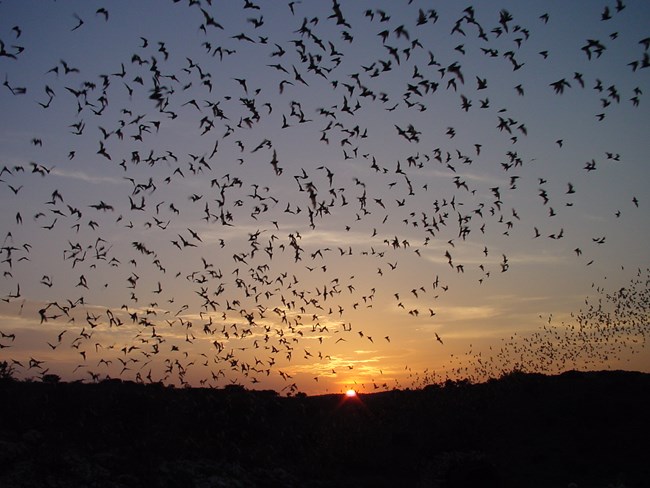
My one experience with bats comes from the 1980s while I was visiting Carlsbad Caverns in New Mexico. Every day from June to October, almost precisely at sunset, tens of thousands of Brazilian free-tailed bats emerge from the cave, gliding inches from the ears of spectators seated in an amphitheater near the entrance.

While I admire the creatures for devouring untold billions of insects, I have never been tempted to eat bat meat in any way, shape, or form. But the current coronavirus pandemic could be due to Chinese in Wuhan attempting to do just that with meat obtained at a highly unsanitary institution referred to as the “Wuhan Wet Market.” According to CNN, a bat-infected pangolin could have been eaten by Patient Zero of the coronavirus.

Bats Emerging from Carlsbad Caverns at Sunset

Others say that the virus emerged as a result of a lab accident in Wuhan in which a study of bats was involved. In either case, it was an instance of zoonotic spillover, in which a disease crosses from an animal to a human.

Whatever the source, there are numerous conspiracy theories in China, the United States, and around the world fomented by the usual guilty parties. These state that the virus was deliberately spread by China or the U.S. or by God, who is dissatisfied by the laxity and sinfulness of His worshipers.

Pangolin

I am not in a position to rule on how COVID-19 started on its quest to infect the world. Many comparisons have been made to the Black Death (Bubonic Plague) of the Middle Ages, of which one website provided the following description:

The Black Death was a devastating global epidemic of bubonic plague that struck Europe and Asia in the mid-1300s. The plague arrived in Europe in October 1347, when 12 ships from the Black Sea docked at the Sicilian port of Messina. People gathered on the docks were met with a horrifying surprise: Most sailors aboard the ships were dead, and those still alive were gravely ill and covered in black boils that oozed blood and pus. Sicilian authorities hastily ordered the fleet of “death ships” out of the harbor, but it was too late: Over the next five years, the Black Death would kill more than 20 million people in Europe—almost one-third of the continent’s population.

Thankfully, COVID-19 has nowhere near that mortality rate.

Still, be careful and stay safe!


Plague Diary 12: Ways of Escape

I Keep Looking for a Way Out

For the first thirty years of my life, I was stuck either in Cleveland or in school. I loved my parents, but they wanted to control my life—and my whereabouts—for much longer than I thought was right. So one day in 1975, instead of taking a flight to Cleveland and remaining stuck in childhood, I flew to Mérida in Yucatán. Ever since then, I saw Cleveland as part of a past that I just happened to sidestep.

Now, during the awful coronavirus plague of 2020, I feel once again that my hands are being tied tightly behind my back. The only difference is that there is a matter of survival involved. For a few weeks, I could stay at home and remain more than six feet away from everyone but Martine. But my mind is traveling. While I eat, I page restlessly through an old Lonely Planet Mexico guide (cover illustrated above) picking places that look promising. Places like Bahía Kino and Alamos in Sonora, Morelia in Michoacán, or San Blas in Nayarit.

It seems that travel has become necessary to my feeling of well-being. I would even pick an American destination so that I can travel with Martine. Of late, she has shied away from going to foreign countries. She has even neglected to renew her passport. I would prefer to travel with Martine, but above all I need to travel.

Have I developed a thousand-mile stare? Perhaps I have. I guess spending a childhood in Cleveland will do that to one.


Plague Diary 11: The Cosa Nostra Cooking Hour

I Develop My Cooking Skills

Living during a time of pestilence, I have decided to become a better cook. My goal is to cook meals that both Martine and I like. We both like Italian food, but for some reason, Los Angeles is not a great place for Italian cooking.

Although Martine was born in France, she spent her most of her childhood in Oceanport, New Jersey, where she loved the pastas with rich red sauce—not the pale imitation to be found in Southern California.

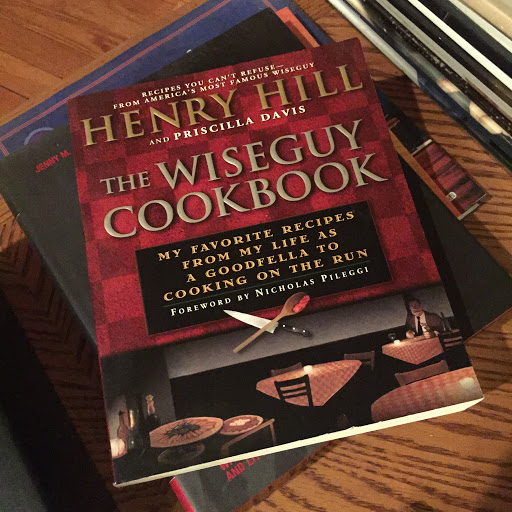
Several years ago I picked up a used cookbook written by ex-Mafioso Henry Hill entitled The Wiseguy Cookbook: My Favorite Recipes from My Life as a Goodfella to Cooking on the Run. Now you may remember an entertaining gangster film directed by Martin Scorsese and released by Warner Brothers in 1990 entitled Goodfellas. The film starred Ray Liotta as a mafioso with the non-Italian moniker of Henry Hill. Well, it’s the same Henry Hill as wrote the cookbook.

Today I spent several hours preparing a favorite dish that Hill cooked while serving time at Lewisburg Federal Penitentiary in Pennsylvania on narcotics charges. The recipe is for “Oven Penitentiary Sauce with Sausage” on page 133. For some reason, there is an Italian grocery in Santa Monica called Bay Cities Italian Deli whose shelves are not picked clean by hoarders. (I guess they’re too busy snooling on their stash of toilet paper.) So I have access to high-quality Italian groceries, while not having comparable access to American goodies at the supermarket.

The Oven Penitentiary Sauce with Sausage was a big hit with Martine, and I loved it as well. It was the rich Italian food of the Italian migration to the East Coast, with lots of garlic and fresh basil baked in a 350º oven for an hour. I even added my own touch, combining the sauce with fusilli pasta in the oven for an additional quarter hour.

I am looking forward to exploring this cookbook in greater detail during the prevailing plague conditions.


Plague Diary 10: Black Beans and Rice

Simple Cooking During Times of Quarantine

Of late, my favorite dishes have combined vegetarianism with hot chiles. Meat doesn’t please me as much, probably because I suspect that over the years the quality has declined somewhat. On Tuesday, I cooked a tuna noodle casserole for Martine to eat for suppers this week. For myself, I made my favorite easy and mostly vegetarian black beans and rice dish. Here is a list of the ingredients:

½ cup olive oil
1 cup Basmati rice
1 chopped onion
2 minced Serrano chiles
Several cloves of garlic, minced or crushed
1 15 oz can of black beans with liquid
2½ cups chicken or vegetable stock
Salt and pepper to taste
Garnish with chopped parsley or cilantro

Start by chopping the onions and adding to the heated olive oil. Then add the garlic, but don’t wait too long before adding the chile: Garlic burns quickly when left untended, leading to an unpleasant flavor. Basmati rice can be a little difficult to work with as the amount of liquid to use is often variable depending on the particular rice used. Add the rice to the browning onions, garlic, and chiles, and stir for a couple of minutes. Lower the flame, then add 2½ cups stock, cover, and leave untouched for about 12 minutes.

Then and only then, remove the cover and stir briefly. If all the liquid is absorbed, add some more and continue. Then open a can of black beans and pour the beans and the liquid it came with on top of the rice. Re-cover the pot and cook for another ten minutes or so, adding salt and pepper to taste. Before serving, garnish with parsley or cilantro.

This quantity of beans and rice usually lasts me for four meals.

The main difficulty during quarantine is that hoarders usually scoop up all the Basmati rice from supermarkets. You can buy it in 5- or 10-pound bags at an Indian or Persian grocery.


Plague Diary 9: Chinese Virus Torture

LA Times Photo of Bus Riders

Looking back on yesterday’s very pessimistic post, I wish I had not posted it. And while I’m in an apologizing mood, I wish I had not used the title “Chinese Virus Torture” for this post—except, as you will see, it is oddly appropriate.

While I could see that COVID-19 is the news story of the century, I am appalled that the news media are pre-empting all other news to strike heavily and again and again and again on the subject of the virus. Almost as if it were a form of Chinese water torture. (I will not otherwise use the racist term Chinese Virus, much beloved of our Orange Führer.)

I think that, at this time, people should learn to laugh again, to remember that, yes, there will be life after the coronavirus slinks away. Other than five or six basic facts such as washing your hands, maintaining social distance, etc., there really isn’t much else to be said. When the broadcast media become all virus all the time, the result is to strike fear among the population.

When toilet paper suddenly disappears from the shelves of our supermarkets, it is an indicator that the news media is presenting an out of balance picture that creates an environment of irrationality and panic.

If I were in charge of programming, I would not replace the endless news cycle with some entertainment. Right now, it is difficult to avoid the talking heads drumming death into our eyes and ears.

The mess we are in is going to last a while. My post yesterday was a sign that the virus news hammer was starting to get to me. Today I feel a little bit better.


Plague Diary 9: What Comes Next?

My Real Worry Is How We Transition Back to Normal Life

Eventually, the COVID-19 curve will flatten and the number of new cases will decline. I expect millions will die, in prisons, in refugee camps, in nursery homes, on aircraft carriers—everywhere where people are forced to live in close quarters. The economy will not simply bounce back: There will be a lot of casualties. They will include hospitals; many of your favorite restaurants, bars, and clubs; thousands of retailers; hundreds of companies across the country, large and small; numerous airlines and (I sincerely hope) ocean cruise lines. The notion of democracy in the United States will likely be in shambles, what with the millions of brain dead who rely on Fox News and fundamentalist Evangelical ministers for the “real story” of what happened.

Will the 2020 presidential election even take place? Or will the orange-haired dictator be crowned king?

People who live paycheck to paycheck will be thrown out of their jobs and be cast out into the streets, unable to pay the rent. Some movements are afoot to prevent this from happening, but I suspect the growing numbers of indigent will just be too much for the system to bear. If things get particularly bad, I may be one of the victims.

I don’t think the present leadership of this country is even marginally competent. There are some governors of populous states who have braved Trump’s displeasure, but the Feds themselves are a sad crew, what with the evil McConnell at the helm of the Senate and circus clowns running the Executive and Judicial branches of government.

My feeling as I look to the future: Dread.


Reconnecting

French Novelist Marie NDiaye

For one month out of every year, I attempt to read only authors I have not previously read. One of the biggest surprises this month as been French novelist Marie NDiaye, whose novel My Heart Hemmed In [Mon coeur à l’étroit] I have just finished reading. Unlike many postmodern writers, who do not shy away from boring their readers to tears, NDiaye carries out a relentless examination of the life of her heroine, a teacher who, along with her husband, suddenly finds herself roundly hated by most of her acquaintances. Nadia has distanced herself from her ex-husband, her son, and her parents. She has gained weight, and several of the people she meets assume that she is pregnant.

The story begins when her husband Ange returns from the class he has been teaching with a serious stomach wound. A neighbor shows up who is known to everyone she meets as an educator and television personality, but whom she does not know as both she and Ange do not even own a TV, being disconnected from their popular culture. NDiaye follows Nadia closely as she begins to try to reconnect with her past and try to come to terms with the pain she feels. The process is a wonderfully told voyage of self-discovery that transforms her.

I have always felt that the best novels involve a radical transformation of the main character. What NDiaye has done is make this voyage exciting rather than the usual banal. I can see myself reading more of her works in the months to come, most recent of which is La Cheffe, which is on my TBR pile.


Plague Diary 8: Beginning to Fray

Santa Monica Bay in the Plague

We have had two full weeks of staying in place during the coronavirus epidemic. I have managed to develop a routine that sees me through the day, but the stress is beginning to tell on Martine. She cannot bear to stay in the apartment except to sleep, wash, and eat. The rest of the time, she takes long walks while listening to old 1960s rock tunes on a Sansa Clip MP3 player I got for her.

It is tough not having any place to go. No restaurants. No book stores. No museums. No movie theaters. No parks. Even the beach scene above from the Los Angeles Times will be difficult, as the beach parking lots are closed. In the meantime, the U.S. is getting some 18,000 new COVID-19 cases a day, and the growth rate is looking frighteningly logarithmic. For someone like Martine who doesn’t like to read and who dreads the “Bring Out Your Dead” tone of the news media, escape is an answer of sorts.

I fear that the stay in place orders will continue through the month of April—at the very least. I will do whatever I can to ease Martine’s restless desperation, though it won’t be easy.


Plague Diary 7: Who Was That Masked Man?

Public Transit at a Time of Plague

I wish I had my camera with me. Why? Because I am witnessing things during this time of plague that may not be seen for another hundred years.

This morning, I took a two-mile walk down Broadway to Bay Cities Italian Deli on Lincoln Boulevard in Santa Monica. It was a cool, crisp, sunny day, free from the lowering clouds that have beset us during the last couple of weeks. Since the long spell of rain, together with an ingrown toenail, kept me indoors, I thought it would be best to take the bus back.

Because of the COVID-19 outbreak, there had been some changes. Passengers on foot had to board from the rear door and did not have to pay any fare. There was a yellow cord stretched just past the two sideways-facing seats in front separating the front from the rear of the bus. The front seats were reserved for wheelchair passengers and passengers with strollers who needed the ramp to be lowered for them. The whole idea is to minimize interaction between driver and passengers. Even so, the driver probably still has to help secure wheelchairs to the side of the bus.

Even so, during the ride from Lincoln to my stop at Bundy Drive, there were never more than four passengers aboard, all sitting several feet from one another for social distancing purposes.

The Big Blue Bus (as the Santa Monica Municipal Bus Lines is known) is a well-run public transportation service. I can see that, given the restrictions enforced by Coronavirus, they are losing beaucoup bucks during this strange period, but I am reassured that, even now, public transportation is still available, and that it is free of charge.