Pre-Columbian

ancient The photo above is of a contemporary figurine of a Pre-Columbian idol on display in Quito’s Museo Mindalae. Although I doubt there was much trade between the ancient peoples of Ecuador and the Olmecs, Maya, and Aztecs of Mexico, there are clearly similarities in their religious iconography.

Before I began my travels to Latin America in 1975, I was puzzled by the images I saw of deities and demons from the more civilized portions of Meso-America. There were many similarities. But once one crossed the Rio Grande and visited where the Anasazi lived, the imagery is altogether different. And when I traveled in Argentina, Uruguay, and Chile, I saw precious little suggesting an advanced ancient civilization (though, in all honesty, I never visited the Northwest of Argentina, which was part of the Inca empire).

Now look at the depiction of one of the Mayan Priest Kings of Yucatán from the Mérida Museum of Anthropology:
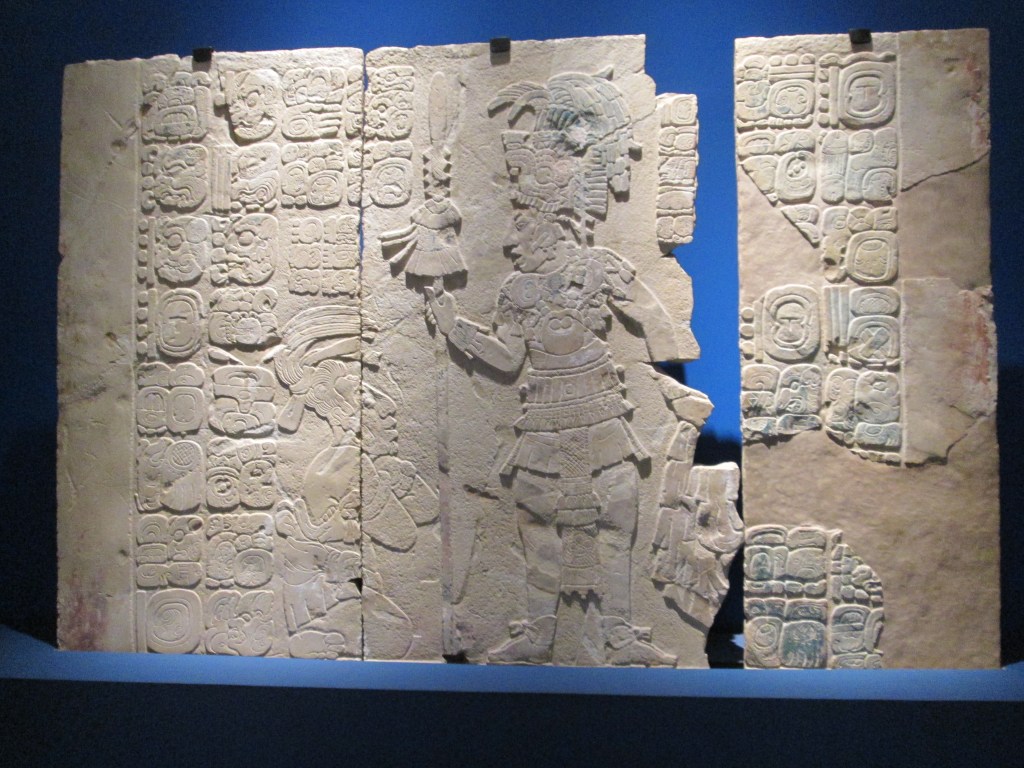
Note the elaborate headdress and the warlike demeanor. Do not expect mercy from either of these rigidly powerful figures. I remember a conversation that took place at a symposium at UCLA decades ago between two archeologists, Michael Coe and Nigel Davies, about whether they would prefer to be in captivity to the Mayans or the Aztecs. Both agreed that, although the Aztecs were an empire and the Mayans were a group of city states, they both feared being prisoners of the Maya.

Why? Take a look at this fresco from the ruins at Bonampak in Chiapas:
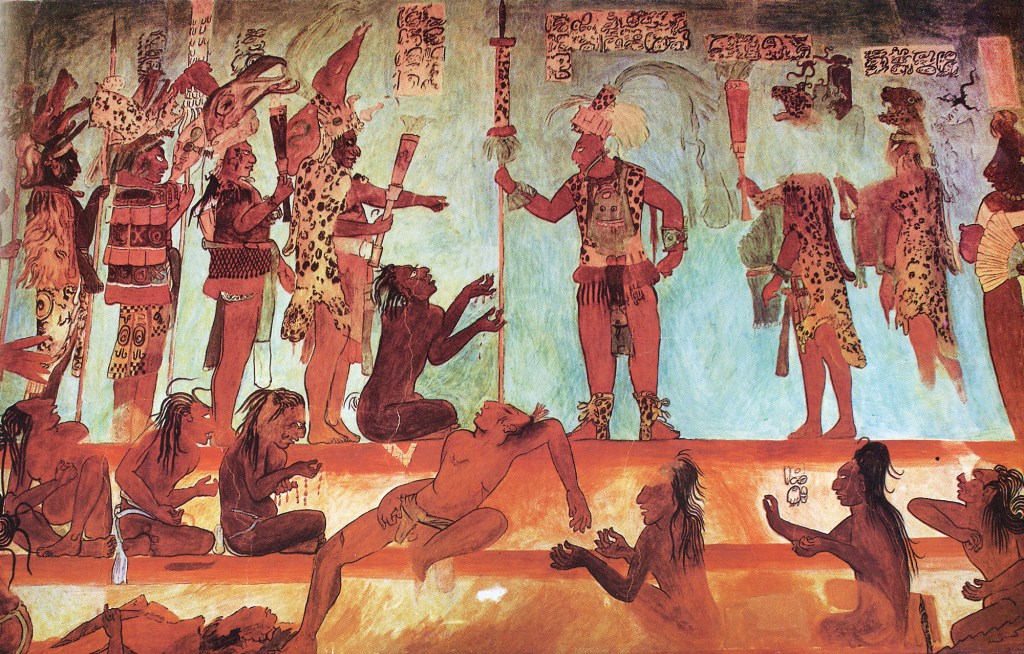
Here you see the victorious Maya of Bonampak with their prisoners captured in a war with another city state. The scene is described in the Sixth Edition of Robert J. Sharer’s The Ancient Maya:

The aftermath is presented on the north wall. Here the full-frontal figure holding his jaguar-pelted spear, again probably Chan Muwan, accompanied by his warrior allies and entourage, along with two women at the far right, stands on the summit of a platform to preside over the captives taken in the battle. The chief captive sits at Chan Muwan’s feet, while the rest of the unfortunate prisoners are displayed on the six steps of the platform, where they are tortured and bled from their fingernails, held and guarded by more victorious warriors. These are the captives that will be sacrificed; one sprawled figure may already be dead, and the severed head of another has already been placed on the steps.

What all these Meso-American peoples had in common was highly organized and ritualistic warfare. Reading the history of many of these city states based on commemorative stelae, paintings, and other media, one clearly gets the feeling that life for the common people was anything but fun.

Even the Dreadful Martyrdom Must Run Its Course

Look at the bottom right of the above painting, Pieter Breughel the Elder’s “The Fall of Icarus.” I would particularly direct your attention to the bare legs of Icarus, who has fallen from the sky into the ocean—punishment for presuming to fly too close to the sun. The following poem by W. H. Auden refers to it in the last stanza. The poem is called “Musée des Beaux Arte.”

 About suffering they were never wrong,
The old Masters: how well they understood
Its human position: how it takes place
While someone else is eating or opening a window or just walking dully along;
How, when the aged are reverently, passionately waiting
For the miraculous birth, there always must be
Children who did not specially want it to happen, skating
On a pond at the edge of the wood:
They never forgot
That even the dreadful martyrdom must run its course
Anyhow in a corner, some untidy spot
Where the dogs go on with their doggy life and the torturer’s horse
Scratches its innocent behind on a tree.

In Breughel’s Icarus, for instance: how everything turns away
Quite leisurely from the disaster; the ploughman may
Have heard the splash, the forsaken cry,
But for him it was not an important failure; the sun shone
As it had to on the white legs disappearing into the green
Water, and the expensive delicate ship that must have seen
Something amazing, a boy falling out of the sky,
Had somewhere to get to and sailed calmly on. 

Survey Research

Are you trying to call my land line to conduct a telephone survey? If you’re from a firm called Survey Research, you have rung my phone twice this evening. As soon as I heard the call was from “Survey Research,” I studiously avoided picking up the phone. If I somehow pick up the receiver, the call lasts only as much time as it takes me to say, “I don’t participate in surveys.”

What do I have against surveys? I find that most of them are composed to convince me of something rather than solicit information. And if they should solicit information from me, they would have difficulty in classifying me. On most issues, I am liberal (I call myself a Libtard); on some, I’m a centrist; and on a few, I am downright conservative. As Walt Whitman wrote in “Song of Myself”:

Do I contradict myself?
Very well then I contradict myself,
(I am large, I contain multitudes.)

If the survey firm finds me to be cooperative, they will sell my number and other surveys will come ringing. They are desperate, because surveys depend on reaching a large number of land lines; and most people have given up their land lines in favor of cell phones. So the next time an election rolls along (there should be one coming up in a few minutes—somewhere), the surveys will be a lot less useful than they used to be in the past. No matter. Political organizations will continue to commission them, and corporations will continue to try to sell or convince.

Just bear in mind that my opinions will not be represented in any of them.

Life Is Different for Him

The woman in the above photograph is Milena Jesenská, with whom Franz Kafka carried on a torrid correspondence in 1920. Although she was a married woman (albeit unhappily), Kafka was strongly drawn to her. The relationship, such as it was, petered out when Milena did not want to run away from her marriage. Milena herself was a writer, and in a letter to Max Brod written in August 1920, provides a riveting description of Kafka. She was to live on for another twenty years, dying in 1944 in Ravensbrück Concentration Camp.

Life for him is something entirely different than for all other human beings; in particular, things like money, the stock market, currency exchange, a typewriter are utterly mystical to him (and they really are, too; just not for the rest of us), they are the strangest riddles to him, and his approach to them is completely different than our own. Can his office work be considered the customary performance of a service? Any official position, including his own, is something very puzzling to him, very admirable, like a locomotive is for a small child. He doesn’t understand the simplest things in the world. Were you ever in a post office with him? After he composes a telegram and picks out whatever little counter he likes best, shaking his head, he then drifts from one counter to another, without the slightest idea to what end or why, until he finally stumbles on the right one, and when he pays and receives change, he counts it and discovers one krone too many, and so gives one back to the girl behind the counter. Then he walks away slowly, counts once again, and in the middle of descending the last staircase he realizes that the missing krone belonged to him after all. So there you stand next to him, at a loss, while he shifts his weight from one foot to the other, wondering what to do. Going back is difficult; upstairs there’s a crowd of people pushing and shoving. “So just let it go,” I say. He looks at me completely horrified. How can you let it go? Not that he’s sorry about the krone. But it’s not good. There’s one krone missing. How can you forget about something like that? He spoke about it for a long time, and was very dissatisfied with me.

And this repeated itself with different variations in every shop, in every restaurant, in front of every beggar. Once he gave a beggar a two-krone piece and wanted one back. She said she didn’t have anything. We stood there for a good two minutes, thinking about how to deal with the matter. Then it occurred to him that he could leave the two krone. But no sooner had he taken a few steps when he started getting very cross. Of course this same man would be eager and extremely happy to give me twenty thousand krone with no questions asked. On the other hand, if I were to ask him for twenty thousand and one krone and we had to change money somewhere and didn’t know where, he would seriously consider what to do with the one krone I hadn’t been allotted. His anxiety in the face of money is almost the same as his anxiety in the face of women. Or his fear of things official. Once I telegraphed him, phoned him, wrote him, begged him in God’s name to come see me for a day. I really needed it at the time. I cursed him to high heaven. He didn’t sleep for nights, tormented himself, wrote letters full of self-destruction, but he did not come. Why? He couldn’t ask for leave. He was unable to ask the director, the same director he admires in the depths of his soul (seriously!) for being able to type so quickly—he wasn’t able to tell the director he was going to see me. And as for saying something else—another horrified letter—how could he? Lie? Lie to the director? Impossible…..

No, this world is and remains a riddle to him.

It is a pity that Milena’s letters to Kafka no longer exist. Because she was still uncertain about divorcing her husband, when Franz died in 1924, she had her letters destroyed so that they would not provide incriminating evidence. In her own way, she was a major Czech literary figure.

Veterans: In Harm’s Way

I don’t usually pay much attention to holidays. That does not mean I’m a Jehovah’s Witness: It just means that I think most holidays are a major pain in the ass. Some of them, such as Thanksgiving and Christmas, are notorious for putting incredible stresses on families, and sometimes breaking them up.

The men and women of our armed forces typically did not join because they wanted to serve our country. I think most wanted to lift themselves out of poverty and take advantage of educational opportunities that would jump start their post service careers. Unfortunately, in the process, they often put themselves in harm’s way fighting our nation’s interminable wars.in Korea, Vietnam, the Dominican Republic, Lebanon, Grenada, Panama, Kuwait, Iraq, Somalia, Haiti, Bosnia, et cetera ad infinitum.

In those “little wars,” some 100,000+ Americans gave their lives. And a much larger number came back with debilitating physical or mental scars.

I consider myself fortunate that my brain surgery operation in 1966 gave me a Selective Service rating of 4F, so that I would not have to fight in Vietnam. Truth to tell, I would probably have been 4F in any case, as I had been walking around with a pituitary tumor for ten years or more and was not in great shape.

During the Vietnam Era, many war protestors held a grudge against the armed forces. I didn’t. Most of them were just trying to survive under difficult circumstances. Instead, I wish them well.

Levels of Mean

I have been accused by some people of being mean to the homeless, typically by people whose experience of homelessness has been very different from what I have encountered. There are people who manage to get out of living on the streets. Usually, this applies to women, especially women with children. I write mostly about people who can more accurately be described as bums and their associated scags.

Does that sound mean? It should given my experience with garbage, poop, fights and screams in the middle of the night, vandalism, aggressive begging, theft, and stench. And this all is less than a hundred feet from my front door. Let us look at three levels of opposition to homeless encampments:

  1. Approach with flamethrowers and baseball bats.
  2. Apply political pressure to get them off the streets.
  3. Refuse to engage with them in conversation.

I am at level 3. When approached by a bum, usually to request a cash donation, I talk to them only in Hungarian. Ever since running into a Hungarian beggar in Vancouver, BC, I do not swear at them in Hungarian. All I want is for them to walk away looking confused.

Is this mean and heartless? Not really. I do not think much of the bums who live across the street from me. I do not sneer at them or give them any indications of opposition. If they want to talk to me, I just insist that it be in Hungarian. And I do not work with politicians on the problem, because I think they have no idea of the nature of the problem. There are just too many widely varying opinions across the entire political spectrum. Mine is just one of them, and by no means the most heartless.

The Narcoleptic Driver?

I was very late learning to drive. It was not until age 40 that I got my first driver’s license. Around that time, I was on some relatively ineffective blood pressure medications that had all sorts of nasty side-effects. Apresoline attacked my joints and made me averse to any sort of movement. Ismelin (which I called Dismalin) made me impotent. And Catapres turned me into a narcoleptic: Whenever I rode in an automobile or bus for any distance, I would quickly drop off to sleep.

Naturally, I was not taking all three medications at the same time; but I had at the time some major concerns about my health. When in 1985 my doctor took me off Catapres, I decided it was now or never. I contacted the Sears Roebuck Driving School and started learning to drive. My driving instructor, Jerry Kellman, was excellent. After a couple of months of driving under his tutelage, I took the driving test and got an excellent score.

No sooner did I get my license than I ordered a 1984 two-door Mitsubishi Montero. Like the model illustrated above, the color was “Dakar Sand.” I was eager to show my father my newfound driving ability, but unfortunately he died of heart failure around that time.

Way back when, he tried to teach me how to drive. But he was so hot-tempered that he would whack me in the head every time I made a mistake; so I decided I would learn on my own. Alas, shortly after I had my brain tumor operation; and everything was put on hold. For my first twenty years in Los Angeles, I depended on public transportation and the kindness of friends.

My Mitsubishi Montero lasted for ten years. Then I burned out the engine by driving up San Marcos Pass in Santa Barbara in low gear. And after replacing the engine (ouch!), my dealership made a mistake that wrecked my automatic transmission. On a trip to Sacramento to see Martine, I started leaking transmission fluid all over the I-5 midway between L.A. and Sacramento. The last straw was in Los Angeles, when an elderly woman driver who was afraid of being late to see her doctor T-boned my car close to home and sent it turning end over end in heavy traffic.

It was only a four-cylinder vehicle, but I grew fond of it.

Rome in God’s Eye

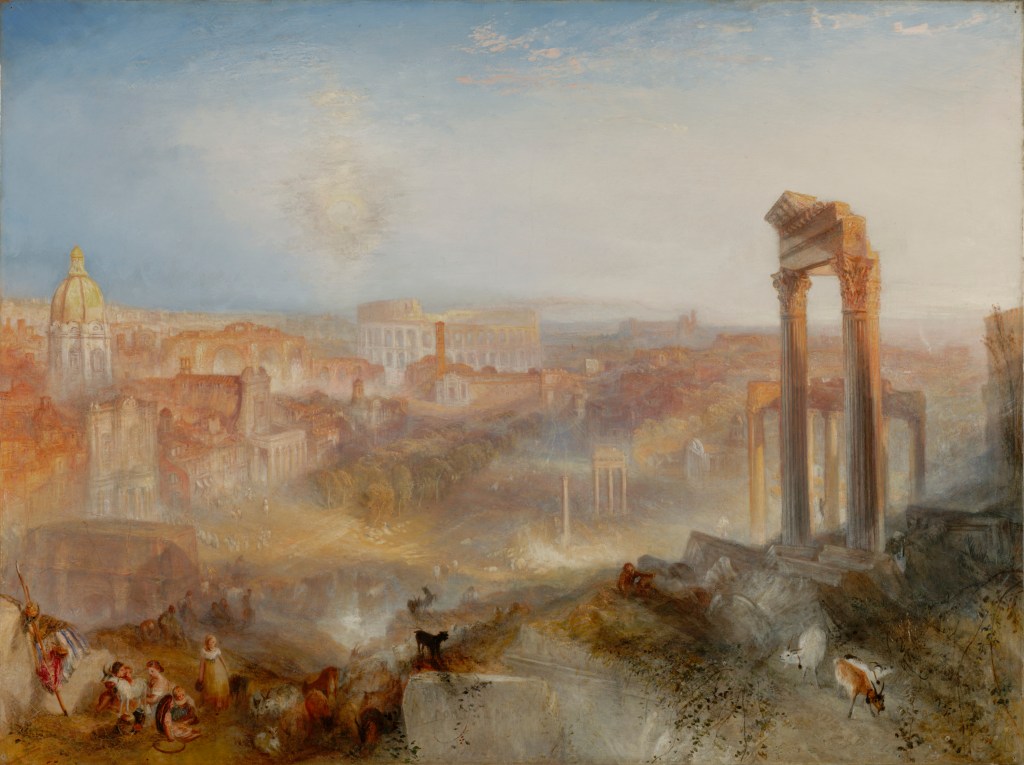
The title of the illustrated painting is “Modern Rome—Campo Vaccino.” It was painted in 1839 by Joseph Mallord William Turner (1775-1851). It is the third of five paintings that moved me during my last visit to the Getty Center in Los Angeles.

There is something about the quality of light in J.M.W. Turner’s work. The painting is described as follows by the Getty’s database:

Ten years after his final journey to Rome, Turner envisioned the Eternal City through a veil of memory. Baroque churches and ancient monuments in and around the Roman Forum seem to dissolve in iridescent light shed by a moon rising at left and a sun setting behind the Capitoline Hill at right. Amidst these splendors, the city’s inhabitants carry on with their daily activities. The picture’s nacreous palette and shimmering light effects exemplify Turner at his most accomplished.

When first exhibited at the Royal Academy in 1839 with its pendant, Ancient Rome; Agrippina Landing with the Ashes of Germanicus, the painting was accompanied by a modified quotation from Lord Byron’s masterpiece, Childe Harold’s Pilgrimage (1818): “The moon is up, and yet it is not night, / The sun as yet divides the day with her.” Like the poem, Turner’s painting evokes the enduring sublimity of Rome, which had been for artists throughout history less a place in the real world than one in the imagination.

Note the characters and livestock in the foreground of the painting. In the background, ancient and contemporary Rome are intermingled as the light at the end of day washes out all the details. It looks almost as if Rome is in flames.

Campo Vaccino literally means cow pasture or cattle field in Italian. For years, the location had been a cattle market. According to the Princeton Art Museum, “Essentially in ruins since the fifth century A.D., by the seventeenth century the still-to-be excavated Roman Forum was popularly known as the Campo Vaccino, or cow field, alluding to its dual role as pasture and cattle market; it was also a popular sketching spot for artists.”

Hitting Rock Bottom

TLOS ANGELES, CA – JANUARY 24: Lisa Rogers, a homeless woman, carries her tent as she relocates her camp on January 24, 2017 in Los Angeles, California. According to a 2016 report by the U.S. Department of Housing and Urban Development, Los Angeles has the highest number of homeless people in the nation with close to 13,000 living on the streets. The annual Greater Los Angeles Homeless Count begins today and will continue through Thursday. (Photo by Justin Sullivan/Getty Images)

To begin with, there are a hell of a lot more than 13,000 homeless living on the streets of Los Angeles. I would put the number at close to 5-10 times that many. I have just finished reading Sam Quinones’s excellent book The Least of Us: True Tales of America and Hope in the Time of Fentanyl and Meth, from which the following paragraph is taken:

We used to believe people needed to hit rock bottom before seeking treatment. That’s another idea made obsolete by our addiction crisis and the current synthetic drug supply. It belongs to an era when drugs of choice were merciful. Nowadays people are living in tents, screaming at unseen demons, raped, pimped, beaten, unshowered, and unfed. That would seem to be rock bottom. Yet it’s not enough to persuade people to get treatment. In Columbus, Ohio, Giti Mayton remembers a meth addict who was hospitalized with frostbitten, gangrenous hands, yet who left the hospital in midwinter to find more dope. San Francisco and Philadelphia, two cities with years of experience with heroin, are seeing users homeless and dying like never before. The dope is different now. Today, rock bottom is death.

The United States of Addiction

Across the street from my apartment is a row of some dozen or more tents usually surrounded by piles of trash and inhabited by people we typically refer to as homeless. (To me, that’s about as useful as referring to my neighbors in this building as “the housed.“) The easternmost tents have the most stable residents, while the ones to the west come and go. Some die of drug overdoses; some are hauled away by the police or ambulance; and, hopefully, some manage to escape life on the streets by happier means. They spend much of the night yelling at one another, particularly if one of the campers is a woman. It’s nobody’s idea of a stable community. Yet Los Angeles has tens of thousands of similar campers, whose numbers seem to be growing every week.

What are the causes of this phenomenon? One could certainly point to economic causes, such as the insanely rising cost of housing. There are also various social causes, such as people released from prison. In my neighborhood, many of the tent dwellers are military veterans as I live two miles from a major Veterans Administration hospital. I suspect, however, that the major causes are a combination of mental illness, alcoholism, and drug addiction.

I am currently reading a new book by Sam Quinones entitled The Least of Us: True Tales of America and Hope in the Time of Fentanyl and Meth. Its author talks about how a relatively new drug called Fentanyl has taken America by storm. Not relying on growing and processing a crop, such as cannabis, cocaine, or opiois, fentanyl is produced in the lab from such substances as Benzylfentanyl and 4-Anilinopiperidine. It is now readily available and devastatingly cheap. So cheap that small amounts are frequently mixed in with cocaine and opioids. The result is twofold: .

  • A more satisfying high
  • A vastly increased mortality rate

The above illustration from the Drug Enforcement Administration tells the whole story, comparing the amount required to cause overdose deaths of heroin, carfentanyl (developed to anesthetize rhinoceroses), and fentanyl. As you can see, if a drug dealer gets a pound of fentanyl or carfentanyl, he or she can make thousands of pills with it and still have enough left over to mix with heroin or cocaine. Because so little is needed—beyond which the risk of overdose looms—one can see how a drug dealer can more easily move the drug without being apprehended and also make a killing selling it.

Most fentanyl comes from China. Although the Chinese government has outlawed its sale, drug manufacturers can evade prosecution by making slight changes to the molecular structure of their product.

I have no doubt that most of the tent dwellers across the street from me are users of fentanyl. It’s compact. It’s cheap. And it’s deadly.