
Limits

Here is one of my favorite poems by the Argentinian Jorge Luis Borges (1899-1986). Above is a view of a street in the San Telmo neighborhood of Buenos Aires.

 
Limits
Of all the streets that blur in to the sunset,
There must be one (which, I am not sure)
That I by now have walked for the last time
Without guessing it, the pawn of that Someone

Who fixes in advance omnipotent laws,
Sets up a secret and unwavering scale
for all the shadows, dreams, and forms
Woven into the texture of this life.

If there is a limit to all things and a measure
And a last time and nothing more and forgetfulness,
Who will tell us to whom in this house
We without knowing it have said farewell?

Through the dawning window night withdraws
And among the stacked books which throw
Irregular shadows on the dim table,
There must be one which I will never read.

There is in the South more than one worn gate,
With its cement urns and planted cactus,
Which is already forbidden to my entry,
Inaccessible, as in a lithograph.

There is a door you have closed forever
And some mirror is expecting you in vain;
To you the crossroads seem wide open,
Yet watching you, four-faced, is a Janus.

There is among all your memories one
Which has now been lost beyond recall.
You will not be seen going down to that fountain
Neither by white sun nor by yellow moon.

You will never recapture what the Persian
Said in his language woven with birds and roses,
When, in the sunset, before the light disperses,
You wish to give words to unforgettable things.

And the steadily flowing Rhone and the lake,
All that vast yesterday over which today I bend?
They will be as lost as Carthage,
Scourged by the Romans with fire and salt.

At dawn I seem to hear the turbulent
Murmur of crowds milling and fading away;
They are all I have been loved by, forgotten by;
Space, time, and Borges now are leaving me.

Embattled Young Victorian Women

There is something so fragile about young Victorian women. Partially, this was because they could not really own property: If they were married, their husbands had full control. According to Bartleby.Com:

The property rights of women during most of the nineteenth century were dependent upon their marital status. Once women married, their property rights were governed by English common law, which required that the property women took into a marriage, or acquired subsequently, be legally absorbed by their husbands. Furthermore, married women could not make wills or dispose of any property without their husbands’ consent. Marital separation, whether initiated by the husband or wife, usually left the women economically destitute, as the law offered them no rights to marital property.

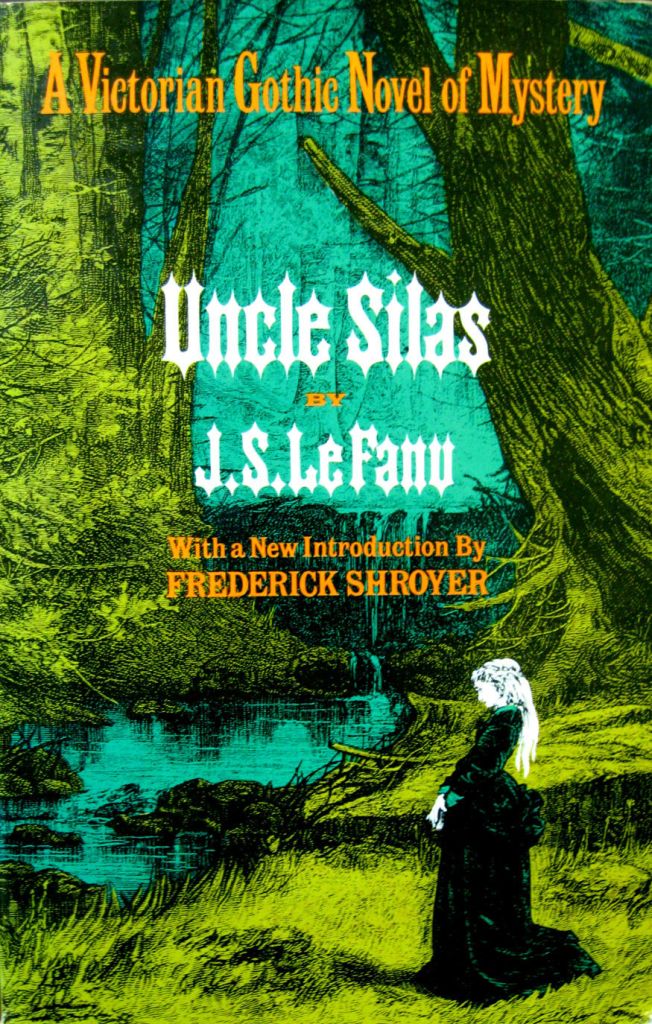
I have just finished reading J. Sheridan Le Fanu’s Uncle Silas: A Tale of Bartram-Haugh (1864), a brooding mystery about a young English heiress named Maud Ruthyn who is hemmed in by the incompetence of her guardians and the villainy of people trusted by their guardians who strive to take advantage of her.

Looking back on English novels of the Victorian era, I find many novels on this theme. Think of Jane Eyre, Bleak House, The Mysteries of Udolpho, and Agney Grey. It made me realize that it took a long time for society to protect the rights of women. Even today, many existing societies fail in this regard.

In those novels, the only prospect young women could look forward to other than marriage with a loving and rich husband is a dead-end job as a governess, seamstress, laundress, or some other poorly paying “-ess.”

Thou Foster-Child of Silence and Slow Time

Irish Writer J. Sheridan LeFanu (1814-1873)

He is probably most famous for his ghost stories. His Carmilla (1872) was a Lesbian vampire tale that inspired Bram Stoker’s Dracula and was turned into a Roger Vadim film called Blood and Roses (1960). His stories were an unusual mixture of horror, mystery, and historical fiction. After putting it off for decades, I am finally reading his Uncle Silas: A Tale of Bartram-Haugh (1864) and am enjoying immensely.

The title of this post comes from John Keats’s “Ode on a Grecian Urn”:

Thou still unravish'd bride of quietness,
       Thou foster-child of silence and slow time,
Sylvan historian, who canst thus express
       A flowery tale more sweetly than our rhyme:
What leaf-fring'd legend haunts about thy shape
       Of deities or mortals, or of both,
               In Tempe or the dales of Arcady?
       What men or gods are these? What maidens loth?
What mad pursuit? What struggle to escape?
               What pipes and timbrels? What wild ecstasy?

There is something eminently satisfying about reading a long nineteenth century novel. It calls for reserves of patience, but rewards with insights similar to those of the Grecian urn about which Keats writes. That is particularly true of novels from the British Isles, where the prose at times approaches the realm of poetry:

See how a sleepy child will put off the inevitable departure for bed. The little creature’s eyes blink and stare, and it needs constant jogging to prevent his nodding off into the slumber which nature craves. His waking is a pain; he is quite worn out, and peevish, and stupid, and yet he implores a respite, and deprecates repose, and vows he is not sleepy, even to the moment when his mother takes him in her arms, and carries him, in a sweet slumber, to the nursery. So it is with us old children of earth and the great sleep of death, and nature our kind mother. Just so reluctantly we part with consciousness, the picture is, even to the last, so interesting; the bird in the hand, though sick and moulting, so inestimably better than all the brilliant tenants of the bush. We sit up, yawning, and blinking, and stupid, the whole scene swimming before us, and the stories and music humming off into the sound of distant winds and waters. It is not time yet; we are not fatigued; we are good for another hour still, and so protesting against bed, we falter and drop into the dreamless sleep which nature assigns to fatigue and satiety.

I am presently 70% of the way through Uncle Silas and look forward to finishing the book tomorrow, come hell or high water. If you are interested in exploring LeFanu’s work, the following editions were issued by Dover Publications and may still be found from used book dealers (I recommend http://www.abebooks.com):

  • Best Ghost Stories of J. S. LeFanu
  • Green Tea and Other Ghost Stories
  • Ghost Stories and Mysteries
  • Wylder’s Hand
  • Uncle Silas: A Tale of Bartram-Haugh
  • The Wyvern Mystery

It is my opinion that LeFanu is a sadly neglected writer who, over time, will come into his own.

Allhallowtide

If you were to look closely at the word Halloween, you may notice that it means the Eve of All Hallows Day, November 1, which is also called All Saints’ Day. In fact, the period from October 31 through November 2 is sometimes referred to as Allhallowtide. In a way, the period is a kind of liturgical trifecta, in that November 2 is All Souls’ Day, also known as the Day of the Dead.

The idea of All Saints’ Day was primarily to commemorate the nameless martyrs who died for their faith at the hands of certain Roman emperors who persecuted them. Perhaps the largest single group is the Theban Legion, commanded by Saint Maurice, who was ordered by the Emperor Maximian to defeat rebels in what is now Switzerland and, in the process, to make sacrifices to pagan gods. Maurice and his men refused. As punishment, Maximian ordered the legion to be decimated, that is, to have every tenth man executed. After two rounds of decimation, it was decided to execute the entire legion, which consisted of some 6,700 legionaries. Their martyrdom took place in AD 286.

Above is a painting by Fra Angelico of various saints and martyrs, not including the entire Theban Legion. In fact, none of the saints depicted look particularly like Roman legionaries.

All Saints’ Day (November 1) is still considered a Holy Day of Obligation in the Catholic Church, during which all Catholics are required to attend Mass or commit a mortal sin for failure to comply.

Although I continue to hold warm feelings about my Catholic upbringing, I am pretty much a lapsed Catholic and am probably doomed to the fires of Heck.