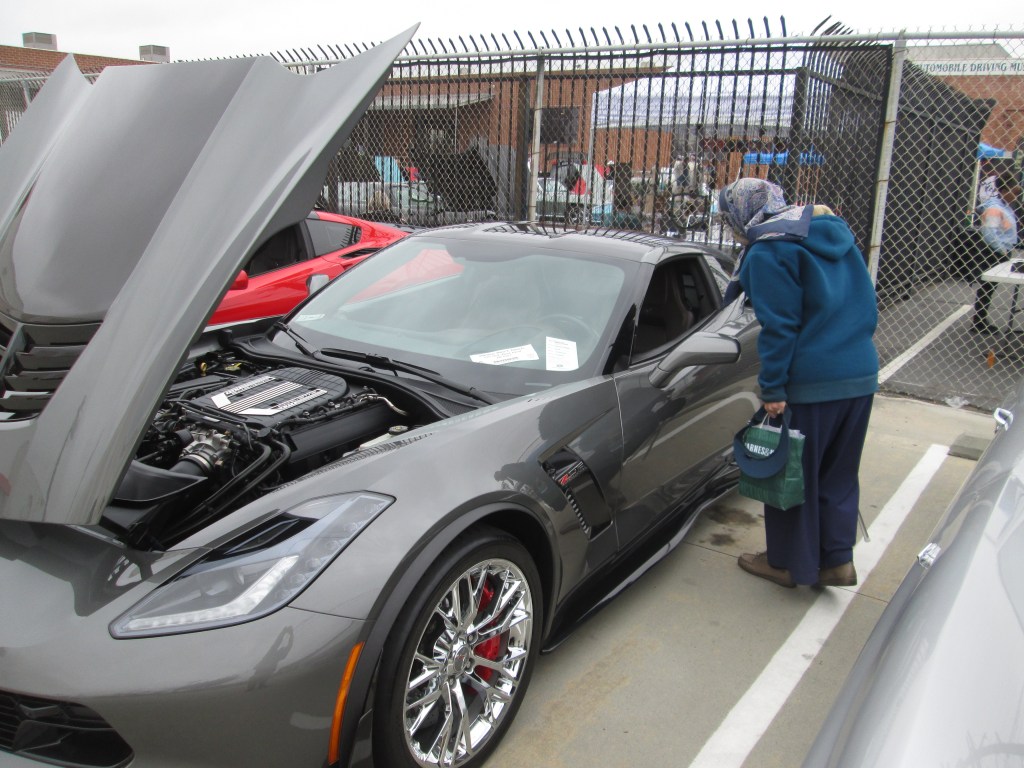
Today, Martine and I visited the Automobile Driving Museum (ADM) in El Segundo for their annual Chevrolet Corvette event. The Corvette is Martine’s favorite car model, whereas I tend toward super-pragmatic Japanese models. The quarantine has taken a lot out of both of us, and it gives me pleasure to make Martine happy.
The Corvette has been in production since 1953 and is still going strong. Of all the single-model car events we have attended at the museum, the Corvette shows have been the best attended.
Martine Checking Out a Corvette
Her preference is for the earlier models, as she has a distinct dislike of bucket seats, although they are to be found practically everywhere now. Myself, I find the Corvettes to be one of those built-low-to-the-ground sports cars favored by aggressive drivers who like to outperform other cars on the road. As the owner of a 2018 Subaru Forester, I would prefer to get from Point A to Point B safely. To others, where is the fun in that?
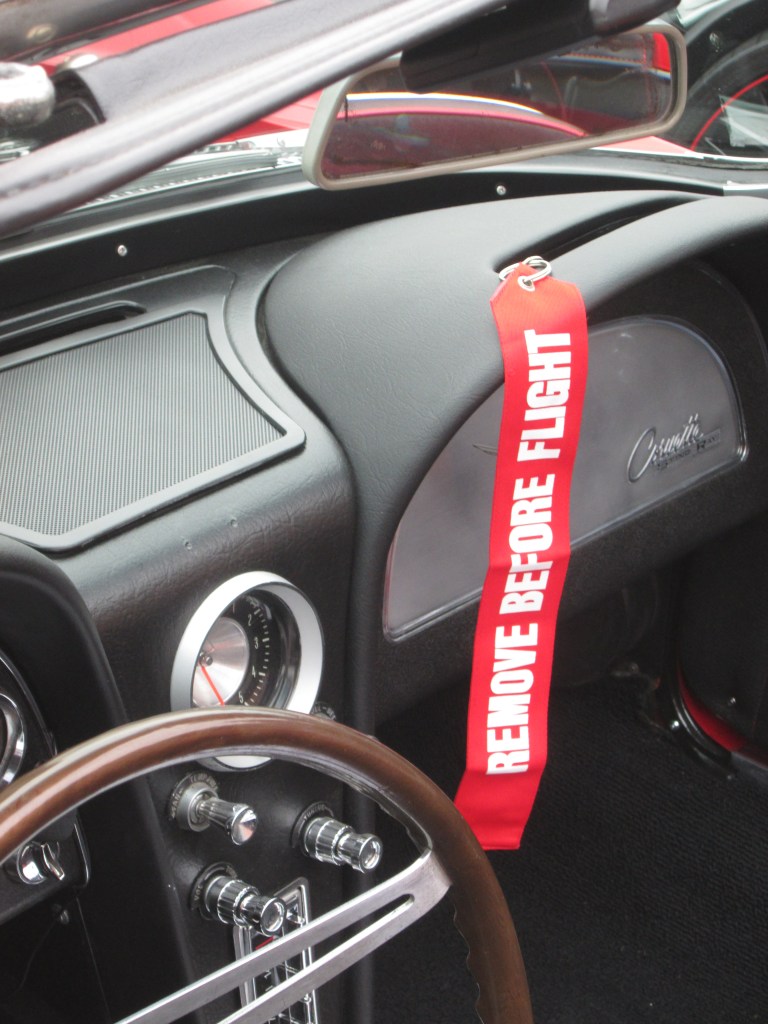
Hmm, I’ve Always Suspected That These Beasts Were Made for Flying
As the quarantine lifts, there will be a lot of other events at the ADM, and we are highly likely to go about once a month.
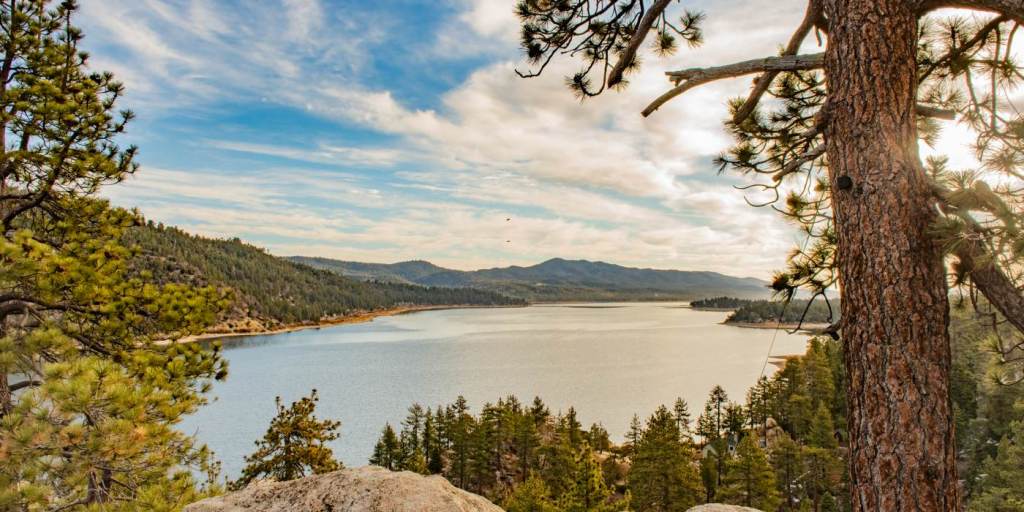
Big Bear Lake Is Located 25 Miles Northeast of San Bernardino
I am itching to get out of Los Angeles for a 2-3 day road trip. One place I have never been in Big Bear Lake, which is about a two plus hour drive from where I live. Most of that drive would be fighting my way through the City of Los Angeles. Then I would cut north around San Bernardino and ascend to 6,752 feet (2,058 meters) above sea level. It is a major resort area with restaurants, accommodation, and numerous activities. It’s probably best known for skiing, but that is not what interests me.
My interests are more in the line of looking around and taking pictures. I’m thinking of taking some time off after my numerous medical appointments between now and the middle of June.
Archway Welcoming Guests to Big Bear Village, with Tall Ghost on Right
I know it’ll cost a few shekels, but then everything does.
Bird of Paradise Flower at Descanso Gardens, February 2020
Indigenous to South Africa, the bird of paradise flower (Strelitzia reginae) has become a welcome interloper among the flora of Southern California. I remember when I first saw one, my first response was, “How exotic!” Now I almost tend to take them for granted, they are so widespread.
It is amazing to me that mankind has succeeded in shuffling the flora around all around the earth. I was amazed to see eucalyptus trees in the Peruvian highlands. Even more amazing to me were the jacarandas in Buenos Aires, flowering as they did in November during the Southern Spring. (But then, jacarandas are native to South America.)
The same thought hit Henry David Thoreau writing in The Maine Woods. On his three trips to Maine, Thoreau is disturbed by what man had dome to the trees of Massachusetts. In the Maine of the early 19th century, that shuffling of the trees had not yet occurred. What had occurred, on the other hand, was massive logging. It was rare for Thoreau and his co-travelers not to come across old logging camps far into the interior of the state.
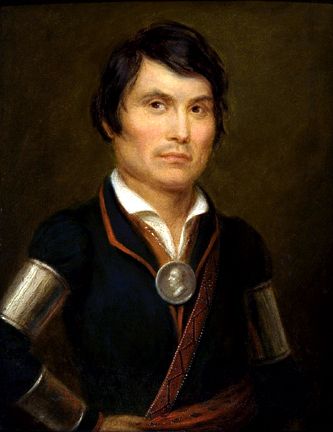
Joe Polis, a Penobscot Indian Who Traveled with Thoreau
One result of man’s interference is the potential loss of important species. On his third trip to Maine, Thoreau traveled with an Indian, Joe Polis, who told him that every plant was medicinal to the Penobscot Indians, and went on to demonstrate among several examples which Thoreau showed him.
After the White Man pretty much replaced the original population, we lost a great deal that they had learned over thousands of years.
Originally published after its author’s death, Henry David Thoreau’s The Maine Woods is a classic. Take, for instance, this description of a night in the woods:
About nine o’clock we reached the river, and ran our boat into a natural haven between some rocks, and drew her out on the sand. This camping-ground McCauslin had been familiar with in his lumbering days, and he now struck it unerringly in the moonlight, and we heard the sound of the rill which would supply us with cool water emptying into the lake. The first business was to make a fire, an operation which was a little delayed by the wetness of the fuel and the ground, owing to the heavy showers of the afternoon. The fire is the main comfort of the camp, whether in summer or winter, and is about as ample at one season as at another. It is as well for cheerfulness as for warmth and dryness. It forms one side of the camp; one bright side at any rate. Some were dispersed to fetch in dead trees and boughs, while Uncle George felled the birches and beeches which stood convenient, and soon we had a fire some ten feet long by three or four high, which rapidly dried the sand before it. This was calculated to burn all night. We next proceeded to pitch our tent; which operation was performed by sticking our two spike-poles into the ground in a slanting direction, about ten feet apart, for rafters, and then drawing our cotton cloth over them, and tying it down at the ends, leaving it open in front, shed-fashion. But this evening the wind carried the sparks on to the tent and burned it. So we hastily drew up the batteau [boat] just within the edge of the woods before the fire, and propping up one side three or four feet high, spread the tent on the ground to lie on; and with the corner of a blanket, or what more or less we could get to put over us, lay down with our heads and bodies under the boat, and our feet and legs on the sand toward the fire. At first we lay awake, talking of our course, and finding ourselves in so convenient a posture for studying the heavens, with the moon and stars shining in our faces, our conversation naturally turned upon astronomy, and we recounted by turns the most interesting discoveries in that science. But at length we composed ourselves seriously to sleep. It was interesting, when awakened at midnight, to watch the grotesque and fiend-like forms and motions of some one of the party, who, not being able to sleep, had got up silently to arouse the fire, and add fresh fuel, for a change; now stealthily lugging a dead tree from out the dark, and heaving it on, now stirring up the embers with his fork, or tiptoeing about to observe the stars, watched, perchance, by half the prostrate party in breathless silence; so much the more intense because they were awake, while each supposed his neighbor sound asleep. Thus aroused, I, too, brought fresh fuel to the fire, and then rambled along the sandy shore in the moonlight, hoping to meet a moose come down to drink, or else a wolf. The little rill tinkled the louder, and peopled all the wilderness for me; and the glassy smoothness of the sleeping lake, laving the shores of a new world, with the dark, fantastic rocks rising here and there from its surface, made a scene not easily described. It has left such an impression of stern, yet gentle, wildness on my memory as will not soon be effaced. Not far from midnight we were one after another awakened by rain falling on our extremities; and as each was made aware of the fact by cold or wet, he drew a long sigh and then drew up his legs, until gradually we had all sidled round from lying at right angles with the boat, till our bodies formed an acute angle with it, and were wholly protected. When next we awoke, the moon and stars were shining again, and there were signs of dawn in the east. I have been thus particular in order to convey some idea of a night in the woods.
When I was a student at Dartmouth, we all made fun of the local New Hampshire employees, whom we called emmets. The most typical speech mannerism was the same as the title of this posting. At the time, I never realized the irony of that phrase.
After I graduated from college, and days before I was to head out for graduate school in Los Angeles, I got the mother of all headaches and lapsed into a coma. It turns out that I had a pituitary tumor, called a chromophobe adenoma. Making the right diagnosis in 1966 was a flipping miracle: Remember that MRIs and CAT Scans weren’t around then. All they had to go on were fuzzy X-Rays, and sheer deduction based on miscellaneous hard-to-interpret factors.
With luck, I not only survived, but I made medical history. The only problem is that I paid for it with a scarred urethra caused by some ICU staffer who forced a catheter up my urethra at a time when, groggy with drugs, I thought I was being attacked and resisted what I perceived was violence.
Well, boy Jeezus it was a pissah! For several years, my scarred urethra tended to shut down, forcing a procedure variously called a dilation or a cystogram tray. I have undergone that procedure about eight times over the last fifty-five years, and I’m going to have to undergo it again on Tuesday because I currently am recovering from a urinary tract infection.
This weekend, I leaked so bad I went around in Depends adult diapers. I either peed into the diaper, or had to carefully aim my instrument at the toilet while the stream tried to go in every which direction. The dilation will be a sort of quick fix, but it will result in copious if painful urination for about two weeks until the urethral scars tend to close up again.
There is no pain I have endured in this life compared to a dilation. It’s like fifteen or twenty minutes of being whipped with a cat-o-nine tails.
With luck, the pain will eventually go away, and the urethra will open up slightly … until the next time.
I still have places to see. Even though I have been to Iceland, Argentina, and the Yucatán Peninsula of Mexico several times each, I have missed a number of destinations. These are just some of them.
Iceland’s Far Northeast
I have been to Egilsstaðir where I had to change buses on my way to Höfn and Hornstrandir, but I have never seen Iceland’s wild northeast coast between Seydisfjorður and Borgarfjörður Eystri. As my brother once told me, I am drawn to wild and desolate places—probably because I have lived most of my life in the United States’s second largest city.
This is one trip for which I would have to rent a car, as public transit here is mostly potty. And I would have to be prepared for bad weather at any time of the year. But with a good four-wheel-drive vehicle, I think I can hack it.
Southeastern Campeche State
Look at All the Maya Ruins Along Route 186 in Campeche
Back in the heyday of the Maya from around AD 600-800, the southeast of the State of Campeche was where it was happening. Particularly important was Calakmul, which was a major competitor to Tikal in Guatemala’s Petén region. The only town of any size in the area is Xpuhil. Ruins include Balamkú, Chicanna, El Ramonal, La Muñeca, Hormiguero, Xpujil, and Rio Bec.
This is one trip where I would have to hire a guide with a car. The accommodations and dining are probably acceptable, but not great. And I would need to apply large amounts of DEET insect repellent, as this area is jungle and thinly inhabited now.
Argentina’s Patagonian Coast
The South South Atlantic
I am intrigued by this wild coast and would love to visit Rio Gallegos, Puerto San Julian, Puerto Deseado, and Comodoro Rivadavia, the port from which Argentina launched its attack on the Falkland Islands, or the Islas Malvinas, as they insist on calling it to this day.
The extreme South Atlantic coast of the provinces of Santa Cruz and Tierra del Fuego are very much unfinished business. In 2006 in broke my shoulder in Ushuaia, which forced me to cancel my ride via a TecniAustral bus to Rio Gallegos, from which I planned to work my way north back to Buenos Aires. But, as the pain was too much to bear, I had to fly back to the United States and get better.
In 2011, Martine and I flew from Ushuaia to El Calafate, and thereupon on to Trelew and Buenos Aires. I’d love to do it by bus, at least as far as Comodoro, from where I could fly the rest of the way.
Here’s the Skinny on What You Must Avoid If You Have IBS
Although Martine keeps telling me not to worry about cooking for her, I feel challenged by the difficulty of preparing a meal that she can eat without triggering her IBS. So I made a ground sirloin and fusilli dish with celery, sweet red pepper, Chinese eggplant, fresh tomatoes, and tomato sauce with basil.
Missing were onions and garlic, which are two baddies. I naturally thought that without onions, the dish would be as yucky as last week’s ghastly FODMAP stew, consisting of ingredients that just didn’t belong with one another. I actually didn’t miss the onions, and I added garlic powder to my portion.
The big surprise was the quinoa pasta that actually tasted pretty good. I’ve had quinoa soup in Peru and Ecuador and liked it. This pasts contained no wheat or rice or corn, yet it was acceptable.
I can’t guarantee that all my FODMAP cookery will please Martine. At least, it shouldn’t disgust either of us.
Of course, Dante Alighieri was the first poet to give us the Grand Tour of Hell, but I am also influenced by a comic strip from my earlier years called “Hatlo’s Inferno,” by Jimmy Hatlo (1897-1963). In the same vein as Mr. Hatlo, I would like to mention a number of my pet peeves that deserve eternal punishment in the flames of Heck:
The guy who takes up a valuable parking space for what seems hours while he is finger f—ing his smart phone.
The freeway driver who has been warned by huge signs for miles to change lanes, and who does it at the last possible second with millimeters to spare.
The supermarket shopper who treats her shopping cart as an aisle blocker while she memorizes all the varieties of Campbell Soups.
The airport public address system which announces gate changes in demotic Urdu while passengers vainly attempt to unscramble what is being said.
The cyclists and e-scooter riders who insist on sharing the sidewalk with pedestrians.
The weather forecaster who’s always talking about a chance of rain, even if the probability is 0.0001%.
The guy who mumbles something about “freedom” while objecting to your wearing a face mask (naturally, they’ve never received their Covid-19 vaccinations).
The neighborhood kids who gleefully and maliciously play in your yard.
Hatlo’s Inferno: Hell for Funsies
Just let me catch my breath, and I’ll find a few dozen more things to complain about. At my age, I’m entitled.
Los Angeles Central Library at 5th and Flower Streets
Today I took the train in to Downtown Los Angeles (or DTLA, as it is also known) to return some library books and pick up the next batch. For the first time in almost a year and a quarter, I was able to enter the library, hand my returns to a human being, and pick up the next batch. The last time, I had to call on my cell phone and have a librarian come out with the bagged books I had put on hold.
Now the ground floor of the library is open. This includes the book check-in and check-out and the international languages department—oh, and the restrooms. For any other books, I still have to put them on hold using the library’s website.
With my books in hand, I took the Dash Bus B to Chinatown and looked for a promising Chinese restaurant that was open to indoor dining. My old standby, the Hong Kong Barbecue, was still take-out only; but I found a good option in the Hop Woo Chinese Seafood Restaurant, just a few doors down, where I had rock cod in black bean sauce.
On the way back to Union Station, I bought my usual small bag of limes from an elderly woman (only $1 for about eight limes). As the weather grows warmer, I am addicted to fresh-squeezed lime juice with a slight splash of tequila.
I still had to wear a face mask on the train and the bus, resulting in fogged-up glasses, but I am encouraged that sometime soon we will be able to dispense with them. My second Pfizer Covid-19 vaccination was two months ago, so I am hopeful that the worst is past.
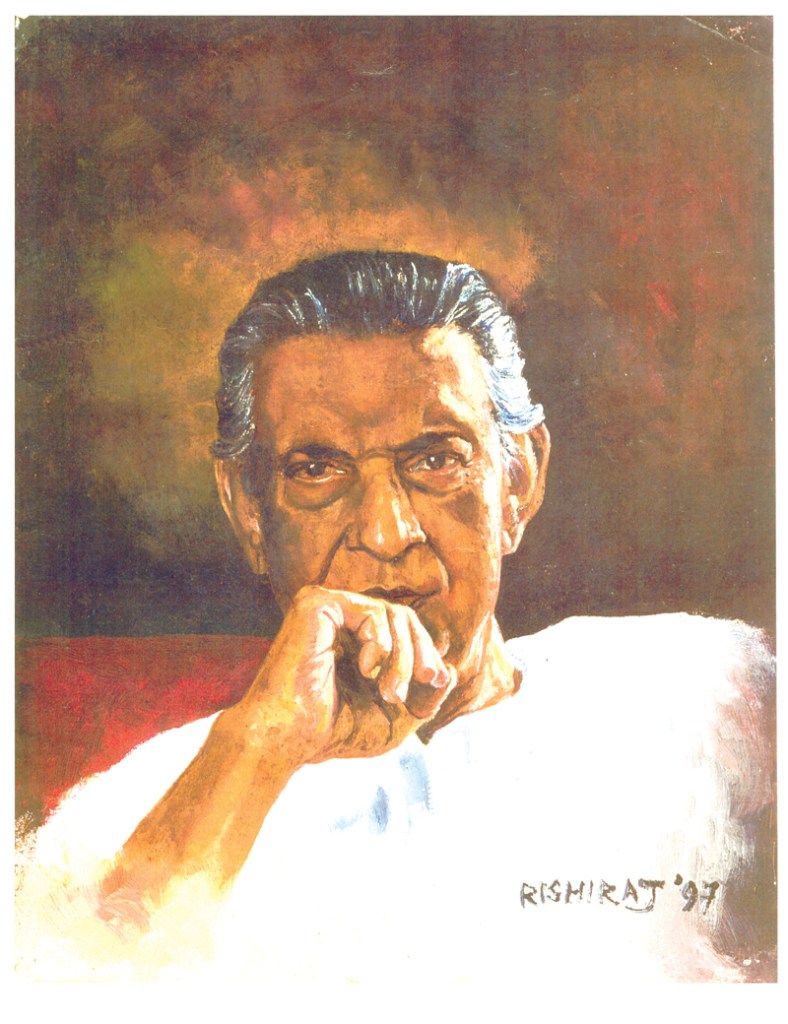
Portrait of Bengali Filmmaker Satyajit Ray (1921-1992)
I always thought that I was pretty good about seeing a goodly number of great films from around the world. Thanks to Turner Classic Movies (TCM), I found that I had somehow missed out on the films of Satyajit Ray of Kolkata (formerly Calcutta). I had seen a number of Merchant-Ivory productions, but not a single film by India’s greatest filmmaker.
TCM decided to celebrate the Centennial of Ray’s birth by presenting a number of his films. I plan to see a number more of them in the weeks to come, but over the last week, I have seen the following:
Pather Panchali (1955), the first film in the Apu trilogy and my favorite
Aparajito (1957), the second film of the Apu trilogy
The World of Apu (1959), the final film of the Apu trilogy
The Big City (1969)
Poster for Ray’s The Apu Trilogy
What I love about the Ray films I have seen is not only the poetic realism, but perhaps the most sophisticated and understanding portrait of human relationships I had ever seen on the big screen. In the three Apu films, we see the growth of the boy Apu after having successively lost his sister, father, and mother to early deaths. In The World of Apu and The Big City, Ray has shown us two marriages that seem to thrive even in the face of hardship. When the wife dies in childbirth in The World of Apu, I actually felt bereft, even as Apu himself did.
In fact, I have never seen marriage portrayed more positively, yet realistically, than in Ray’s films. There is nothing in these films of a standard American heartthrob product. His films do not shy away from death, disease, and dire poverty; yet they are almost religiously positive.
When I finish seeing the ten Ray films that TCM showed, I will post more about him and his work.












 Tarnmoor
You must be logged in to post a comment.