By no means is Clark Ashton Smith (1893-1961) considered as a mainstream American writer. Yet his poems and stories have a certain quality, reinforced by his association with H. P. Lovecraft and Robert E Howard. Of him, Lovecraft said, “in sheer daemonic strangeness and fertility of conception, Clark Ashton Smith is perhaps unexcelled.” And Ray Bradbury said that Smith “filled my mind with incredible worlds, impossibly beautiful cities, and still more fantastic creatures.”
Below is a poem of his entitled “Beyond the Great Wall”:
Beyond the Great Wall
Beyond the far Cathayan wall,
A thousand leagues athwart the sky,
The scarlet stars and mornings die,
The gilded moons and sunsets fall.

Across the sulphur-colored sands
With bales of silk the camels fare,
Harnessed with vermeil and with vair,
Into the blue and burning lands.

And ah, the song the drivers sing
To while the desert leagues away—
A song they sang in old Cathay
Ere youth had left the eldest king,

Ere love and beauty both grew old
And wonder and romance were flown
On irised wings to worlds unknown,
To stars of undiscovered gold.

And I their alien words would know,
And follow past the lonely wall
Where gilded moons and sunsets fall,
As in a song of long ago.
I think that Smith deserves a long second look, both for his poems and his eldritch short stories.
Not all my cooking creations are successful. The first time I tried cooking Hungarian stuffed cabbage rolls—a dish I was brought up on by my mother and great-grandmother—the rolls all fell apart. I didn’t know the trick of trimming the thick “veins” in the cabbage leaves, and I don’t remember parboiling and coring the cabbage.
This week, I got it right. First of all, I consulted with my brother, who is by far the best cook in the family. Then he sent me the recipe he uses. Here it is.
It took me five hours to cook the cabbage rolls from start to finish, though much of that time was waiting for the rolls to boil for 1½ to 2 hours. I used four different kind of meats in my recipe: smoked Hungarian gyulai kolbasz, Hickory smoked bacon, ground pork, and ground beef. Fortunately, there’s a great butcher shop at Alpine Village in Torrance which has several different types of kolbasz.
Once you make stuffed cabbage rolls, it’s easy to cook enough to feed a family for several days. Our lasted five days, with some left over that we had to discard because i have a rule that no cooked dish I make can be eaten for more than five days.
If you should try the recipe, be sure to get some fresh dill and some marjoram and—most important of all—real Hungarian paprika from Szeged, Hungary. The Spanish stuff has the color, but not the flavor.
PARIS – JUNE 07: (FILE PHOTO) Bohumil Hrabal poses while in Paris,France on a promotional visit on the 7th of June 1995. (Photo by Ulf Andersen/Getty Images)
England and Western Europe do not have a monopoly on great literature. I love prospecting for interesting writers from Eastern Europe. Perhaps that has something to do with the fact that I am Hungarian (and Czech and Slovak), and that I feel that the writers of the East have gotten short shrift from the American literary establishment.
I have just finished reading Bohumil Hrabal’s Why I Write? and Other Early Prose Pieces, which consists of his early work, much of which was circulated via samizdat, or underground typescript distribution to bypass strict censorship. There is a freshness to most of the stories within and a sharp attention to dialog as it is actually spoken by common people. Several whole stories consist of stream of consciousness ramblings of Hrabal’s Uncle Pepin, who goes on for pages shifting from one topic to another. Footnotes explain many of the obscure local references to Bars in Prague and people unknown outside of the Czech Republic.
From Ukraine, there is Andrey Kurkov, whose Death and the Penguin fills us in on the absurdity of life in Kiev. His Ukraine Diaries bring us up to date on the tensions with Putin’s Russia.
The former Soviet Union is another good source, such as the literary journalism from Svetlana Alexievich of Belarus, who won the Nobel Prize for Literature in 2015. I was appalled by her book of interviews on the Russian War in Afghanistan, called (in English) Zinky Boys. I also read Voices from Chernobyl, which gives a Russian perspective on that disaster.
Anna Politkovskaya’s criticisms of Putin cost her her life. She was murdered at her block of flats upon returning from grocery shopping. Her books on Chechnya (especially A Small Corner of Hell: Dispatches from Chechnya) and Putin’s Russia earned her the enmity of Putin, who cynically staged a show trial of several stooges who probably didn’t have anything to do with her killing.
Every month I try to read at least one Eastern European book. Often, they are the best things I’ve read that month.
Puerto Rican poet Martin Espada has recently won the National Book Award for his collection of poems entitled Floaters, named after the famous photograph of a father and daughter who drowned in the Rio Grande swimming to supposed safety in Trump’s United States. One of the poems in that collection is the following prose poem:
Letter to My Father
You once said: My reward for this life will be a thousand pounds of dirt shoveled in my face. You were wrong. You are seven pounds of ashes in a box, a Puerto Rican flag wrapped around you, next to a red brick from the house in Utuado where you were born, all crammed together on my bookshelf. You taught me there is no God, no life after this life, so I know you are not watching me type this letter over my shoulder.
When I was a boy, you were God. I watched from the seventh floor of the projects as you walked down into the street to stop a public execution. A big man caught a small man stealing his car, and everyone in Brooklyn heard the car alarm wail of the condemned: He’s killing me. At a word from you, the executioner’s hand slipped from the hair of the thief. The kid was high, was all you said when you came back to us.
When I was a boy, and you were God, we flew to Puerto Rico. You said: My grandfather was the mayor of Utuado. His name was Buenaventura. That means good fortune. I believed in your grandfather’s name. I heard the tree frogs chanting to each other all night. I saw banana leaf and elephant palm sprouting from the mountain’s belly. I gnawed the mango’s pit, and the sweet yellow hair stuck between my teeth. I said to you: You came from another planet. How did you do it? You said: Every morning, just before I woke up, I saw the mountains.
Every morning, I see the mountains. In Utuado, three sisters, all in their seventies, all bedridden, all Pentecostales who only left the house for church, lay sleeping on mattresses spread across the floor when the hurricane gutted the mountain the way a butcher slices open a dangled pig, and a rolling wall of mud buried them, leaving the fourth sister to stagger into the street, screaming like an unheeded prophet about the end of the world. In Utuado, a man who cultivated a garden of aguacate and carambola, feeding the avocado and star fruit to his nieces from New York, saw the trees in his garden beheaded all at once like the soldiers of a beaten army, and so hanged himself. In Utuado, a welder and a handyman rigged a pulley with a shopping cart to ferry rice and beans across the river where the bridge collapsed, witnessed the cart swaying above so many hands, then raised a sign that told the helicopters: Campamento los Olvidados: Camp of the Forgotten.
Los olvidados wait seven hours in line for a government meal of Skittles and Vienna sausage, or a tarp to cover the bones of a house with no roof, as the fungus grows on their skin from sleeping on mattresses drenched with the spit of the hurricane. They drink the brown water, waiting for microscopic monsters in their bellies to visit plagues upon them. A nurse says: These people are going to have an epidemic. These people are going to die. The president flips rolls of paper towels to a crowd at a church in Guaynabo, Zeus lobbing thunderbolts on the locked ward of his delusions. Down the block, cousin Ricardo, Bernice’s boy, says that somebody stole his can of diesel. I heard somebody ask you once what Puerto Rico needed to be free. And you said: Tres pulgadas de sangre en la calle: Three inches of blood in the street. Now, three inches of mud flow through the streets of Utuado, and troops patrol the town, as if guarding the vein of copper in the ground, as if a shovel digging graves in the backyard might strike the ore below, as if la brigada swinging machetes to clear the road might remember the last uprising.
I know you are not God. I have the proof: seven pounds of ashes in a box on my bookshelf. Gods do not die, and yet I want you to be God again. Stride from the crowd to seize the president’s arm before another roll of paper towels sails away. Thunder Spanish obscenities in his face. Banish him to a roofless rainstorm in Utuado, so he unravels, one soaked sheet after another, till there is nothing left but his cardboard heart.
I promised myself I would stop talking to you, white box of gray grit. You were deaf even before you died. Hear my promise now: I will take you to the mountains, where houses lost like ships at sea rise blue and yellow from the mud. I will open my hands. I will scatter your ashes in Utuado.
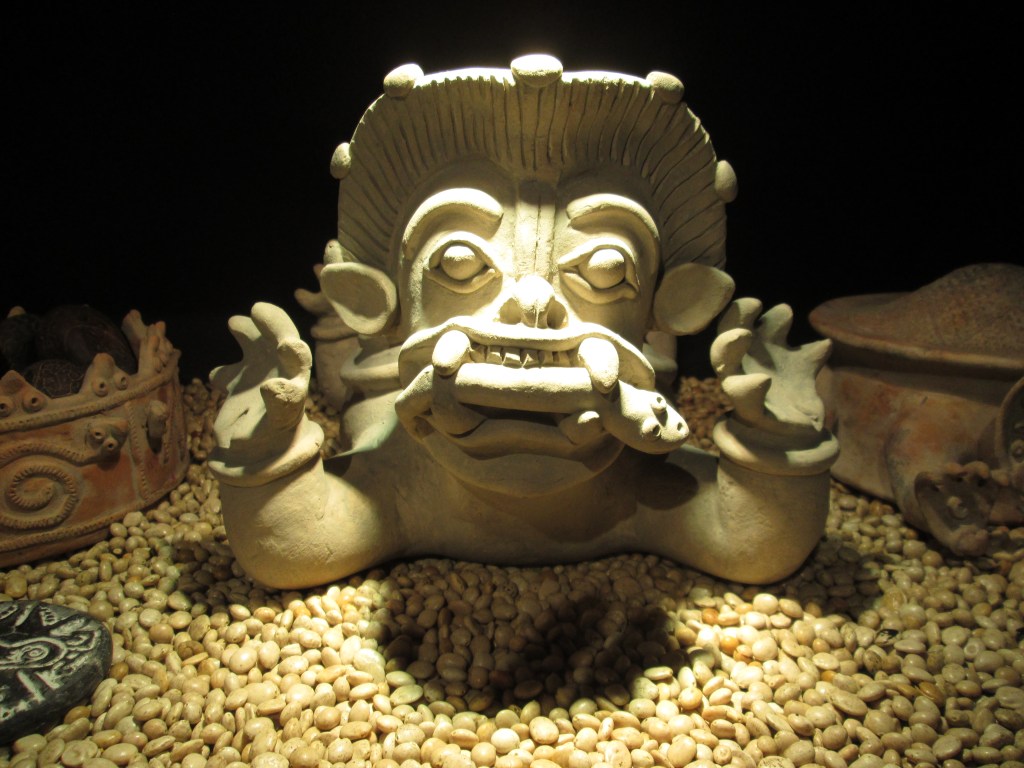
ancient The photo above is of a contemporary figurine of a Pre-Columbian idol on display in Quito’s Museo Mindalae. Although I doubt there was much trade between the ancient peoples of Ecuador and the Olmecs, Maya, and Aztecs of Mexico, there are clearly similarities in their religious iconography.
Before I began my travels to Latin America in 1975, I was puzzled by the images I saw of deities and demons from the more civilized portions of Meso-America. There were many similarities. But once one crossed the Rio Grande and visited where the Anasazi lived, the imagery is altogether different. And when I traveled in Argentina, Uruguay, and Chile, I saw precious little suggesting an advanced ancient civilization (though, in all honesty, I never visited the Northwest of Argentina, which was part of the Inca empire).
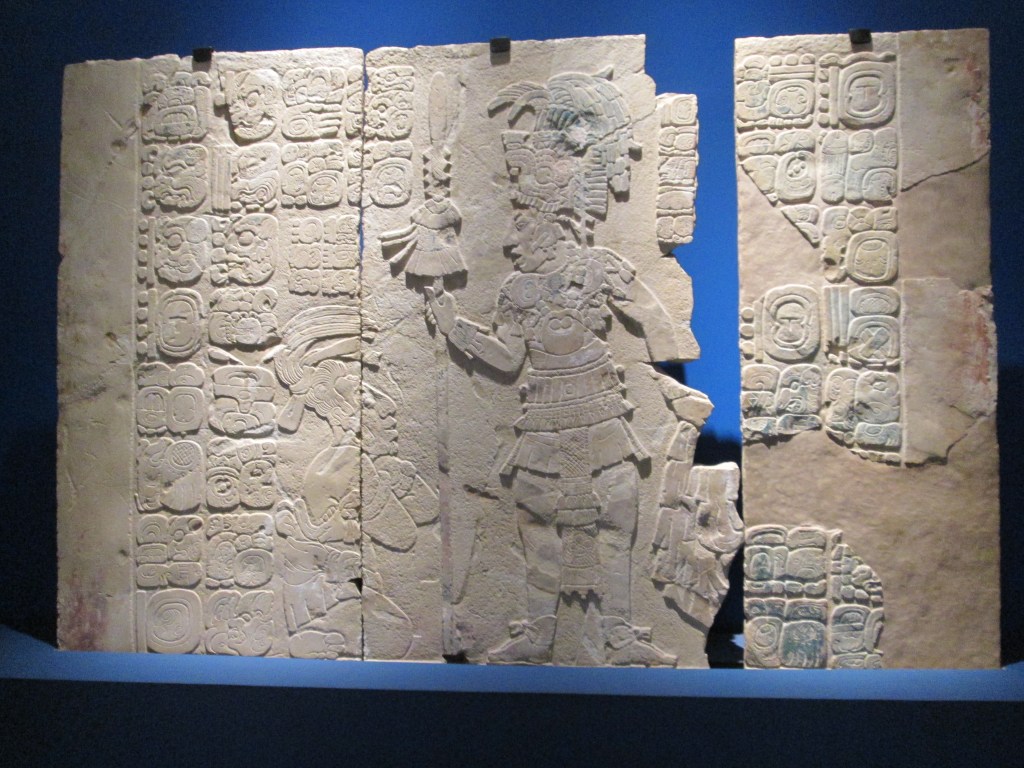
Now look at the depiction of one of the Mayan Priest Kings of Yucatán from the Mérida Museum of Anthropology:
Note the elaborate headdress and the warlike demeanor. Do not expect mercy from either of these rigidly powerful figures. I remember a conversation that took place at a symposium at UCLA decades ago between two archeologists, Michael Coe and Nigel Davies, about whether they would prefer to be in captivity to the Mayans or the Aztecs. Both agreed that, although the Aztecs were an empire and the Mayans were a group of city states, they both feared being prisoners of the Maya.
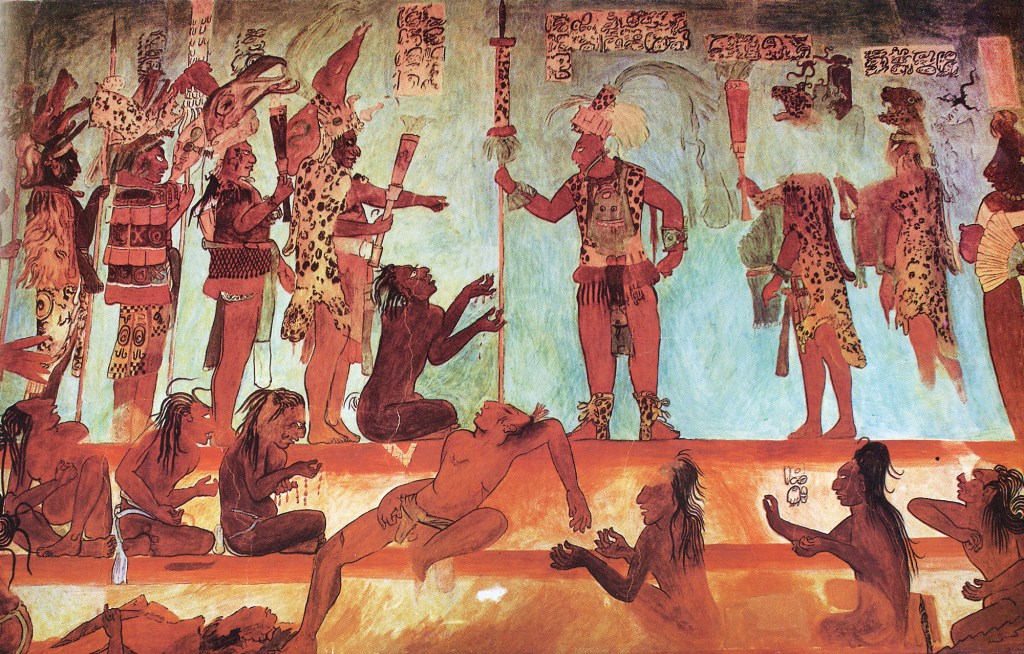
Why? Take a look at this fresco from the ruins at Bonampak in Chiapas:
Here you see the victorious Maya of Bonampak with their prisoners captured in a war with another city state. The scene is described in the Sixth Edition of Robert J. Sharer’s The Ancient Maya:
The aftermath is presented on the north wall. Here the full-frontal figure holding his jaguar-pelted spear, again probably Chan Muwan, accompanied by his warrior allies and entourage, along with two women at the far right, stands on the summit of a platform to preside over the captives taken in the battle. The chief captive sits at Chan Muwan’s feet, while the rest of the unfortunate prisoners are displayed on the six steps of the platform, where they are tortured and bled from their fingernails, held and guarded by more victorious warriors. These are the captives that will be sacrificed; one sprawled figure may already be dead, and the severed head of another has already been placed on the steps.
What all these Meso-American peoples had in common was highly organized and ritualistic warfare. Reading the history of many of these city states based on commemorative stelae, paintings, and other media, one clearly gets the feeling that life for the common people was anything but fun.
Look at the bottom right of the above painting, Pieter Breughel the Elder’s “The Fall of Icarus.” I would particularly direct your attention to the bare legs of Icarus, who has fallen from the sky into the ocean—punishment for presuming to fly too close to the sun. The following poem by W. H. Auden refers to it in the last stanza. The poem is called “Musée des Beaux Arte.”
 About suffering they were never wrong,
The old Masters: how well they understood
Its human position: how it takes place
While someone else is eating or opening a window or just walking dully along;
How, when the aged are reverently, passionately waiting
For the miraculous birth, there always must be
Children who did not specially want it to happen, skating
On a pond at the edge of the wood:
They never forgot
That even the dreadful martyrdom must run its course
Anyhow in a corner, some untidy spot
Where the dogs go on with their doggy life and the torturer’s horse
Scratches its innocent behind on a tree.

In Breughel’s Icarus, for instance: how everything turns away
Quite leisurely from the disaster; the ploughman may
Have heard the splash, the forsaken cry,
But for him it was not an important failure; the sun shone
As it had to on the white legs disappearing into the green
Water, and the expensive delicate ship that must have seen
Something amazing, a boy falling out of the sky,
Had somewhere to get to and sailed calmly on.
Are you trying to call my land line to conduct a telephone survey? If you’re from a firm called Survey Research, you have rung my phone twice this evening. As soon as I heard the call was from “Survey Research,” I studiously avoided picking up the phone. If I somehow pick up the receiver, the call lasts only as much time as it takes me to say, “I don’t participate in surveys.”
What do I have against surveys? I find that most of them are composed to convince me of something rather than solicit information. And if they should solicit information from me, they would have difficulty in classifying me. On most issues, I am liberal (I call myself a Libtard); on some, I’m a centrist; and on a few, I am downright conservative. As Walt Whitman wrote in “Song of Myself”:
Do I contradict myself?
Very well then I contradict myself,
(I am large, I contain multitudes.)
If the survey firm finds me to be cooperative, they will sell my number and other surveys will come ringing. They are desperate, because surveys depend on reaching a large number of land lines; and most people have given up their land lines in favor of cell phones.
So the next time an election rolls along (there should be one coming up in a few minutes—somewhere), the surveys will be a lot less useful than they used to be in the past. No matter. Political organizations will continue to commission them, and corporations will continue to try to sell or convince.
Just bear in mind that my opinions will not be represented in any of them.
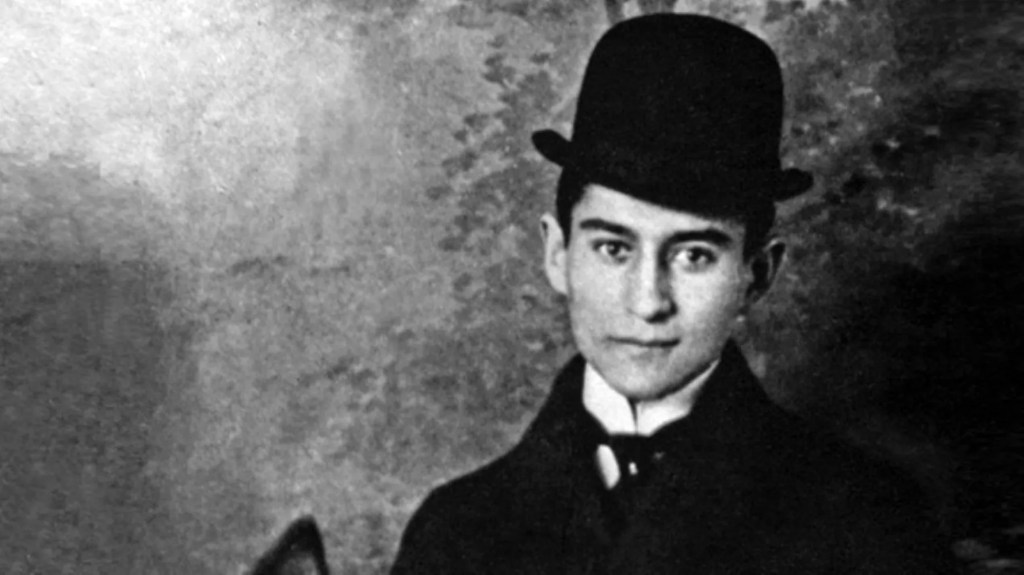
The woman in the above photograph is Milena Jesenská, with whom Franz Kafka carried on a torrid correspondence in 1920. Although she was a married woman (albeit unhappily), Kafka was strongly drawn to her. The relationship, such as it was, petered out when Milena did not want to run away from her marriage. Milena herself was a writer, and in a letter to Max Brod written in August 1920, provides a riveting description of Kafka. She was to live on for another twenty years, dying in 1944 in Ravensbrück Concentration Camp.
Life for him is something entirely different than for all other human beings; in particular, things like money, the stock market, currency exchange, a typewriter are utterly mystical to him (and they really are, too; just not for the rest of us), they are the strangest riddles to him, and his approach to them is completely different than our own. Can his office work be considered the customary performance of a service? Any official position, including his own, is something very puzzling to him, very admirable, like a locomotive is for a small child. He doesn’t understand the simplest things in the world. Were you ever in a post office with him? After he composes a telegram and picks out whatever little counter he likes best, shaking his head, he then drifts from one counter to another, without the slightest idea to what end or why, until he finally stumbles on the right one, and when he pays and receives change, he counts it and discovers one krone too many, and so gives one back to the girl behind the counter. Then he walks away slowly, counts once again, and in the middle of descending the last staircase he realizes that the missing krone belonged to him after all. So there you stand next to him, at a loss, while he shifts his weight from one foot to the other, wondering what to do. Going back is difficult; upstairs there’s a crowd of people pushing and shoving. “So just let it go,” I say. He looks at me completely horrified. How can you let it go? Not that he’s sorry about the krone. But it’s not good. There’s one krone missing. How can you forget about something like that? He spoke about it for a long time, and was very dissatisfied with me.
And this repeated itself with different variations in every shop, in every restaurant, in front of every beggar. Once he gave a beggar a two-krone piece and wanted one back. She said she didn’t have anything. We stood there for a good two minutes, thinking about how to deal with the matter. Then it occurred to him that he could leave the two krone. But no sooner had he taken a few steps when he started getting very cross. Of course this same man would be eager and extremely happy to give me twenty thousand krone with no questions asked. On the other hand, if I were to ask him for twenty thousand and one krone and we had to change money somewhere and didn’t know where, he would seriously consider what to do with the one krone I hadn’t been allotted. His anxiety in the face of money is almost the same as his anxiety in the face of women. Or his fear of things official. Once I telegraphed him, phoned him, wrote him, begged him in God’s name to come see me for a day. I really needed it at the time. I cursed him to high heaven. He didn’t sleep for nights, tormented himself, wrote letters full of self-destruction, but he did not come. Why? He couldn’t ask for leave. He was unable to ask the director, the same director he admires in the depths of his soul (seriously!) for being able to type so quickly—he wasn’t able to tell the director he was going to see me. And as for saying something else—another horrified letter—how could he? Lie? Lie to the director? Impossible…..
No, this world is and remains a riddle to him.
It is a pity that Milena’s letters to Kafka no longer exist. Because she was still uncertain about divorcing her husband, when Franz died in 1924, she had her letters destroyed so that they would not provide incriminating evidence. In her own way, she was a major Czech literary figure.
I don’t usually pay much attention to holidays. That does not mean I’m a Jehovah’s Witness: It just means that I think most holidays are a major pain in the ass. Some of them, such as Thanksgiving and Christmas, are notorious for putting incredible stresses on families, and sometimes breaking them up.
The men and women of our armed forces typically did not join because they wanted to serve our country. I think most wanted to lift themselves out of poverty and take advantage of educational opportunities that would jump start their post service careers. Unfortunately, in the process, they often put themselves in harm’s way fighting our nation’s interminable wars.in Korea, Vietnam, the Dominican Republic, Lebanon, Grenada, Panama, Kuwait, Iraq, Somalia, Haiti, Bosnia, et cetera ad infinitum.
In those “little wars,” some 100,000+ Americans gave their lives. And a much larger number came back with debilitating physical or mental scars.
I consider myself fortunate that my brain surgery operation in 1966 gave me a Selective Service rating of 4F, so that I would not have to fight in Vietnam. Truth to tell, I would probably have been 4F in any case, as I had been walking around with a pituitary tumor for ten years or more and was not in great shape.
During the Vietnam Era, many war protestors held a grudge against the armed forces. I didn’t. Most of them were just trying to survive under difficult circumstances. Instead, I wish them well.
I have been accused by some people of being mean to the homeless, typically by people whose experience of homelessness has been very different from what I have encountered. There are people who manage to get out of living on the streets. Usually, this applies to women, especially women with children. I write mostly about people who can more accurately be described as bums and their associated scags.
Does that sound mean? It should given my experience with garbage, poop, fights and screams in the middle of the night, vandalism, aggressive begging, theft, and stench. And this all is less than a hundred feet from my front door. Let us look at three levels of opposition to homeless encampments:
Approach with flamethrowers and baseball bats.
Apply political pressure to get them off the streets.
Refuse to engage with them in conversation.
I am at level 3. When approached by a bum, usually to request a cash donation, I talk to them only in Hungarian. Ever since running into a Hungarian beggar in Vancouver, BC, I do not swear at them in Hungarian. All I want is for them to walk away looking confused.
Is this mean and heartless? Not really. I do not think much of the bums who live across the street from me. I do not sneer at them or give them any indications of opposition. If they want to talk to me, I just insist that it be in Hungarian. And I do not work with politicians on the problem, because I think they have no idea of the nature of the problem. There are just too many widely varying opinions across the entire political spectrum. Mine is just one of them, and by no means the most heartless.








 Tarnmoor
You must be logged in to post a comment.