In 2000, University of Maine geological scientist Roger LeB. Hooke estimated that human beings now move more earth than any other geomorphic agent, 6 metric tons of earth and rock per capita each year (31 tonnes in the United States!), for a global total of about 35 billion tonnes.
For comparison, ancient Egypt moved 625 kg per capita per year, Easter Island 260 kg, and the Mayan city of Copán 665 kg. Rome, at its zenith, including the roads, moved 3.85 tonnes of earth per person each year. Hooke estimates that the earth we’ve moved in the last 5,000 years could build a mountain range 4,000 meters high, 40 km wide, and 100 km long. And if the current rates of increase persist (mostly due to technology and population growth), that mountain range could double in length by 2100.
“One may well ask how long such rates of increase can be sustained, and whether it will be rational behavior or catastrophe that brings them to an end.”
We as a species are particularly susceptible to our technologies. Each commonly used technology is associated with a series of behaviors. I am particularly aware of what the smartphone has done—particularly since I have chosen not to adopt this particular technology. (Tiny screens are not kind to my aging eyes.)
I thought I would mention some of the behaviors I have observed, beginning with this basic root behavior:
When using a smartphone, stop everything else you’re doing.
On the roadway, a particularly annoying corollary is the tendency to play with your smartphone when stopped at a traffic signal, yield or stop sign, and to not move until other motorists beep at you.
In the supermarket parking lots in my neighborhood, approximately 30% of the spaces are occupied, not by shoppers, but by smartphone users checking e-mail, FaceBook, or other social media applications. This makes it more difficult to find parking spaces at busy times.
In the aisles of a store, one finds shoppers stopped dead in an aisle while fingering their smartphones. I have to come up behind them and say BEEP BEEP to get them to be aware of their surroundings.
As a corollary of this corollary, you frequently finds smartphone users annoyed to be interrupted in their use of their digital drug. It is as if they now have earned the right to stop dead in their tracks and that people who attempt to “disturb” them in the exercise of this right are being rude.
I am reminded of the bad old days when half the population smoked most of the time. It was inevitable that when I sat at a restaurant counter, a human chimney would sit next to me burning a particularly foul rope. That, too, was a right that was assumed. Fortunately, no more.
No work of literature is so closely tied in with painting than Marcel Proust’s In Search of Lost Time. In the first volume, Swann’s Way, Charles Swann finds himself in an obsessive relationship with Odette de Crécy. At one point, he compares his inamorata with Zipporah, Jethro’s daughter, in Sandro Botticelli’s “Life of Moses.”
On his way to the house, as always when he knew that they were to meet, he formed a picture of her in his mind; and the necessity, if he was to find any beauty in her face, of fixing his eyes on the fresh and rosy protuberance of her cheekbones, and of shutting out all the rest of those cheeks which were so often languorous and sallow, except when they were punctuated with little fiery spots, plunged him in acute depression, as proving that one’s ideal is always unattainable, and one’s actual happiness mediocre. He was taking her an engraving which she had asked to see. She was not very well; she received him, wearing a wrapper of mauve crêpe de Chine, which draped her bosom, like a mantle, with a richly embroidered web. As she stood there beside him, brushing his cheek with the loosened tresses of her hair, bending one knee in what was almost a dancer’s pose, so that she could lean without tiring herself over the picture, at which she was gazing, with bended head, out of those great eyes, which seemed so weary and so sullen when there was nothing to animate her, Swann was struck by her resemblance to the figure of Zipporah, Jethro’s Daughter, which is to be seen in one of the Sistine frescoes. He had always found a peculiar fascination in tracing in the paintings of the Old Masters, not merely the general characteristics of the people whom he encountered in his daily life, but rather what seems least susceptible of generalisation, the individual features of men and women whom he knew, as, for instance, in a bust of the Doge Loredan by Antonio Rizzo, the prominent cheekbones, the slanting eyebrows, in short, a speaking likeness to his own coachman Rémi; in the colouring of a Ghirlandaio, the nose of M. de Palancy; in a portrait by Tintoretto, the invasion of the plumpness of the cheek by an outcrop of whisker, the broken nose, the penetrating stare, the swollen eyelids of Dr. du Boulbon. Perhaps because he had always regretted, in his heart, that he had confined his attention to the social side of life, had talked, always, rather than acted, he felt that he might find a sort of indulgence bestowed upon him by those great artists, in his perception of the fact that they also had regarded with pleasure and had admitted into the canon of their works such types of physiognomy as give those works the strongest possible certificate of reality and trueness to life; a modern, almost a topical savour; perhaps, also, he had so far succumbed to the prevailing frivolity of the world of fashion that he felt the necessity of finding in an old masterpiece some such obvious and refreshing allusion to a person about whom jokes could be made and repeated and enjoyed to-day. Perhaps, on the other hand, he had retained enough of the artistic temperament to be able to find a genuine satisfaction in watching these individual features take on a more general significance when he saw them, uprooted and disembodied, in the abstract idea of similarity between an historic portrait and a modern original, whom it was not intended to represent. However that might be, and perhaps because the abundance of impressions which he, for some time past, had been receiving—though, indeed, they had come to him rather through the channel of his appreciation of music—had enriched his appetite for painting as well, it was with an unusual intensity of pleasure, a pleasure destined to have a lasting effect upon his character and conduct, that Swann remarked Odette’s resemblance to the Zipporah of that Alessandro de Mariano, to whom one shrinks from giving his more popular surname, now that ‘Botticelli’ suggests not so much the actual work of the Master as that false and banal conception of it which has of late obtained common currency. He no longer based his estimate of the merit of Odette’s face on the more or less good quality of her cheeks, and the softness and sweetness—as of carnation-petals—which, he supposed, would greet his lips there, should he ever hazard an embrace, but regarded it rather as a skein of subtle and lovely silken threads, which his gazing eyes collected and wound together, following the curving line from the skein to the ball, where he mingled the cadence of her neck with the spring of her hair and the droop of her eyelids, as though from a portrait of herself, in which her type was made clearly intelligible.
He stood gazing at her; traces of the old fresco were apparent in her face and limbs, and these he tried incessantly, afterwards, to recapture, both when he was with Odette, and when he was only thinking of her in her absence; and, albeit his admiration for the Florentine masterpiece was probably based upon his discovery that it had been reproduced in her, the similarity enhanced her beauty also, and rendered her more precious in his sight. Swann reproached himself with his failure, hitherto, to estimate at her true worth a creature whom the great Sandro would have adored, and counted himself fortunate that his pleasure in the contemplation of Odette found a justification in his own system of aesthetic. He told himself that, in choosing the thought of Odette as the inspiration of his dreams of ideal happiness, he was not, as he had until then supposed, falling back, merely, upon an expedient of doubtful and certainly inadequate value, since she contained in herself what satisfied the utmost refinement of his taste in art. He failed to observe that this quality would not naturally avail to bring Odette into the category of women whom he found desirable, simply because his desires had always run counter to his aesthetic taste. The words ‘Florentine painting’ were invaluable to Swann. They enabled him (gave him, as it were, a legal title) to introduce the image of Odette into a world of dreams and fancies which, until then, she had been debarred from entering, and where she assumed a new and nobler form. And whereas the mere sight of her in the flesh, by perpetually reviving his misgivings as to the quality of her face, her figure, the whole of her beauty, used to cool the ardour of his love, those misgivings were swept away and that love confirmed now that he could re-erect his estimate of her on the sure foundations of his aesthetic principles; while the kiss, the bodily surrender which would have seemed natural and but moderately attractive, had they been granted him by a creature of somewhat withered flesh and sluggish blood, coming, as now they came, to crown his adoration of a masterpiece in a gallery, must, it seemed, prove as exquisite as they would be supernatural.
The term comes from the card game Blackjack when a player doubles the bid in exchange for one more card to be drawn. Politically, it means to become more tenacious, zealous, or resolute in a position or undertaking, particularly if it is risky. It seems to be ever more common, as if everyone is deathly afraid of backing down, even if the road ahead is full of traps.
I have made a number of mistakes in my life, but I have rarely been persistent in my errors. True, I might have become a soulless millionaire instead of a mere survivor. But, in my book, surviving is a good thing.
For people like Vladimir Putin or Donald J. Trump, surrender is never an option. Trump may well wind up in prison, and it is entirely possible for Putin to be forcibly escorted out of the Kremlin. But for the time being, they will remain resolute as if they were immortal and all-powerful—which they aren’t.
I am reading a great travel classic written in the 1950s about two Swiss who drove a ratty old Fiat from Yugoslavia to the Khyber Pass on the Afghanistan/Pakistan border. Nicolas Bouvier’s The Way of the World describes Persian politics in Tabriz in 1953, when Muhammad Musaddeq’s government was overthrown by a Royalist coup. Wonderful stuff!BTW, is this where we’re headed?
The Musaddeq trial, which had just opened in Tehran, led to fears of skirmishes in Tabriz. They didn’t take place because that very morning the Governor demonstrated to the town that he was in full control: five armoured cars, several mortars and twenty trucks, carrying troops whose numbers had been increased for the occasion.
The Governor was a wily old man, a cruel jester, oddly esteemed even by opponents of the government he represented. He was forgiven much because everyone knew he had no political convictions and had entirely devoted his rule to building up his personal fortune, with a skill that had won him many admirers. Tabriz had always been a recalcitrant town, but it recognized ‘fair play’, and well-aimed shots. That unexpected parade, for example, which had the town by the scruff of the neck when it woke up, was absolutely in the style of the man to whom the town referred familiarly by his first name. A despot, of course, whose disappearance would have been welcomed with relief, and who was intently watched in case he should slip up. Meanwhile, informed, bland, pitiless and efficient, he was impressive. The town, familiar with despotism, granted his talent.
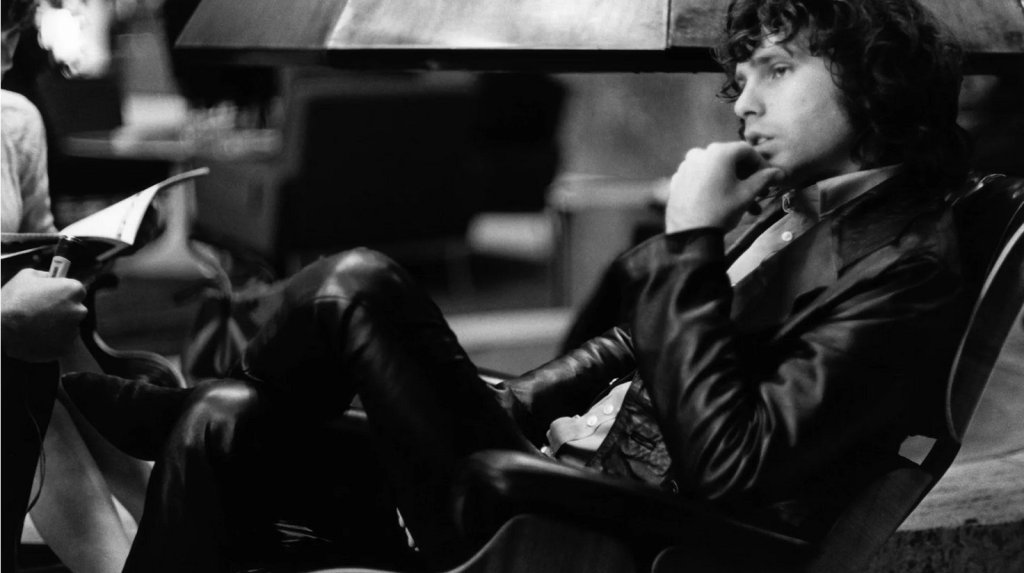
We know him from The Doors, but he was also a decent poet. He had to be, particularly considering his original songs, particularly in his group’s initial album, The Doors (1967). I am not that much into rock music, but I did take the trouble to visit Jim Morrison’s grave at Père Lachaise cemetery in Paris after he died of a drug overdose.
Here is one of my favorites among his poems:
The Celebration of the Lizard
Lions in the street & roaming Dogs in heat, rabid, foaming A beast caged in the heart of a city
The body of his mother Rotting in the summer ground. He fled the town.
He went down South And crossed the border Left the chaos & disorder Back there Over his shoulder.
One morning he awoke in a green hotel W/a strange creature groaning beside him. Sweat oozed from its shiny skin.
Is everybody in? The ceremony is about to begin.
Wake up! You can’t remember where it was. Had this dream stopped? The snake was pale gold glazed & shrunken. We were afraid to touch it. The sheets were hot dead prisons. And she was beside me, old, She’s, no; young. Her dark red hair. The white soft skin. Now, run to the mirror in the bathroom, Look! She’s coming in here. I can’t live thru each slow century of her moving. I let my cheek slide down The cool smooth tile Feel the good cold stinging blood. The smooth hissing snakes of rain…
Once I had a little game
I liked to crawl back in my brain
I think you know the game I mean
I mean the game called “Go Insane”

Now you should try this little game
Just close your eyes forget your name
forget the world, forget the people
and we'll erect a different steeple.

This little game is fun to do.
Just close your eyes, no way to lose
And I'm right here, I'm going too
Release control, we're breaking through
Way back deep into the brain Way back past the realm of pain Back where there’s never any rain
And the rain falls gently on the town And over the heads of all of us
And in the labyrinth of streams beneath Quiet unearthly presence of Nervous hill dwellers in the gentle hills around Reptiles abounding Fossils, caves, cool air heights
Each house repeats a mold Windows rolled A beast car locked in against morning All now sleeping Rugs silent, mirrors vacant Dust blind under the beds of lawful couples Wound in sheets And daughters, smug with semen Eyes in their nipples
Wait! There’s been a slaughter here
Don’t stop to speak or look around Your gloves and fan are on the ground We’re getting out of town We’re going on the run And you’re the one I want to come!
Not to touch the earth, not to see the sun
Nothing left to do but run, run, run
Let's run, let's run

House upon the hill, moon is lying still
Shadows of the trees witnessing the wild breeze
Come on, baby, run with me
Let's run

Run with me, run with me, run with me
Let's run

The mansion is warm at the top of the hill
Rich are the rooms and the comforts there
Red are the arms of luxuriant chairs
And you won't know a thing till you get inside

Dead president's corpse in the driver's car
The engine runs on glue and tar
Come on along, not going very far
To the east to meet the Czar

Run with me, run with me, run with me
Let's run

Some outlaws live by the side of a lake
The minister's daughter's in love with the snake
Who lives in a well by the side of the road
Wake up, girl! We're almost home

Sun, sun, sun
Burn, burn, burn
Moon, moon, moon
I will get you soon...soon...soon!

I am the Lizard King
I can do anything
We came down the rivers and highways We came down from forests and falls We came down from Carson and Springfield We came down from Phoenix enthralled
And I can tell you the names of the kingdom I can tell you the things that you know Listening for a fistful of silence Climbing valleys into the shade ~~~
For seven years I dwelt in the loose palace of exile Playing strange games with the girls of the island Now I have come again to the land of the fair And the strong and the wise
Brothers and sisters of the pale forest Children of night Who among you will run with the hunt?
Now night arrives with her purple legion Retire now to your tents and to your dreams Tomorrow we enter the town of my birth I want to be ready
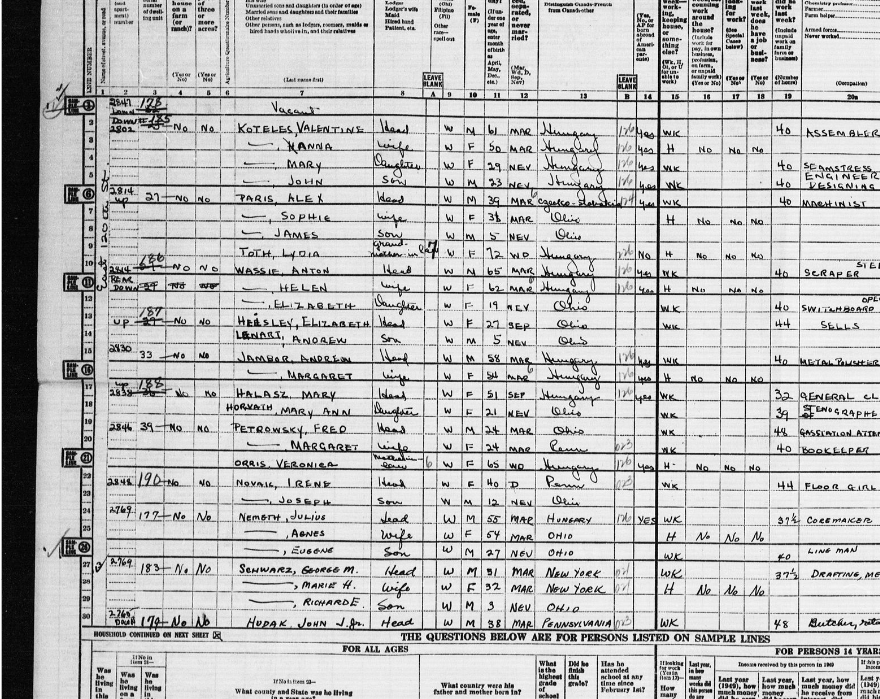
The 1950 Census has been unsealed and is now available for searching. Above is the page of the census (look starting with line 6). At the time, we lived at 2814 East 120th Street in the Buckeye Road Hungarian neighborhood of Cleveland, Ohio. In our household were:
My father Alex, born in what at the time of his birth was the Austro-Hungarian Empire, but in 1950 was part of Czechoslovakia.
My mother Sophie, born in the U.S. but raised in Hungary.
Me—but not my brother, who was to come along the next year.
My great-grandmother Lidia Toth (correct spelling: the enumerator goofed). Since both parents worked, she served as a live-in caregiver to me. She was born in Felcsut, Hungary, and spoke no English.
Note that my father was listed as a machinist. He was then employed by Lees-Bradner and Company, which manufactured gear-hobbing machines.
If you are curious about your own family, you can search the 1950 Census for yourself by clicking here. Please confine your search to the head of the household, as things get a little scattered when it comes to wives, children, and other live-in family members.
My Martine is as sweet as sweet can be, but her heart can be steel-plated when it comes to street hooligans. On most days, she takes a long walk in the neighborhood, keeping a weather eye out for what she calls “tiny treasures.” Sometimes these are foreign coins or interesting lanyards or any number of things.
Lately, however, some of her discoveries have been on the alarming side:
Two baseball bats, near a bus stop ad that had been vandalized
A bolt cutter
A large sledgehammer
In each case, she walked the item to the Santa Monica Police Station and handed it to the officer on duty. I cannot help but think that the local police are wondering what she will bring in next. Will it be an AK-47? An RPG (that’s rocket propelled grenade)? A box of land mines?
The streets of West L.A. and Santa Monica are getting rougher each year, and that’s reflected in what she finds.
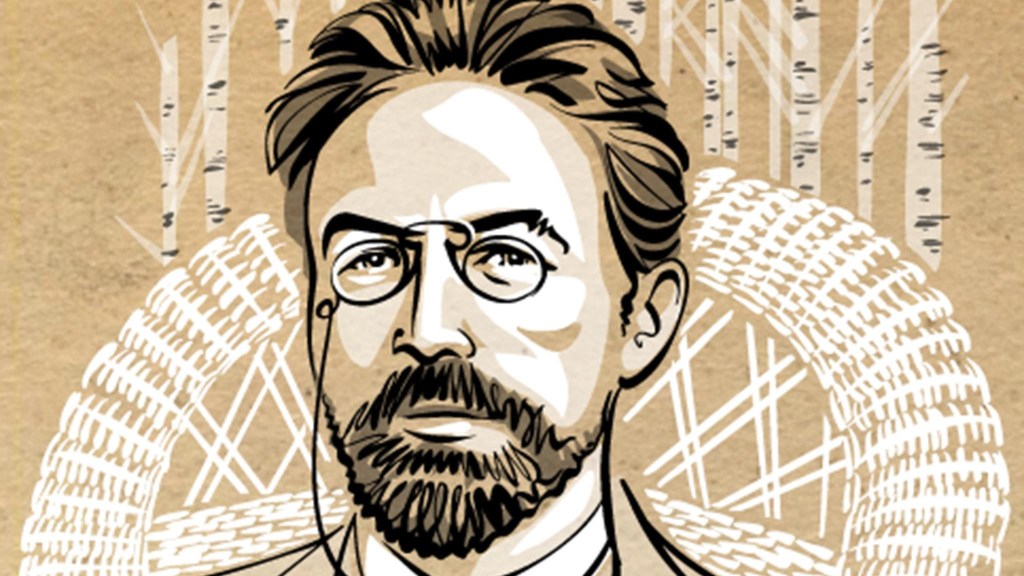
I have just finished a collection of short stories by Anton Chekhov (1860-1904) entitled The Wife and Other Stories which has been, by far, the best book I have read so far this year. Even though her translations are being increasingly considered as clunky and slightly archaic, I really enjoyed Constance Garnett. The following discussion on happiness vs. unhappiness is from a story entitled “Gooseberries.”
I saw a happy man whose cherished dream was so obviously fulfilled, who had attained his object in life, who had gained what he wanted, who was satisfied with his fate and himself. There is always, for some reason, an element of sadness mingled with my thoughts of human happiness, and, on this occasion, at the sight of a happy man I was overcome by an oppressive feeling that was close upon despair. It was particularly oppressive at night. A bed was made up for me in the room next to my brother’s bedroom, and I could hear that he was awake, and that he kept getting up and going to the plate of gooseberries and taking one. I reflected how many satisfied, happy people there really are! What a suffocating force it is! You look at life: the insolence and idleness of the strong, the ignorance and brutishness of the weak, incredible poverty all about us, overcrowding, degeneration, drunkenness, hypocrisy, lying…. Yet all is calm and stillness in the houses and in the streets; of the fifty thousand living in a town, there is not one who would cry out, who would give vent to his indignation aloud. We see the people going to market for provisions, eating by day, sleeping by night, talking their silly nonsense, getting married, growing old, serenely escorting their dead to the cemetery; but we do not see and we do not hear those who suffer, and what is terrible in life goes on somewhere behind the scenes…. Everything is quiet and peaceful, and nothing protests but mute statistics: so many people gone out of their minds, so many gallons of vodka drunk, so many children dead from malnutrition…. And this order of things is evidently necessary; evidently the happy man only feels at ease because the unhappy bear their burdens in silence, and without that silence happiness would be impossible. It’s a case of general hypnotism. There ought to be behind the door of every happy, contented man some one standing with a hammer continually reminding him with a tap that there are unhappy people; that however happy he may be, life will show him her laws sooner or later, trouble will come for him—disease, poverty, losses, and no one will see or hear, just as now he neither sees nor hears others. But there is no man with a hammer; the happy man lives at his ease, and trivial daily cares faintly agitate him like the wind in the aspen-tree—and all goes well.
And mixed with these were splashes of California poppies. These too are of a burning color—not orange, not gold, but if pure gold were liquid and could raise a cream, that golden cream might be like the color of poppies.
As I mentioned in yesterday’s post, my favorite flowers are tulips and California poppies.
Some people say that it is illegal to pick a California poppy. The truth is actually a little more complicated. According to the CBS News site for San Francisco:
Now here is the interesting part: as a native Californian, I grew up believing it is illegal to PICK a California Poppy. As that turns out, it’s not entirely true! You can pick, bend, eat or smoke a Poppy as long it is not on state property. However, if a Poppy or any other flower is on School, Park, a median or even outside a courthouse, DO NOT pick or hurt the flower. Harming the flower or plant life could be considered a misdemeanor offense, and you can be fined up to $1000 and as many as six months in jail. That’s real Flower Power!
I wouldn’t pick a California poppy for different reasons: They are so beautiful that they should be left alone so that they can continue to bring joy to passers-by.







 Tarnmoor
You must be logged in to post a comment.