A Criminal Mind

NEW YORK, NEW YORK – JULY 19: Former U.S. President Donald Trump leaves Trump Tower in Manhattan on July 19, 2021 in New York City. (Photo by James Devaney/GC Images)

Today, for the first time, I watched the January 6 Congressional investigation of the January 6 insurrection. While I have never confessed to liking Donald J. Trump, I now view him with utter disdain. This is an individual who clawed his way to the top using chicanery, corruption, outrageous lies, and a total lack of moral compass—with the help of a particularly sleazy set of attorneys, beginning with the notorious Roy Cohn and continuing to Rudy Giuliani.

Trump’s unrelenting plot to steal the 2020 election by forcing his Vice President, Mike Pence, to commit illegal acts, and then raising a mob to threaten his life shows the polluted sludge in his veins, shows him to be successful only as a criminal. Certainly not as a leader of the American people.

Unfortunately, there are still millions of American voters who are 100% behind Trump and his political party. We have not seen the end of the MAGA mobs, nor will we until Oxycontin and Heroin have thinned the herd and their mothers have turned them out of their basement digs.

Long before Trump is re-elected to any office, I am sure that a regiment of demons from the uttermost pit of Hell will have reclaimed their golden boy.

A Black Cat Crosses Our Path

Some Days You Just Can’t Win

I don’t know if the black cat had anything to do with it, but today was not a lucky day. At least, it wasn’t a terrible day, but it certainly was a wasted one.

Martine had a doctor appointment in East Los Angeles, so I drove her there. On the way, we had lunch at one of her favorite restaurants, Philippe’s The Original on Alameda and Ord Street, just on the east edge of Chinatown. After we were finished, I propose that we walk to the bakery at Homeboy Industries, where gang girls bake and sell tasty pastries. On our way up Alameda to Bruno Street, a black kitten suddenly crossed our path. There was a forced intake of air on both our parts.

Of course, for some inexplicable reason, the bakery was closed today. That was numero uno.

Numero duo was a bit more annoying. We go to the Adventist Health White Memorial medical center on Cesar Chavez and wait for an hour, only to find out that Martine was not expected there, but at some location in Montebello with which we were unfamiliar. Her ophthalmologist had suddenly decided to no longer see patients there.

As I am unfamiliar with Montebello street network, all we could do is reschedule and head home—in rush hour traffic. That black cat sure didn’t help us much.

Mauka and Makai

Postcard Map of O’ahu

This afternoon I finally took the plunge. I had been delaying reserving my flight and hotel in Hawaii until Martine got her passport (without which she couldn’t take a flight, as she doesn’t have a REAL ID drivers license). She finally got her passport in the mail on Saturday; and, today I went to the Culver City office of the Auto Club and made our reservation.

Now I have some direction and can do some more detailed planning on destinations and public transportation.

Speaking of direction, the whole north/south/east/west system of directions is generally not used in Hawaii. Think of it for a second: Hawaii is a collection of volcanic mountains upraised from the floor of the ocean. With few exceptions, most people live within hailing distance of the Pacific; and relatively few live in the interior. Therefore, the words Hawaiians most frequently used for directions are mauka and makai—namely, inland and shore.

In Honolulu, the same words are used; but since it is a big city, there are two additional directions: Toward Ewa (west of Pearl Harbor) or toward Diamond Head.

It’ll take some getting used to, but I can understand its usefulness.

Royal Palaces on American Soil

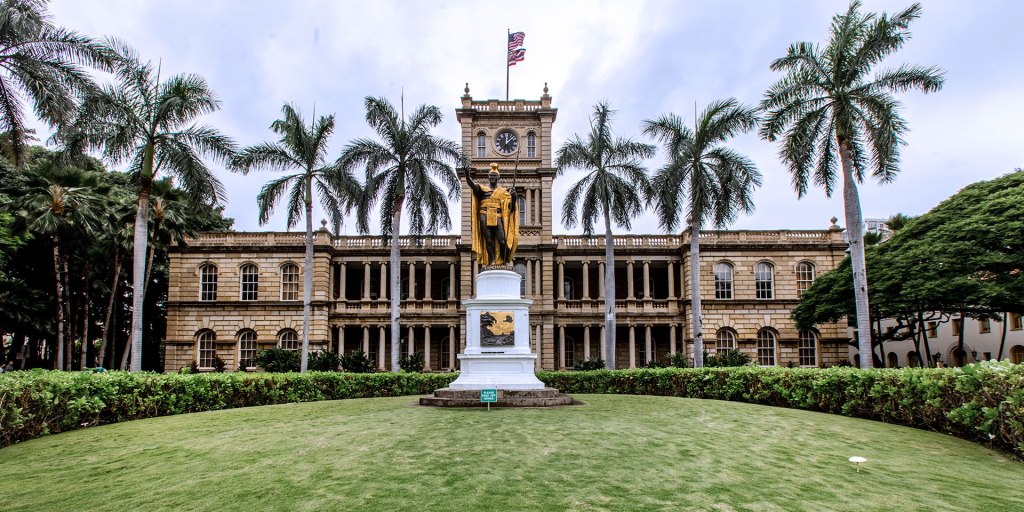
The Iolani Palace, Honolulu

Most Americans are not aware that there are at least three royal palaces in the Hawaiian Islands. Two of them are in the Honolulu area: the Iolani Palace downtown and Queen Emma’s Summer Palace on the Pali Highway. Martine and I have been to the Iolani Palace in 1996 and intend to revisit it on our upcoming trip to O’ahu along with Queen Emma’s Summer Palace.

Hawai’i was a perfectly viable kingdom when the United States annexed the islands in 1898. In the wake of the Spanish-American War, Americans were eager for new colonies; and there was already in place a willing cadre of American settlers willing to raise Old Glory. The reigning monarch, Queen Lili’uokalani was kept a prisoner in the Iolani Palace under suspicion of “treason,” namely for being loyal to her country.

Interior Queen Emma’s Summer Palace

The other palace is connected with a happier time, when Queen Emma (1836-1885), wife to King Kamehameha IV preferred the cooler temperatures of her hillside retreat, which today is a museum operated by the Daughters of Hawai’i. The same group operates a third royal palace on the Big Island of Hawai’i, the Hulihe’e Palace in Kailua-Kona.

In my reading in preparation for our trip, I am concentrating on the period between Captain Cook’s landing on the islands in 1778 and the American annexation in 1898. The memory of the royal families of Kamehameha and Kalakaua is still alive in the islands. There is even a Royal Mausoleum in Honolulu where most of the royal family is interred.

Through Russian Eyes

Russian Troops in Ukraine

If you were old enough in 1962 to remember the Cuban Missile Crisis, you will recall that feeling of dread about the world possibly ending in a nuclear holocaust—within mere days. That showdown between Kennedy and Khrushchev was all because Russia had supplied Cuba with missiles to be pointed at targets in the United States.

Today, I had the unique experience of seeing the war in Ukraine through Russian eyes. I am a member of the European History Meetup Group which gets together several times a year at the Will & Ariel Durant Branch Library in Hollywood. According to Bronislav Meyler, the Ukrainian-born moderator of the group:

Let’s kick off our next program with a discussion about Russia/Ukraine historic relationship. The program will try to focus on the last thirty years of relations between the two states. Historical perspective will not be excluded just for the simple fact that the two nations shared (and still share) almost one thousand years of common history.

The fact that this meeting was held almost in the center of the Russian community in Los Angeles brought a number of Russian-Americans to attend. It is interesting to see how Russians think of the NATO threat. They view the nearness of NATO in the Baltic Republics of Lithuania, Estonia, and Latvia; Poland; Slovakia; Hungary; Bulgaria; Romania; and Turkey much the same way we viewed the threat of Russian missiles less than a hundred miles from the United States.

Where the Russians view NATO as a monolithic threat, I see them as a relatively disunited group that would have insuperable difficulties agreeing on where to eat lunch. But the threat of Ukraine, which has been tied in historically and culturally with Russia since the 17th century, possibly joining NATO was for Putin possibly the straw that broke the camel’s back.

It is always valuable to see the other side’s point of view.

A Good Walk Spoiled

It was Mark Twain who said, “Golf is a good walk spoiled.” All across the United States, Europe, and the world there are some 40,000 golf courses, The average 18-hole golf course covers some 150 acres. At 640 acres in a square mile, that means that some 9,375 square miles (24,281 square kilometers) across the planet are dedicated to golf courses—approximately the area of the State of Massachusetts.

That’s a fair-sized piece of land. What makes the statistic interesting is that golf is on the decline, at least in the United States. According to one source, “The number of core American golfers (those playing eight rounds or more per year) has fallen between three and 4.5 percent every year since 2006.”

The Three Stooges at the Golf Course

If that trend continues, I see a giant land rush forming to convert golf courses into expensive subdivided real estate.

In fact, in the news there is a big kerfuffle about a dispute between the PGA and Saudi Arabia’s LIV, which is making inroads on the PGA’s monopoly. You can read about it here.

So don’t spend too much money on golf clubs and golf fashions. They may not be around much longer.

Not So Fragile After All

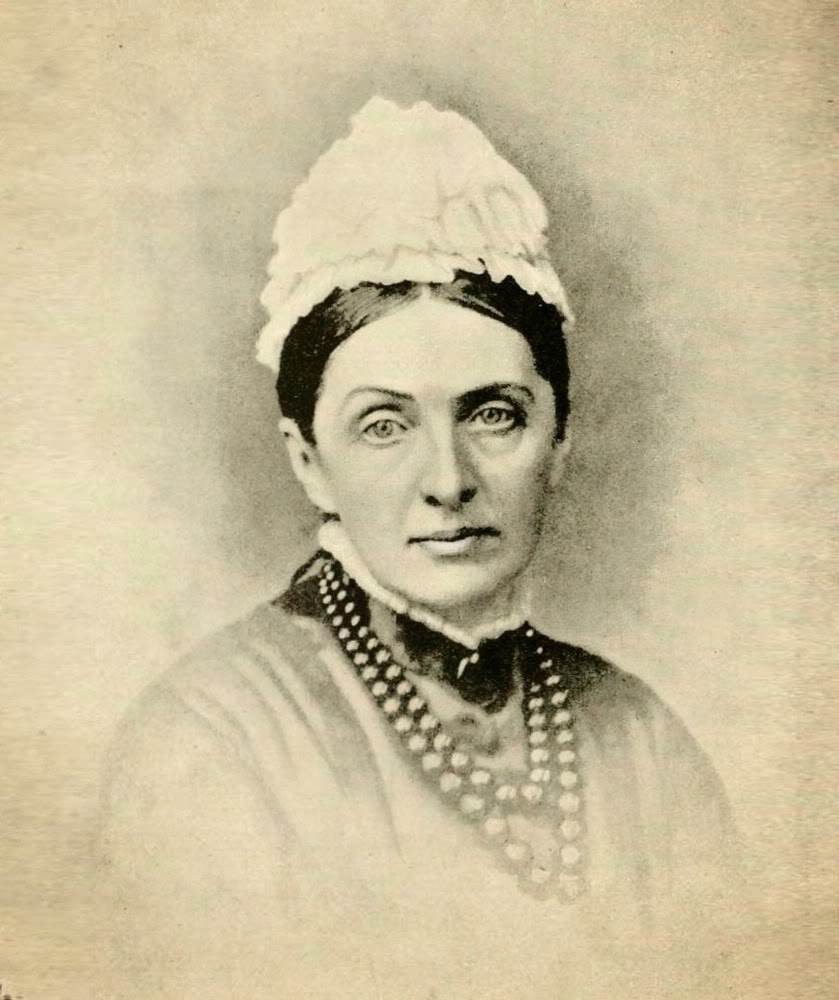
Isabella Lucy Bird (1831-1904)

Were Victorian women really as fragile as depicted? Take the case of Isabella Lucy Bird, who is described in her Wikipedia entry as follows:

From early childhood Bird was frail, suffering from a spinal complaint, nervous headaches, and insomnia. The doctor recommended an open-air life, and consequently, Bird learned to ride in infancy, and later to row. Her only education came from her parents: her father was a keen botanist who instructed Bird in flora, and her mother taught her daughters an eclectic mix of subjects. Bird became an avid reader. However, her “bright intelligence, [and] an extreme curiosity as to the world outside, made it impossible for her brain and her nature generally to be narrowed and stiffened by the strictly evangelical atmosphere of her childhood.”

So what did this proper lady do for kicks? She traveled around the world for several decades, writing a series of creditable travel classics. I am currently reading Six Months in the Sandwich Islands, amongst the Palm Groves, Coral Reefs and Volcanoes (1874), which described her seven-month stay in the Hawaiian Archipelago.

Other books and articles describe her travels to Australia, the American West, Japan, Malaya, Greece, Persia, Tibet, China, Korea, and Morocco.

Isabella Bird was by no means the only woman solo traveler of her time. There was also Lady Florence Dixie (1855-1905), who wrote an excellent book about Patagonia; Frances Trollope (1779-1863), mother of novelist Anthony Trollope, who wrote of her travels in the United States; and Lady Hester Stanhope (1776-1839), who traveled extensively in the Middle East.

Dame Freya Stark (1893-1993)

Somewhat later, there was Dame Freya Stark, who traveled by herself among the Arabs and lived to the ripe old age of a hundred. I have read several of her books, which are uniformly excellent.

I can only look upon these women travelers with wonder and admiration.

Now You Tell Me!

AP Photo/Julio Cortez, File

I was reading the last short story in a collection by Marshall N. Klimasewiski entitled Tyrants, when I came upon this quote by an Arctic explorer (via hydrogen balloon) from Sweden named Salomon August Andrée. It struck me right between the eyes.

The conservatives are always more active in their own behalf than liberals. The reason is that the liberals or progressives feel sure of the ultimate triumph of their cause because they know they are supported by the law of evolution, while the conservatives feel themselves constantly threatened and are therefore busy protecting themselves.

Bibliotherapy

The Last Bookstore in Downtown Los Angeles

There is no question in my mind that reading books can be a form of therapy. Not all books, but certainly those that make you think. Some books could be the opposite of therapeutic, like anything by Ayn Rand or Donald J. Trump.

I read incessantly. Only when I am ill do I not pick up a book. Since September 1998, I have read 2,750 books, ranging from literary classics to poetry to philosophy to history to travel.

Beginning in 1975, the year of my first real vacation (in Yucatán, Mexico), I decided to prepare several months in advance by reading books about my destination. They included archaeology, history, fiction, and descriptions of journeys. That way, when I finally reached my destination, I was there as a person who knew all sorts of things about where he was. That made me feel good about traveling. I didn’t feel like an ignorant interloper.

The therapeutic aspect was there, too. I came to the conclusion that the best philosophy books were written by the ancient Greeks and Romans. Cicero, Marcus Aurelius, and Epictetus had more to say about the human condition than the vast majority of academic philosophers, whose works were by and large unreadable. And it didn’t involve swallowing a whole lot of dogma administered by organized religion.

If you were to read the four dialogues of Plato about the death of Socrates (Euthyphro, Apology, Crito, and Phaedo), you will have read the greatest works of Western Philosophy ever written.

Also worth considering are some of the Hindu, Taoist, and Buddhist texts, such as The Bhagavad Gita, The Tao Te Ching, and the literature of Zen Buddhism. They taught me that desire is always accompanied by suffering. The less one desires, the happier one is. And happiness is not a lasting thing: It goes into hiding and manifests itself only at irregular intervals.

Now if I can only declare my book purchases as medical expenses….

Favorite Films: Out of the Past (1947)

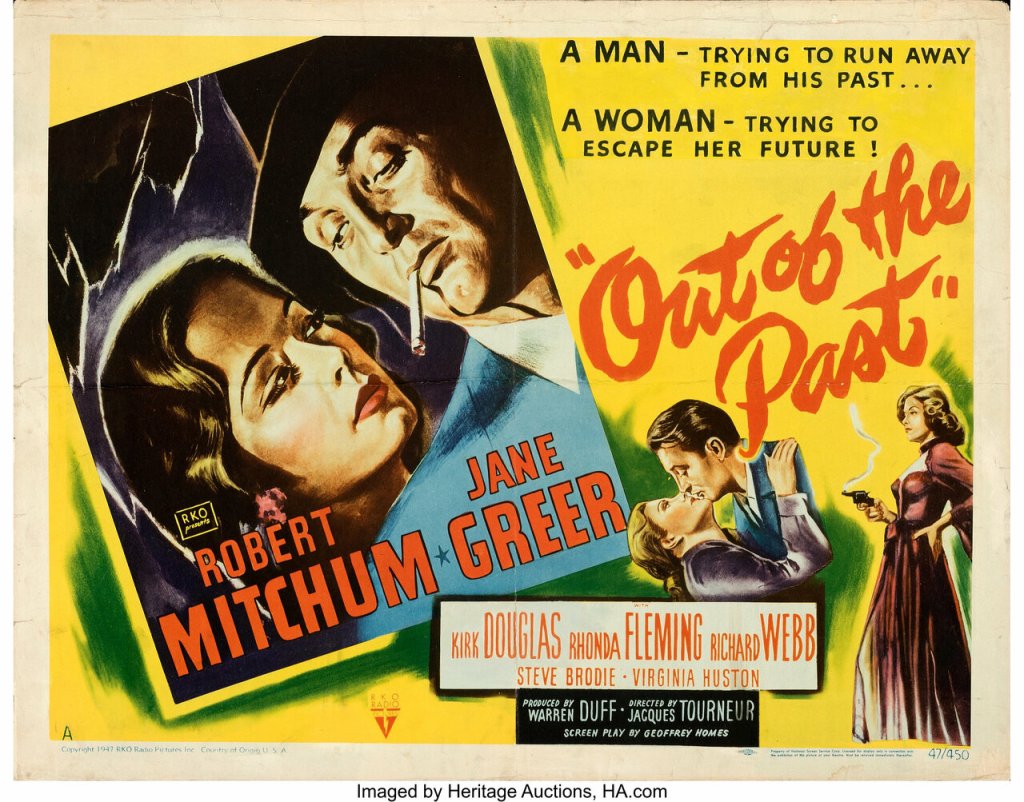
Robert Mitchum and Jane Greer in RKO’s Out of the Past

It seems the most unlikely place to open one of the greatest film noir productions that Hollywood ever made: the bright sunny town of Bridgeport, California, within view of the Eastern Sierras. (But then, didn’t Warner Brothers’ High Sierra end up with Humphrey Bogart’s death in the same general area?)

I have seen Jacques Tourneur’s Out of the Past approximately half a dozen times now and am nowhere near tired of the film. It contains early performances by Robert Mitchum and Kirk Douglas, and a sockdollager femme fatale performance by Jane Greer. Jane would have had a brilliant career if Howard Hughes hadn’t fallen in love with her and gotten the brush-off when she married someone else: She remained on contract to RKO, but she was not chosen for many roles.

The plot concerns a gas station operator in Bridgeport who has, in the past, worked for a sleazy gangster played by Kirk Douglas. Though he changed his name and disappeared to a small town, Douglas has him tracked down and sucks him into his criminal schemes. In this, he is abetted by the devious Jane Greer, who, it seems, is unable to tell the truth, even when she and Mitchum fall for each other.

It’s strange that so soon after the glorious victory of World War Two by the so-called Greatest Generation, Hollywood produced so many great films noted for their pessimism. And this is one of the most pessimistic, with the message that if you should stray ever so slightly off the straight and narrow path, you are an irredeemable goner.

This is a film that never grows old. I may have aged since the first time I viewed it, but the film is still as fresh as an Eastern Sierra field full of wildflowers.