The first time I ate a Frito Pie, it looked like the above photo, and it was purchased from where it was invented, a lunch counter in Santa Fe, New Mexico.
The second time was today. I cooked it myself from this recipe. As I made it to please Martine, the finickiest of all eaters, there was no way I could add raw onions as a garnish. And I used a mild La Victoria Red Enchilada sauce, even though my preferences is for spicy hot dishes. I second the recommendation of using Ranch House canned beans, as they go very well with this recipe. Oh, and I recommend extra sharp cheddar cheese. By the way, don’t use any other chips other than original recipe Fritos: That’s why it’s called Frito Pie.
Tomorrow, I will serve the leftovers with cut up fresh avocado. It’s not in the recipe, but I think it would go well with it.
A Strange Film Set Near the California-Nevada Border in the 1950s
Yesterday afternoon, I went to see a matinee performance of Wes Anderson’s Asteroid City (2023). I had seen his earlier The French Dispatch (2021), which did the same for France as Asteroid City did for the 1950s American desert.
Is it a great film? Not exactly, but I think it is definitely worth seeing. Wes Anderson has, rattling around somewhere in his head, a great film; and I believe it will eventually be made.
Picture a group of Junior Stargazers and their parents descending on a nowhere town in the Mohave Desert. With a cast that includes Tom Hanks, Scarlett Johansson, Jason Schwartzman, Tom Hanks, Tilda Swinton, Margaret Robie, Steve Carell, and some very talented juvenile actors, the film ranged from riveting to “What the …?”
During the Junior Stargazers awards ceremony, a space alien kidnaps a meteor that was on display and later returns it with various inventory markings. The military proceeds to put Asteroid City on lockdown, with no one able to leave or arrive—until the alien makes his second appearance.
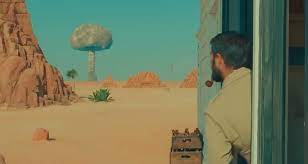
One of Two Nuclear Tests That Occur During the Course of the Film
The most striking thing about the film is its visual style. It all looks like desert postcards of the period. except for a connecting story of a writer and a group of play actors which is not only shot in black and white, but in Academa 4:3 ratio, whereas most of the film is in color and wide screen. In fact, the weakest part of the film is this connecting story.
I remember when I first saw The French Dispatch on TV at my brother’s house. At first, I didn’t know what to make of it. Some of it I loved, some I thought deplorable.
No matter, just hold your nose during the bad parts and enjoy the scenes set in Asteroid City.
Something About Hiring a Lawyer I Don’t Understand
People in Southern California must be very accident-prone. I don’t know what other parts of the country are like, but you can’t pass a bus or a row of billboards without seeing an ad for an attorney who promises “to fight for you” with a 95% or higher ratio of won cases.
Excuse me, but don’t lawyers get to keep a hefty chunk of what they earn by fighting for you? I see a lot of people who were injured in auto accidents praising their hired bad-ass lawyers to the skies, but I wonder how much of that money actually finds its way into the pockets of poor slobs who have been victimized on the highways of SoCal.
I know you want to hurt the party that injured you, but what do you really get out of it?
It’s a lot like the lottery. If you win a jillion dollars, unless you opt for a payout over so many decades, you only get what is called the present value of a jillion dollars, which might be 0.5 jillion. And then there is the Internal Revenue Service (IRS) and your state and local income tax authorities, which might lower your winnings to 0.3 jillion dollars.
But, after all, this is America. Everyone wants to hire a bad-ass to handle your case, but that bad-ass, being a bad-ass, is probably more intent on enriching his own coffers.
I’ve always liked the poetry of Hart Crane. To begin with, he was from Cleveland, like me. In 1932, he killed himself by jumping overboard from a steamship sailing the Gulf of Mexico—after he had made an unsuccessful sexual overture to a crew member. This poem is a tribute to Herman Melville, author of Moby Dick, Billy Budd, and other tales of the sea.
At Melville’s Tomb
Often beneath the wave, wide from this ledge
The dice of drowned men’s bones he saw bequeath
An embassy. Their numbers as he watched,
Beat on the dusty shore and were obscured.

And wrecks passed without sound of bells,
The calyx of death’s bounty giving back
A scattered chapter, livid hieroglyph,
The portent wound in corridors of shells.

Then in the circuit calm of one vast coil,
Its lashings charmed and malice reconciled,
Frosted eyes there were that lifted altars;
And silent answers crept across the stars.

Compass, quadrant and sextant contrive
No farther tides ... High in the azure steeps
Monody shall not wake the mariner.
This fabulous shadow only the sea keeps.
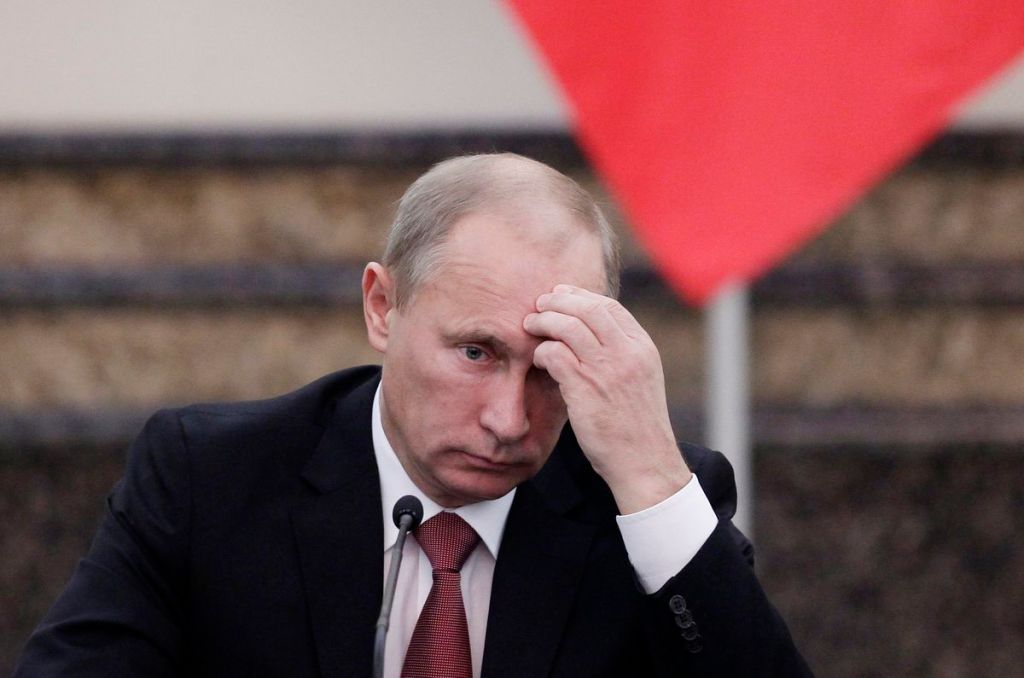
Back in February 27, 2022, I submitted a blog post entitled Putin Screws the Pooch. In it, I wrote:
I cannot help but think that Vladimir Putin has made a serious misstep in his assumptions regarding Ukraine’s willingness to abide by his thuggish behavior. The Russians made the same assumptions that Donald Rumsfeld and Vice President Dick Cheney made when we invaded Iraq in 2003: We were not in fact welcomed with flowers and candy, and, moreover, we are still there.
Now Putin is in a worse position politically than Nikita Khrushchev was in after the Cuban Missile Crisis of October 1962. Not only has Putin failed in his attempt to walk all over Ukraine, but he had to put down a quasi-coup by Yevgeny Prigozhin and his Wagner Group mercenaries.
When one is a totalitarian dictator, one cannot afford to look weak. And Vladimir Putin at this time looks a lot weaker than Khrushchev did in 1964 when Brezhnev and Kosygin replaced him as top dog of the Soviet Union.
And how can you be top dog when you’ve screwed the pooch like Putin has?
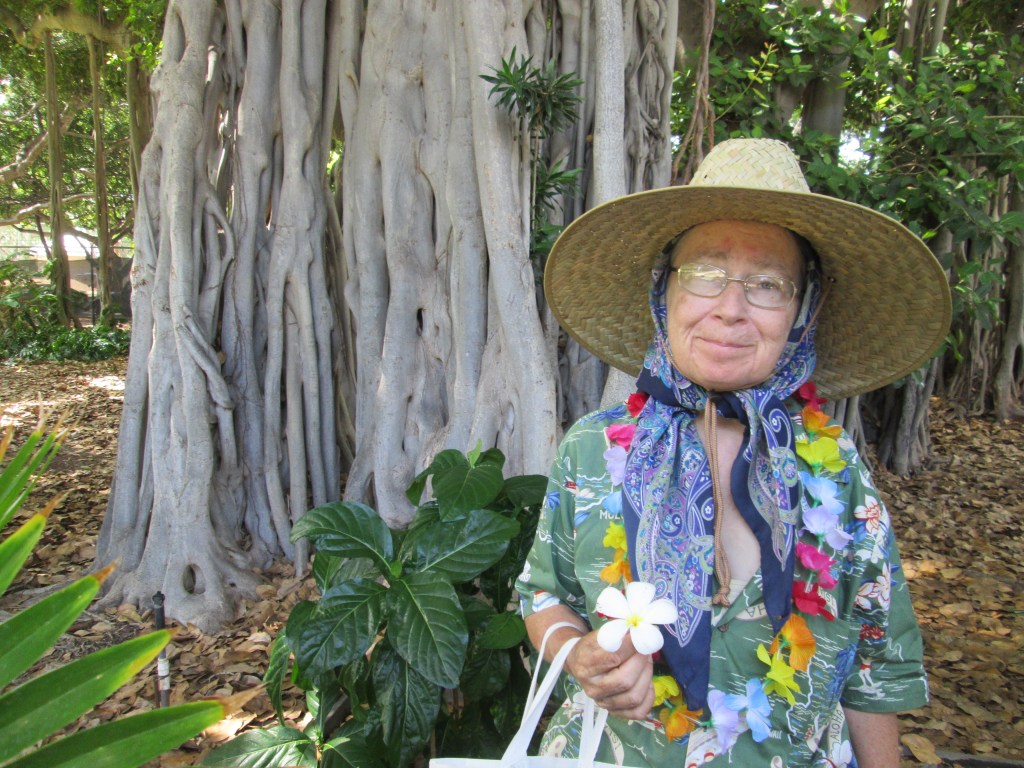
Martine by a Banyan Tree in Kapi’olani Regional Park
This fall, Martine and I are returning to Honolulu. If I had my druthers, I would prefer tracking down obscure Maya ruins in Yucatán, but if I did, I would have to do it alone. And I am getting to an age where that is becoming a bit on the dangerous side for me. Also, as I enjoy traveling with Martine to places that she likes, it adds an extra level of enjoyment for me.
Last year, we concentrated our efforts visiting the Iolani Palace, the Bishop Museum, the Zoo, the Aquarium, and the Foster Botanical Garden. This time, we could visit Queen Emma’s Summer Palace, the Lyons Botanical Garden, the military museum at Fort DeRussy (Martine worked for years as a civilian Army employee), and any number of other places—possibly including another visit to the ethnological riches of the Bishop Museum.
Tomorrow morning, Martine and I will drive down to the Auto Club in Culver City and pick a flight and hotel. I wouldn’t mind staying at the Malia again, even though it is no longer owned by Outrigger Hotels. The area of Waikiki around Kuhio Avenue and Lewers Street may be a few blocks from the beach; but as we are not beach people, we don’t mind. It is right by the bus stop at that intersection which will take us anywhere we want to go.
We still have our HOLO senior ride discount cards for the Honolulu bus system. We just have to add a few dollars of stored value to our cards. That way we can avoid the expense of renting a car and paying big bucks to garage it at our hotel.
The following is a section from the Shambhala Pocket Classics edition of Dhammapada: The Sayings of the Buddha as translated by Thomas Byrom. It is called “The Master.”
At the end of the way
The master finds freedom
From desire and sorrow—
Freedom without bounds.

Those who awaken
Never rest in one place.
Like swans, they rise
And leave the lake.

On the air they rise
And fly an invisible course,
Gathering nothing, storing nothing.
Their food is knowledge.
They live upon emptiness.
They have seen how to break free.

Who can follow them?
Only the master.
Such is his purity.

Like a bird,
He rises on the limitless air
And flies an invisible course.
He wishes for nothing.
His food is knowledge.
He lives upon emptiness.
He has broken free.

He is the charioteer.
He has tamed his horses,
Pride and the senses.
Even the gods admire him.

Yielding like the earth,
Joyous and clear like the lake,
Still as a stone at the door,
He is free from life and death.

His thoughts are still.
His words are still.
His work is stillness.
He sees his freedom and is free.

The master surrenders his beliefs.
He sees beyond the end and the beginning.

He cuts all ties.
He gives up all his desires.
He resists all temptations.
And he rises.

And wherever he lives,
In the city or in the country,
In the valley or in the hills,
There is great joy.

Even in the empty forest
He finds joy
Because he wants nothing.
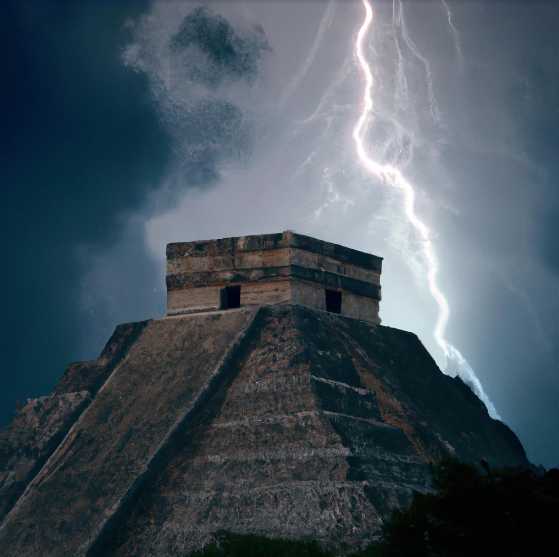
El Castillo at Chichén Itza Being Struck by Lightning
Except for this first paragraph and the photo caption above, this post was created by ChatGTP. I wanted to see what the program could do with a topic I proposed (“Discuss the many dialects of the Maya language”) accompanied by a picture of a Maya pyramid being struck by lightning. Let’s take the picture first: ChatGTP seems to think that the Castillo at Chichén Itza is the only Maya pyramid. Personally, I would have chosen the Temple of the Dwarf at Uxmal. In the AI discussion of Maya dialects below, ChatGPT starts with the patently false statement that Maya is also known as Yucatec Maya. Not so, Yucatec Maya is the most populous dialect of Maya, but the statement confuses a part with the whole. The rest is not objectionable, except that ChatGPT does not attempt to quantify the number of speakers of each dialect.
The Maya language, often referred to as Yucatec Maya, is a language spoken by the indigenous Maya people in Mexico, Belize, Guatemala, and Honduras. While Yucatec Maya is the most widely spoken and recognized dialect, there are actually many dialects within the Maya language family. These dialects exhibit variations in vocabulary, pronunciation, grammar, and even some differences in syntax.
Here are some notable dialects of the Maya language:
Yucatec Maya: This is the most prominent dialect and is primarily spoken in the Yucatán Peninsula of Mexico, including the states of Yucatán, Campeche, and Quintana Roo. Yucatec Maya has the largest number of speakers among the Maya languages.
K’iche’ Maya: K’iche’ is one of the largest Maya language groups, spoken mainly in Guatemala. It has several regional variations, and the dialect spoken in the city of Quetzaltenango (Xela) is considered the standard. K’iche’ Maya gained recognition for being the language of the Popol Vuh, a sacred book of the Maya.
Tzotzil Maya: Tzotzil is spoken in the Chiapas region of Mexico, primarily in the highlands. It is one of the most widely spoken indigenous languages in Mexico, and it has a significant number of speakers.
Tzeltal Maya: Another major Maya language of the Chiapas region in Mexico is Tzeltal. It is closely related to Tzotzil and shares some similarities. Tzeltal is spoken by a sizable population and has various dialectal variations.
Mam Maya: Mam is spoken in Guatemala and parts of Mexico. It is known for having a considerable number of speakers and is recognized as one of the major Maya languages.
Q’anjob’al Maya: Q’anjob’al is spoken in Guatemala, mainly in the western highlands. It has a significant number of speakers and is recognized as an official language in Guatemala.
Ch’ol Maya: Ch’ol is spoken in the state of Chiapas in Mexico. It has a substantial number of speakers and is considered a separate branch of the Maya language family.
Itzá Maya: Itzá is spoken by the Itza people in the Petén region of Guatemala. Itzá is considered a distinct dialect within the Yucatec Maya branch.
These are just a few examples of the diverse Maya language family, and there are many more dialects and variations within each branch. Each dialect has its own unique characteristics, influenced by regional differences and historical factors. The preservation and revitalization of these dialects are crucial for maintaining the rich cultural heritage and identity of the Maya people.
Do We Eat a Credit Card Worth of Plastic Every Week?
In 2019, the World Wildlife Fund quoted research from the University of Newcastle, Australia, to the effect that all of us eat a credit card worth of plastic in our food every week. I have heard the expression that you have to eat a peck of dirt before you die, but this is ridiculous. I read an article entitled “No, you don’t eat a credit card worth of plastic every week. But you still swallow a lot of it” on Salon.Com.
Although plastics of various sorts have been around for decades, they have not been studied as intensively as they deserve to be. After all, we as a people tend to be early adopters of convenient new technologies. It is only later that the grim news hits the streets.
It’s the same with cell phones. There have been arguments pro and con about the phones causing brain cancer, but it is very likely that there are other ill effects that will not come out for years. Back in the mid 1980s, I was involved selling demographic data for telephone service providers to be used in deciding where to erect cell phone towers. Now I feel somewhat guilty about my participation in this effort.
Getting back to plastics, an article in the journal Environmental Health Perspectives stated:
Current estimates suggest that over 10,000 unique chemicals are linked to chemical manufacturing, many with unknown health effects and others identified as chemicals of concern. With such a large number of chemicals, it is very challenging to identify the key exposures we should be measuring to study health impacts of microplastics, as well as understanding their levels in humans.
Dr. Shanna Swan, a professor of environmental medicine and public health at Mount Sinai School of Medicine in New York City, has documented plummeting human sperm counts possibly being affected by widespread plastic pollution: “I think it is important to note that micro and nanoplastics (MNPs) can increase the body burden of the previously recognized — and often studied — chemicals in plastic (most notably phthalates, bisphenols, parabens etc.).”
I suppose we’ll find out the whole truth eventually, but not before the human species has been irretrievably changed by the prevalence of plastics in our environment and our food.
In November 2011, Martine and I spent two and a half weeks in Argentina, plus a few days in Colonia del Sacramento, just across the River Plate from Buenos Aires. With a population of three and a half million people, Buenos Aires was at times a bit much for Martine, especially when she had to ride the crowded buses and subways.
So I planned in advance for a mini-vacation from the crowds of Buenos Aires by taking a ferry across the Plate to Colonia del Sacramento in nearby Uruguay. Colonia is, in fact, where Porteños (that’s what the residents of Buenos Aires call themselves) go when the big city is too much for them.
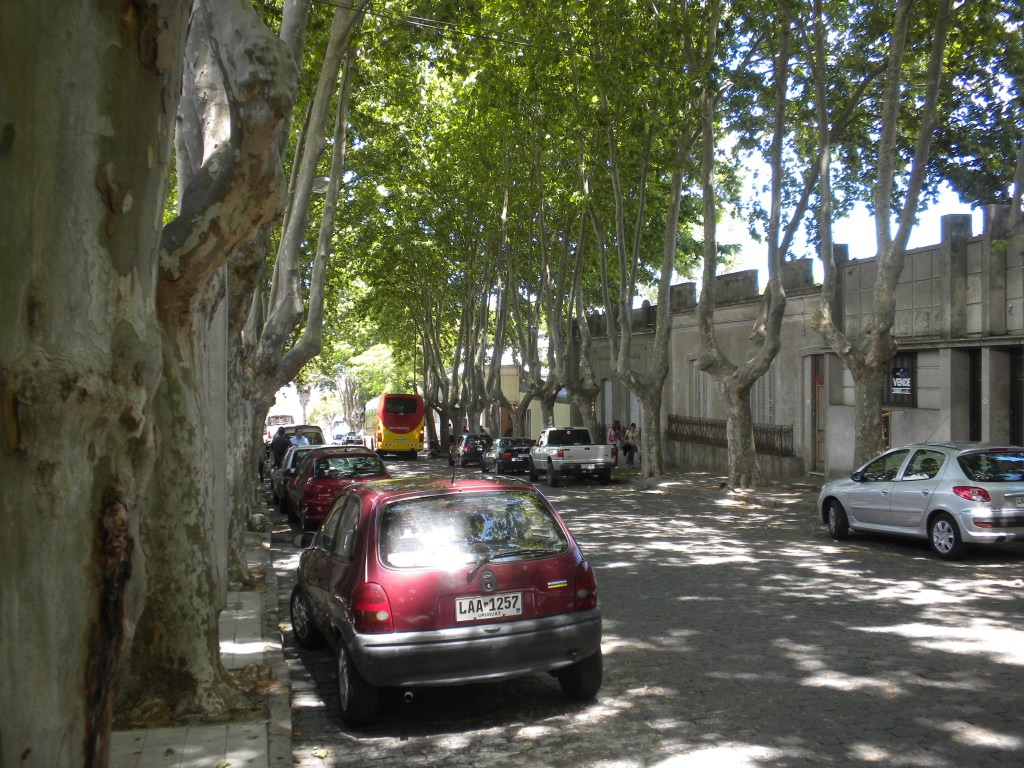
With only 27,000 people, Colonia is a 17th century town founded by Brazil. The streets are mostly all cobblestone, and there are a half dozen small pokey museums that are good for about an hour each.
A Tasty Restaurant Within Sight of the Atlantic
As a getaway, Colonia del Sacramento was a roaring success. We stayed at an old bed & breakfast that was at least three hundred years old. We lazily trod the cobblestones going from sight to sight, and eating some tasty steak dinners. We went back to Buenos Aires for one day before catching a flight to Patagonia, which is an entirely different story.








 Tarnmoor
You must be logged in to post a comment.