
Earth’s Answer

Hurricane Seen from Above

If global warming was some sort of challenge to us, then I would say we lost. There are still multitudes that will think nothing of denying it until their own asses catch fire. Re-reading J. R. R. Tolkien’s The Lord of the Rings, I am conscious of a kind of Celtic sadness as the Barbarians stagger up to the gates and unthinkingly push back against anything that will help our world as we knew it survive into the future.

There are just too many Barbarians, and they delight in making grimaces at us Libtards. We are to be pwned at all events. It as as Sly says in Shakespeare’s The Taming of the Shrew: “Therefore, paucas pallabris, let the world slide. Sessa!”

Well we some some indications of what the world’s “slide” will entail. There are hurricanes, tornadoes, overheated oceans that cook the fish, floods, droughts, record heat. And that°s just the start.

Face it, we humans are toxic to the earth. So we can expect that the earth will just up the ante and make it impossible for us to live as we have done into the future. I can think of no better symbol for our future than the floods at Burning Man near Nevada’s Black Rock City:

Perhaps to come are cacti growing in the Amazon Basin, Hurricanes in Southern California (hey, we had one last week!), trees growing the northern Alaskan bush, accelerated extinction of plant and animal species, ever fiercer and more widespread wild fires, food shortages, water shortages, the disappearance of green lawns—and that’s just the beginning.

So continue to say there is no such thing as global warming, and get ready to run for your life.
Cries in the Streets

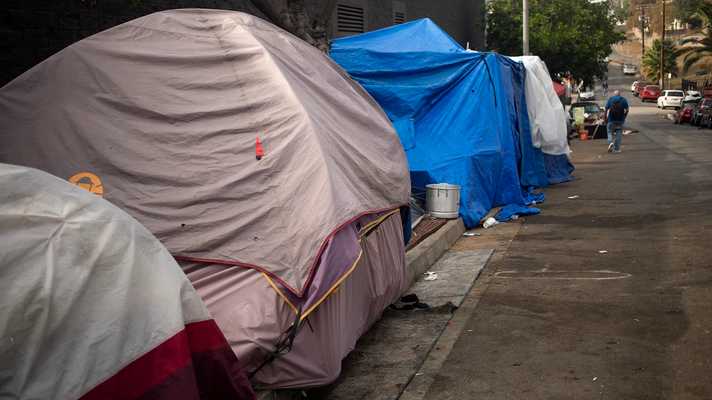
Tents of the L.A. Homeless

In our 21st Century city of Los Angeles, there are tens of thousands of people who are living in scattered Medieval tent cities. Even though the city has banned tents from across the street from my apartment, there are a number of bums who “sleep rough” on the sidewalk. Martine and I can hear them when they raise their voices in anger in the middle of the night, particularly if they are competing for the attentions of a homeless woman.

I am very happy that I am not a politician, because then I would have to pretend as they do they these homeless are all poor unfortunates who need to be placed in public housing. That’ll work for some of them, the roughly 50% who really just need a place to bed down and are willing to follow the rules about drink, drugs, and violence. Except a very large percentage don’t want to follow any rules whatsoever. When they are offered housing, they will get drunk or stoned and smear their feces on the wall—whereupon they find themselves in the street again.

America is full of raggedy men who do not give a tinker’s damn about THE RULES. What they want is the freedom to live as they want to, even if they are burying the city of their residence in piles of fetid garbage. They don’t particularly care if their pursuit of freedom is toxic to others.

It’s kind of like American politics as a whole, which can best be summarized by who can say EFF YOU the loudest and longest. We used to have two political parties with platforms. Now we have one party that has a platform, and the rest have EFF YOU as their platform.

The homeless who don’t want to be homeless I can understand. The ones who want to spend all night drinking, shouting, getting high and meth and Fentanyl, and whoring with female ratbags do not have my sympathies.

Travis McGee and Others

Mystery Writer John D. MacDonald (1916-1986)

When the dog days of summer roll around, I like to look for a good mystery novel, especially if the scene of action is in a steamy place like Florida. Ever since I discovered that I could “check out” up to ten books from the L.A. public library to read on my Amazon Kindle, I have been looking for John D. MacDonald titles. In the last few weeks, I have picked out four titles. To date, I have read eleven of his books.

In many ways, MacDonald reminds me of Georges Simenon, another of my favorites. On one hand, Simenon wrote some 75 novels featuring Inspector Jules Maigret, and hundreds of other of what he calls his romans durs, or “hard” novels. You guessed it: The latter group tend to be much more hard-bitten than the Maigret titles.

In the same way, MacDonald has his score of Travis McGee novels set in Florida and featuring the very sympathetic captain of the Busted Flush, the yacht on board of which he lives. Like Raymond Chandler’s Philip Marlowe, he is a knightly presence in the Southern California darkness. MacDonald’s non-Travis-McGee titles also tend to be a bit tougher sledding, with his detective’s humane presence absent.

I am just now starting to read some of MacDonald’s other fiction, such as Border Town Girl.

Third Time’s a Charm

Martine at Kapiolani Park in September 2022

As I mentioned in my post yesterday, Martine and I are headed back to Honolulu for another visit. Looking back at last year’s pictures, I noticed that Martine looked genuinely happy in most of them. Returning to L.A., Martine has had a difficult year—especially when she broke her wrist in two places after a fall at home. And recovery has been painfully slow, especially since the cast which she war was too tight and affected her ability to bend her fingers once it was removed.

Although I would probably be happier traipsing off to Latin America, Martine’s happiness matters to me; and I can certainly enjoy myself in Hawaii provided I stay away from most mainland tourists of the luau-frequenting variety.

We will be staying at the same hotel we stayed in last year, the Malia. Last year, it was a hotel in the Outrigger chain; now, it is the Waikiki Malia, apparently no longer part of a chain. It is not exactly on the beach, but that is no matter to us as we are not beach types. We prefer the corner of Kuhio and Lewers because of its convenient access to public transportation.

The big success story of last year’s trip was our discovery of the Honolulu bus system, the best we have seen in any American city. As senior citizens, we picked up a Senior Citizens discount Holo card, which enables us to unlimited rides for the entire month of September for $20.00 US for each of us. Compare that with high car rental fees and hotel parking rates of up to $50-60 US per night.

Amazingly, the Honolulu buses go not only all around the city, but along the Southeast (Hanauma Bay, Hawaii Kai), the Windward Coast (Kailuka, Kaneohe, La’e), the North Shore (Waimea, the Banzai Pipeline), and Central O’ahu (the Dole Pinapple Plantation). Where we would need a car would be the Leeward Coast (Ko Olina) and certain trailheads on mountain trails. If you’re thinking of going to Hawaii on a budget, I firmly recommend the public transportation and a non-luxury-priced hotel, preferably on Kuhio Avenue.

We booked our trip through the Southern California Auto Club, which I also recommend.

Kahuna Lapa’au

In preparation for an upcoming trip to Hawaii in a couple of weeks, I am reading the work of a distinguished novelist and microbiologist: O. A. Bushnell’s The Gifts of Civilization: Germs and Genocide in Hawaii. Never before have I read a book about what happens to public health when a 19th century Western power takes over a primitive aboriginal society.

Bushnell claims that the native Kahuna Lapa’au healers were not inferior to American physicians of the period. When you consider that 19th century medicine was into bloodletting, blistering, and the ingestion of mineral poisons. it is not surprising that aboriginal healers were in now wise inferior.

Unfortunately, they were dealing with a whole new range of illnesses introduced by the white man, diseases such as measles, smallpox, malaria, leprosy, and the various venereal diseases. This led to widespread confusion among native healers as to which treatment to use, at a time when neither American nor native Hawaiian medical practice was effective.

In this book and in his novels—The Return of Lono, Ka’a’awa, Molokai, The Stone of Kannon, and The Water of Kane—Bushnell created an impressive body of work on the interface of the two cultures.