Downtown Trifecta

The Food Court of the Grand Central Market

Today was a perfect day to go downtown. Instead of the usual bright sun and searing heat, we had a heavy marine layer with a light drizzle. The temperature could not have gone over 68º Fahrenheit (20º Celsius).

I started by returning three books at the Central Library and picking up three other books to read in the next month or so:

  • Argentinian Juan José Saer’s The Regal Lemon Tree
  • Italian Pier Paolo Pasolini’s The Street Kids
  • Nina Revoyr’s Southland

From the library, I hoofed it to the Grand Central Market, where I had a delicious everything bagel with smoked sturgeon at Wexler’s Deli, which specializes in smoked fish.

Then it was on to the Last Bookstore at 5th and Spring. I picked up nice copies of two Sir Walter Scott novels at a good price: Kenilworth and Woodstock. I’m perhaps the only person I know who has the patience to read one of Sir Walter’s long and dilatory novels. Although he is not much read today, partly because he wrote in a difficult South Scottish dialect, I have always loved reading his novels. So I’ll have to consult the glossary at the rear of both books frequently. No problem there.

With my books in tow, I walked south on Broadway to 7th Street, past the abandoned old movie theaters where I used to watch all-night triple features with my old friend Norm Witty, then cut right on 7th Street to the Metro Rail station at 7th and Flower Street.

It was a good day, and I look forward to reading some good books.

Beware of Mayan Gods

The Mayan Goddess Ix Chel

This is a poem about a famous photograph of a Salvadoran refugee and his child found drowned in the Rio Grande while attempting to cross it near Matamoros. Poet Brenda Cárdenas refers to the Mayan goddess Ix Chel in the course of her poem. She bases her work on a drawing by Erik Ricardo de Luna Genel which I have not been able to find. Below is the photograph:

Cien nombres para la muerte:
La hilacha/The Loose Thread

Ix Chel, skeleton moon at her loom,
wipes her furrowed forehead, daddy
longlegs dangling like loose threads
from the corners of her eyes dark as ditches.
She stitches crossbones into skirts,
weaves skulls into blankets she will trade
with travelers. “Mantillas, rebozos!”
she’ll sing unfurling her wares for parents
to wrap around babes she has guided
from their mothers’ oceans to Earth.

Under one moon, a Salvadoran father
and mother cannot wait any longer
in the winding lines of starved
asylum seekers ordered to halt.
So their daughter, not yet two, wraps
her tiny arms around the bough
of papi’s neck, clings to his trunk
as he wades into the big river, swims
strong as salmon, against churning currents.

But when he spills her on the bank, warns
her to wait, and lunges back into the torrent
for mami, the little one panics, follows.
Under one sun, the river carries them
away, defying the border
it never meant to become.

Ix Chel’s waning crescent finds them
first, face down in the mud,
wrapped together in the black shroud
of papi’s shirt. And from her great jug,
holding all the waters of heaven,
she spills storms to wash away
the lines we’ve carved, dug, drilled,
the walls we’ve built in chain link, barbed
wire, concrete, and steel between desert
and desert, river
and river, earth
and earth, between father
and mother, mother and
child
under one moon.

“Long Torn By Ill Fate”

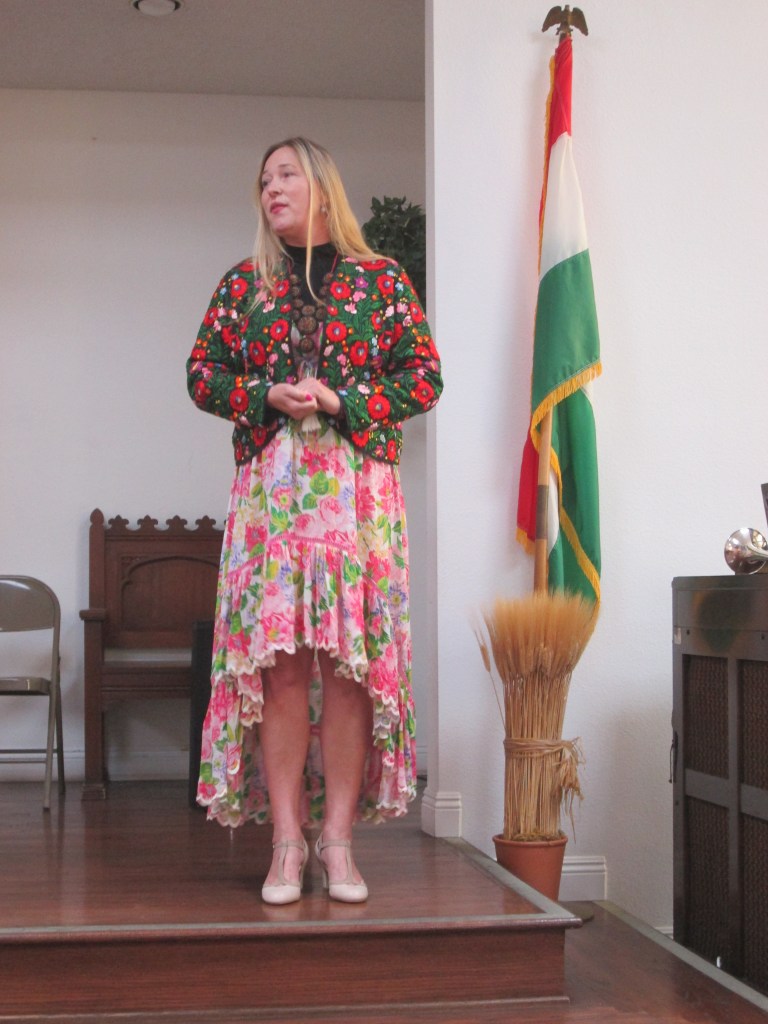
Melinda Borbely Singing Hungarian Folk Songs

Today was another Hungarian festival, this time it was the Tavaszköszöntő at the First Hungarian Reformed Church of Los Angeles. Although I can speak Hungarian (ungrammatically), I have a difficult time understanding the language when all the long agglutinative words are strung together in paragraph lengths.

Still, just letting the language wash over me, while understanding only bits and pieces, sends me back to my roots. As a child born in the Hungarian neighborhood of Buckeye Road in Cleveland, Ohio, I did not even know that English existed as the language of my home and neighborhood was strictly Magyar. Listening to spoken Hungarian makes me feel as if I were being washed by the gentle waves of the Danube as it flows through Budapest.

This is the 100th anniversary of the Treaty of Trianon, which resulted in millions of Hungarians being assigned to Czechoslovakia, Romania, the Soviet Union, and Yugoslavia. One cannot go to a Hungarian gathering without seeing a map of the pre-Trianon borders of Hungary. It has led to a mythology of the lost cause, which is perfectly enshrined in the Himnusz, the Hungarian national anthem. Here is a YouTube video of the Himnusz:

Here are the lyrics in all the stanzas of the Himnusz:

Verse 1
O God, bless the nation of Hungary
With your grace and bounty
Extend over it your guarding arm
During strife with its enemies
Long torn by ill fate
Bring upon it a time of relief
This nation has suffered for all sins
Of the past and of the future!

Verse 2
You brought our ancestors up
Over the Carpathians’ holy peaks
By You was won a beautiful homeland
For Bendeguz’s sons
And wherever flow the rivers of
The Tisza and the Danube
Árpád our hero’s descendants
Will root and bloom.

Verse 3
For us on the plains of the Kuns
You ripened the wheat
In the grape fields of Tokaj
You dripped sweet nectar
Our flag you often planted
On the wild Turk’s earthworks
And under Mátyás’ grave army whimpered
Vienna’s “proud fort.”

Verse 4
Ah, but for our sins
Anger gathered in Your bosom
And You struck with Your lightning
From Your thundering clouds
Now the plundering Mongols’ arrows
You swarmed over us
Then the Turks’ slave yoke
We took upon our shoulders.

Verse 5
How often came from the mouths
Of Osman’s barbarian nation
Over the corpses of our defeated army
A victory song!
How often did your own son aggress
My homeland, upon your breast,
And you became because of your own sons
Your own sons’ funeral urn!

Verse 6
The fugitive hid, and towards him
The sword reached into his cave
Looking everywhere he could not find
His home in his homeland
Climbs the mountain, descends the valley
Sadness and despair his companions
Sea of blood beneath his feet
Ocean of flame above.

Verse 7
Castle stood, now a heap of stones
Happiness and joy fluttered,
Groans of death, weeping
Now sound in their place.
And Ah! Freedom does not bloom
From the blood of the dead,
Torturous slavery’s tears fall
From the burning eyes of the orphans!

Verse 8
Pity, O Lord, the Hungarians
Who are tossed by waves of danger
Extend over it your guarding arm
On the sea of its misery
Long torn by ill fate
Bring upon it a time of relief
They who have suffered for all sins
Of the past and of the future!

It is a powerful anthem. Hearing it sung at the festival today, I felt like taking my sword and riding to the border to stop the Turkish invader in his tracks. It is such a powerful hymn that it is forbidden to be sung at international sporting events—which just adds to the Hungarian sense of grievance.

Sympathy for Mules

Drug Smuggler Caught by Airport Police

Of late I have been fascinated by a National Geographic Channel series called “To Catch a Smuggler.” The show concentrates on drug smugglers attempting to smuggle cocaine, heroine, so-called party drugs, and other narcotics in their luggage or on their persons.

Initially, I was elated that people smuggling drugs into this country (or, in fact, any country) were being caught. Then, as I viewed more of the series, I started feeling some compassion for the drug mules, who were mostly poor people in serious debt who were persuaded by the real criminals that they would not get caught if they carried heroine in a false bottom in their luggage or swallowed rubber contraceptives full of cocaine. In the latter case, if one of the rubbers broke while in transit, the result would be a fatal overdose.

When caught, the drug mules would begin by denying everything. Then, when presented with clear evidence of their crime, they would break down. Allowed one phone call to their loved ones, they broke down when they realized their lives were irretrievably ruined.

Thinking one could smuggle several kilos of drugs past trained dogs, experienced security and customs personnel, and instant chemical tests for banned substances is a form of magical thinking. Unfortunately, the prison sentences for smuggling can be up to thirty years in countries like Peru and Colombia, and somewhat less in Europe.

Also on the show are another set of “smugglers,” except what they are smuggling are themselves. Show after show highlights cases of Syrians, Turks, and Albanians attempting to get to the United States or Europe with forged or otherwise false travel documents. It seems that many Muslims are desperately trying to leave their home countries, many of which are either despotisms or fighting endless civil wars.

I think one would have to be Marjorie Taylor Greene to watch this show and not feel for the perpetrators.

Two Spongers

D. H. Lawrence (1885-1930)

In my reading, I have come across two cases of great writers being taken in by freeloaders with pretensions to gentility. Most recently, I have read D. H. Lawrence’s Memoir of Maurice Magnus, which appears in its entirety in the New York Review of Books Collection of Lawrence’s essays entitled The Bad Side of Books, edited by Geoff Dyer. The sponger in question—Maurice Magnus—was getting into serious financial problems when he hooked up with the British writer. He claimed to be Isadora Duncan’s manager (he wasn’t) and to be a writer of some note (he was, but of very little note). Attaching himself to the young Lawrence and his wife like a barnacle, Magnus was forever showing up and asking for “one last favor.” Only when Lawrence left him behind in Malta did he finally shake himself of the infestation. And that was only because Magnus, fearing to be deported to Italy for check kiting and other financial crimes, committed suicide by poisoning.

The experience led Lawrence to conclude:

It is the humble, the wistful, the would-be-loving souls today who bully us with their charity-demanding insolence. They just make up their minds, these needful sympathetic souls, that one is there to do their will.

Henry Miller (1891-1980)

The second sponger fastened himself to Henry Miller, who wrote about the experience in Big Sur and the Oranges of Hieronymus Bosch. The whole episode is summed up by the Wikipedia entry for the Miller Book:

The third part tells the story of when Miller was visited by an old friend from Paris, the French astrologer Conrad Moricand, in 1947. Moricand had written Miller that he was penniless. Miller invited Moricand to live with him in Big Sur for the rest of his life. Moricand arrived at the end of the year. The arrangement quickly turned into a disaster. Although Miller had told Moricand about the isolated and rugged life of Big Sur, Moricand was unprepared and complained often about the weather, food, and his own poor health, among other things. Miller put Moricand in a hotel in Monterey, and arranged for him to return to France. Moricand did not immediately return to Europe, however, instead writing Miller angry letters about his perceived mistreatment. Miller wrote about this episode, which would be published in 1956 as A Devil in Paradise, and a year later as the third part of Big Sur, called “Paradise Lost.”

It is interesting to know that one can always be taken in by sharpers who prey on artists with generous impulses. Sometimes, indeed, no good deed goes unpunished.

Martine’s Tiny Treasures

A Sample California State Identification Card

Martine likes to take long walks. She walks very slowly and looks carefully around her and typically finds all manner of things. These include infant socks (many different varieties), unused Narcan nasal spray for opiate overdoses, birth control pills, drug syringes, and coins of all denominations, including foreign coins.

Today, she picked up a California state identification card outside a Santa Monica supermarket, similar in format to the above photograph. It was from a young woman who lived in the immediate vicinity of Santa Monica College. As she was about to go by bus to deliver the card to the address shown on it, I offered to drive her there. Going on foot or by bus would have taken hours, and it was already dark.

So I drove Martine to the house whose address was on the card. She went up to the door and handed it to an older woman who was probably the mother of the card holder.

When I first came to Southern California around 1967, I had one such card. After all, it was not until 1985 that I learned to drive and was able to get a California drivers’ license. The card enabled me to buy alcoholic beverages for eighteen years. I imagine that the young woman whose card Martine found is now able to celebrate by boozing it up with her good buds.

Hot! Hot!! Hot!!!

They Weren’t Whistling Dixie

I returned yesterday from the Coachella Valley after four days of excess 100° Fahrenheit (38° Celsius) temperatures. When summer temperatures arrive in the lower desert, it is time to seek air-conditioned comfort. No walkies, no hikes, no outdoor activities of any sort: It is simply time to seek air-conditioned comfort and hunker down. Even the steering wheel of my Subaru Forester was hot to the touch.

Knowing full well what was in store for me, I had a god time nonetheless. My brother’s house in Palm Desert is comfortable, and I enjoyed reading and talking with him and with my sister-in-law Lori. Yesterday, before setting out for Los Angeles, I had breakfast with Dan and my niece Hilary, who had just arrived by plane from Seattle. After an hour of pleasant chatter, I hit the road with only a single rest stop in Rowland Heights.

The Los Angeles temperature was a full 40° Fahrenheit (22° Celsius) cooler than the Coachella Valley. I found I needed a jacket when I unloaded the luggage from my car.

The net result: I didn’t really go anywhere which I could feature in my blog posts. Sometimes, it just happens that way. Fortunately, the hot weather did not stop me from enjoying myself.

Off to Hide Out in the Desert

The Cactus Garden at Sunnylands in Rancho Mirage

I will not be posting any blogs this weekend as I will be out of town visiting my brother in the Coachella Valley. My next post will likely be on Monday or Tuesday of next week.

Unfortunately, the temperature is expected to be in excess of 100° Fahrenheit (37° Celsius) for the four days I will be there, but I will not likely be doing a lot of outdoor exercise, unless it involves a cooling dip in the pool. More than likely, I will be watching some of the NBA playoff games, especially the ones in which the Lakers are playing.

I will also be reading Robert M. Utley’s The Indian Frontier of the American West 1846-1890. That will be in addition to eating some of my brother’s excellent cooking, watching films with him and my sister-in-law, and talking up a storm.

This Is Not a Debating Society

If it hasn’t happened to you before, it will—especially if you post a blog that identifies you as a libtard. I am certainly one, and proud of it. A few days ago, I wrote a post about my dislike of what the Second Amendment has come to mean. If you say something negative about guns, you will inevitably draw a response from a troll.

Now it is a well-known fact that it is not worth disputing with a troll. If the troll posts a comment, it will not be to obtain information or evaluate your post: It will aim at “pwning” you, by making you look like a fool. The goal of the comment is for the troll to “win” and for the blogger to “lose.”

What I usually do is, as soon as I detect a troll-like tone, is to hit the troll with a preemptive burst of snark right off the bat. Before he could bring his guns to bear, either hit him again or casually deprive him of the right to post on your blog site.

This is not a debating society. When I write about politically sensitive issues, I have no interest in engaging with the opposition in a dispute. All these disputes come across as dreary exercises that are not worth engaging in. So have no compulsion about blowing off the troll. You have no obligation to defend yourself against nugatory attacks.

“Rat Among the Pines”

Poet Roger Reeves at the Los Angeles Times Book Festival

As I have mentioned before, the highlight of my visit to the Los Angeles Times Festival of Books was the Poetry Pavilion, where I could sit in the cool shade on a hot spring day and listen to some outstanding poets. One of them was Roger Reeves, an Associate Professor of Poetry at the University of Texas in Austin. The following poem, entitled “Rat Among the Pines” comes from his collection Best Barbarian, a finalist for the National Book Award. It tells in terse poetic language the violence of life in America.

Rat Among the Pines

Terror, tonight

Is the moon
Slipping from a rat’s gray grasp,

Finding its way back
Into the sky, which is America—

A white moon
Leaning on the night’s neck

With its hand in its pocket,
Moon hung calm above

Catastrophe, the police
Breaking the neck of a man

Who had just brushed summer’s
First bead of rain from his eye-

Lashes. Who—knocking a Newport
Against a wrist, watching smoke

Break its head against a brick
Wall—is preparing to die

Unaware they are preparing to die.
Heavy the moon, silly the tasking

Of a rat with delaying death.
Terror, tonight

Is the candor of the earth
Where someone is preparing to die

And the earth receives that dying
With its hands in its pockets.

And the moon that once burnt the silk
Hump of a rat, back in the sky.

And my daughter hiding in the rose
Bushes, asking who, who the sirens

Have come to kill. And someone calling
It beautiful—summer, moon—

And someone dying beneath that beauty,
Which is America.