Magyar Blood

Folk Dancers from the Kárpátok Troupe at Grace Hungarian Reformed Church

For the first time since the Covid lockdown began, Martine and I were able to attend a church festival, in this case the Hungarian festival at Grace Hungarian Reformed Church in Reseda. I was raised on Hungarian food, and Martine, although French, prefers Hungarian food to the cuisine of her native land.

So we chowed down on stuffed cabbage and krémes (Hungarian style cheesecake) and watched a program of folk dancing. Plus I had the opportunity of practicing my rusty Hungarian. Although it is my native language, my vocabulary and grammar are atrocious. Yet my pronunciation is still pretty accurate. As I’ve mentioned before, I speak a rural Fehérmegye dialect dating back to the 1930s. This is what we spoke at home in Cleveland.

Still and all, I want to stay close to my Magyar roots as much as possible. I see it as an escape hatch when I get too disgusted with my fellow Americans. I like to stay current with Hungarian literature, even though I have to rely on translations into English, of which there are few.

Below is the announcement for the festival we attended today:

Not a single word is in English, and yet I understood most of it. And what I didn’t understand, I looked up.

Martine and I have been attending this church’s spring festivals for most of the last eleven or twelve years. Great fun!

Visiting Kuruvungna Springs

As I wrote in my last post, I wanted to introduce Martine to the sacred Tongva/Gabrieleño springs that exist as an enclave at West L.A.’s University High School. Apparently, the springs are closed to the public except on the first Saturday of each month.

Today, we showed up around noon and spent a few minutes walking around the springs and visiting the little cultural center with its exhibits. The tribe forbids photography of their cultural center, so I was unable to present any views of the exhibits. Below, however, is what the springs look like:

Kuruvungna Springs with High Rise Apartments in Background

I was surprised to see so many people in attendance. For one thing, a number of volunteers were doing yard work; and my guess is that most of the other visitors are locals who know about the Springs’ rare opening times.

Kuruvungna

Kuruvungna Springs in West Los Angeles

Not a mile from my front door, on the grounds of University High School in West Los Angeles is a spring that is sacred to the Tongva (aka Gabrieleño or Fernandeño or Kizh) tribe that inhabited this area. For many years, it was vandalized and graffitied until the State of California provided funds for restoring it. Today, it is a cool enclave of the Uni Hi campus.

(Uni High, by the way, was where Roger Vadim’s Pretty Maids All in a Row (1971) was shot, starring Rock Hudson, Angie Dickinson, and Telly Savalas.)

The Tongva tribe has no reservation, but there is a small cultural center on the grounds of Kuruvungna Springs. I found an old newspaper article which gave the original Tongva names of many Southern California places.

Several years ago, I visited the Springs. I understand that they will be open on Saturday. With luck, I can talk Martine into visiting it with me. It is one of those secret little places that make Los Angeles endlessly interesting.

About That Militia

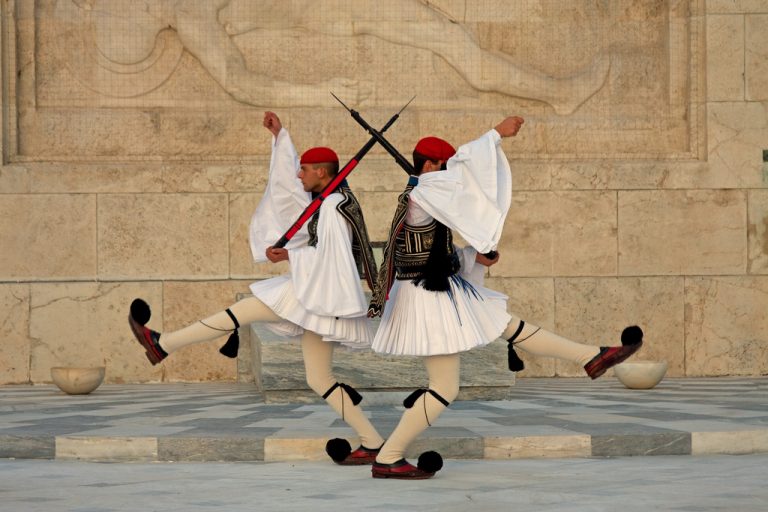
Evzones: Traditional Uniform of the Elite Greek Guards

Everyone I know is sick to death of the multiple shootings appearing in the news every day. I look back at the text of the Second Amendment, so beloved of pudgy aged 50+ Texans and Midwesterners, and I wonder how we have come to this. Here is the entire text of the amendment:

A well regulated Militia, being necessary to the security of a free State, the right of the people to keep and bear Arms, shall not be infringed.

Well, I say let them buy guns, but with one proviso: They must form a well-regulated militia, with frequent regular meetings, preferably scheduled during major sports playoffs, bowl games, and championships. Oh, and they must have a uniform. Otherwise, they can’t really be said to be a well-regulated militia, no?

As for the uniform, I prefer that of the Greek Evzones, illustrated above. Now although the uniform doesn’t look butch enough to most Americans, the Evzones were elite mountain and light infantry units that were tested in battle against the Turks in the 1920s and Communist insurgents of the 1950s.

Since I am opposed to cultural appropriation, I suggest that the skirts worn by the pot-bellied gun-toting militia be rainbow colored; and the pom-poms on the shoes should be pink.

The guards in the above photo are serious soldiers, which our NRA-loving militia would not be. But, by God, they would be well-regulated … to the point of complete exasperation and utter abashment.

Stuck in a Bubble

As we age, we tend to find ourselves stuck in a bubble. Even with the wonders of the smart phone and social media, we seem to have found a new way of isolating ourselves. One of my friends cannot have a conversation without mentioning the politics and culture of America between 1966 and 1976. His talk is of the Kennedy assassinations (he was actually present at Robert Kennedy’s), the FBI vs. the Sioux at Pine Ridge, the Manson Family, and related topics. He goes back frequently to his college days or his Midwestern upbringing.

If one is feeling stressed, I can understand trying to find refuge in the past. It is a particular temptation as one ages, especially if life has not proved satisfactory in some way. And, when you think about it, it rarely does. We are all mortal, and the stresses do not disappear when one is up against the endgame. As we all inevitably are.

My way of fighting the bubble-ization of old age is to try to understand the present. Mind, I didn’t say to accept it. For instance, I do not own a smart phone—though I have a flip phone I use occasionally. I use FaceBook mainly as a content provider: All my WordPress posts are sent to my FaceBook page, and I usually add a couple of funny comics to boot. I do not have any Twitter, Instagram, TikTok, or other social media accounts. (And I don’t feel socially deprived as a result.)

When people try to put me down with an “Okay, Boomer!,” I merely point out that I am pre-Baby-Boom, having been born during the last days of the Second World War. In fact, I was born some six months before the Trinity A-Bomb test, so I’m also pre-Atomic-Age. That only means I am older than dirt. But I am still alive.

One Night in Santa Monica

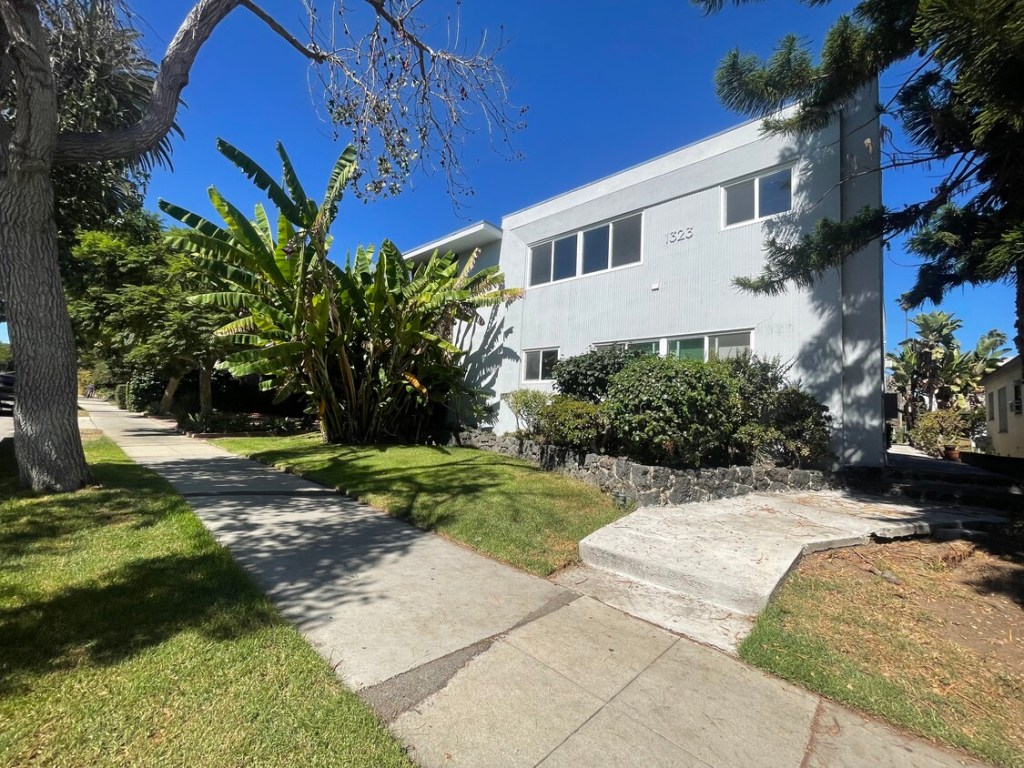
The Apartment Building at 1323 11th Street

During most of the 1970s, I lived in a two-bedroom apartment on 11th Street in Santa Monica. I was on the second floor, with the bottom floor being a carport. On the way up the back stairs to my apartment (#10), I had to pass #8 and #9. I am giving you this detail so that you will be able to better see what happened to me on night around 1978.

I was returning from Von’s Supermarket with a bag of groceries. As I walked down the alley, I saw two young Armenian men crouching behind a car with a trailer loaded with furniture. They motioned for me to take cover. I surmised that they were moving into one of the apartments (the building owner was Armenian), but I had no desire to wait for man indeterminate time in the dark, cold alley. So I continued on.

As I turned to mount the stairs, I saw my alcoholic white trash neighbor Merle standing at the top of the stairs with a rifle. I greeted him: “Hi, Merle. How’s it going?” He complained that those damned kids who were moving in made too much noise and giving him a headache. He added: “You’ve always been a good neighbor to me, Jim.” So he moved to one side and let me pass.

As I turned my back to him to go to my front door, I was conscious that I had just done something irrecoverably stupid and that I might be shot in the back. I turned the key, entered my apartment, and fell on the floor, breathing heavily.

Within minutes, the Santa Monica Police arrived and arrested Merle. I never saw him again. Shortly thereafter, his wife Ursula moved out. One neighbor had told me that once, when he knocked on the door of #8, Ursula answered the door stark naked. I, however, was deprived of that experience.

Actually, except for that one incident, Merle and I got along all right.

J M W Turner’s Castle in Wales

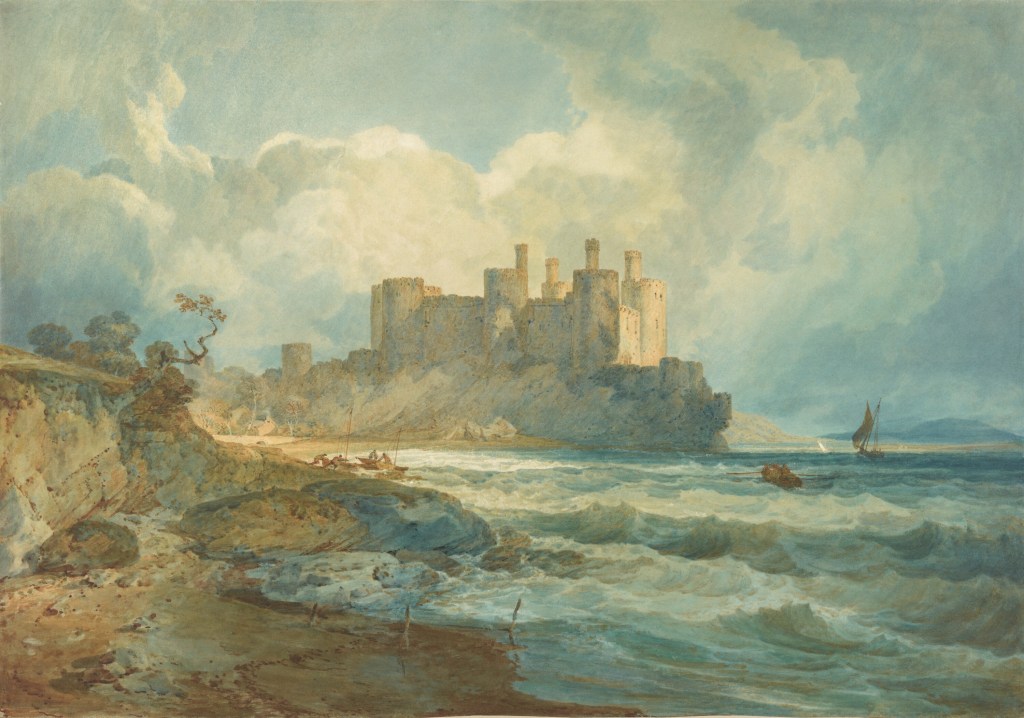
“Conway Castle, North Wales” as Painted by Joseph Mallord William Turner (1798)

Back in 1976, I visited Britain after making some money selling a script idea. One of the places I stayed was Betws-y-Coed, from which I could visit several beauty spots in North Wales. One of them was Conwy [sic] Castle. I was elated to see at the Getty Center J M W Turner’s rendition of Conway Castle, which is what the English called it.

The Getty website describes the painting:

On a dramatic, rocky area of the northern coast of Wales looms the late medieval Conway Castle. It towers over a stormy bay while fisherman struggle to pull their boats ashore. Caught in this uproaring of the sea, the tiny figures of fishermen in their boat convey a sense of humans’ barely significant place in the order of the universe.

The Welsh landscape exerted a strong hold on Joseph Mallord William Turner, and he made several sketching trips there in the 1790s. In this early Romantic painting, Turner represented the dramatic effects of natural light, allowing sunshine breaking through the clouds to illuminate the castle and the coast beyond.

The castle was built by Edward I—the evil king in Mel Gibson’s Braveheart played by Patrick McGoohan—between 1283 and 1287. It was one of a number of fortifications he built in his effort to subdue the Welsh. Here’s what it looks like today:

Conwy Castle Today

A Civilized Man

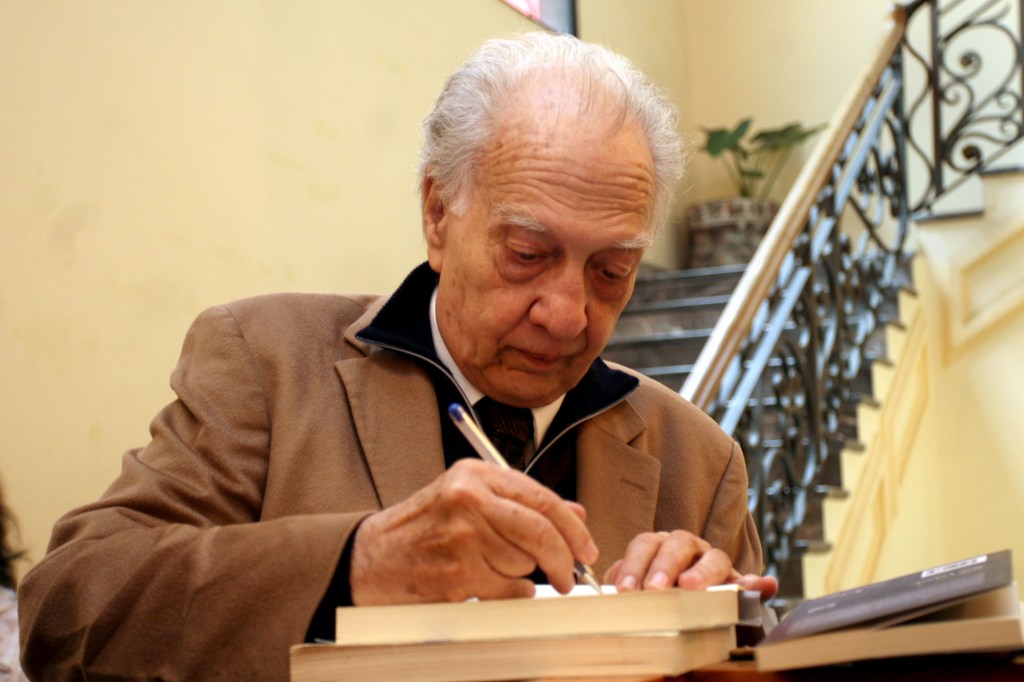
MƒEXICO D.F. 19 NOVIEMBRE2007.-El escritor Sergio Pitol, presento su nueva obra literaria que lleva como titulo “Trilog’a de la Memor’a” esto en la Casa del Refugio. FOTO: GUILLERMO PEREA/CUARTOSCURO.COM

Mexican author Sergio Pitol Deméneghi (1933-2018) was a man of the world. As a writer and diplomat, he traveled the world and wrote some fascinating books that were a curious mélange of literature, autobiography, and travel. The following is taken from his The Art of Flight.

[Italian philosopher] Norberto Bobbio offers a definition of the “civilized” man that embodies the concept of tolerance as daily action, a working moral exercise: The civilized man “lets others be themselves irrespective of whether these individuals may be arrogant, haughty, or domineering. They do not engage with others intending to compete, harass, and ultimately prevail. They refrain from exercising the spirit of contest, competition, or rivalry, and therefore also of winning. In life’s struggle [civilized men] are perpetual losers. […] This is because in this kind of world there are no contests for primacy, no struggles for power, and no competitions for wealth. In short, here the very conditions that enable the division of individuals into winners and losers do not exist.“ There is something enormous in those words. When I observe the deterioration of Mexican life, I think that only an act of reflection, of critique, and of tolerance could provide an exit from the situation. But conceiving of tolerance as it is imagined in Bobbio’s text implies a titanic effort. I begin to think about the hubris, arrogance, and corruption of some acquaintances, and I become angry, I begin to list their attitudes that most irritate me, I discover the magnitude of contempt they inspire in me, and eventually I must recognize how far I am from being a civilized man.

My Safe Spaces

Day of the Dead Celebration in the San Fernando Valley

Ever since my first visit to Mexico in 1975, I no longer felt myself superior to Mexican-Americans. It didn’t take long before I felt that way about African-Americans and Asian-Americans. My safe space was becoming larger with each year. Now when I encounter prejudiced white people, I don’t even regard myself as being white. In fact, I’ve always felt particularly safe thinking of myself as a Hungarian.

That is a bit of a joke, really, as I am only 25% Hungarian. I am also 25% Slovak, 25% Czech, and 25% Bavarian German. The only difference is that Hungarian was my first language, and I can still think in Hungarian.

At the Los Angeles Times Book Festival this past weekend, I enjoyed the work of three black poets (Roger Reeves, Courtney Faye Taylor, and D. Manuel II) and one Hispanic poet (Brenda Cárdenas). Oh, and don’t forget Eloise Klein Healy, a white poet from El Paso, Texas, whose courage impressed me so much (see yesterday’s post).

I was presented with multiple templates of Los Angeles, all of which I accepted—if not exactly as my own, still as plausible worlds understandable to me. Probably the scariest Los Angeles was that of Eloise Klein Healy, because she fought successfully against the horrors of encephalitis and aphasia and recovered her verbal skills as a poet.

My reaction to the paranoia of white supremacists like Tucker Carlson is to regard them as broken people who are unable to join in the incredible richness of other ethnicities.

LA Times Poets: Eloise Klein Healy

Former Los Angeles Poet Laureate Eloise Klein Healy

As I mentioned in my previous post, what I enjoyed most at the Los Angeles Times Book Festival were the poetry readings at the Poetry Stage sponsored by Small World Books of Venice. One poet that impressed me for her sheer cojones was the 80-year-old Eloise Klein Healy who clawed her way back from aphasia. Let the introduction to her poetry collection Another Phase tell the story:

You cannot understand what you hear or read. You cannot speak or write and be understood. Your use of language has been lost. You speak and write words in a nonsensical manner. You hear what people say, but it makes no sense.

Her post-aphasia collection entitled Another Phase consists of haiku-like five-line poems that discuss her triumph. Below is one of them, entitled “Another Phase,” which lends its title to the collection:

Another Phase

It’s hard for me to read the L.A. Times.
I want to relearn, to refine part of me.
How did my brain twist?
How did the whack of it phase me?
Every page. Every word blank.

The subject of her rehab in the world of poetry is also covered in a poem entitled “Problem”:

Problem

When first I wrote a poem,
I couldn't change anything.
Didn't plan to edit or write another.
“Brain fry” was my reality time.
Step two wasn't there yet.

What I learned from listening to Healy read her poetry and then reading the poems in Another Phase was the woman’s courage and persistence in the face of calamity. She is still a little unsteady on her pins, but I find her to be an inspiration to me. And that’s not something I say about a lot of people.