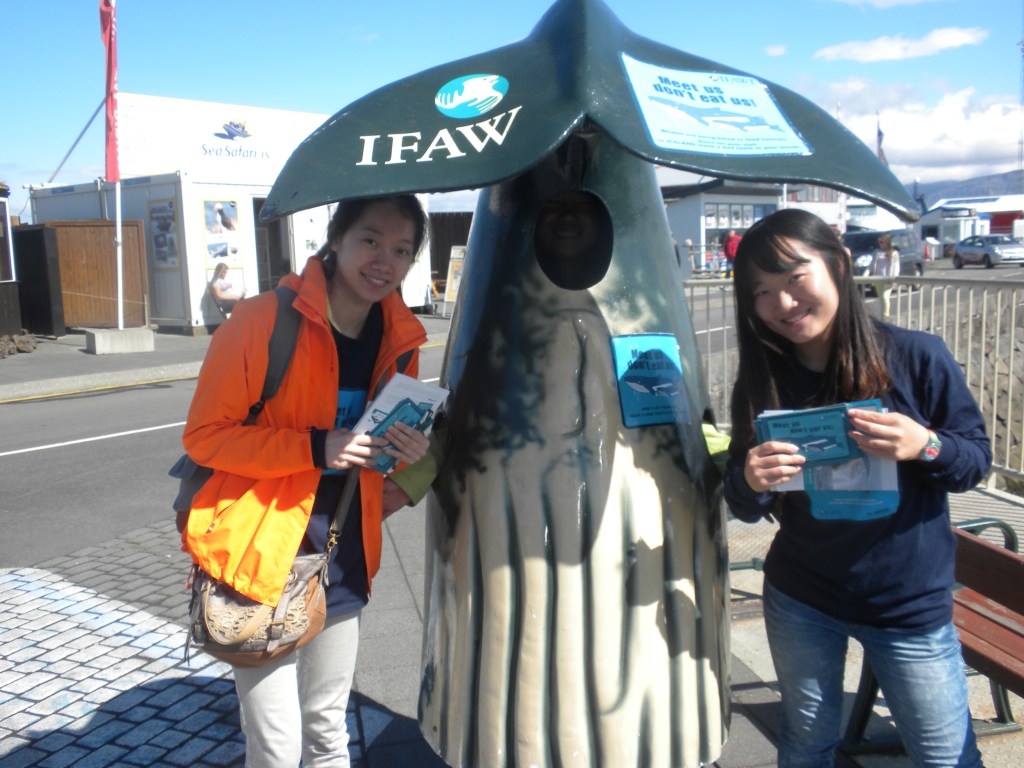
I had just landed in Iceland. Because I was eight hours ahead of Pacific Time (Los Angeles), I decided to hang out at Reykjavík Harbor for several hours and go to bed around midnight Iceland time. I was met by two cute Japanese girls who were collecting funds for the International Fund for Animal Welfare (IFAW), specifically to save the whales. At that time (2013), Iceland was one of two countries which hunted whales for food. The other was Japan.
In the U.S., only Native Americans are allowed to hunt whales, and the average number of kills is 300-500 Belugas and 40-70 Bowhead a year.
I was happy to contribute to the protection of the whales. And while I was in Iceland, I did not eat any whale meat, though I saw it in several markets.
Fortunately, I was able to keep my eyes open until 8 AM Los Angeles time and did not suffer from jet lag in the subsequent days. Flying back to California was, alas, a different story.
Poet and Publisher Lawrence Ferlinghetti (1919-2021)
Ever since I saw him speak at Dartmouth College in the early 1960s, I have admired Lawrence Ferlinghetti. I loved his poetry collection A Coney Island of the Mind. And I am fond of the books he has published under his City Lights Books imprint. I am currently reading his Writing Across the Landscape: Travel Journals 1960-2010, which also contains some poetry written during his travels, such as the following untitled piece:
La puerta escondida
	no está escondida
La puerta al invisible
	no está invisibile
The door to the invisible
	is visible
The hidden door
	is not hidden
I continually walk through it
	not seeing it
And I am what I am
And will be what I will be
Sobre las playas perdidas
	del Sur ....
The first four lines are translated in the poem. The last two lines read “On the lost beaches/Of the South.”
My first flight was in the summer of 1959—to Florida of all places. Way back around 1946-47, we had all lived in Lake Worth, now a suburb of West Palm Beach. My Dad had the worst job in the world for someone with a delicate stomach: disposing of the bodies of dead alligators. My Mom worked as a checker in a supermarket. So when Mom wanted to hook up with her Florida friends a dozen or so years later, my Dad wanted no part of it.
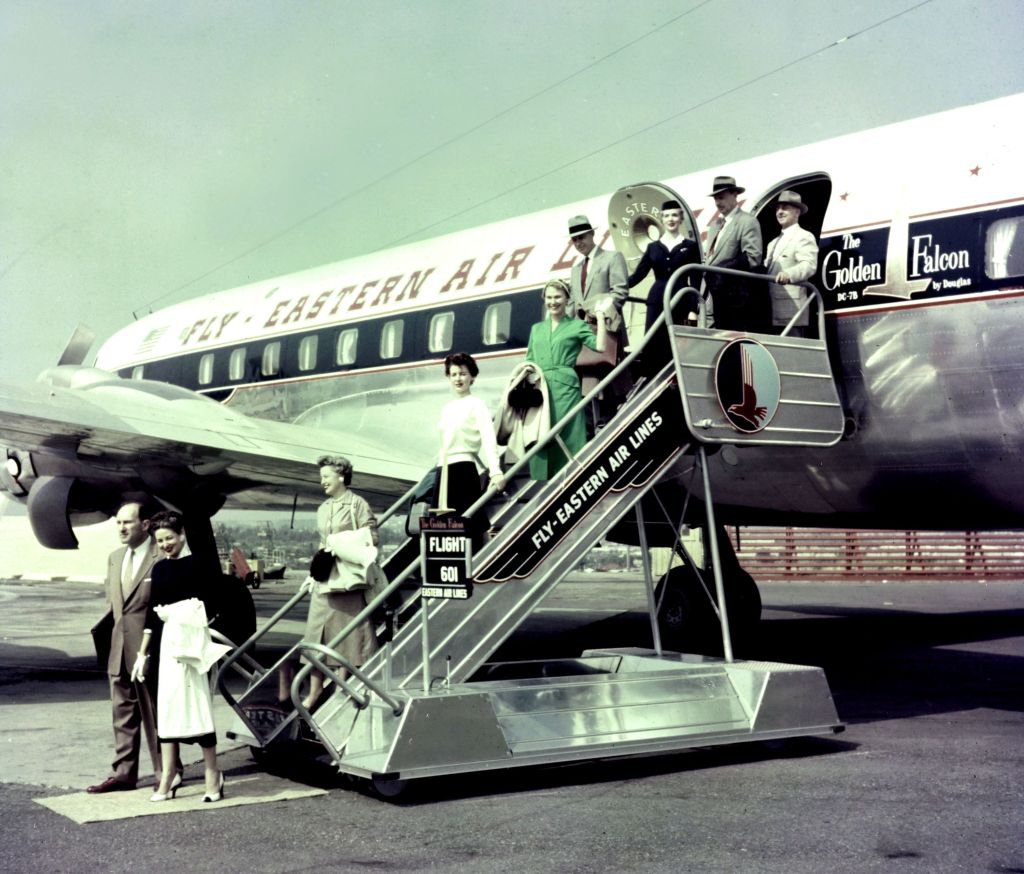
Wait a minute! Florida in the summer? Were we out of our minds? Apparently. It was either June or July, and Mom had made a reservation at an apartment on Federal Highway in Lake Worth. So Mom, my brother (then seven years old), and me (aged fourteen) were off to Cleveland Hopkins Airport, where we boarded a prop plane similar to the one shown above and flew to Jacksonville, where we landed to embark and disembark passengers, and continued on to West Palm Beach.
That second leg of the flight was a real doozy. We were flying at low altitude through a violent thunderstorm. I saw a stewardess lose her footing and dump a tray of beverages into the laps of a row of passengers.
Then, when we finally landed in West Palm Beach and stepped out of the plane, it was as if we were hit in the face with a hot, wet towel. Cleveland in the summer was humid, but nowhere near so bad as Florida. We sort of got used to it. We even got used to seeing dead palmetto bugs as big as mice piled up along the curbs.
Bookworm that I was, even at that early age, I remember vividly that I was reading Lew Wallace’s novel Ben-Hur, which I completed there and started reading MorrisWest’s The Shoes of the Fisherman. Good reading for a devout Catholic schoolboy, though I couldn’t stomach it today.
One interesting memory of that trip: My Mom had worked for a rich widow in Palm Beach named Mrs. Gregory. One day, we went to visit her. Mom always thought that some rich person would out of the goodness of her heart shower us with money and gifts. It never happened. Instead, we went for a ride in her chauffeured Cadillac with no air conditioning and the windows resolutely closed on a sweltering day. Afterwards, she generously offered us a glass of ice water.
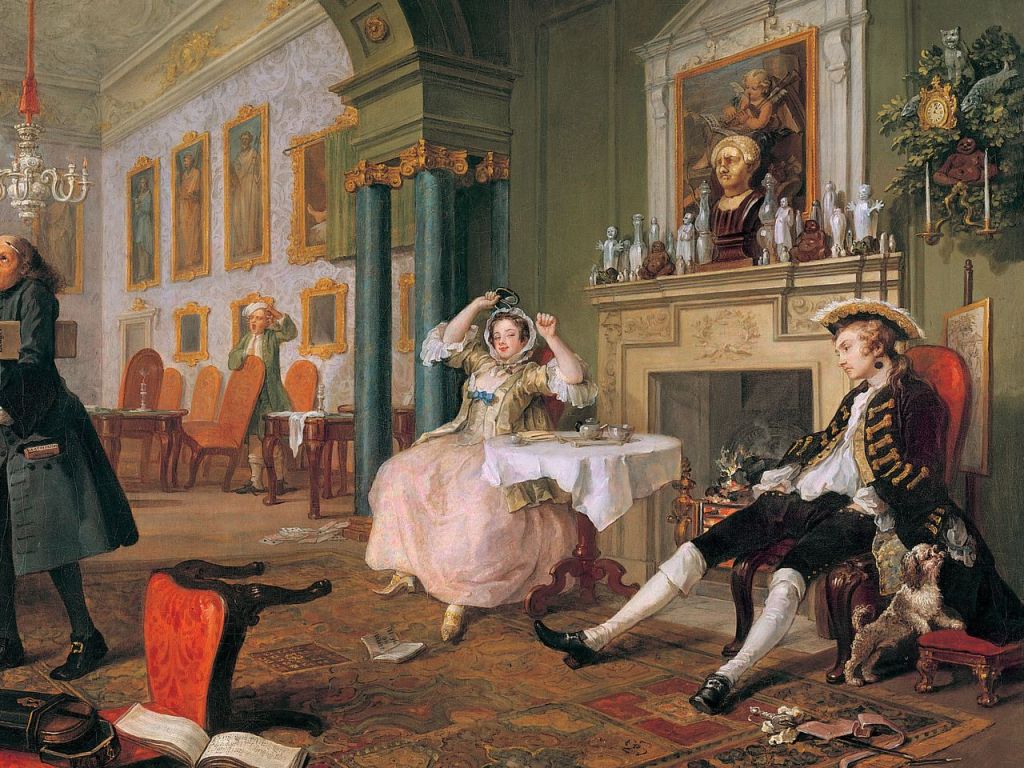
Detail from ‘The Tête à Tête,’ a painting from William Hogarth’s series ‘Marriage A-la-Mode’ (1743-45)
I have always had a love for Eighteenth Century Literature. It stems from the time I had a course in the novel of the period taught by my favorite professor at Dartmouth, the late Chauncey Chester Loomis. Swift not only wrote great prose, as vouched by Gulliver’s Travels and a slew of essays, but he was a formidable poet as well. The following poem gives us a feeling for the period in much the same way that James Boswell’s London Journal does.
A Description of the Morning
Now hardly here and there a hackney-coach
Appearing, show'd the ruddy morn's approach.
Now Betty from her master's bed had flown,
And softly stole to discompose her own.
The slip-shod 'prentice from his master's door
Had par'd the dirt, and sprinkled round the floor.
Now Moll had whirl'd her mop with dext'rous airs,
Prepar'd to scrub the entry and the stairs.
The youth with broomy stumps began to trace
The kennel-edge, where wheels had worn the place.
The small-coal man was heard with cadence deep;
Till drown'd in shriller notes of “chimney-sweep.”
Duns at his lordship's gate began to meet;
And brickdust Moll had scream'd through half a street.
The turnkey now his flock returning sees,
Duly let out a-nights to steal for fees.
The watchful bailiffs take their silent stands;
And schoolboys lag with satchels in their hands.
Kennel is a gutter or drain Brickdust Moll is a street vendor selling powdered brick, used for cleaning knives
My friends Alain Silver and Jim Ursini, whose many books on the subject are in my library, introduced me to the joys of film noir. In time, I decided to investigate the fiction from which these films were adapted. I was already familiar with the triumvirate of greats—Raymond Chandler, Dashiell Hammett, and James M. Cain—but I decided to dig further.
Of the novelists who wrote two or more books that I read were:
David Goodis: Black Friday, Down There (Shoot the Piano Player), Of Tender Sin, Dark Passage, The Moon in the Gutter, The Burglar, Nightfall, Cassidy’s Girl, and Street of No Return
Jim Thompson: Numerous titles, the best being The Killer Inside Me, Pop. 1280, After Dark My Sweet, and A Swell Looking Babe
Cornell Woolrich (aka William Irish): I Married a Dead Man and The Bride Wore Black
Charles Willeford: Pick-Up, The High Priest of California, Understudy for Death, The Burnt Orange Heresy, and the four Hoke Moseley novels
Robert Edmond Alter: Carny Kill and Swamp Sister
Then there is the category which I refer to as Oddities and One-Shots, people who were either famous for a single work or, if they wrote more, I only read one of their books. They include, in no particular order: W. R. Burnett (High Sierra); Don Carpenter (Hard Rain Falling), Elliott Chaze (Black Wings Has My Angel); Horace McCoy (They Shoot Horses, Don’t They); Kenneth Fearing (The Big Clock); William Lindsay Gresham (Nightmare Alley); Patricia Highsmith (The Talented Mr. Ripley); and Chester Himes (The Real Cool Killers).
Reading these books, one becomes painfully conscious that the streets of America are not paved with gold. Life is not necessarily a walk through the park—unless it is night and the forces of evil are lurking in the shadows.
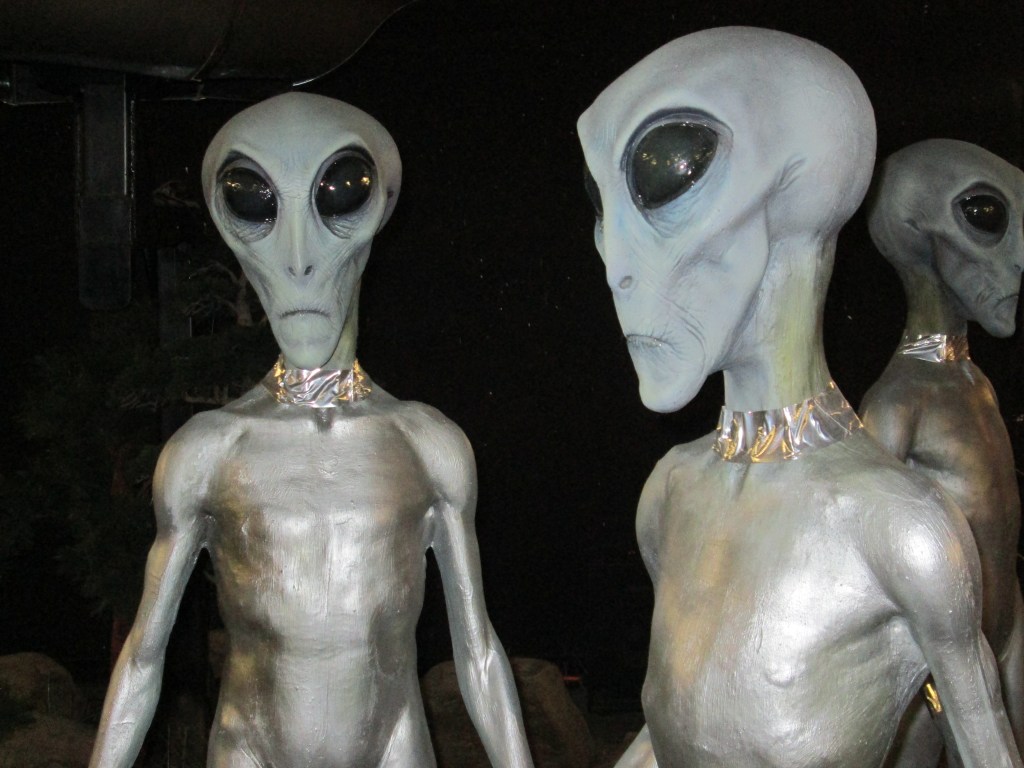
What happens to Christianity if space aliens from another world were to make contact with us? What would they made of the Garden of Eden, the Incarnation, the Crucifixion and a thousand other details that are part and parcel of Christianity? What are the chances that any of the space aliens would ever convert to Christianity?
In fact, all the major monotheistic religions would come across as quaint and primitive. That includes Judaism and Islam. The life experience of creatures from another world would be so radically different that they in turn would affect how (and whom) earthlings worshiped.
I do not necessarily believe that we will ever contact space aliens, but I do wonder what would be the result of such a contact. At worst, it would be like that famous Twilight Zone episode from Season Three of that show entitled “To Serve Man.” (At the end of the episode, it is revealed that the “To Serve Man” book the aliens carried was not an altruistic guide, but a cookbook!) At best, there is the movie The Day the Earth Stood Still (1951) with Michael Rennie’s Klaatu come to warn Earth that it is in danger of destroying itself.
Myself, I am more inclined to think of any space invaders as Conquistadores come to enslave the planet and mine it for its riches.
Over the last few decades, I have become quite blasé about my date of birth. I usually saw I was born on the thirteenth day of the thirteenth month (which is true, as the months wrap around). When asked for my astrological sign, I say, “No Trespassing.”
When you’re young, you get all kinds of cake and presents. When you’re my age, you just get measurably older.
Am I any wiser? Not really, I am probably a little more tolerant maybe up two percentage points. I have definitely noticed I am getting more crabby. (Those kids had better get off my lawn, STAT, or I’ll have to reach for my flamethrower.)
After what I went through with my brain tumor more than half a century ago, I never thought I would live this long. Even as a grade school kid, I looked forward to the year 2000 and thought, “Wow, if I live to that year, I’ll be fifty-five years old!” And to an eight-year-old, that seemed really O-L-D.
My father died at the age of seventy-four; and my mother, at the age of seventy-nine. Though I am minus a few body parts (pituitary gland, left hip), I am still surprisingly healthy. The joints are getting a bit creaky, but I can still walk. As for my mind, well let us speak respectfully of the dead.
I wonder, what kind of crap will I write when I reach seventy-nine?
It Baffled Einstein, But Suggests a Whole Different Outlook on the Universe
Einstein called it “spooky action at a distance” and quipped, “God does not play dice with the universe!” But apparently, He does. Mind-bending experiments have seemingly invalidated the speed of light (186,000 miles per second) when two protons shot in opposite directions sped away from each other at that speed. A measurement of one of the two protons affected the other one instantaneously, although theoretically communication between them was impossible. Here is one recent explanation by a physicist.
In the Wikipedia article on Quantum Entanglement, it says:
Measurements of physical properties such as position, momentum, spin, and polarization performed on entangled particles can, in some cases, be found to be perfectly correlated. For example, if a pair of entangled particles is generated such that their total spin is known to be zero, and one particle is found to have clockwise spin on a first axis, then the spin of the other particle, measured on the same axis, is found to be anticlockwise. However, this behavior gives rise to seemingly paradoxical effects: any measurement of a particle’s properties results in an irreversible wave function collapse of that particle and changes the original quantum state. With entangled particles, such measurements affect the entangled system as a whole.
Apparently some things in the universe are linked together in ways we do not yet understand.
At the same time, I think people are also similarly “entangled.” For example, I firmly believe one cannot avoid auto accidents without being able to make a good guess whether the other driver (whose face you have not seen) is going to cut in front of you. Unless I am distracted by conversing with a passenger, I am pretty good at “reading” traffic. How is that possible?
Then there is the whole question of presentiments of disaster which are proven to be true, There have been studies that people who have survived disasters had some foreshadowing of what was to occur. Does that mean that people are in some strange way entangled with events?
We are used to seeing people, things, and events as existing in separate “boxes.” What if some elements are in fact separate, and others are interlinked in ways we cannot foresee? Perhaps in future scientists will be able to describe how some of these entanglements work. Until then, we will just have to open our minds to a certain degree of strangeness. Which is probably a good idea in any case.
Here is one of my favorite dog poems. It is by Thomas Hardy, who is better known for his novels than his poetry. Wessex was the name of Hardy’s dog, and it is also the scene of his novels, such as Return of the Native and Tess of the Durbervilles.
A Popular Personage at Home
'I live here: "Wessex" is my name:
I am a dog known rather well:
I guard the house but how that came
To be my whim I cannot tell.

'With a leap and a heart elate I go
At the end of an hour's expectancy
To take a walk of a mile or so
With the folk I let live here with me.

'Along the path, amid the grass
I sniff, and find out rarest smells
For rolling over as I pass
The open fields toward the dells.

'No doubt I shall always cross this sill,
And turn the corner, and stand steady,
Gazing back for my Mistress till
She reaches where I have run already,

'And that this meadow with its brook,
And bulrush, even as it appears
As I plunge by with hasty look,
Will stay the same a thousand years.'

Thus 'Wessex.' But a dubious ray
At times informs his steadfast eye,
Just for a trice, as though to say,
'Yet, will this pass, and pass shall I?'
Today, I took Martine to her orthopedic appointment during a major rainstorm. By the time we left, Martine had replaced the punishing cast that tortured her right arm for the last six weeks with a smaller, more lightweight Ossür Formfit “Wrist Universal” manufactured in, of all places, Iceland.
That means that I am now free to leave Martine at home without worrying that she would be unable to perform some simple everyday task like tying her shoes, washing the dishes, and doing the laundry. That also means that I am no longer always on call to help her with those tasks.
Shortly after she broke her wrist late in November, I felt so stressed at having to double my household duties that I underwent an Addisonian Crisis early in December due to the fact that my body no longer produces adrenaline as I lost my pituitary gland years ago due to a tumor. As the month went on, however, I adjusted.
Fortunately, Martine now has the use of her right hand for everything but heavy lifting, at least for the next two weeks. And she could take baths again and wear regular clothes again. Because of the size of the cast on her right arm, she had to wear my shirts and jackets.
Of course, it will be some time before her right arm feels normal. It has been rigidly immobile for the last six weeks, and the fingers of her right hand are still a bit puffy from the pressure of the cast.







 Tarnmoor
You must be logged in to post a comment.