At Sea in 1949

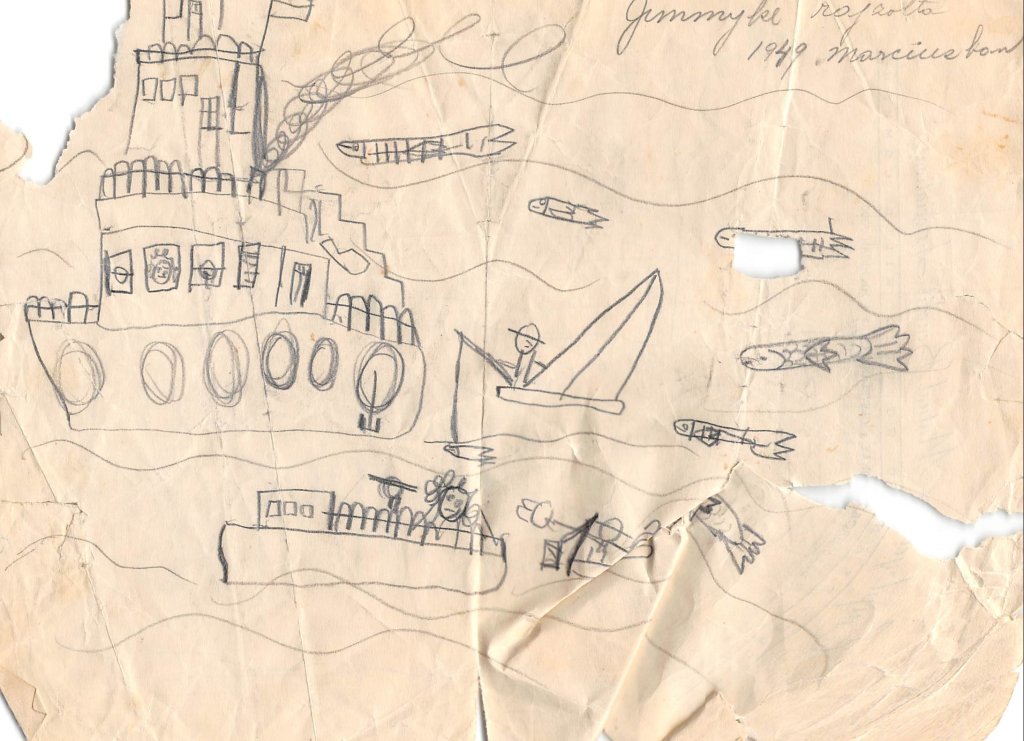
Boats and Fish Seen By Me at the Age of Four

It’s in execrable shape—but then, so am I—but here is a pencil drawing I made at the age of four. It is inscribed by my mother in Hungarian “Jimmy drew this in March 1949.” It displays an attention to detail surprising for a little boy who did not have access to television and who did not know a word of English. All I had were the stories my mother told me. Interestingly, she made them up herself most of the time. A lot of them involved fairy princesses and dark forests.

Then, too, there were the stories she read to me from library books. We would go together to the public library near Harvey Rice School (where I would go for kindergarten and half of first grade) and pick them out, mostly based on the pictures in them. My mother knew English: she was born in Cleveland, but taken back to Hungary to be raised. She would meticulously translate the selected stories from English to my little-boy Magyar tongue. (Magyar means Hungarian in the Hungarian language.)

At the time, we were living at 2814 East 120th Street in the Buckeye Road Hungarian neighborhood of Cleveland. For several blocks around, one could be born, live, and die without knowing a word of English. Not any more, of course. Eventually all the Hungarians moved out and it became a black ghetto. We moved out, too, in 1951, shortly after my brother was born.

Carnitas for My Birthday

Crispy Carnitas with Fresh Corn Tortillas. Yum!

Today I got taken out for my upcoming birthday. I had lunch with my brother and sister-in-law, my niece Jennifer, and her boyfriend John. I didn’t expect that birthday would be remembered—in fact, I haven’t given any thought to it at all. So it came as a pleasant surprise.

We were at the Kalaveras Restaurant in Redondo Beach. I was in the mood for a plato de carnitas with the pork slightly crispy. One of my favorite Mexican meals are home-made carnitas soft tacos with guacamole, hot sauce, and fire-roasted jalapeño chiles. The carnitas at Kalaveras came with cooked plantains and the usual beans and rice.

What with the conversation and the great food, I haven’t enjoyed myself half so much since Martine and I spent a week in Honolulu in September. Martine did not join us as she is still enduring the pain of a cast on her right arm after she broke two wrist bones late in December. She has a orthopedist appointment on Tuesday, so we’re both hoping the cast comes off, or is replaced with something less painful.

I don’t usually feel good about my birthday. In fact, I usually don’t feel anything about my birthday. Somehow, this year looks to be different.

The Januarius Budapest Trifecta

Having finished my jaunt to the decaying Roman Empire during the Visigothic invasions, I decided to read three books in a row written by Hungarian authors:

  • Vilmos Kondor’s Budapest Noir (2008), a first novel about a murder on the streets of Budapest.
  • Magda Szabo’s The Door (1987), a novel about the relationship between two women, a writer and a peasant.
  • Laszló F. Földényi’s Melancholy (1984), a history of melancholy through the ages.

As we begin 2023, I find the farther I get from my own Hungarian roots, the more at loose ends I feel. There is a figure in Greek mythology called Antaeus, about whom Wikipedia writes:

Antaeus would challenge all passers-by to wrestling matches and remained invincible as long as he remained in contact with his mother, the earth. As Greek wrestling, like its modern equivalent, typically attempted to force opponents to the ground, he always won, killing his opponents. He built a temple to his father using their skulls. Antaeus fought Heracles as he was on his way to the Garden of Hesperides as his 11th Labour. Heracles realized that he could not beat Antaeus by throwing or pinning him. Instead, he held him aloft and then crushed him to death in a bear hug.

Returning to my Hungarian roots is like Antaeus renewing himself by touching the earth. (If, however, I run into Heracles, I will pointedly avoid wrestling with him.)

So far, I am on schedule with my Januarius reading program.

Rome in Eclipse

An 1836 Painting Showing the Sack of Rome by the Visigoths in AD 410

I have begun reading Thomas Hodgkin’s magisterial Italy and Her Invaders in the Folio Society edition, which has been retitled The Barbarian Invasions of the Roman Empire. The first volume covers the Visigoths and the Empire as it was from the death of Julian the Apostate in AD 363 to AD 414.

We entertain a false picture of the Roman Empire during the Fifth Century. In the late Third Century, the Emperor Diocletian decided that, insofar as administration was concerned, the Empire was too big for one man to control. He decided to divvy it up into four pieces, creating the Tetrarchy.

By the reign of Julian, the four pieces consisted of Gaul (including France, England, and Spain); Italy (including Italy, Austria, Yugoslavia, and North Africa); Illyricum (including Greece, Macedonia, and Ukraine); and the Orient (including Turkey, Bulgaria, Syria, and Egypt). Note that Egypt, which was the bread basket of the Empire, now shipped most of its grain to Constantinople, leaving Rome high and dry.

In fact, after Diocletian’s Tetrarchy, the city of Rome began to decline. The co-emperor ruled from either Milan or Ravenna. Both cities were closer to the Alps and the routes the Barbarians would take in attacking the Italian Peninsula.

The other “capitals” were Constantinople for the Orient; Augusta Treverorum, or Trier, for Gaul; and Thessalonika or Sirmium for Illyricum.

When I cam across this line in Hodgkin’s first volume, I realized that by this time Rome was toast:

Strange to say, during the whole preceding century, Rome had only four times seen an emperor within her walls, Constantine (312) after his victory over Maxentius, Constantius (357) four years after the overthrow of Magnentius, and Theodosius (389) after his defeat of maximus, and again (394) after his defeat of Eugenius.

Once the Barbarians started invading in numbers, Rome was just too far away from the action. Days were wasted getting to the top of the boot of Italy. So when Rome was sacked by the Barbarians, they were largely attacking a symbol rather than a seat of power.

The End of HalloThankMas

Our End of Year Holiday Ordeal Is Now Over!

From the beginning of October to the end of the Tournament of Roses Parade is one unending holiday, which I call HallowThanksMas, but others shorten (not by much) to HalloThankMas. It’s supposed to be a time of family closeness, warmth, and happiness—but isn’t, not by a long shot.

This is why I love the whole idea of Festivus—a holiday for the rest of us—as introduced by the Seinfeld show in 1997. It consists of the following:

  • A vertical, unadorned aluminum pole
  • A Festivus dinner, during which there is an “airing of grievances”
  • In response to pushback from the diners, there are “feats of strength,” during which the whiners are wrestled to the ground
  • “Festivus Miracles” are easily explained coincidences

I actually like Halloween, though I never attend Halloween parties, nor would any of my friends be so unwise as to invite me to one. But Thanksgiving and Christmas could and probably should be replaced by something like Festivus. It’s cheaper, does not involve the consumption of dry birds, does not involve greeting cards or gifts, and airs out all the hidden aggressions behind the holidays.

Think about it.

Beginnings and Endings

My Januarius Project Is Named After the Roman God Janus

If you have been reading my blog for a long time, you may remember that I usually devote the month of January to reading writers I have never read before. According to one website:

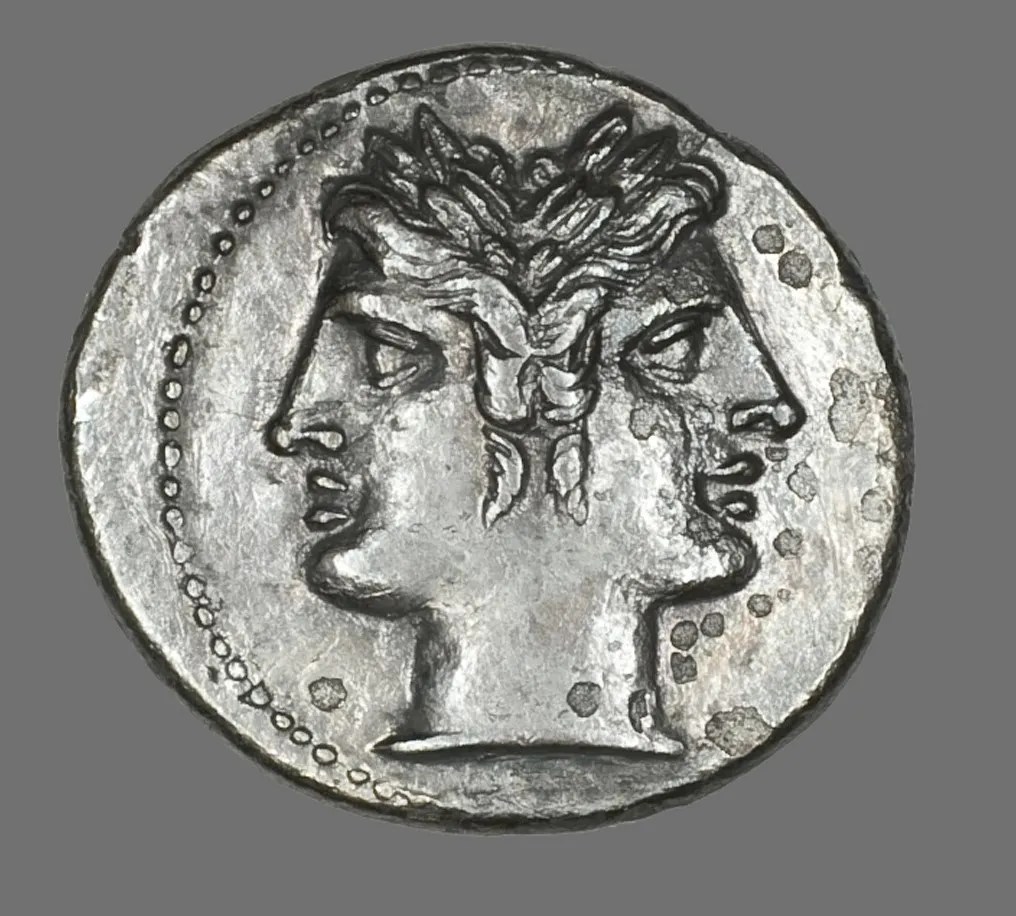
Janus presides over beginnings and endings, passages and transitions, doorways and gateways, whether physical entry points between home and the outside world, city and countryside, or invisible ones like the connection between human and divine through prayer. He was said to have invented coinage, and appears on a number of coins with his characteristic two faces.

In fact, I have started the month by beginning Thomas Hodgkin’s eight-volume The Barbarian Invasions of the Roman Empire (originally called Italy and Her Invaders). Volume I covers the Visigothic Invasion. I fully expect it will take a number of years to complete the 5,000 pages of Hodgkin’s magnum opus—perhaps even more years than I have left. In any case, I have made a beginning.

As it will take me upwards of a week to complete the first volume, I will hold off before telling you what other titles are in my To Be Read (TBR) pile.

The reason I do what I call the Januarius Project is to avoid letting myself get bogged down doing such things as reading the minor works of my favorite writers. I do not pretend to have discovered the best writers who have ever lived, and I probably never will, as many of them have never been translated into English.

One feature of the project for this year is to include some classical historians, such as Hodgkin, who wrote his series between 1870 and 1899. There was some great history written back then, such as John Lloyd Stephens on discovering Maya ruins, Samuel Prescott and the Spanish conquest of Mexico and Peru and Francis Parkman on the history of Canada to the French and Indian War and the opening of the American West.

Check back with me to see what I plan to read next.