The Cleveland Indians

Cleveland Municipal Stadium in 1993

They’re no longer called the Cleveland Indians. Now they’re called the Guardians, Guardians of what, I don’t know. I guess because you’re not supposed to call your team the Indians because of cultural appropriation, whatever that is.. But they’ll always be the Indians to me. My fraught relationship with them continued from the late 1950s to the early 1960s, when I left Cleveland to go to college.

The Cleveland Press, the cities Hearst-owned afternoon newspaper, got the bright idea of giving all straight-A students in the city seven pairs of baseball tickets, mostly to ill-attended afternoon games. As I could reliably get top grades every year after fourth grade, I got a lot of chances to see the Indians lose to a lot of teams. Except for 1959, when they almost won the American League pennant, but lost out to the Al Lopez’s Chicago White Sox,

On the team were such players as Rocky Colavito, Jim Piersall, Minnie Minoso, George Strickland, and Woody Held. Pitchers included Herb Score (before his career stumbled after he got hit in the face with a baseball), Jim “Mudcat” Grant, and Cal McLish.

Usually I went to the games alone or with a school friend, because my father was working as a machine tool builder at Lees-Bradner and Company. I would hop on the 56A bus at East 177th and Harvard and get off at Proispect and Ontario downtown. From there, it was a five or six block walk to Cleveland Municipal Stadium, which, as I understand it, is no more.

Just like my grade school (Saint Henry) and high school (Chanel High), which also are no more. Much of my history has been effectively wiped clean in the evil days that befell Cleveland around that time.

It was difficult as a child to follow a baseball team that usually lagged in the standings. But then, who has a 100% winning record? No one.
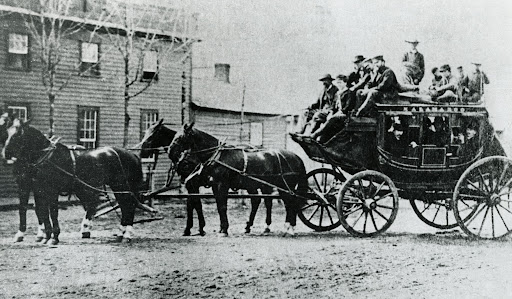
Three Journeys West, 1859

It was ten years before the completion of the transcontinental railroad in 1869. Just by chance, there were three notable journeys across the Plains to the West that year which were described in books that are still worth reading and readily available:

  • Mark Twain’s Roughing It is partly fictionalized but largely true, and it is still one of the funniest books ever written
  • Sir Richard Francis Burton’s The City of the Saints: Among the Mormons and Across the Rocky Mountains to California is mostly about a trip to visit Salt Lake City and Brigham Young, but includes the whole journey from East to West
  • Newspaper Editor Horace Greeley’s An Overland Journey from New York to San Francisco in the Summer of 1859 is not as well known but equally valuable

If you are interested in the history of the Western United States, these three books together constitute a priceless snapshot of what it was like in one particular year.

The Maldive Shark

Shark with Pilot Fish

Herman Melville is not known for his poetry, probably because he wrote it during an optimistic time in American history (i.e., after the Civil War) when his natural pessimism ran against the grain. Below is a poem that harks back to his years at sea aboard a whaler:

The Maldive Shark

About the Shark, phlegmatical one,
Pale sot of the Maldive sea,
The sleek little pilot-fish, azure and slim,
How alert in attendance be.
From his saw-pit of mouth, from his charnel of maw,
They have nothing of harm to dread,
But liquidly glide on his ghastly flank
Or before his Gorgonian head;
Or lurk in the port of serrated teeth
In white triple tiers of glittering gates,
And there find a haven when peril’s abroad,
An asylum in jaws of the Fates!
They are friends; and friendly they guide him to prey,
Yet never partake of the treat —
Eyes and brains to the dotard lethargic and dull,
Pale ravener of horrible meat.

El Dorado

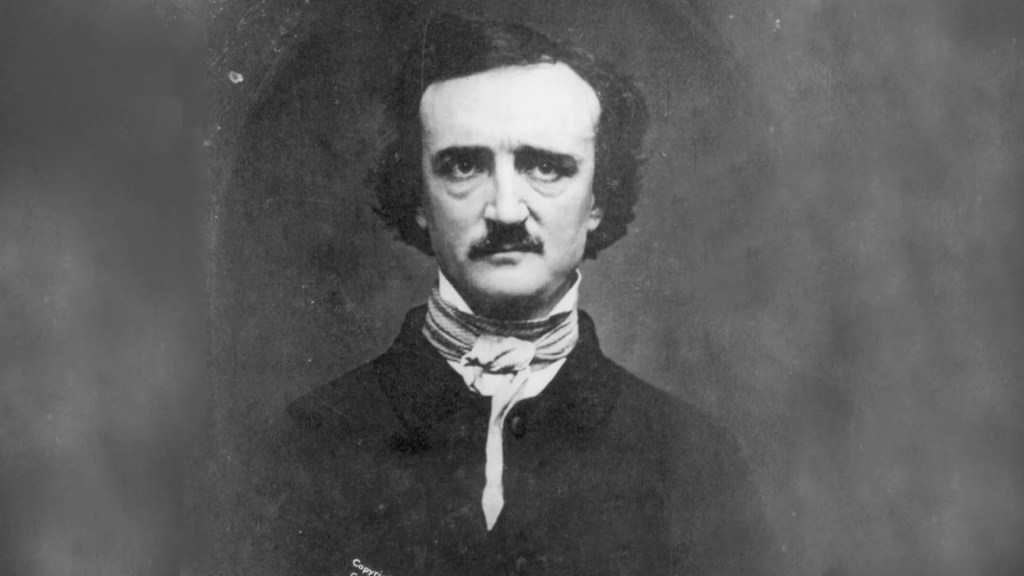
Edgar Allan Poe (1809-1849)

I am currently in the middle of the riches of Van Wyck Brooks’s The Times of Melville and Whitman (published 1947), devouring each chapter slowly, mining it for information on obscure 19th century American authors. I am even paying close attention to all the footnotes, in which I found this excerpt of a letter from Edgar Allan Poe to F. W. Thomas written on February 14, 1849. The subject was why Poe wasn’t interested in joining the Gold Rush:

Talking of gold and temptations at present held out to ‘poor-devil authors,’ did it ever strike you that all that is really valuable to a man of letters—to a poet in especial—is absolutely unpurchasable? Love, fame, the dominion of intellect, the consciousness of power, the thrilling sense of beauty, the free air of heaven, exercise of body and mind, with the physical and moral health which result—these and such as these are really all that a poet cares for—then answer me this—why should he go to California?

In fact, Poe wrote a poem on the subject:

Eldorado

Gaily bedight,
A gallant knight,
In sunshine and in shadow,
Had journeyed long,
Singing a song,
In search of Eldorado.

But he grew old—
This knight so bold—
And o’er his heart a shadow
Fell as he found
No spot of ground
That looked like Eldorado.

And, as his strength
Failed him at length,
He met a pilgrim shadow—
“Shadow,” said he,
“Where can it be—
This land of Eldorado?”

“Over the Mountains
Of the Moon,
Down the Valley of the Shadow,
Ride, boldly ride,”
The shade replied—
“If you seek for Eldorado!”

If the poem sounds vaguely familiar, it was quoted in its entirety in a Howard Hawks Western made in 1967 called, suitably enough, El Dorado. The film starred John Wayne, James Caan, and Robert Mitchum.

The Sun King

Jean-Loup Bitterlin of El Rey Sol with My Brother Dan

One final word about our trip to Ensenada, by way of a coda. We were amazed to find on Lopez Mateos a high quality French restaurant, that despite the fact that Ensenada has no shortage of good food. We were staying around the corner at the hotel affiliated with the Restaurant El Rey Sol, namely the Posada el Rey Sol. (The name refers to Louis XIV, France’s Le Roi Soleil, or Sun King.)

Dan and I were spending our last night in Baja, and we were all glorious tacoed out; so we decided to try for a nice French meal. It was a whole lot better than nice; in fact, it was outstanding. We started out with an appetizer of beef carpaccio, which was accompanied by an amuse-bouche that resembled a French bruschetta with cheese and a delightfully creamy sopa de verduras (vegetable soup).

As his main course, Dan ordered the Chicken Cordon Bleu, and I had the Linguine Neptuno (with assorted super-fresh mariscos). With it, Dan tried a glass of Guadalupe Valley Nebbiolo red wine, while, ever the proletarian, I had a Dos Equis (XX) beer.

A Plaque Outside the Restaurant Honoring Its 50th Anniversary

A meal like this in the United States would run at least a couple hundred dollars. We wound up paying around $70.00 in pesos. The sad thing is that the equivalent meal in the States would not necessarily be as tasty or fresh as what we had.

All I can say after the best meal I’ve had in several years, Vive la France—en Mexique!

Stateside

The Long Wait at El Border

Last Thursday, Dan and I left Ensenada just as the cruise ship Navigator of the Seas was just disgorging the thousands of bandy-legged passengers who shortly would be wandering the streets in search of one of them there cervezis. It was as if we had Ensenada to ourselves, and just when it would become crowded with noisome boat people, we were out of there.

The drive back to Tijuana was uneventful. The wait at the San Ysidro Port of Entry to the United States took about ninety minutes, which was nowhere as long as the three- and four-hour waits of which I had heard—but those were probably on weekends. Still, it was no fun waiting with multiple lines of cars idling in line while kamikaze vendors tried desperately to make a sale. The only sale they made from us was one sawbuck to use a tiny bathroom that had no lighting. I didn’t know whether I was urinating in a toilet, a bucket, or my shoes.

One of the items for sale at the border were plaster statues of Donald Trump and outgoing Mexican President Andrés Manuel López Obrador. I guess there hadn’t been sufficient time for plaster statues of Kamala Harris or Claudia Sheinbaum, the new Mexican President, to be cast.

I dropped my brother off at the lot where his truck was parked for his drive back to the Coachella Valley and hopped onto I-805 for the four-hour ride back to my apartment in West Los Angeles.

La Bufadora

The La Bufadora Blowhole South of Ensenada

There aren’t really too many tourist sights near Ensenada, unless you feel you must include Hussong’s Cantina on the list. Neither Dan nor I wanted to visit that particular institution, however, so we drove south to the Punta Banda Peninsula 17 miles (27 km) south of Ensenada.

According to Wikipedia:

La Bufadora is often considered a marine geyser, however, it does not have a thermal source or cause, as geysers do. In this case, the spout of sea water is the result of air, trapped in a sea cave, exploding upwards. Air is forced into the cave by wave action and is released when the water recedes, ejecting water up to 100 ft. [30.5 meters] above sea level. This interaction not only creates the spout, but a thunderous noise as well.

The interval between eruptions is fairly constant, and matches the dominant swell, confirming that the activity at La Bufadora is determined by surface ocean waves. Between 2005 and 2011 the recurrence between eruptions was between 13 and 17 seconds.

La Bufadora is one of the largest blowholes in the world.

Normally, on a busy day, visitors must run the gauntlet from the parking lot to the blowhole, bypassing a slew of souvenir stands, food vendors, highly suspicious pharmacies, and bars. But, as we were there on a day when there were no cruise ships in the Port of Ensenada, most of the businesses were closed. On the day after, I am sure the place was hopping.

La Bufadora Between Upswells

In a word, La Bufadora was an interesting place. I did get tired of telling importunate vendors on the way to the blowhole, however, that I was a cheap bastard and wasn’t interested in souvenirs.

Mercado Negro

At Ensenada’s Seafood Market

It is generally referred to as the Mercado Negro, the Black Market. Not because its contents are smuggled in illegally, but because the market used to be on the dingy side. In yesterday’s post, I mistakenly referred to it by the name Mercado de Pescados. Actually, it is more properly called the Mercado de Mariscos.

I love visiting Latin American seafood markets. Perhaps the most impressive I have ever seen is the one in Puerto Montt, Chile—mainly because so much of what was on display was totally unknown and strange to me. That was not the case in Ensenada.

As my brother and I wandered down the aisles looking at the seafood on offer, one enterprising young salesman suggested I buy one of the large fish and have one of the local restaurants prepare it for me. I had this picture of myself hauling a smelly and dripping 10 pound (4.5 kg) salmon from one restaurant to another begging they would take it off my hands and filet and cook it for us. Nice try, kid!

Given all the seafood stands and restaurants in Ensenada, I was surprised that the mercado de mariscos was so small, but then Ensenada is flanked by a number of small fishing villages which probably also supply it. Some of these villages, like Puerto Nuevo and Popotla, have developed reputations of their own for seafood.

Street Grunting

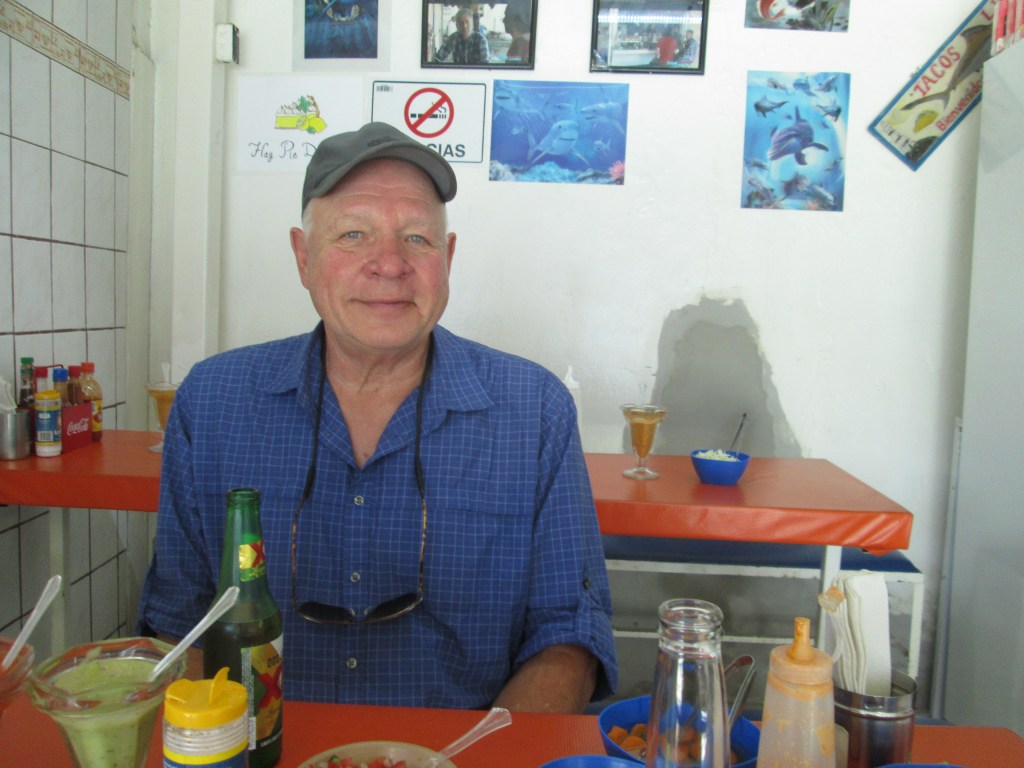
My Brother Dan at Lily’s Tacos in Ensenada

The city of Ensenada is full of fascinating street carts and little hole-in-the-wall restaurants specializing in fish and shrimp tacos and other seafood dishes. The first one we went to, Lily’s Tacos, is right by the Mercado de Pescados (aka the Mercado Negro). It was visited by Anthony Bourdain on a show in his “Parts Unknown” TV series. In fact, there is a picture of Bourdain on the wall behind my brother’s hat.

I had two fish tacos and a Corona. As is the custom, we were given the warm corn tortilla with a plain piece of lightly breaded fish. In front of us were various salsas, crema, pickled onions, chiles en escabeche, shredded cabbage, salt, and other condiments that we spooned onto the fish tacos. We were in hog heaven.

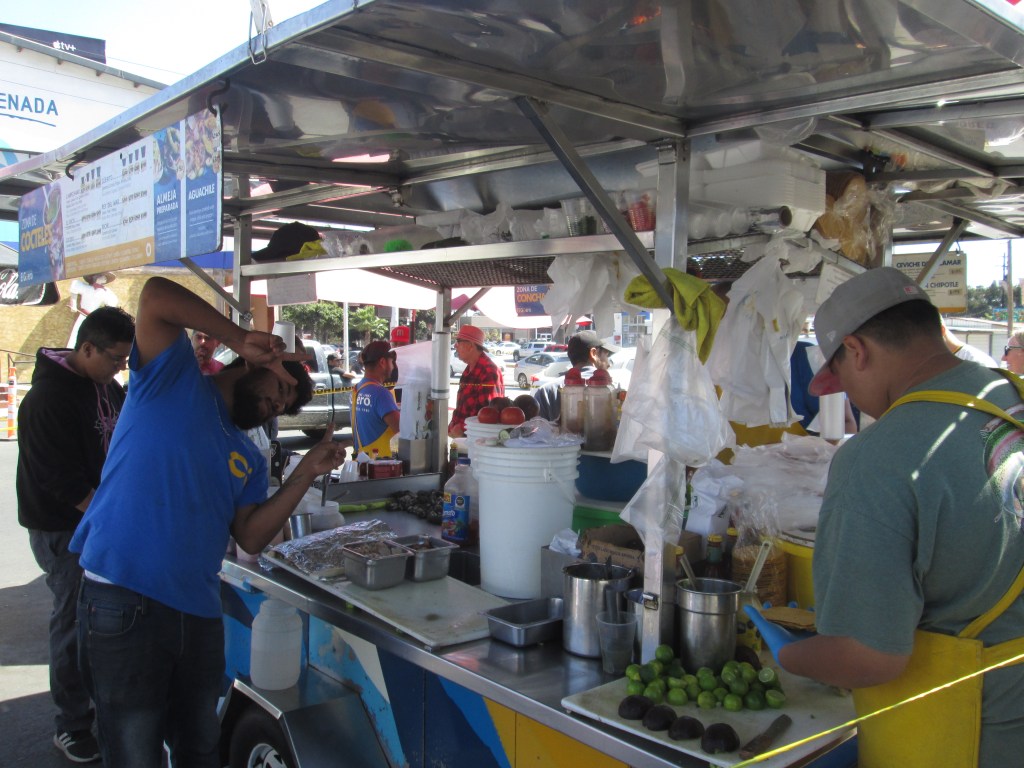
Guero’s, Another Fish Taco Vendor

Whereas Lily’s Tacos had a few tables for customers, many of the taco stands were for standees only, such as Guero’s and Fenix. I tended to prefer sit-down places, as I had to take medications with my meals, including a shot of insulin.

Dan and I actually did go to Ensenada mainly to eat fish tacos, and we were not disappointed in our quest. Fish tacos in the U.S, usually are too heavily breaded, made with frozen fish old enough to vote, and minus the rich condiments that made an Ensenada fish taco a culinary treat. Yes, I mean you, Rubio’s Fish Tacos. May you shrivel up out of shame!

Mexico has a rich tradition of street grunting. Don’t feel like a heavy meal? Just get a taco or a quesadilla or chicharrones or carnitas or a tostada. It won’t set you back too much; and it can be an amazing treat. Of course, you have to be able to judge which carts are good and which are unsanitary traps. One easy method: Check out the number and type of customers waiting in line.

Fortunately, all the places we tried in Ensenada were strictly A-1.

Back from Ensenada

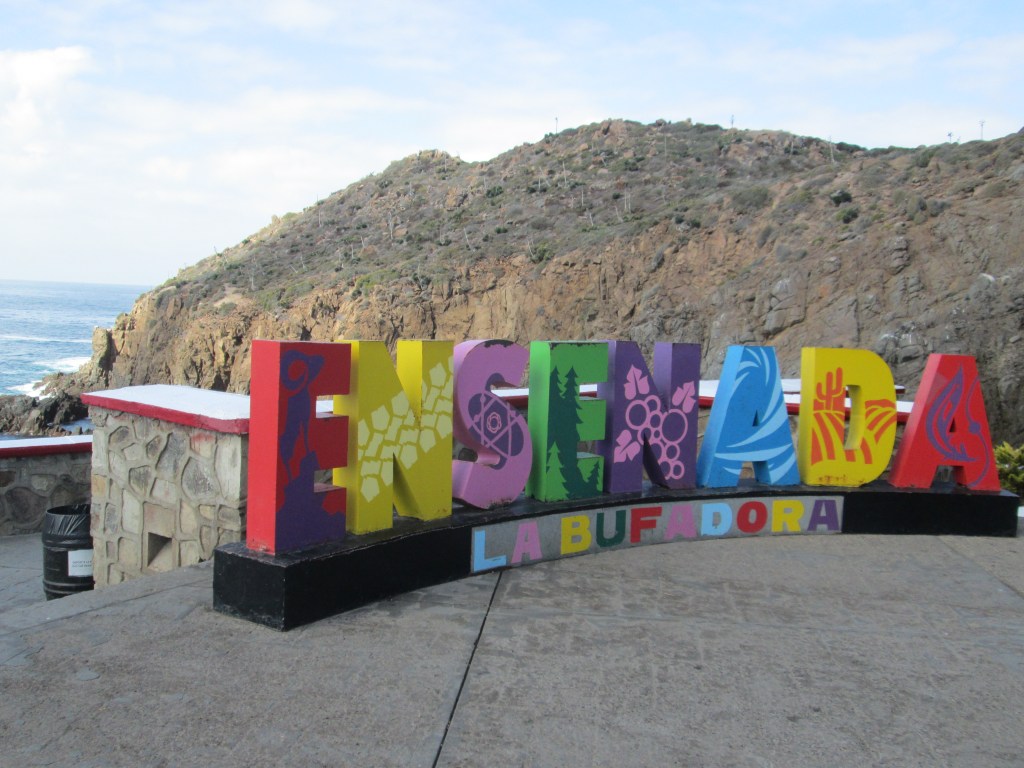
Ensenada Sign at La Bufadora

Yesterday afternoon I returned from Ensenada, where I spent a couple of days with my brother Dan. Unfortunately, the long drive left me with a bit of a sore throat, which I fought by sucking Ricola lozenges. It made me think that I have to scale down some of my travel ambitions, as I am no longer as young as I used to be. But that doesn’t mean that I am falling out of love with travel: It just means I have to do everything more slowly, in stages.

I met my brother in front of one of the San Ysidro parking lots by the border crossing. He drove down I-15 from the Coachella Valley, while I took the I-405, the I-5, and the I-805. Because of heavy traffic and several accidents on the highway, it took me four hours to reach the border.

At that point, Dan took the wheel to cross the border and take the scenic 1-D Quota Road past Rosarito Beach to Ensenada. I was relieved to be just a passenger for that final leg of the trip, as driving in Mexico could be a challenge.

Fortunately, the weather on Tuesday and Wednesday was perfect: breezy and in the low 70s Fahrenheit (21 to 26° Celsius). For some reason there weren’t many American tourists in town, so it felt as if we had the whole place to ourselves. We were surprised to see that a lot of the businesses were closed, until we realized that most of the Yanqui invaders came from cruise ships like The Navigator of the Seas and various Carnival Cruise liners. In fact, only as we were leaving town yesterday morning did we see a liner loosing boat people on the streets of Ensenada.

For the next few days, I will describe in some detail about what we did, what we ate (hey, we went down there for fish tacos—and we were not disappointed), and what we saw.