The Borgo Pass at Midnight

I have always loved the beginning of Tod Browning’s Dracula (1931). It shows Renfield (Dwight Frye) arriving at a Transylvanian village late in the evening at Walpurgis Night, when witches and evil spirits hold sway. Everybody is bemoaning that fact in Hungarian. As a Hungarian-American,I always had a fondness for that scene—rather than for the, I thought, less interesting events in England in the vicinity of Carfax Abbey.

Today I saw bits and pieces of the two original Universal horror classics—Dracula and Frankenstein (both 1931)—on Turner Classic Movies (TCM). There altogether too many large rooms in which too many people, many of them in formal evening attire, confronted one another. I was much happier with James Whale’s The Bride of Frankenstein (1935), which was a much better film than Whale’s original Frankenstein.

I suppose that, in the deepest days of the Great Depression, people had a yearning for actors with British accents dressed in tuxedos. I’ve always thought it was a bit silly.

Still, there were those scenes in which Renfield is working his way to Castle Dracula. They are forever etched in my mind.

Vladimir Ivanovich Leventon

Lobby Card for Val Lewton’s The Cat People (1942)

This is a re-post from October 20, 2022. I have just sat through four films directed by Jacques Tourneur on Turner Classic Movies (TCM), three of them produced by the great Val Lewton. He is the only producer who deserves to be called great. Most of the others are impediments to greater or lesser degrees.

There are horror films, and there are horror films. They can scare you out of your wits, like Curse of the Demon (1957) and Poltergeist (1982), or they can make you understand that the world is both light and dark in equal measure, like Val Lewton’s great films of the 1940s, such as The Cat People (1942).

Val Lewton, born Vladimir Ivanovich Leventon in Yalta, Russia, was interested in making low budget films to compete with Universal Pictures’ highly successful Frankenstein, Dracula, Mummy, and Wolf Man franchises. The title for The Cat People was assigned to Lewton by RKO, and Lewton went to work on a psychological thriller in which there is no overt violence. Perhaps the greatest scene takes place in a swimming pool in which a young woman is swimming all by herself at night. In the shadows, we imagine there is a black panther, but neither the swimmer nor we the viewers are absolutely sure.

Even though Halloween is just about over, I highly recommend all the following Lewton films:

  • The Cat People (1942)
  • I Walked with a Zombie (1943)
  • The Leopard Man (1943)
  • The Seventh Victim (1943)
  • The Ghost Ship (1943)
  • The Curse of the Cat People (1944)
  • The Body Snatcher (1945)
  • Isle of the Dead (1945)
  • Bedlam (1946)

All are great films worthy of being seen multiple times. They are short, thoughtful, extremely moody, and highly successful. Also available is a Turner Classics biopic about Lewton’s career called Shadows in the Dark narrated by Martin Scorsese. Martine and I watched it last night and recommend you see it.

In all of Hollywood’s history, Lewton was probably the only film producer who controlled his products as if he were the director. Even though Lewton directorial protegés Jacques Tourneur, Robert Wise, and Mark Robson went on to have brilliant careers, when one is watching a Lewton film, one recognizes it as a Lewton film.

Autumn Heat

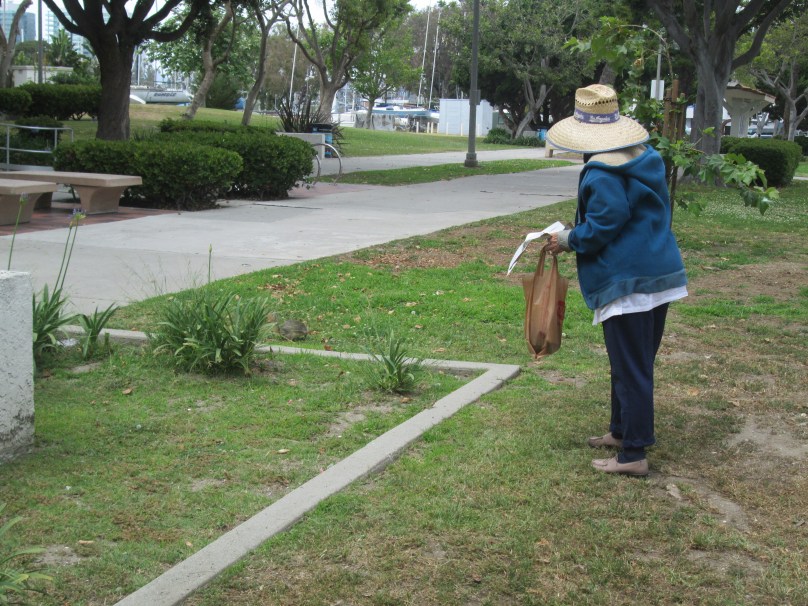
Martine at Chace Park in the Marina

Predictably, we are in the middle of an autumn heat wave. No, I did not go to Chace Park today. This time of year, the wind blows hot air from the desert; so there is little to be gained waiting for sea breezes that are not likely to cool my brow.

Martine went downtown by herself to partake of the high-toned atmosphere around Union Station and the Civic Center. (Am I being ironic? To be sure I am being ironic.)

Tomorrow I may go downtown, though I may bail if the temp gets too high, like 95° degrees Fahrenheit (35° Celsius) or above. That walk from the Metro Rail 7th Street Station to the Central Library would be prohibitively hot. I will check the temp tomorrow morning before making my decision.

I have become very dependent on the weekly Mindful Meditation sessions at the Central Library. Then, too, there are those seven floors of books that draw me in.

Visiting the Equator

The Yellow Painted Line Is Supposedly the Equator

In November 2016—a time of evil omen for the United States—my brother Dan and I visited Ecuador. One of our destinations was latitude zero, the line of the equator. The Ecuadorians built a big park with museums. a planetarium, and restaurants at a place they called La Ciudad Mitad del Mundo—“Middle of the World City.” The line of the equator was as it was defined by scientists in the 18th century.

The only problem was that the actual equator line is some 250 meters to the north of Middle of the World City. But this was not determined until GPS was invented.

Dan and I didn’t much care that the Middle of the World City was slightly misplaced. It was a nice park, and the real equator line didn’t have as big a budget. So it goes.

Dan Paris with the Equator Monument in the Background

It’s always a tricky business to identify the location of the poles, the tropics, as well as the equator. Did you know, for instance, that because the earth is not a perfect sphere, if one were to identify the tallest mountain on the planet based not on its height from sea level, but from an imaginary point at the center of the earth, the tallest mountain would not be Everest but Ecuador’s own Mount Chimborazo? Don’t believe me? Check out this website from the National Oceanic and Atmospheric Administration.

Bad Weather Ahead

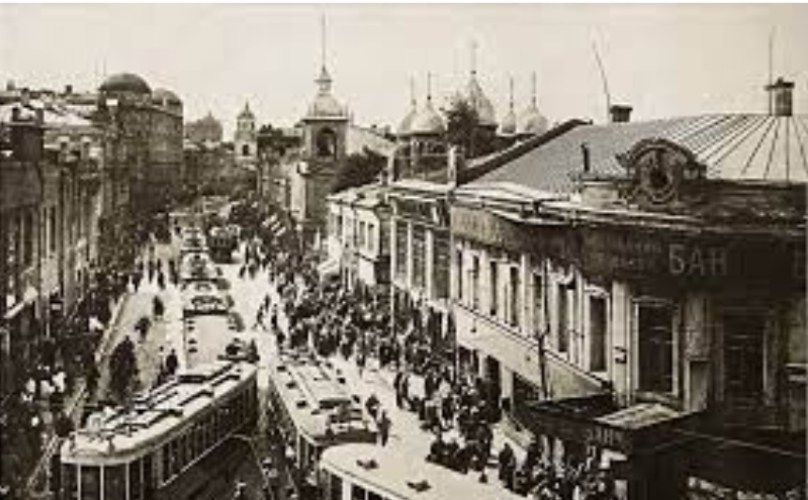
Moscow in the 1920s

Sigizmund Krzhizhanovsky (1887-1950) was a Soviet writer who, in his own words, was “known for being unknown.” Hopefully, that will no longer be true as New York Review Books releases more of his stories. I have just finished reading his Autobiography of a Corpse, which contains a prescient 1939 story titled “Yellow Coal.” Tell me if the first paragraph of the story, quoted below, reminds you of our present situation:

The economic barometer at Harvard University had continually pointed to bad weather. But even its exact readings could not have predicted such a swift deepening of the crisis. Wars and the elements had turned the earth into a waster of its energies. Oil wells were running dry. The energy-producing effect of black, white and brown coal was diminishing yearly. An unprecedented drought had swaddled the sere earth in what felt like a dozen equators. Crops burned to their roots. Forests caught fire in the infernal heat. The selvas of South America and the jungles of India blazed with smoky flames. Agrarian countries were ravaged first. True, forests reduced to ashes had given place to ashy boles of factory smoke. But their days too were numbered. Fuellessness was threatening machines with motionlessness. Even glacier snow-caps, melted by the perennial summer, could not provide an adequate supply of waterpower; the beds of shrinking rivers lay exposed, and soon the turbine-generators would stop.

Samhainophilia

The Winner: Most Popular and Guilt-Free Holiday

There is a such a word as samhainophobia, which means hatred of Halloween. By applying the principal of parallelism, there must be such a word as samhainophilia, meaning love of Halloween. According to Wikipedia:

Samhain is a Gaelic festival on 1 November marking the end of the harvest season and beginning of winter or the “darker half” of the year. It is also the Irish and Scottish Gaelic name for November. Celebrations begin on the evening of 31 October, since the Celtic day began and ended at sunset. This is about halfway between the autumnal equinox and winter solstice. It is one of the four Gaelic seasonal festivals along with Imbolc, Bealtaine, and Lughnasa.

We don’t celebrate Imbolc, Bealtaine, or Lughnasa very much any more; but Samhain, or Halloween, is continue to grow more and more popular. Think about it: There isn’t any guilt associated with buying a few bucks worth of candy and giving it to kids. On the other hand, you have to cook up a huge complicated feast for Thanksgiving and pretend to be nice to all your most objectionable relatives.

And don’t even get me started about Christrmas! You have to kill a tree, decorate it with expensive ornaments, buy expensive gifts for everybody, and do all the same stuff required for Thanksgiving, except maybe you don’t have to serve turkey at your holiday feast.

Then there are all those other holidays: You have to set off an explosive on Independence Day, blowing off a finger or limb. You have to get drunk and endanger your marriage at a New Years office party. And so on and so on.

Heck, I’ll take the candy any day.

The above photo was taken at Los Angeles’s Grier Musser Museum of Victoriana. Martine and I spent a pleasant afternoon visiting the museum owners, Susan and Rey Tejada, who live on the premises. They have an impressive collection of holiday-related books, animated displays, and figurines. I spent over an hour looking at 3-D First World War images on a stereopticon. They also have a great collection of pop-up books of every description.

Temperate Rainforest

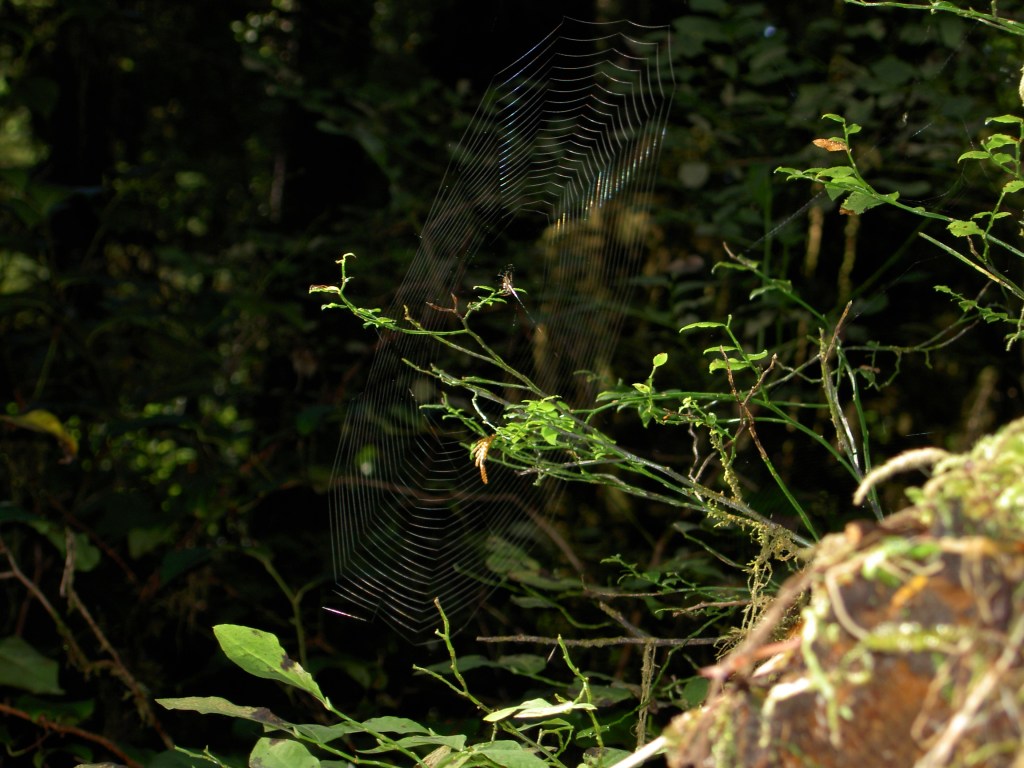
Forest Near Tofino on Vancouver Island, BC

Until I saw it with my own eyes, I did not know there was such a thing as a temperate rain forest. They are relatively rare, but you can find them in the Pacific Northwest and even in the Eastern Appalachians. Basically, they have an average temperature range between 39° and 54° Fahrenheit (4° and 12° Celsius) and are characterized by annual precipitation over 50 inches, dense canopies, and a proliferation of ferns, lichens, and mosses.

My encounter with one such temperate rain forest was close to the Vancouver Island town of Tofino. I was able to take a guided hike through it and take pictures.

Notice the Large Spider Web

Walking through the woods, I was reminded of my mother’s made-up fairy tales, which were always set in a sötét erdő (dark forest) and involved a tündérléány (fairy princess). I was walking not only through an actual forest but the land of my childhood dreams.

I Didn’t Like L.A. at First …

Downtown Los Angeles 2011

It took a few years for me to get to like Los Angeles. I had grown up in Cleveland, Ohio—nobody’s idea of a beautiful city. I was used to red brick buildings overlaid with grime, along with hot humid summers and unrelievedly grim winters. My first opinion of Southern California was, “This place just isn’t real!”

Oh, it was real all right. After enduring earthquakes and floods and smog and wildfires, I saw that L.A. had its own demons, which were more intermittent. (In Cleveland, they were pretty constant.)

When I was in college trying to decide where to go to grad school to study film history and criticism, I remember reading a snide book (whose title I forget) about a state whose residents were called Procals (short for Pro-California) whose residents endlessly plugged their state as “God’s country.”

The part that sticks in my mind was the description of the Pacific Coast Highway as it followed the coast north from Santa Monica. Anyhow, the highway was always being covered with destructive landslides. Well, now I live a scant two miles from that road. It is incredibly beautiful, but I haven’t the heart to drive it ever since the January wildfire that destroyed Pacific Palisades. Too many of my favorite places have been burned to a crisp.

Am I a Procal? No, not at all. There are too many people in Southern California. Too many of the recent arrivals are homeless people who live in tents pitched any which way on sidewalks, surrounded by piles of trash. They have taken a lot of the shine off Los Angeles. I still love the place, but I am all to conscious that no place ever remains the same over the decades.

Potato and Spinach Curry

Vegetarian Potato and Spinach Curry

After cooking a bland mushy dish for Martine—at her request—I had a sudden urge to make something hot and spicy. A simple and tasty vegetarian dish is a potato and spinach curry. Here are my cooking instructions:

  1. Pour several tablespoons of sunflower oil into a cooking pot and light a medium fire under it.
  2. Add about 2 tablespoons of black mustard seeds when the oil gets hot.
  3. Add the same amount of cumin seeds (jira).
  4. After about a minute, add 2 peeled russet potatoes cut into 3/4 inch cubes. Stir frequently to avoid ticking to the pot.
  5. Add approx 1 tablespoon each of turmeric, ground cumin, ground coriander, and powdered chile pepper.
  6. Add salt to taste.
  7. While cooking potatoes, soak 1 bunch of spinach leaves in a large bowl, shake off any dirt, and chop and add to the potatoes after spices added..
  8. If you like your curry fiery, chop up and add a serrano chile.
  9. Cover and cook until potatoes sufficiently cooked.
  10. Serve with plain yogurt to cut the hotness of the chiles.

The More Things Change …

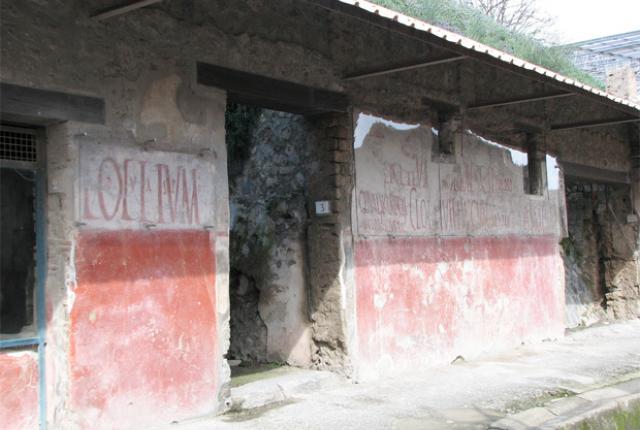
Roman Graffiti from Pompeii

The following is a reprint from January 28, 2013.

Let us say we were seated across the table from an ancient Roman and, say, a Viking. Aside from the obvious language problem, would there be enough commonality to allow for a spirited discussion? I think there would be, primarily because I have read enough Roman and Viking (I should say Icelandic and Norse) literature to vouch for the fact that, when all is said and done, we are not all that different from one another.

Let me take as a case in point graffiti that has been discovered from the ruins of Pompeii and Herculaneum. You can probably find the equivalent in any nightclub’s restroom wall:

  • Philiros spado – “Philiros is a eunuch”
  • Apollinaris, medicus Titi Imperatoris hic cacavit bene – “Apollinaris, physician to the Emperor Titud, had a good crap here”
  • Oppi, emboliari, fur, furuncle – “Oppius, you’re a clown, a thief, and a cheap crook”
  • Miximus in lecto. Faetor, peccavimus, hospes. Si dices: quare? Nulla matella fuit –
    This one was found in an inn: “We have wet the bed. I admit we were wrong, my host, but if you ask why, it is because there was no chamber pot.”
  • Virgula Tertio su: Indecens esVirgula to Tertius: You are a nasty boy.“
  • Suspirium puellam Celadus thraex – “Celadus makes the girls moan”

Now I have not seen the graffiti of Ancient Rome, but I saw the viking graffiti in the tomb at Maes Howe in the Orkneys. Built over 5,000 years ago, Maes Howe was frequently visited by Viking raiders in the hopes that some buried treasure could be found there. They found none, but left such observations as the following in their Futharc runes:

  • “Thorni fucked. Helgi carved.”
  • “Ingigerth is the most beautiful of all women” next to a picture of a slobbering dog.
  • “These runes were carved by the man most skilled in runes in the Western Ocean.”

You can find more about the Pompeiian graffiti by clicking here. The runes at Maes Howe are explained here.

The more things change, the more they remain the same.