The Decline and Fall of the American Meal

Last night, Martine and I had dinner at a restaurant in Glendale that we have loved for twenty-five years. As soon as we walked in, we noticed some ominous signs. The waitstaff were all young, they were wearing bright new T-shirts imprinted with the name of the restaurant, and there was a brand new illuminated sign. Most seriously, the old owner was not there.

For the first time ever, both Martine and I left the restaurant feeling slightly ill. I almost didn’t make it back to my parked car. And it was lucky that there was a large Mobil gas station at the corner of Brand and Chevy Chase in Glendale, where I was able to dispose of some of the intestinal irritants.

Mind you, I can understand why restaurants are dropping like flies. It is no fun to own or work at a restaurant, especially after the Covid-19 lockdowns. And increasingly, there is more microwaving than cooking taking place in the kitchen—by people who don’t know much about food safety.

Not only in restaurants, but across the board the quality of the American meal has declined precipitously. Even supermarkets are moving away from serving customers who do their own cooking. Recently, I have had problems finding basic food items such as barley or peanut oil. What there is no lack of are frozen meals that taste like cardboard and various “helper” mixes for people afraid to make anything from scratch.

Increasingly, the foods that people eat at home or in restaurants are deficient in nutrition and flavor.

One thing that particularly bothers me is the disappearance of ethnic restaurants as the next generation takes charge. When I first came to Los Angeles, there were loads of great Italian, French, Hungarian, Greek, and other ethnic restaurants. And there were even good cheeseburgers that didn’t look like a 300-pound guy named Rufus sat on them.

“Come On, Tough Guy”

I had never read any of Sherman Alexie’s poems before, Wedged in between the short stories in his collection War Games were a number of poems, the most interesting of which is this one at the start of the book:

The Limited

I saw a man swerve his car
And try to hit a stray dog,
But the quick mutt dodged
Between two parked cars

And made his escape.
God, I thought, did I just see
What I think I saw?
At the next red light,

I pulled up beside the man
And stared hard at him.
He knew that’d I seen
His murder attempt,

But he didn’t care.
He smiled and yelled loud
Enough for me to hear him
Through our closed windows:

“Don’t give me that face
Unless you’re going to do
Something about it.
Come on tough guy,

What are you going to do?”
I didn’t do anything
I turned right on the green
He turned left against traffic.

I don’t know what happened
To that man or the dog,
But I drove home
And wrote this poem.

Why do poets think
They can change the world?
The only life I can save
Is my own.

Selling Our Birthright

Hendrick ter Brugghen’s Esau Selling His Birthright (1627)

The original text comes from the Old Testament, namely Genesis 25:29-34. The quote is from the New King James Version:

Now Jacob cooked a stew; and Esau came in from the field, and he was weary. And Esau said to Jacob, “Please feed me with that same red stew, for I am weary.” Therefore his name was called Edom [Red]. But Jacob said, “Sell me your birthright as of this day.” And Esau said, “Look. I am about to die; so what is this birthright to me?” Then Jacob said, “Swear to me as of this day.” So he swore to him, and sold his birthright to Jacob. And Jacob gave Esau bread and stew of lentils, then he ate and drank, arose, and went his way. Thus Esau despised his birthright.

I cannot help but think that we Americans are Esau. We were once fairly happy and somewhat more united. Then came the Depression. Then World War Two. We were briefly on top of the world, except that somewhere along the line, we had sold our birthright.

Who is Jacob in this story? Actually, there is no Jacob to whom we sold our birthright. We just dribbled it away, then ate, drank, arose, and went our way, like Esau in the Bible story.

We are not a happy people. Look at our violent movies, our angry music, our wannabe warrior tattoos and facial hair. We had freedom, and still have a lot more than most peoples. But we are fearful and growing stupid with our fear.

We regard it as almost normal that a mentally disturbed person will collect guns to shoot up children at a school or worshipers in a church or—what the hell—random people gathered together for whatever purpose.

Oh what a great fall there was when we sold our birthright. Did we enjoy our pottage? If anything, we enjoyed too much pottage; but for how long can we continue to do so?

Barking Up the Wrong Technology

Where Are We Headed with Technology?

When I was a student at Dartmouth, I taught myself how to use the new Basic programming language on the college’s General Electric computer. That was at some time in the mid 1960s. Little did I know that much of my post-graduate life would be involved with computers.

In March 1968, I was hired for the Lexicography & Discourse project at System Development Corporation in Santa Monica. My job involved proofreading and correcting the transcriptions of two Merriam-Webster dictionaries. The project was funded by the Advanced Research Projects Agency (ARPA) of the U. S. Air Force. That was the same agency which created the forerunner of the Internet, which was created to communicate with other computer nodes spread across the country even if several U. S. cities were destroyed by nuclear bombs.

The technology of the late 1960s was clunky, but it enabled us to land on the moon in 1969!

I went on to become a computer programmer and informational technology (IT) specialist for two accounting firms. During that time I saw technology change from a kind of intellectual priesthood into a pursuit for the masses. Everybody wanted in.

It all started with the Apple Macintosh, which supposedly made computing accessible to everyone. Then, the Internet was for everybody, via Prodigy and America Online. Kids were playing computer games.

A major hurdle was passed when touch-screen interfaces were invented. You didn’t need to remember commands with their complicated parameters: You simply pointed, and, if you were lucky, your choice was registered and acted upon. Of course, this went hand in hand with poor language skills. Who needed spelling and grammar when all you had to do was point at the options you wanted.

On one hand, there were many advantages to this; but techno continued to evolve with cryptocurrencies and artificial intelligence (AI). Money was now worth what you wanted it to be worth. And, with AI, you didn’t have to think any more. These are ominous developments. If technology continues to evolve along these lines, I expect no good to come of it.

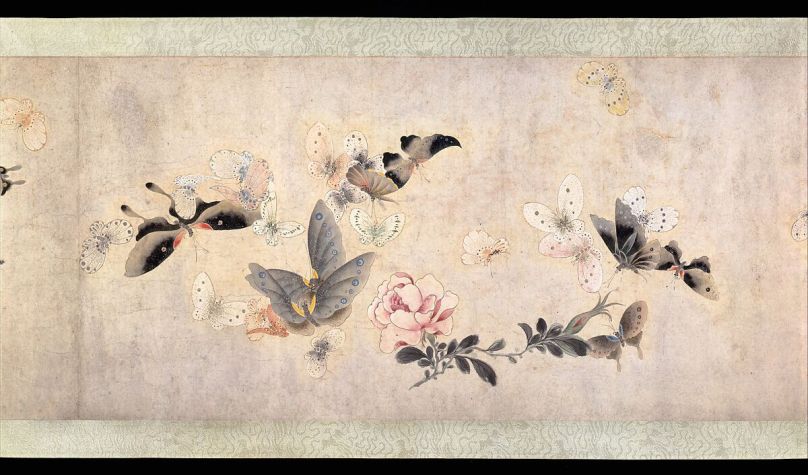
Chuang Tzu and the Butterfly

The two greatest poets of T’ang China were Tu Fu (712-770 CE) and Li Po (701-762 CE). The following poem by Li Po is one of the most profound he ever wrote. The Chuang Tzu (4th century BCE) referred to was the Taoist philosopher and follower of Lao Tzu. Forget all this detail: The following poem speaks for itself.

Chuang Tzu and the Butterfly

Chuang Tzu in dream became a butterfly,
And the butterfly became Chuang Tzu at waking.
Which was the real—the butterfly or the man ?
Who can tell the end of the endless changes of things?
The water that flows into the depth of the distant sea
Returns anon to the shallows of a transparent stream.
The man, raising melons outside the green gate of the city,
Was once the Prince of the East Hill.
So must rank and riches vanish.
You know it, still you toil and toil,—what for?

Where Wood Is Scarce

Sod-Roofed Farmhouses at Reykjavík’s Árbær Open Air Museum

There is an old joke that goes: What do you do if lost in an Icelandic forest? Answer: Stand Up.

Because of the Arctic winds that scour the island of Iceland, there are no substantial forests. At one time there were more than there are now., but the early settlers burned them for fuel. Even then, in no case was there enough wood of the right kind to build structures, unless the wood was shipped over at ruinous cost from Scandinavia.

Notice in the above photo the sparing use of wood on the short sides of the above structures. The photo was taken at the Árbær Open Air Museum in Reykjavík, which includes buildings that had been moved to the museum from other parts of the city and country.

Shown below is the layout of the turf house at Stöng in Southwest Iceland:

Farmhouse Layout at Stöng

The single largest room consists of two rows of benches where the residents slept. There was no living room as such, though there was a combined dining room/kitchen on the left. Add a storeroom and a lavatory, and that’s pretty much it.

If you read any Icelandic literature, such as Halldór Laxness’s Independent People, you will find that, before independence, the lives of Icelanders were grim to say the least. Now Iceland is enjoying prosperity due mostly to tourism.

It’s an expensive country to visit, but note that the tourist season is only three months long: from June through August. Some people visit in the winter, mostly to see the Northern Lights, but the weather can be forbidding.

Where Once Poe Walked

Edgar Allan Poe’s Cottage in the Bronx

There are times when H. P. Lovecraft’s poetry comes across as overripe. But when the subject is Edgar Allan Poe, it seems more appropriate.

Above is the cottage in the Bronx where Poe lived with his young wife Virginia Clemm (married at age 13 to the 27-year-old writer) in the Bronx. I remember visiting it with my mother sometime early in the 1960s.

Where Once Poe Walked

Eternal brood the shadows on this ground,
Dreaming of centuries that have gone before;
Great elms rise solemnly by slab and mound,
Arched high above a hidden world of yore.
Round all the scene a light of memory plays,
And dead leaves whisper of departed days,
Longing for sights and sounds that are no more.

Lonely and sad, a specter glides along
Aisles where of old his living footsteps fell;
No common glance discerns him, though his song
Peals down through time with a mysterious spell.
Only the few who sorcery’s secret know,
Espy amidst these tombs the shade of Poe.

By the way, notice that the initial letters in each line together spell out EDGAR ALLAN POE.