On Eating Leaves

Some People’s Idea of a Meal

Some People’s Idea of a Meal

Sometimes I feel as if the entire medical profession is ganging up on me to eat salads with or without chicken. To begin with, I am no lover of chicken or turkey, though I like to use their stock in cooking soups.

But I draw the line at what the typical American considers a salad: a bunch of leaves with some goopy dressing. My complaint is not with raw vegetables. In hot weather I make good salads with red and green peppers, celery, onions, garlic, and even a few leaves of red leaf or butter lettuce mixed in. Salads consisting of nothing but leaves, as in “field greens,” I usually leave on my plate untouched. Without a decent crunch, salads come across as limp weeds with no character.

Now certain Middle Eastern salads are more to my liking, such as Shirazi or Israeli salads, with diced tomatoes and cucumbers—and no raw greens. Even Greek salads have some crunch, along with some tasty feta cheese for flavor. But American salads, well ….

I know that “they’re good for you”—but so is a lot of other unpalatable stuff. When I eat, I don’t like to feel that I am grazing in a meadow. (I suspect that most people who eat those all-leaf salads are doing it to make room for rich pastries or chocolates afterwards, when out of sight of one’s friends.)

Do I eat enough vegetables? Yes, indeed! All my dishes include a good mix of veggies. Especially my soups, which usually contain Swiss chard or kale mixed with stock in my blender.


Beware of Deadly Hype

Berkeley Breathed’s Take on the New Star Wars

Berkeley Breathed’s Take on the New Star Wars

For the last several months, I have been closely following the cartoons of Berkeley Breathed, author of the Bloom County comic strip, newly resuscitated in view of the sudden rise of Donald Trump.  You can follow the progress of Opus, Bill the Cat, Steve Dallas, Milo, Binkley, and the gang on Breathed’s Facebook page. (His last name, by the way, is pronounced BRETH-edd.)  That’s where I got the two posters displayed on this page.

I was a big fan of the original Star Wars, which I saw previewed at Twentieth Century Fox studio before it was premiered. It was electrifying with its gritty view of outer space. But then they just kept adding curlicues to it, and for me the magic palled. I still love science fiction, but I stick with the classics, such as Philip K. Dick, Stanislaw Lem, and Boris and Arkady Strugatsky.

Say, Is That a Pooper Scooper, Boba?

Say, Is That a Pooper Scooper, Boba?

You probably will not find me sleeping outside the theater to be first in line for the premiere of the Disney Star Wars: Instead, I will be wending my way to Palm Desert to visit my brother and his family.

The Franchise

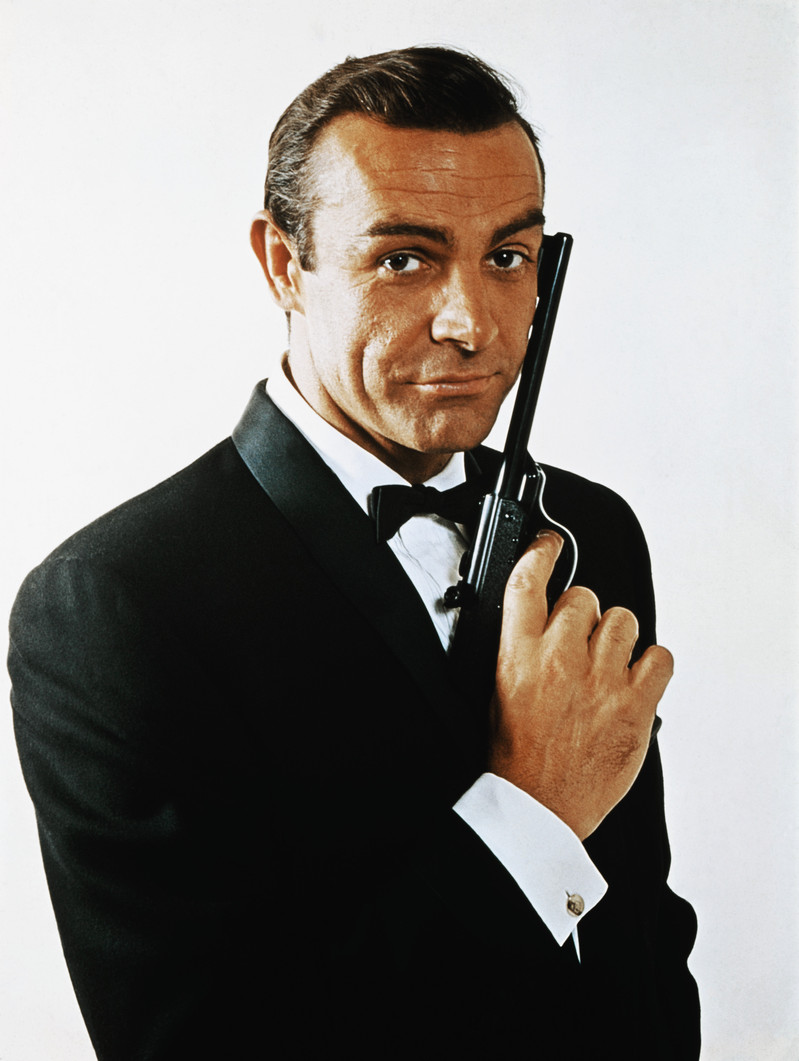
Sean Connery as James Bond

Sean Connery as James Bond

It’s been going strong for over half a century and shows no signs of letting up. I saw my first James Bond film, Doctor No (1962), at the Nugget Theater in Hanover, New Hampshire, when I was a freshman at Dartmouth College. I saw my most recent 007 epic, Spectre (2015), at the Village Cinema in Recoleta, Buenos Aires, last month.

When I was a grad student at UCLA, I wrote a feature article for the Daily Bruin entitled “James Bond in Vietnam,” about how the technologically superior U.S. military were losing to the Viet Cong—that we were, in effect, hypnotized by the gadgets of war furnished by our military’s equivalent of Q.

What amazes me is that, during its long run, the James Bond franchise has maintained a high level of quality despite the fact that not all of the subsequent Bonds were up to the level of Sean Connery. When you go to see a Bond film, you know what you’re going to get: a high level of action and entertainment. The sophisticated British secret agent with his taste for martinis that are “shaken, not stirred” makes all of us peasants wish that we were as suave as he is.

Over the last six months, I have been reading the Ian Fleming Bond books in succession, having just finished Doctor No, the sixth in the series. The books are good, but not quite up to the level of the films.


Serendipity: Camus on Travel

Albert Camus

Albert Camus

The text below is from his posthumously published Literary and Critical Essays:

Without cafés and newspapers, it would be difficult to travel. A paper printed in our own language, a place to rub shoulders with others in the evenings enable us to imitate the familiar gestures of the man we were at home, who, seen from a distance, seems so much a stranger. For what gives value to travel is fear. It breaks down a kind of inner structure we have. One can no longer cheat — hide behind the hours spent at the office or at the plant (those hours we protest so loudly, which protect us so well from the pain of being alone). I have always wanted to write novels in which my heroes would say: “What would I do without the office?” or again: “My wife has died, but fortunately I have all these orders to fill for tomorrow.” Travel robs us of such refuge. Far from our own people, our own language, stripped of all our props, deprived of our masks (one doesn’t know the fare on the streetcars, or anything else), we are completely on the surface of ourselves. But also, soul-sick, we restore to every being and every object its miraculous value. A woman dancing without a thought in her head, a bottle on a table, glimpsed behind a curtain: each image becomes a symbol. The whole of life seems reflected in it, insofar as it summarizes our own life at the moment. When we are aware of every gift, the contradictory intoxications we can enjoy (including that of lucidity) are indescribable.


Green Zones of the Future?

Is This What the Pentagon Wants?

Is This What the Pentagon Really Wants?

I love listening to the Republican Presidential Candidates for 2016 talk about foreign policy. All agree that Barack Obama is a “pussy” and that what we need is to destroy ISIS. But do they want to send in our troops and open new Green Zones in Syria and Northern Iraq? Urm, well, not really. Although Ahmed Chalabi is no longer around to say that we would be greeted with candy and flowers, I am sure that there are some Pentagon planners who would love to see an expansion of their powers, despite the cost.

Can the United States effectively wage war in an area where it doesn’t know the language, the culture, or the players involved? I myself think that all our direct efforts would be foredoomed to failure. Perhaps we can seal off parts of the country and reserve them for tennis courts, driving ranges, and chain burger restaurants for our boys and girls in uniform. But haven’t we already done that? And with what results?

As much as we love seeing ourselves as the mighty victors of World War Two, we’ve done precious little to add to our reputation since then. But, heaven knows, we keep on trying, piling up failure upon spectacular failure. The only thing our politicians can hope for is that the voters have a short memory and an even shorter fuse.

In the end, what we are doing in the Middle East right now is probably the right thing. ISIS will eventually collapse on its own. Isn’t it really quite stupid to build a caliphate on a bunch of foreign mercenaries, some of them not even Muslim, recruited through social media?


Falling in Love with a Ship

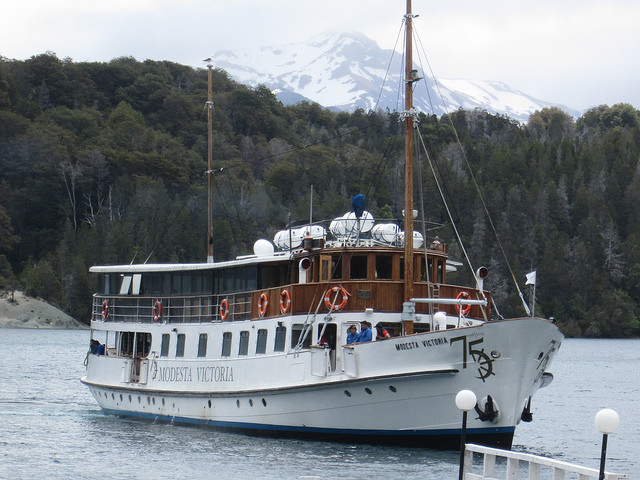
The Modesta Victoria on Lago Nahuel Huapi

The Modesta Victoria on Lago Nahuel Huapi

On November 15, I took a boat tour to Isla Victoria and Los Arrayanes National Park. In the process, I fell in love with a Dutch ship that was built in 1937, disassembled, shipped to Argentina, and re-assembled in 1938 on the shores of Lago Nahuel Huapi. (YouTube has a charming video depicting the original launch of the Modesta Victoria: It looks as if the whole population of San Carlos de Bariloche showed up to celebrate.)

It was the Modesta Victoria on which I rode across the lake. It was the same ship that carried Che Guevara, his friend Alberto Granado, and their Norton motorcycle across the lake during the trek that Guevara described in The Motorcycle Diaries. Other famous passengers included the Shah of Iran, his empress Farah Diba, and U.S. Presidents Dwight D. Eisenhower and Bill Clinton.

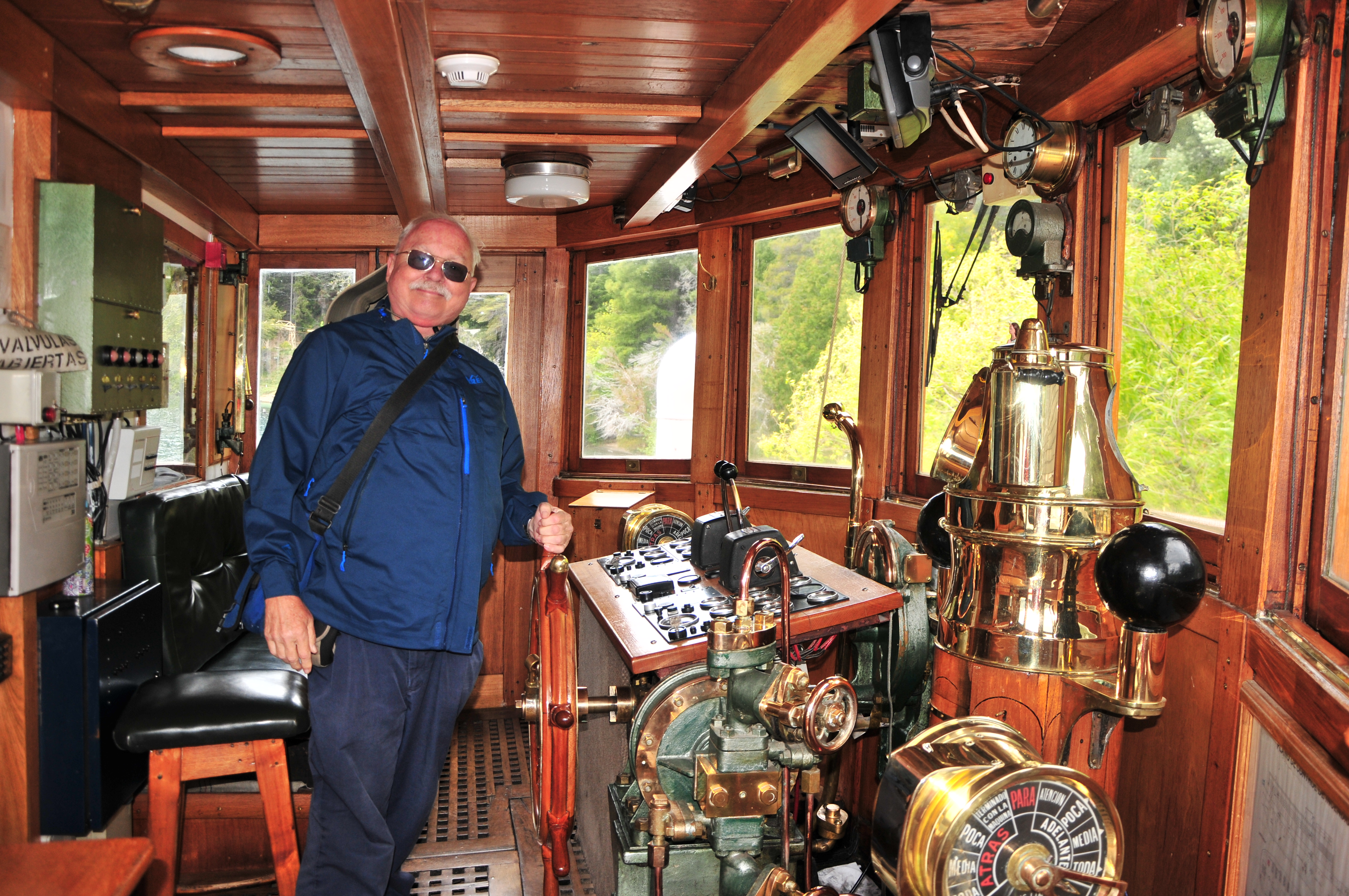
At the Helm of the Modesta Victoria

At the Helm of the Modesta Victoria

I have a love for old steamships, which began when I rode the old MV Lady Rose in Canada between Port Alberni and Bamfield. That was back in 2003. Today, the Lady Rose, which was built in the same year as the Modesta Victoria is being fitted out to serve as a restaurant in Tofino on Vancouver Island, which I suppose is marginally better than gracing a ship graveyard.

My hope is for the Modesta Victoria to keep sailing until I have a chance to take it again … some day.


Serendipity: The Ombú

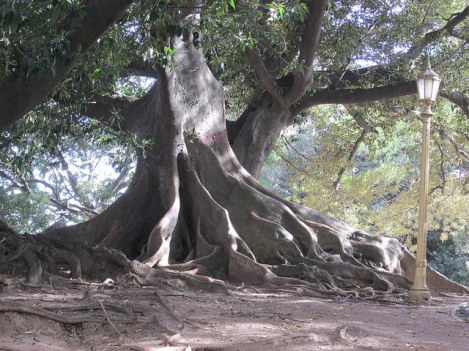
Ombú Tree in Recoleta, Buenos Aires

Ombú Tree in Recoleta, Buenos Aires

I first grew curious about the Ombú trees of the Pampas when I read W. H. Hudson’s Tales of the Pampas. Following is the beginning of his short story entitled “The Ombú”:

IN ALL THIS DISTRICT, though you should go twenty leagues to this way and that, you will not find a tree as big as this ombú, standing solitary, where there is no house; therefore it is known to all as “the ombú,” as if but one existed; and the name of all this estate, which is now ownerless and ruined, is El Ombú. From one of the higher branches, if you can climb, you will see the lake of Chascomus, two thirds of a league away, from shore to shore, and the village on its banks. Even smaller things will you see on a clear day; perhaps a red line moving across the water—a flock of flamingos flying in their usual way. A great tree standing alone, with no house near it; only the old brick foundations of a house, so overgrown with grass and weeds that you have to look closely to find them. When I am out with my flock in the summer time, I often come here to sit in the shade. It is near the main road; travellers, droves of cattle, the diligence, and bullock-carts pass in sight. Sometimes, at noon, I find a traveller resting in the shade, and if he is not sleeping we talk and he tells me the news of that great world my eyes have never seen.

They say that sorrow and at last ruin comes upon the house on whose roof the shadow of the ombú tree falls; and on that house which now is not, the shadow of this tree came every summer day when the sun was low. They say, too, that those who sit much in the ombú shade become crazed. Perhaps, sir, the bone of my skull is thicker than in most men, since I have been accustomed to sit here all my life, and though now an old man I have not yet lost my reason. It is true that evil fortune came to the old house in the end; but into every door sorrow must enter—sorrow and death that comes to all men; and every house must fall at last.

Do you hear the mangangá, the carpenter bee, in the foliage over our heads? Look at him, like a ball of shining gold among the green leaves, suspended in one place, humming loudly! Ah, sefior, the years that are gone, the people that have lived and died, speak to me thus audibly when I am sitting here by myself. These are memories; but there are other things that come back to us from the past; I mean ghosts. Sometimes, at midnight, the whole tree, from its great roots to its topmost leaves, is seen from a distance shining like white fire. What is that fire, seen of so many, which does not scorch the leaves? And, sometimes, when a traveller lies down here to sleep the siesta, he hears sounds of footsteps coming and going, and noises of dogs and fowls, and of children shouting and laughing, and voices of people talking; but when he starts up and listens, the sounds grow faint, and seem at last to pass away into the tree with a low murmur as of wind among the leaves.

As a small boy, from the time when I was able, at the age of about six years, to climb on to a pony and ride, I knew this tree. It was then what it is now; five men with their arms stretched to their utmost length could hardly encircle it. And the house stood there, where you see a bed of nettles—a long, low house, built of bricks, when there were few brick houses in this district, with a thatched roof.

The ombú in the photograph stands in front of La Biela, an old café that Jorge Luis Borges and his friend and collaborator Adolfo Bioy Casares used to frequent. It is on Plaza Francia not far from the entrance to Recoleta Cemetery.

.

Feeling the Onset of Christmas

Angel at the Grier Musser Museum

Elf at the Grier Musser Museum

On Sunday, Martine and I went to view the extensive Christmas collections at the Grier Musser Museum near downtown Los Angeles. Ray and Susan Tejada have displays dating back to the 19th Century—and as recent as this year, including hundreds of fascinating Victorian and turn of the century Christmas cards.

There aren’t too many things that we do that are Christmassy. For one thing, we never have a Christmas tree. (You can blame me for having somewhere between 6,000 and 8,000 books.)  When we visit my brother next week, we may view a holiday light display at the Living Desert Museum in Palm Desert.

We always used to visit the Department of Water and Power’s Holiday Light Festival, but budgetary constraints closed that down in 2009. We also regularly attended the Christmas Concert put on by the Torrance Civil Chorale, but Concert Master David Burks retired after the Spring concert; and we incorrectly assumed that the organization would undergo extensive rebuilding.


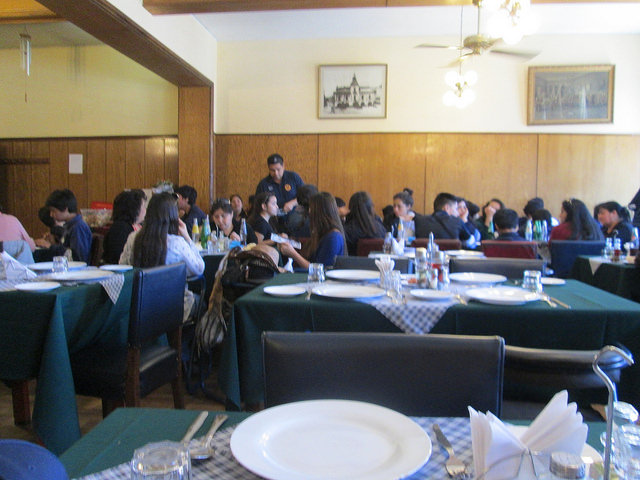
Dining with the Bomberos

One of the Best Places to Eat in Chile is the Main Fire Station in Valparaiso

One of the Best Places to Eat in Chile is the Main Fire Station in Valparaiso

One of the best places to have good wholesome food in Chile is at the local firehouse. I put this truism to the test in Valparaiso, where I had a delicious meal consisting of chicken consommé, salad, fried fish, rice, and a fruit dessert at the main fire station in Valparaiso—for only 3,000 pesos (that’s less than five dollars).

I believe my waiter was one of the firemen (he’s shown standing in the background in the above photo). The food was straightforward; there were no other tourists in attendance; and the place was immaculately clean.

The word bombero sounds vaguely menacing in English, probably because it looks like “bomber.” Rest assured that I do not make a practice of dining with terrorists. Chilean firemen is a different story altogether.

Dreams of Soon Tofu

Cold Weather? Time for Soup!

Cold Weather? Time for Soup!

Today, Martine and I went to lunch at Galbi King. With the onset of cold weather in L.A., I felt like having some hot soup. And what can be hotter than extra spicy soon tofu? What is soon tofu? Here’s what one food writer on Chowhound.Com wrote:

Soon means “soft” in Korean, in this usage. So “soon tofu” is soft tofu. It’s quivery soft, like custard, but flavored with a savory broth filled with any number of good things from beef, to seafood, to pork. It’s just like the tofu in tofu fa, if you’ve ever had that.

At BCD and most other soft tofu joints in L.A. and OC [Orange County], the soft tofu comes bubbling in a stone crock to your table.

When the hot stone crock comes to your table, you break a raw egg in it—and prepare for a culinary paradise. I also spoon in some steamed rice to cool the fire. Mine was served with pork and was as spicy as the restaurant was willing to risk. As it happens, I am a certified chili-head, so I had no difficulty with the fiery broth. (Unless you too are one, don’t try this at home, Kids!)

Please note that not all Korean restaurants can make good soon tofu. I went to one Korean-owned place in the Patronato district of Santiago, Chile, and had a bowl that was sadly deficient in flavor. Even in Los Angeles, there are good Korean restaurants, and bad Korean restaurants.