Above all else, DON’T WATCH THE NEWS, at least until Thursday or Friday. The way that news channels make money is by instilling fear, You don’t want that. Read a good book. If you absolutely must watch television, tune in to a channel that has no news—like Turner Classic Movies (TCM).
If you have friends who like to discuss politics, AVOID THEM until the weekend. They will be agitated and all too willing to make you feel as terrible as they do.
DON’T VOTE IN PERSON. You will be in line with hundreds of agitated people; and you may run into people who openly express contempt for your political choices.
STAY AWAY FROM SOCIAL MEDIA. It’s an instrument of the devil and his tools: Zuckerberg, Musk, et al.
Be extra good to yourself and the people you love. Eat foods you like. Once you’ve voted, just distance yourself from the whole process. And whatever you do, DON’T GIVE MONEY TO POLITICIANS. It only encourages them.
Avoid posting political signs or bumper stickers. Stay away from political rallies. Don’t wear any red baseball caps made in China.
You might just want to lock yourself in the closet. It’s going to be a rough week.
Let’s see, the celebrations this last week have come fast and furious:
Halloween (October 31)
All Saints’ Day (November 1)
All Souls’ Day (November 2)
And now:
My Mother’s Birthday (November 3)
It was Sophie Paris’s goal to make it to her 80th birthday. She admired her grandmother, my great-grandmother Lidia Toth, who made it into her mid-eighties. Unfortunately, she died several months short of her 80th birthday in the summer of 1998.
I don’t write often enough about my mother, although I owe my life and much of my happiness to her. She was abandoned by her own parents, so her grandmother and grandfather raised her. Although she was born in the United States, Daniel and Lidia Toth took her and raised her on a farm near Felcsut, Hungary in the Province of Fehérmegye. She returned to the U.S. with them in 1937 as the Nazi menace began to loom throughout Central Europe.
She met my father in Cleveland around 1943 and married him shortly thereafter. I was born in 1945, and Daniel Toth died in that year. Lidia never really liked my father, Alex Paris, and told my mother that, being his son, I should be allowed to die in my crib. In time, my brother and I developed a strong relationship with Lidia, who helped bring us up. With my father, however, it was war from start to finish.
Sophie was about 5 feet (1.525 meters) tall in her stocking feet. To compensate for her short stature, she had an oversized heart and loved my brother and me. That love has been very instrumental in Dan’s happiness and certainly mine.
Today, as Martine and I ate lunch at the Siam Chan in West L.A., we overheard two tattooed and pierced young men talking about getting up enough energy to attend an Alcoholics Anonymous (A.A.) meeting. The streets in our neighborhood are full of bums who suffering from various stages of mental illness and dependency on drugs and alcohol. I realize how lucky we are because of the love of our parents, Alex and Sophie Paris.
So Happy Birthday, Mom. You are not forgotten and never will be.
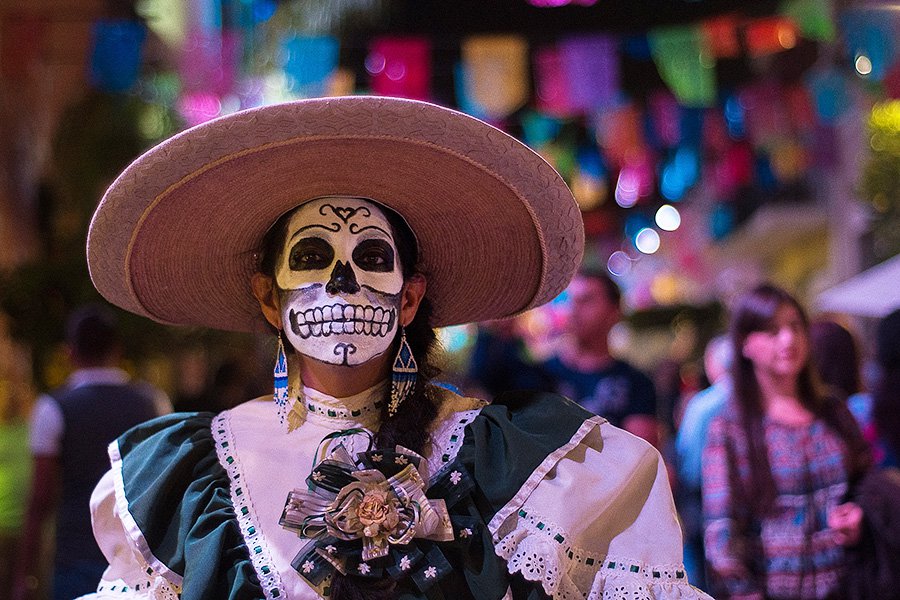
November 2 in the Catholic liturgy is All Souls’ Day, or in Mexico, El Dia de Los Muertos, the Day of the Dead. Here is a poem by Alberto Rios, a Hispanic resident of Arizona.
November 2: Día de los muertos
1
It is not simply the Day of the Dead—loud, and parties. More quietly, it is the day of my dead. The day of your dead.
These days, the neon of it all, the big-teeth, laughing skulls, The posed calacas and Catrinas and happy dead people doing funny things—
It’s all in good humor, and sometimes I can’t help myself: I laugh out loud, too. But I miss my father. My grandmother has been gone
Almost so long I can’t grab hold of her voice with my ears anymore, Not easily. My mother-in-law, she’s still here, still in things packed
In boxes, her laughter on videotape, and in conversations. Our dog died several years ago and I try to say his name
Whenever I leave the house—You take care of this house now, I say to him, the way I always have, the way he knows.
I grew up with the trips to the cemetery and pan de muerto, The prayers and the favorite foods, the carne asada, the beer.
But that was in the small town where my memory still lives. Today, I’m in the big city, and that small town feels far away.
2
The Day of the Dead—it’s really the days of the dead. All Saints’ Day, The first of November, also called the día de los angelitos—
Everybody thinks it’s Day of the Dead—but it’s not, not exactly. This first day is for those who have died a saint
And for the small innocents—the criaturas—the tender creatures Who have been taken from us all, sometimes without a name.
To die a saint deserves its day, to die a child. The following day, The second of November, this is for everybody else who has died
And there are so many, A grandmother, a father, a distant uncle or lost cousin.
It is hard enough to keep track even within one’s own family. But the day belongs to everyone, so many home altars,
So many parents gone, so many husbands, so many Aunt Normas, so many Connies and Matildes. Countless friends.
Still, by the end of the day, we all ask ourselves the same thing: Isn’t this all over yet?
3
All these dead coming after—and so close to—Halloween, The days all start to blend,
The goblins and princesses of the miniature world Not so different from the ways in which we imagine
Those who are gone, their memories smaller, their clothes brighter. We want to feed them only candy, too—so much candy
That our own mouths will get hypnotized by the sweetness, Our own eyes dazzled by the color, our noses by the smells
The first cool breath of fall makes, a fire always burning Somewhere out there. We feed our memories
And then, humans that we are, we just want to move quickly away From it all, happy for the richness of everything
If unsettled by the cut pumpkins and gourds, The howling decorations. The marigolds—cempasúchiles—
If it rains, they stink, these fussy flowers of the dead. Bread of the dead, day of the dead—it’s hard to keep saying the word.
4
The dead: They take over the town like beach vacationers, returning tourists getting into everything:
I had my honeymoon here, they say, and are always full of contagious nostalgia. But it’s all right. They go away, after a while.
They go, and you miss them all over again. The papel picado, the cut blue and red and green paper decorations,
The empanadas and coconut candy, the boxes of cajeta, saladitos, Which make your tongue white like a ghost’s—
You miss all of it soon enough, Pictures of people smiling, news stories, all the fiestas, all this exhaustion.
The coming night, the sweet breads, the bone tiredness of too much— Loud noise, loud colors, loud food, mariachis, even just talking.
It’s all a lot of noise, but it belongs here. The loud is to help us not think, To make us confuse the day and our feelings with happiness.
Because, you know, if we do think about our dead, Wherever they are, we’ll get sad, and begin to look across at each other.
Today is All Saints’ Day, which has become something of a non-event ensconced as it is between Halloween and the Dia de los Muertos (All Souls’ Day).
Growing up as a Catholic in the eastern suburbs of Cleveland, Ohio, I was very aware of the saints. As a reward for good behavior in class, the Dominican sisters at Saint Henry’s would hand out holy pictures. There were so many saints! One of my favorites was Saint Maurice and the Theban Legion. The whole legion was ordered to be put to death by the Emperor Maximian in the 3rd Century for not following his orders to kill Egyptian Christians. If the legion was at full strength, that means 5,000 martyrs for Holy Mother the Church at one fell swoop!
Even though it’s a Holy Day of Obligation (at least I think it still is) requiring attendance at Mass, I¹ve backslid. I’m not even entirely sold on the saints any more … especially after Fra Junípero Serra was canonized by Pope Francis in 2015. Not too many descendants of Indians who were forced to live at the California Missions would agree with his elevation to sainthood.
I wonder how many other saints were outright stinkers.
I have been reading Maxim Gorky’s Fragments from My Diary (Заметки из дневника) published in 1924. Here are two excerpts.
SUBSTITUTES FOR MONKEYS
Professor Z., the bacteriologist, once told me the following story.
‘One day, talking to General B., I happened to mention that I was anxious to obtain some monkeys for my experiments. The General immediately said, quite seriously:
‘“What about Jews—wouldn’t they do? I’ve got some Jews here, spies that are going to be hanged anyway—you’re quite welcome to them if they are of any use to you.”
‘And without waiting for an answer he sent his orderly to find out how many spieas were awaiting execution.
‘I tried to explain to His Excellency that men would not be suitable for my experiments, but he was quite unable to understand me, and opening his eyes very wide he said:
‘“Yes, but men are cleverer than monkeys, aren’t they? If you inoculate a man with poison he will be able to tell you what he feels, whereas a money won’t.”
‘Just then the orderly came in and reported that there was not a single Jew among the men arrested for spying—only Rumanians and gypsies.
‘“What a pity!” said the General. “I suppose gypsies won’t do either? … What a pity …!”’
The second is a paragraph excerpted from a fragment labelled:
ANTI-SEMITISM
I have read, thoroughly and attentively, a number of books which try to justify anti-Semitism. It is a hard and even repugnant duty to read books written with a definitely ugly and immoral design: to brand a nation, a whole nation. A remarkable task indeed! And I never found anything in those books but a moral ignorance, an angry squeal, a wild beast’s bellowing, and a grudging, envious grinding of teeth. Thus armed, there is nothing to prevent one from proving that Slavs, and all the other nations as well are also incurably depraved. And is not this the reason for the violent hatred of the Jews, that they, of all races of mixed blood, are the ones who have preserved comparatively the greatest purity of outward life as well as of the spirit? Is there not more perhaps of the ‘Man’ in the Jew than there is in the anti-Semite?
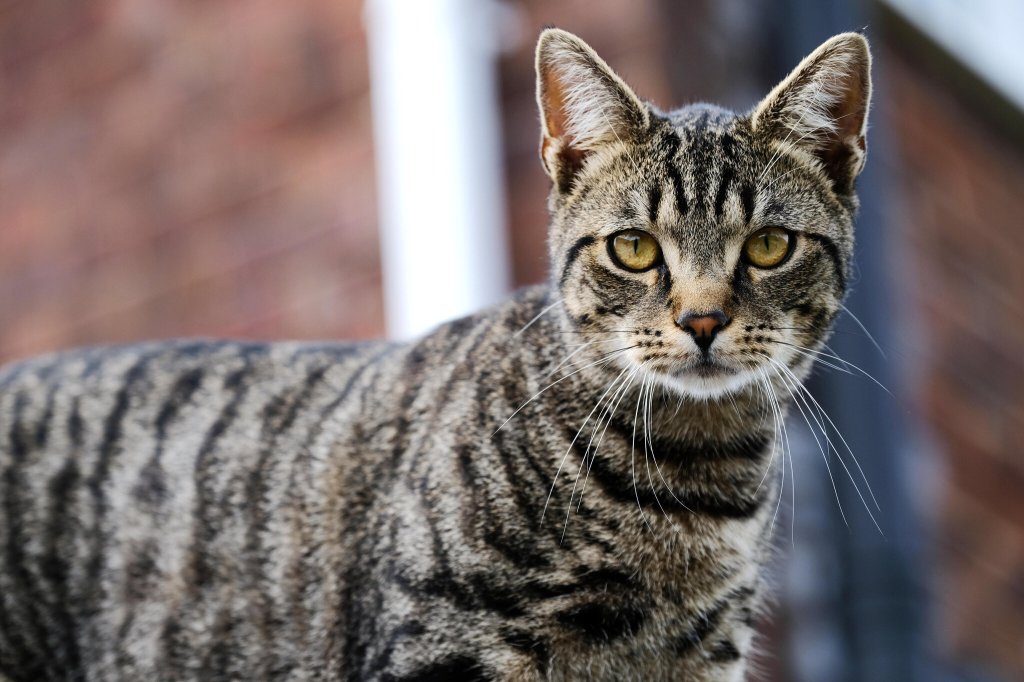
The Argentinian poet Jorge Luis Borges could not play with a cat without thinking of those other cats he saw at the Buenos Aires Zoo too large and too ferocious for play.
To a Cat
Mirrors are not more silent nor the creeping dawn more secretive; in the moonlight, you are that panther we catch sight of from afar. By the inexplicable workings of a divine law, we look for you in vain; More remote, even, than the Ganges or the setting sun, yours is the solitude, yours the secret. Your haunch allows the lingering caress of my hand. You have accepted, since that long forgotten past, the love of the distrustful hand. You belong to another time. You are lord of a place bounded like a dream.
At first, Martine and I liked visiting the Grier Musser Museum because of the of the interesting holiday related displays. We still like the displays, but in the meantime, we have become friends with the owners, Rey and Susan Tejada. Re-visiting the museum and chatting with the Tejadas has become part of the fun surrounding holidays.
Speaking of holidays, it is becoming ever clearer to me that celebrating Halloween is becoming more of a thing, and that celebrating Christmas is becoming less of a thing. Perhaps because it is so associated with guilt trips: so many things that have to be done, some many unrealized goals that remain unrealized, so much expenditure of cash and effort.
Halloween, on the other hand, is cheaper and more fun. And it is not tinged with guilt. It involves pretending that you’re a ghastly monster (no difficulty for most people), attending fun events, and eating a ton of candy.
So even if we don’t get any trick-or-treaters this year (they don’t like climbing stairs), Martine and I feel good about Halloween. Martine got her annual pumpkin pie from Marie Callender’s, we stockpiled candy in case some trick-or-treaters do ascend the stairs, and I’ve read some good scary books this month.
Of course, coming up is my least favorite holiday. I really dislike Thanksgiving. And I’m not overly fond of the traditional food items associated with it.
Fort much of my life I have been plagued with crusty eyes. When I was a little boy, my mother referred to me as a csuri madár, which meant a cute little fledgling bird with crusty eyes whose mouth was always open for food. Later on, my ophthalmologist identified my ailment as blepharitis.
Even as I am writing this post, my eyes are watering and there are small solid particles dotting the line of my eyelashes. There are four things I can do to make me feel good for a little while:
Cleanse my eyelashes with a medicated wipe
Put a warm compress on my eyes for about fifteen minutes or more
Use extra-strength Pataday eye drops once in a 24 hour period
Use artificial tears eye drops as needed
The only thing that really works is for summer to return. The blepharitis plagues me only during the fall, winter, and spring—roughly nine months out of the year.
It doesn’t keep me from reading: It just makes me feel extremely yucky most of the time. If that isn’t existential, I don’t know what is.
In this case, obscuridad is translated not as obscurity, but darkness. I toyed with the idea of calling this post “Noir Mexicana,” but I didn’t want to mix the two languages. I hope you get the general idea.
Fernanda Melchor is a very dark writer indeed. I have in the last few months read all three of her novels that have been translated into English:
This Isn’t Miami (Aqui no es Miami)
Hurricane Season (Temporada de huracanes)
Paradais
All three novels are about wasted lives in the vicinity of the author’s home state of Veracruz. Although short in length, all three are crammed with violence, superstition, and fear. In the background—or sometimes in the foreground—there are the drug cartels, with scenes such as Milton in Paradais being commanded to shoot and kill a pathetic old taxi driver who is begging for his life.
Reading Melchor is like reading Louis-Ferdinand Céline or the Jim Thompson of The Killer Inside Me. One is reminded that, in Mexico, it is easier to see the skull beneath the skin.
I’ve only been to Hungary once, back in 1977. One of my happiest times alone with my father was the two of us visiting Budapest’s Széchenyi (SAY-chen-yee) baths and chatting for hours in the thermal pools. Of course, an opportunity gained can also be an opportunity lost. During that time, my mother went back to Felcsut in the Fehérmegye countryside, where she was raised as a young girl on a farm by her grandparents. I never did get to see Felcsut.
Although I spent so little time in Hungary, I am proud to say that I still somehow bear inside of me the seed of the Magyar culture and language. When I was a little boy in Cleveland, television was just coming in; so, living in a Hungarian neighborhood, I was blissfully unaware that the English language even existed. Until I showed up for kindergarten classes at Harvey Rice Elementary School.
That set off a whole chain of events, from moving to the suburbs, even though my father always yearned to be back in the old Buckeye Road neighborhood, to my majoring in English at an Ivy League school. But that is another story.








 Tarnmoor
You must be logged in to post a comment.